IRC Section 704(b) Capital Account Maintenance: Substantial Economic Effect, Deficit Restoration & Book-vs-Tax Worked Examples
A puts in $100,000 cash; B puts in a building worth $100,000, tax basis $60,000. The agreement gives A 90% of the losses and B 90% of the income. Whether the IRS respects it turns on one question: does the allocation have substantial economic effect under section 704(b)? If not, the allocations are rewritten per each partner's interest in the partnership. Sources, 2026-11-13: § 704, Reg. § 1.704-1, IRS Form 1065 and Schedule K-1 instructions (2025).
What section 704(b) actually says
Section 704(a) gives the partnership agreement the first word: a partner's distributive share is determined by the agreement. Section 704(b) takes the second word. If the agreement does not provide for an item, or if the allocation it provides "does not have substantial economic effect," the partner's share is determined in accordance with the partner's interest in the partnership, taking into account all facts and circumstances. Section 704(c) sits alongside: tax items on contributed property must reflect the variation between basis and fair market value at contribution, and a distribution of contributed property to another partner within 7 years triggers recognition of that gain or loss. Section 704(d) caps deductible loss at the partner's adjusted basis, with the excess carried forward.
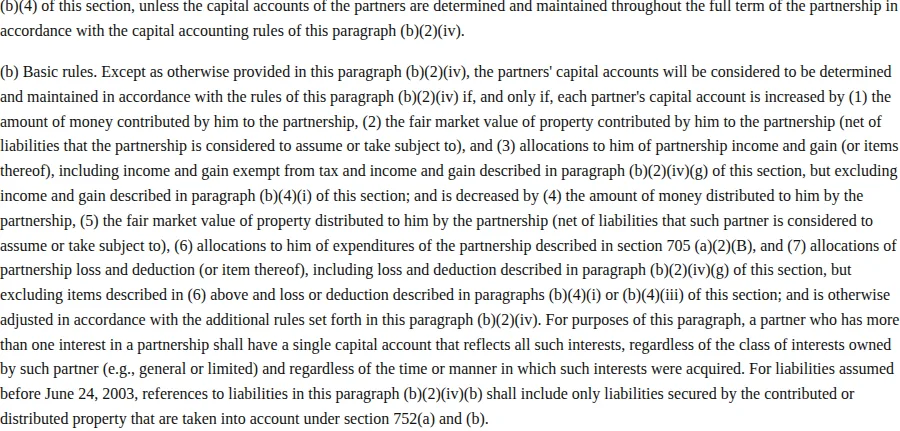
Treas. Reg. § 1.704-1(b)(1)(i) names three ways an allocation can survive: substantial economic effect, accordance with the partner's interest, or a special rule — and paragraph (b)(2)(iv)(a) adds that no allocation has economic effect unless the capital accounts are maintained under the capital accounting rules throughout the partnership's full term.
The three-part economic-effect test
Treas. Reg. § 1.704-1(b)(2)(ii)(a) states the principle: the partner who takes the allocation must receive the economic benefit or bear the economic burden that corresponds to it. Paragraph (b)(2)(ii)(b) turns that principle into three requirements the agreement must satisfy throughout the full term of the partnership:
- Capital accounts are determined and maintained under the rules of paragraph (b)(2)(iv).
- On liquidation of the partnership or of any partner's interest, liquidating distributions must in all cases follow the partners' positive capital account balances, as adjusted for the year of liquidation, by the end of that taxable year or within 90 days after.
- A partner with a deficit capital account on liquidation of his interest is unconditionally obligated to restore it by the same deadline, the restored amount going to creditors or to the other partners by positive balances.
A DRO that is not legally enforceable, or a bottom dollar payment obligation not recognized under § 1.752-2(b)(3), is disregarded under paragraph (b)(2)(ii)(c)(4).
The decision table: which test governs your allocation
| Situation | Test that applies | Authority |
|---|---|---|
| Three requirements met, unlimited DRO | Economic effect | § 1.704-1(b)(2)(ii)(b) |
| No DRO or capped DRO, plus QIO | Alternate test | § 1.704-1(b)(2)(ii)(d) |
| No economic effect | Partner's interest | § 1.704-1(b)(3); § 704(b) |
| Shifts tax, not economics | Shifting — insubstantial | § 1.704-1(b)(2)(iii)(b) |
| Reversed by a later offsetting allocation | Transitory — insubstantial | § 1.704-1(b)(2)(iii)(c) |
| Economics match without the formal clauses | Economic effect equivalence | § 1.704-1(b)(2)(ii)(i) |
Founder & CEO Insight — Enow A. Jovial
Deficit restoration vs qualified income offset
Most partnerships never use the primary test: limited partners will not sign an unlimited obligation to repay a failed venture. That is what the alternate test in paragraph (b)(2)(ii)(d) is for. It requires the first two requirements plus a qualified income offset, and protects the allocation only to the extent it does not cause or increase a deficit beyond any limited DRO amount, measured at year end.
The QIO is a mop-up clause. It must provide that a partner who unexpectedly receives an adjustment, allocation, or distribution described in paragraphs (b)(2)(ii)(d)(4), (5), or (6) will be allocated items of income and gain, consisting of a pro rata portion of each item of partnership income including gross income, sufficient to eliminate the deficit as quickly as possible. Under a DRO, the partner promises cash, unconditional and enforceable, due by the end of the liquidation year or within 90 days after; under a QIO, the partnership promises income, redirecting future gross income to the deficit partner until it is gone. QIO protection is capped: an allocation pushing the capital account below zero, beyond a limited DRO, has no economic effect to that extent.
Worked math 1: the capital account roll-forward
Treas. Reg. § 1.704-1(b)(2)(iv)(b) states the seven bookkeeping moves. A partner's capital account is increased by money contributed, the fair market value of property contributed (net of assumed liabilities), and allocated income and gain including tax-exempt income; decreased by money and property distributed (at fair market value), section 705(a)(2)(B) expenditures, and allocated loss and deduction.
A contributes $100,000 cash. B contributes a building with a fair market value of $100,000 and an adjusted tax basis of $60,000. The partnership earns $40,000 before depreciation; the building depreciates $10,000 for book purposes and $6,000 for tax purposes. Book income is $30,000 and tax income is $34,000. The agreement allocates income 50/50. A withdraws $10,000 cash during the year.
B's tax capital is credited at tax basis, not fair market value: $60,000 plus B's $17,000 share of tax income:
The $38,000 gap between B's book capital ($115,000) and tax capital ($77,000) is the section 704(c) variation: it began at $40,000, the built-in gain at contribution, and narrowed by $2,000, B's half of the $4,000 annual book-tax depreciation difference. For the debt side of the same ledger, see the section 752 debt-basis playbook: liabilities move outside basis, not capital accounts.
Worked math 2: liquidation must follow positive capital accounts
The partnership liquidates at year-end with $220,000 of cash — exactly the sum of the two book capital accounts. Requirement (2) says the cash goes out by positive capital account balances:
A 50/50 split would pay each $110,000, failing requirement (2) outright. The opening example fails the same way: A takes 90% of the losses but 50% of the cash.
Worked math 3: deficit restoration and the qualified income offset in numbers
DRO case. Partner D starts the year with a capital account of $20,000 and an unlimited DRO. The agreement allocates D a $40,000 loss.
The $20,000 deficit is within D's unlimited DRO, so the full allocation has economic effect. On liquidation, D restores $20,000 in cash by the end of the taxable year or within 90 days after.
QIO case, no DRO. Partner C starts the year with a capital account of $20,000 and no DRO. The agreement allocates C a $30,000 loss.
Under the alternate test, only $20,000 of the loss has economic effect — the amount that brings C's account exactly to zero. The remaining $10,000 is reallocated per the partners' interests. If C instead unexpectedly receives a $15,000 distribution against a $10,000 capital account, the QIO fires on the resulting $5,000 deficit. The agreement must then allocate $5,000 of gross income to C until the deficit is eliminated.
Substantiality: shifting and transitory allocations
Paragraph (b)(2)(iii)(a): economic effect is substantial if there is a reasonable possibility the allocation will affect substantially the dollar amounts the partners receive, independent of tax consequences. Two named patterns fail it.
Shifting tax consequences, paragraph (b)(2)(iii)(b): there is a strong likelihood the net capital account movements will not differ substantially without the allocation, and total partner tax liability will be less. The classic shape: allocate $20,000 of year-1 depreciation to A, in the 37% bracket, and $20,000 of year-2 income to A. Capital accounts end the two years unchanged, but A defers $7,400 of tax — $20,000 times 37% — by a year.
Transitory allocations, paragraph (b)(2)(iii)(c): an original allocation is largely offset by a later one, with the same two conditions. The regulation gives the pattern a clock: if the offsetting allocation is unlikely to be made within five years after the original, the allocations are presumed substantial.
Who must keep section 704(b) books, and who may not
A multi-member LLC taxed as a partnership files Form 1065 under its EIN and must maintain section 704(b) books for special allocations. A C-Corp has no partners and files Form 1120, so it never keeps section 704(b) books. An S-Corp files Form 1120-S and allocates by share ownership. A CPA reconciles book capital to tax-basis Item L capital every year: the book ledger decides who gets cash on liquidation, the tax ledger decides what the K-1 reports. GAAP books are a third ledger, built for financial reporting. A SaaS partnership billing through an API must still keep the book ledger by hand, and a general partner's guaranteed payments for services are not allocations at all. FICA and self-employment tax apply at the partner level, outside the capital account.
The K-1 reporting hook: Item L
Schedule K-1, Item L, is where the outside world sees the capital account. Since tax year 2020, Item L reports each partner's capital account on the tax-basis method. The Instructions for Form 1065 state two confusing facts. First, the ending capital account may be negative if losses and distributions exceed contributions and income. Second, tax-basis ending capital might not equal adjusted tax basis, because adjusted basis includes the partner's share of liabilities, and section 743(b) adjustments are excluded. For the full K-1 walkthrough, see the Schedule K-1 pass-through income playbook; for basis adjustments, the section 754 basis adjustment playbook. Run the totals through the break-even analysis playbook before promising a distribution the capital accounts cannot support.
The risk layer: what reallocation costs
When an allocation fails, the item is reallocated under paragraph (b)(3) in accordance with the partner's interest, weighing relative contributions, interests in profits, losses, and cash flow, and rights on liquidation. The reallocation is retroactive, so the partners' returns for that year are wrong, and the section 704(d) loss limit recomputes on the corrected basis. The practical cost is the amended returns, corrected K-1s, restated capital accounts, and the partner dispute that follows.
Run the operation
- Read the agreement as the regulation reads it: the agreement includes every side agreement, put, option, and buy-sell arrangement under paragraph (b)(2)(ii)(h), plus state law.
- Confirm the three clauses exist: capital accounts under (b)(2)(iv), liquidation by positive balances within 90 days, and an unlimited DRO or a QIO.
- Post every event to the book ledger: contributions and distributions at FMV, book income and loss, section 705(a)(2)(B) expenditures.
- Test each special allocation for economic effect: run the deficit math as of year end.
- Test for substantiality: ask whether the capital accounts would move the same without the allocation while total tax falls, and whether an offset is expected within five years.
- Reconcile the three ledgers and re-test yearly: book capital, tax-basis Item L capital, and outside basis — an allocation that passed last year fails when a capital account goes negative beyond the DRO.
The year-end checklist
- [x] Capital accounts posted under (b)(2)(iv), one per partner
- [x] Liquidation by positive balances within 90 days
- [x] DRO signed, or QIO clause in place
- [x] Book-tax variation tracked per property
- [x] Item L reconciled to Schedules M-2 and L
- [x] Shifting and transitory tests run on every special allocation
The decision in advance
Section 704(b) asks one question of every allocation: would the partner feel it in cash on liquidation? Keep the capital account by the book rules, liquidate by its positive balances, restore its deficits, and the allocation stands. Skip any step and the regulation rewrites the deal.
Partnership QBUs translate under section 987, not section 704(b) — the Section 987 QBU translation playbook works the remittance proportion and the partnership boundary. Capital accounts are only half the partnership story — the section 704(c) contributed-property playbook runs the built-in gain math that sits on top of them. Contributions set the capital accounts: the Section 721 partnership contribution playbook works the nonrecognition rule, the basis math, and the seven-year backstops. For the distribution side of the same capital account, the Section 731 partnership distributions playbook runs the nonrecognition, basis and disguised-sale tests in order. Capital accounts and outside basis meet again in Section 737: the excess-distribution formula, the 7-year window, and eight worked examples. Shareholder basis runs on the same ordering rules as IRS Form 7203 S-Corp Shareholder Basis Playbook.