Section 731 tells a partner a property distribution is tax-free. Section 737 takes the tax back when the distribution is a swap in disguise: a partner contributes land worth $400,000 with a $240,000 basis, then takes $300,000 of other property out. Section 737 calls it the partner cashing in $60,000 of built-in gain that was meant to stay in the partnership.
What Section 737 actually says
Section 737(a) states the rule. On a distribution, the partner recognises gain equal to the lesser of (1) the excess of the fair market value of property (other than money) received over the adjusted basis of the partner interest immediately before the distribution, reduced (but not below zero) by the money received, or (2) the partner net precontribution gain. Character follows the proportionate character of the net precontribution gain.
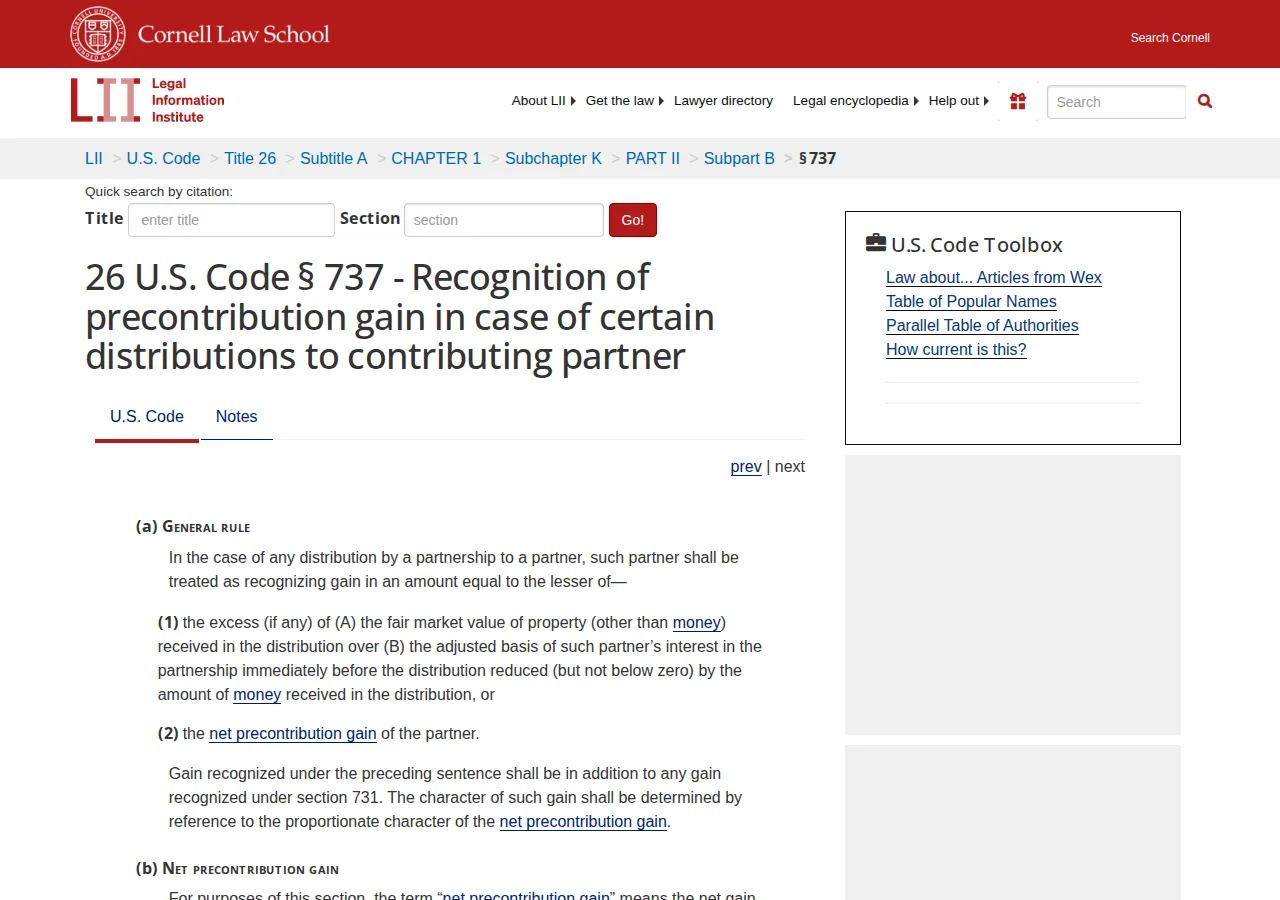
Section 737(b) defines the second prong. Net precontribution gain is the net gain that would have been recognised under Section 704(c)(1)(B) if all property the partner contributed within 7 years of the distribution, and still held by the partnership immediately before the distribution, had been distributed to another partner. It is a hypothetical ceiling. Property contributed more than 7 years ago drops out, as does property the partnership has already sold or distributed.
Section 737(c) carries the basis mechanics. Paragraph (1) increases the adjusted basis of the partner interest by the gain recognised, treated as occurring immediately before the distribution for purposes of determining the basis of the distributed property. Paragraph (2) requires appropriate adjustments to the partnership basis in the contributed property to reflect the gain recognised. The partner pays once, and both bases move up by the amount paid.
The 7-year window
The window is 7 years. The Taxpayer Relief Act of 1997 (Pub. L. 105-34, § 1063(a), 5 August 1997) substituted "7 years" for "5 years" in both Section 704(c)(1)(B) and Section 737, for property contributed after 8 June 1997. Section 704(c)(1)(B): if contributed property is distributed to another partner within 7 years of contribution, the contributor recognises gain or loss as if the property had been sold at its fair market value.
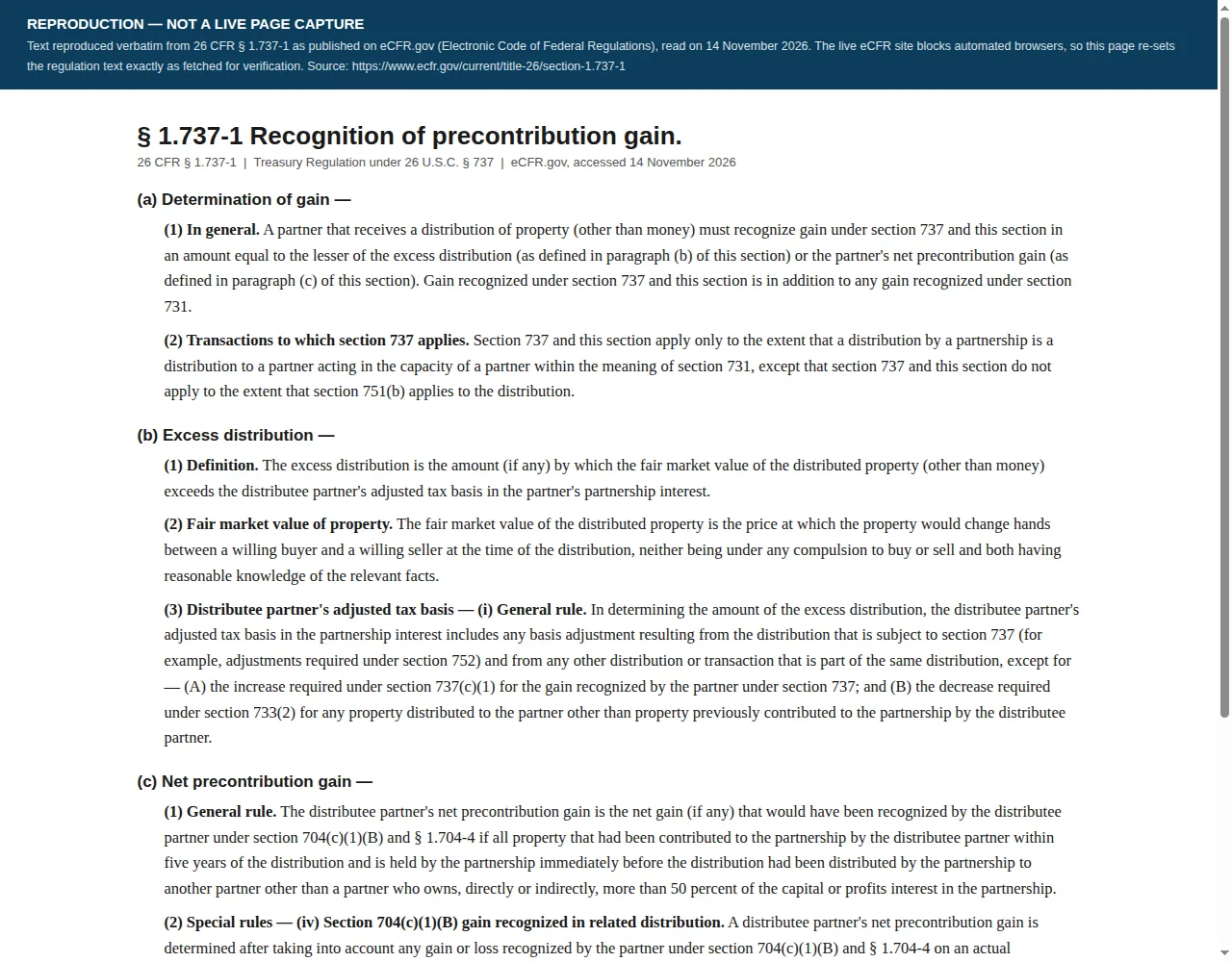
Paragraph (b)(2) defines fair market value as the price between a willing buyer and a willing seller, neither under compulsion, both with reasonable knowledge. Paragraph (b)(3)(i) is the trap: the outside basis in the excess computation includes basis adjustments from the same distribution, including Section 752 liability shifts, but excludes the Section 737(c)(1) increase and the Section 733(2) decrease for other property.
The decision table
| Situation | § 737 gain? | § 731 gain? | Authority |
|---|---|---|---|
| Other property out, FMV above basis, § 704(c) gain inside 7 years | Yes, lesser of the two | Only if money exceeds basis | § 737(a); § 731(a)(1) |
| Other property out, contribution older than 7 years | No, net precontribution gain $0 | Only if money exceeds basis | § 737(b); § 731(a)(1) |
| Own contributed property returned | No, excluded | Only if money exceeds basis | § 737(d)(1) |
| Marketable securities distributed | No, securities are money | Yes, securities are money at FMV | § 737(e); § 731(c) |
| Liability relief and assumption | Only after § 752 adjustments | Money includes § 752(b) relief | § 737(a); Reg. § 1.737-1(b)(3)(i); § 752 |
| Contributed property to another partner, same transaction | Net precontribution gain reduced | Only if money exceeds basis | § 704(c)(1)(B); Reg. § 1.737-1(c)(2)(iv) |
| § 751(b) disproportionate distribution | No, to the extent § 751(b) applies | § 751(b) taxes the exchange instead | § 737(d)(2); § 751(b) |
Worked examples: A1 to A8
The fact pattern is fixed across A1 to A4 and A8. Partnership ABC, an LLC, equal partners A, B, C, formed 1 January 2024. The same math applies to contributed IP. A contributes land, Property A1: FMV $400,000, basis $240,000, built-in gain $160,000, outside basis $240,000. B contributes $400,000 cash; C contributes a building worth $400,000, basis $400,000. No liabilities, no § 754 election, no depreciation.
— Example A1: the excess binds. Property D, FMV $300,000, basis $300,000, current distribution, no money. Excess: $300,000 − $240,000 = $60,000. Net precontribution gain: $400,000 − $240,000 = $160,000. § 737 gain: the lesser, $60,000. § 731 gain: $0. Outside basis, § 737(c)(1): $240,000 + $60,000 = $300,000. Property D basis, § 732(a): $300,000. Outside basis after § 733: $0. Partnership basis in A1: $300,000; remaining built-in gain $100,000.
— Example A2: the net precontribution gain binds. Property D is worth $500,000, basis $500,000. Excess: $500,000 − $240,000 = $260,000. Net precontribution gain: $160,000. § 737 gain: $160,000, the whole built-in gain. Outside basis: $240,000 + $160,000 = $400,000. Property D basis, § 732(a): $400,000, the lesser of $500,000 and $400,000; the $100,000 gap is never recovered. Partnership basis in A1: $400,000; built-in gain $0.
— Example A3: the 7-year window, inside against outside. Distribute the same $300,000 Property D on 31 December 2030, six years and 364 days after contribution: A1 is inside the window, net precontribution gain $160,000, § 737 gain $60,000 as in A1. Distribute it on 1 February 2031, seven years and one month after contribution: net precontribution gain $0, § 737 gain $0. § 731 gain is $0 either way; on the outside date A takes Property D at a $240,000 basis under § 732(a). Waiting saves the $60,000 tax but costs the $60,000 basis step-up. A distribution on the exact seventh anniversary, 1 January 2031, is a confirm-with-your-CPA date.
— Example A4: previously contributed property comes home. In 2026 the partnership distributes Property A1 back to A, plus Property D worth $100,000. § 737(d)(1) excludes the A1 portion from the excess computation and from net precontribution gain, so the excess counts only Property D: $100,000 against a $240,000 outside basis is $0, § 737 gain $0. A takes A1 back at a $240,000 basis, absorbing the whole outside basis, so Property D takes a $0 basis and A outside basis ends at $0.
— Example A5: the § 752 debt shift erases the excess. A contributes land worth $100,000, basis $40,000; B and C each contribute $100,000 cash; the partnership buys Property B worth $90,000 subject to a $90,000 nonrecourse liability, $30,000 per partner, so A outside basis is $70,000. On 31 December 2026 A receives $20,000 cash and Property B subject to the $90,000 liability. § 752(b) relief of $30,000 is a money distribution; § 752(a) assumption of the $90,000 liability is a money contribution. Outside basis for § 737 purposes: $70,000 − $20,000 − $30,000 + $90,000 = $110,000, above the $90,000 value — no excess, § 737 gain $0. § 731: money $50,000 against a $130,000 outside basis, gain $0. Omit the assumption: basis $20,000, excess $70,000.
— Example A6: the § 704(c)(1)(B) overlap. A contributes A1 and A2, each worth $100,000, basis $60,000; B contributes Property B worth $200,000; C contributes $200,000 cash. A outside basis $120,000; net precontribution gain $80,000. On 31 December 2026 Property B goes to A in complete liquidation and A1 goes to B. § 704(c)(1)(B) gain on A1: $100,000 − $60,000 = $40,000. Outside basis: $120,000 + $40,000 = $160,000. Net precontribution gain: $80,000 − $40,000 = $40,000 under Reg. § 1.737-1(c)(2)(iv). Excess: $200,000 − $160,000 = $40,000. § 737 gain: $40,000. Total gain: $80,000, the original built-in gain. § 731 gain: $0. Property B basis, § 732(b): $200,000. Partnership basis in A2: $100,000; built-in gain $0.
— Example A7: character netting. A contributes A1 (worth $300,000, basis $200,000, long-term US-source), A2 (worth $300,000, basis $380,000, long-term US-source, built-in loss $80,000), A3 (worth $100,000, basis $90,000, long-term foreign-source). B contributes Property B worth $700,000; C contributes $700,000 cash. A outside basis $670,000. On 31 December 2026 Property B goes to A in complete liquidation. Net precontribution gain: $700,000 − $670,000 = $30,000. By character, Reg. § 1.737-1(d): long-term US-source $100,000 − $80,000 = $20,000; long-term foreign-source $10,000. Excess: $30,000. § 737 gain: $30,000 — $20,000 long-term US-source and $10,000 long-term foreign-source.
— Example A8: marketable securities are money. A contributed cash only, has no § 704(c) property and no net precontribution gain, and holds a $100,000 outside basis. The partnership distributes actively traded stock worth $150,000, basis $150,000. § 737(e) treats the securities as money, so § 737 gain is $0. § 731(c)(1) treats the same securities as money for § 731: $150,000 against a $100,000 outside basis produces § 731 gain of $50,000, treated as gain from the sale of the partnership interest. Securities basis to A: the § 732(a) cap is $0, plus the $50,000 gain under § 731(c)(4), $50,000. Outside basis ends at $0.
The exceptions
Section 737(d)(1) has a carve-out: if the property distributed is an interest in an entity, the exception does not apply to the extent the interest value is attributable to property contributed to the entity after the interest itself was contributed.
Section 737(d)(2): Section 737 does not apply to the extent Section 751(b) applies, so a disproportionate distribution of unrealised receivables or inventory is taxed as a sale or exchange under Section 751(b) first, and Section 737 reaches only what is left.
Section 704(c)(2) is the like-kind safety valve. If contributed property is distributed to another partner and like-kind property is distributed to the contributing partner by the earlier of the 180th day after the distribution or the due date (with extensions) of the contributor return, Section 704(c)(1)(B) applies as if the contributor had contributed the like-kind property. But Reg. § 1.737-1(c)(2)(v) disregards Section 704(c)(2) when the contributed property is not actually distributed to another partner in a related distribution.
Two more regulation rules belong on every LLC checklist. A transferee of all or part of a contributing partner's LLC interest succeeds to the transferor net precontribution gain in proportion to the interest transferred, under Reg. § 1.737-1(c)(2)(iii). With a Section 754 election in effect, net precontribution gain is reduced by Section 734(b)(1)(A) basis adjustments on money distributions that are part of the same distribution, under Reg. § 1.737-1(c)(2)(ii).
Distribution ordering
- Section 752 — liability shifts move the outside basis first.
- Section 751(b) — receivables or inventory are taxed as an exchange first.
- Section 731 — money against outside basis.
- Section 737 — the lesser of the excess and the net precontribution gain.
- Sections 732 and 733 — set the property basis and the remaining outside basis.
Execution checklist
- [x] List every property the distributee contributed within 7 years and still held, with FMV and partnership basis.
- [x] Compute net precontribution gain as the Section 704(c)(1)(B) hypothetical, netted by character, reduced for any related Section 704(c)(1)(B) gain.
- [x] Apply Section 752 first — relief is money out, assumption is money in — then test Section 751(b).
- [x] Compute the excess on the adjusted outside basis, excluding the Section 737(c)(1) increase and the Section 733(2) decrease for other property.
- [x] Take the lesser of the excess and the net precontribution gain; add any Section 731 gain separately.
- [x] Increase the outside basis by the Section 737 gain before setting the distributed property basis under Section 732, and increase the partnership basis in the contributed property by the same amount.
Who this playbook is not for
A partner who contributed only cash has no net precontribution gain — Section 731 alone governs their distributions, as A8 shows. An S-Corp or C-Corp shareholder is outside this section entirely. A partner whose contributions are all more than 7 years old is outside the section entirely; the planning question is Section 731 and Section 751(b). A partner receiving only money is outside Section 737: money is not property for subsection (a)(1). A § 737 gain is not FICA wages.
Related reading: the distribution companion is Section 731 Distributions Playbook, the built-in gain machinery is Section 704(c) Built-In Gain Playbook, and the debt-basis rules are Section 752 Debt Basis Playbook.
Founder & CEO Insight — Enow A. Jovial