IRC Section 704(c): Contributed Property and Built-in Gain Playbook
A partner contributes a warehouse worth $10,000 that cost them $4,000. The partnership takes it at a $4,000 tax basis, and the $6,000 of appreciation stays attached to the contributor. The contribution itself is not taxed — the regulation states section 704(c) applies only where the contribution is governed by section 721 — but depreciation, sale, and distribution must be allocated so the precontribution gain or loss lands on the partner who brought it in.
Why section 704(c) exists
Without it, a contribution would be a tax-planning machine: a high-bracket partner contributes appreciated property, the partnership sells it, and the gain is split among partners who pay less tax. The regulation states the purpose plainly — section 704(c) exists to prevent the shifting of tax consequences among partners with respect to precontribution gain or loss. A method is not reasonable if the contribution and the allocations are made with a view to shifting built-in gain or loss so as to substantially reduce the partners' aggregate tax liability. Treas. Reg. section 1.704-3(a)(10) is the backstop behind all three methods. The rules apply property by property. The Section 704(b) capital account playbook works the three tests that keep capital accounts honest, and debt that changes a partner's outside basis runs through the Section 752 partnership-debt basis playbook.
The variation: built-in gain and built-in loss
Built-in gain is the excess of the property's book value over the contributing partner's adjusted tax basis on contribution; built-in loss is the excess of adjusted tax basis over book value. Book value equals fair market value at contribution, adjusted later for cost recovery. Property whose book value differs from its tax basis is section 704(c) property.
Take the regulation's own example, Treas. Reg. section 1.704-3(b)(2), Example 1.
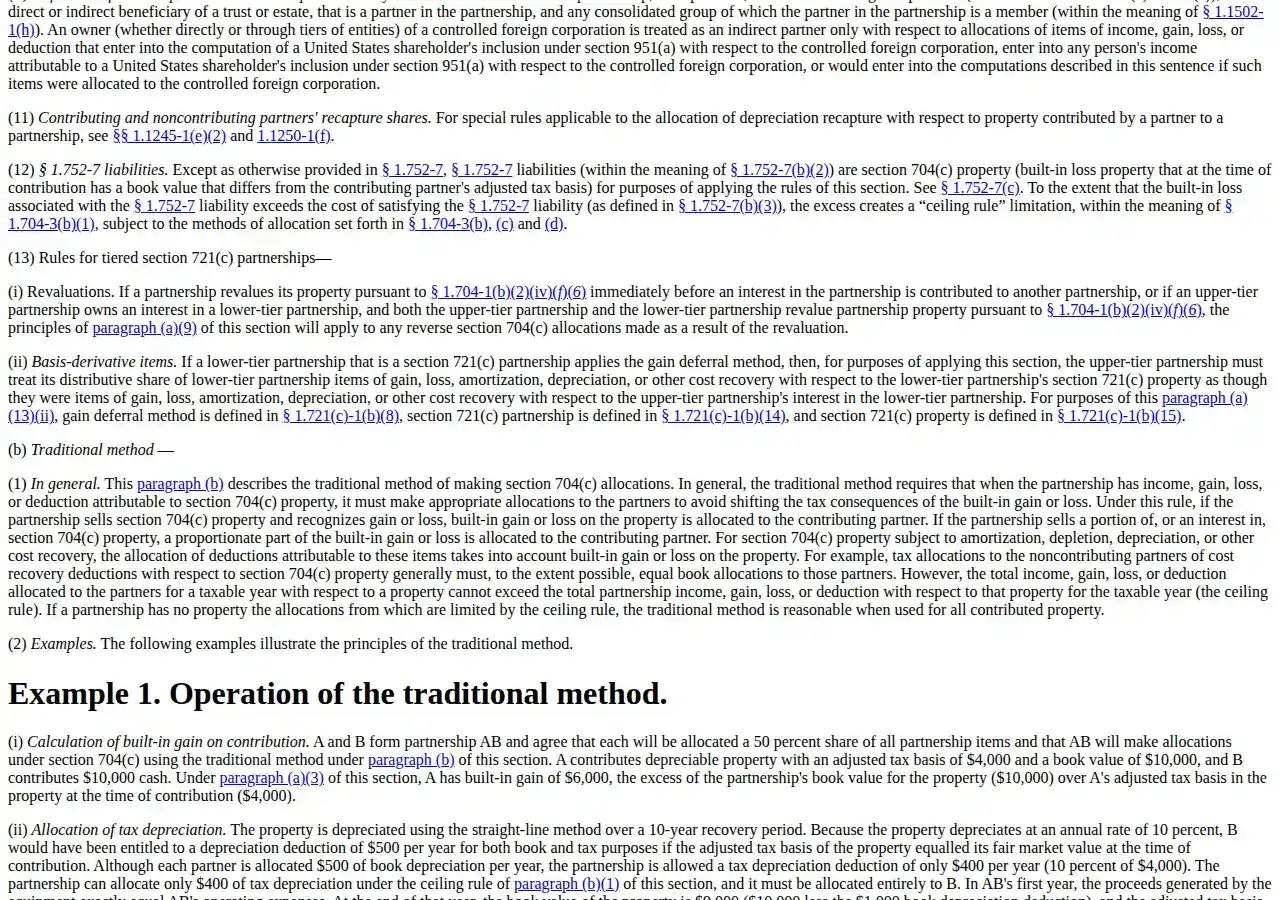 A and B form partnership AB, each allocated 50 percent of all items, using the traditional method. A contributes depreciable property with a $4,000 tax basis and a $10,000 book value; B contributes $10,000 cash. A's built-in gain is $6,000. The property depreciates straight-line over ten years: book depreciation $1,000 a year, tax depreciation $400 a year. Each partner is allocated $500 of book depreciation, but the $400 of tax depreciation must go entirely to B. The $100 gap is the ceiling-rule distortion, repeating every year until the property is sold or fully depreciated:
At the end of year one the book value is $9,000, the tax basis $3,600, and the remaining built-in gain $5,400. Run your own numbers through the profit calculator first.
The three methods, compared
| Method | How it handles the ceiling rule | What it costs | Authority |
|---|---|---|---|
| Traditional | Allocates only tax items actually recognized | Nothing extra; distortion remains | Treas. Reg. § 1.704-3(b) |
| Traditional with curative allocations | Fills the gap with real tax items from other property | Uses up other deductions or income | Treas. Reg. § 1.704-3(c) |
| Remedial allocation | Creates notional tax items to erase the gap | Phantom income to the contributor | Treas. Reg. § 1.704-3(d) |
The regulation calls all three methods generally reasonable. Stepping basis up or down to reflect built-in gain or loss is never reasonable without published guidance.
The traditional method and the ceiling rule
Under the traditional method, built-in gain or loss on a sale goes to the contributor first, and a sale of part of the property sends a proportionate part to the contributor. For depreciable property, tax deductions for the noncontributors must, to the extent possible, equal their book allocations. The ceiling rule caps the tax items allocated for a property in a year at the total the partnership actually has for that property.
Sell at the start of year two for $9,000 and the tax gain is $5,400 — amount realized less the $3,600 tax basis — all of it to A, exactly the built-in gain remaining. Sell for $10,000 and the tax gain is $6,400: $5,400 to A, the rest split $500 each:
Traditional method with curative allocations
Curative allocations correct the distortion with real tax items from other partnership property. If a noncontributor receives less tax depreciation than book depreciation on the contributed property, the partnership may allocate that partner tax depreciation from another item, even though the corresponding book depreciation belongs to the contributor. The partnership may limit curative allocations to particular items. A curative allocation is reasonable only up to the amount needed to offset the ceiling rule's effect, and it must be expected to have substantially the same effect on each partner's tax liability as the item limited.
Paragraph (c), Example 1, reuses the AB numbers. E contributes equipment with a $4,000 basis and a $10,000 book value; F contributes $10,000 cash, which the partnership uses to buy inventory. In year one the partnership sells the inventory for a $700 gain, and under the traditional method alone F's book and tax capital accounts end $100 apart. The partnership cures it by allocating E an additional $100 of inventory income for tax purposes — E takes $450, F takes $250 — and the accounts reconcile exactly. Allocate the whole $700 to E instead and the cure overshoots: the regulation calls that unreasonable.
The remedial allocation method
The remedial method erases the distortion entirely by creating tax items that do not exist at the partnership level. Book items are allocated under section 704(b); actual tax items follow the traditional method. Where the ceiling rule leaves the noncontributor's book allocation different from the tax allocation, the partnership creates a remedial item equal to the full difference for the noncontributor and an offsetting item in the identical amount for the contributor. Remedial items do not affect the partnership's taxable income, its basis in the property, or book capital accounts — but they act like real tax items for each partner.
The regulation's Example 1 in paragraph (d) runs the full life. L contributes depreciable property with a $4,000 basis and a $10,000 fair market value, four years left on its recovery period; M contributes $10,000 cash. Book depreciation is $1,600 a year for the first four years. In years one through four the $1,000 of tax depreciation covers M's $800 book share, so no remedial items arise. In years five through ten there is $600 of book depreciation and none for tax, so each year M is short $300 and L picks up $300 of remedial income:
At the end of year ten, both partners hold $5,000 book and $5,000 tax capital accounts. The price is phantom income: L reports $1,800 over six years that the partnership never earned, and the IRS cannot force a partnership onto the remedial method.
Built-in loss: the contributor keeps the loss too
Section 704(c)(1)(C), added in 2004, runs the same logic in reverse. Built-in loss is the excess of adjusted basis over fair market value at contribution, taken into account only for the contributing partner; for other partners, the property's basis is treated as its fair market value at contribution. Suppose a partner contributes land with a $10,000 basis and a $6,000 fair market value, and the partnership later sells it for $5,000. Book loss is $1,000, split $500 each; tax loss is $5,000: the $4,000 built-in loss belongs to the contributor and the remaining $1,000 follows the book split, so the contributor takes $4,500 and the noncontributor $500.
Scenario: the seven-year distribution rule
Section 704(c)(1)(B) is the trap that catches partnerships that contribute property and then hand it to someone else. If contributed property is distributed to another partner within seven years of contribution, the contributing partner recognizes the gain or loss that would have been allocated to them if the property had been sold at its fair market value at distribution. The contributor's outside basis and the distributed property's basis are adjusted for the gain or loss recognized. The 1997 Taxpayer Relief Act lengthened it from five years for property contributed after June 8, 1997.
Scenario: A contributes the same $10,000 warehouse with a $4,000 basis to partnership AB in year one, and in year two the partnership distributes it to B when it is worth $9,000. After one year of depreciation the tax basis is $3,600 and the book value is $9,000, so a sale at $9,000 would produce $5,400 of tax gain, all of it A's built-in gain. A therefore recognizes $5,400 of gain on the distribution, even though A received nothing. A's outside basis rises by $5,400, and B takes the warehouse with a basis adjusted for the gain A recognized. The like-kind escape in section 704(c)(2) is narrow: it applies only where other like-kind property is distributed to the contributor within 180 days or by the due date of the contributor's return, whichever is earlier.
Section 737: the excess-distribution rule
Section 737 catches the mirror image: the contributing partner receives other property back. If a partner who contributed property within the last seven years receives a distribution of other property, the partner recognizes gain equal to the lesser of the excess distribution and the partner's net precontribution gain. The excess distribution is the fair market value of property other than money received, minus the partner's adjusted outside basis before the distribution, reduced — but not below zero — by the money received.
On the AB numbers: A contributed the warehouse with $6,000 of built-in gain, still held by the partnership. A's outside basis is $5,000, A receives no money, and A receives other property worth $9,000:
A recognizes $4,000 of gain, and A's outside basis rises by that $4,000. Property the distributee partner contributed is ignored in both measures, and section 737 does not apply to the extent section 751(b) applies. Marketable securities are treated as money under section 731(c).
Where it lands on the return
Form 1065 is the partnership's annual information return, and Schedule K-1 is how each partner's share reaches the partner's own return. The partnership pays no income tax; the items pass through. Item M asks whether the partner contributed property with a built-in gain or loss during the year. A "Yes" answer requires an attached statement showing the property, the contribution date, and the amount of the built-in gain or loss. The 2024 Partner's Instructions point readers to box 20, code W for precontribution gain or loss, and to box 19, code B for distributions subject to section 737. Form 1065 is generally due March 15 for a calendar-year partnership, and the K-1s are due the same day.
Operator Boundaries
This playbook is for whoever sets up a contribution — typically an LLC taxed as a partnership, not a C-Corp or an S-Corp — and must choose the section 704(c) method before the agreement is signed. It is written for operating and real-estate partnerships contributing depreciable property or land with a real valuation at contribution, where the CPA reconciles the GAAP book capital accounts against the tax capital accounts and the EIN on Form 1065 matches the agreement. It is not a guide for property with no reliable appraisal, for tiered partnerships tracking lower-tier built-in gain, or for section 721(c) gain-deferral contributions involving foreign partners — those carry special remedial-method modifications and need specialist advice. It is also not a substitute for a valuation.
Founder & CEO Insight — Enow A. Jovial
Run the contribution: execution checklist
- Record the contribution on the day it happens. Description, value, basis, date, and the resulting built-in gain or loss — property by property, never netted.
- Write the section 704(c) method into the partnership agreement. Name the method for each property.
- Run the ceiling-rule math for the first five years. Book against tax depreciation, year by year.
- Mark the seven-year date for every contribution.
- Check Item M on every K-1. A "Yes" needs the attached statement.
- Reconcile book and tax capital accounts annually.
- Test any method change against the anti-abuse rule.
- Keep the appraisal with the return workpapers.
The decision in advance
Choose the method when the property is contributed, record the value that supports it, and calendar the seven-year date before anyone talks about moving property between partners. The traditional method is free and leaves a gap; the curative method spends real items; the remedial method closes it exactly and charges phantom income.