Section 721 Partnership Contribution Nonrecognition Playbook
A founder owns a warehouse worth $500,000 with a $200,000 tax basis and needs it inside the operating partnership without a tax bill today. Section 721 does that work in one sentence: no gain or loss is recognized on a contribution of property to a partnership in exchange for a partnership interest. The machinery around it is longer: basis, character, and two seven-year backstops.
1. The Section 721(a) test
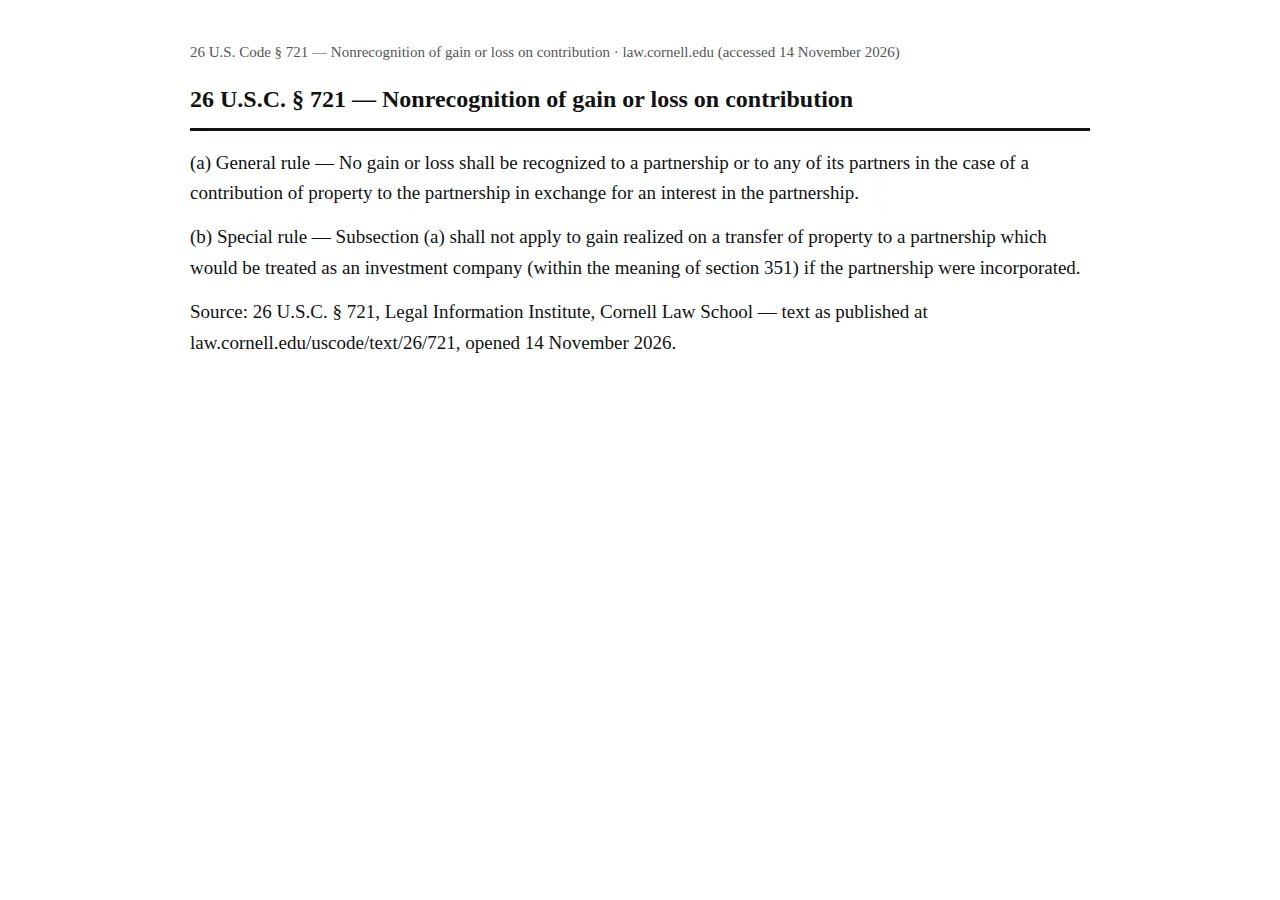
26 U.S.C. § 721(a), quoted verbatim from Cornell Law School as opened this cycle, reads: "No gain or loss shall be recognized to a partnership or to any of its partners in the case of a contribution of property to the partnership in exchange for an interest in the partnership." Three elements: property, a partnership, and an interest received in exchange. Meet all three and neither side recognizes gain or loss, at formation or later.
No control threshold, unlike Section 351's 80 percent test. The rule is mandatory: a contributor on a built-in loss cannot elect out.
2. The services trap
Founders most often lose Section 721 treatment by contributing work as property. Under Treas. Reg. § 1.721-1(b)(1), to the extent a partner gives up a right to be repaid contributions as compensation for services, Section 721 does not apply, and the capital interest transferred is income under Section 61. A developer receiving a 20 percent capital interest for software work recognizes ordinary income at FMV when transferable or free of a substantial risk of forfeiture. A profits interest is different: Publication 541 states its receipt for services is generally not a taxable event — except for a substantially certain income stream, disposition within two years, or a limited interest in a PTP.
3. Basis mechanics: Sections 722, 723, 752
Section 722 sets outside basis at money plus adjusted basis, increased by any Section 721(b) gain; Section 723 sets inside basis the same way. The warehouse: $500,000 fair market value, $200,000 basis, no Section 721(b) gain.
Both sides now carry the $200,000 basis against $500,000 of value. Debt changes the arithmetic: under Section 752, the partnership's assumption of a partner's liability counts as a money distribution to the partner, while the partner's share of partnership liabilities counts as a money contribution. Warehouse with a $150,000 mortgage assumed and a $75,000 post-contribution liability share:
Net deemed distribution: $75,000. If net liability relief exceeds outside basis, the excess is gain under Sections 731 and 752. The Section 752 partnership debt basis playbook covers liability sharing, where most contribution surprises live.
4. The five-year character taint and Section 704(c)
Section 724 fixes the character of later sales: receivables always ordinary (§724(a)); inventory ordinary if sold within five years (§724(b)); a loss on capital-loss property stays capital, capped at basis over FMV, within five years (§724(c)); §724(d)(3) carries the taint into substituted basis property.
Section 704(c)(1)(A) requires allocations accounting for the basis-to-fair-market-value variation; Reg. § 1.704-3 prescribes three methods — traditional, curative, remedial — one per item, applied consistently. Publication 541's example: Areta contributes $10,000 cash; Sofia contributes depreciable property worth $10,000 with a $4,000 basis — the partnership's depreciation basis.
Areta is owed $500 of book depreciation a year, but only $400 of tax depreciation exists, and the traditional method gives all $400 to Areta. That is the ceiling rule: tax allocations cannot exceed the tax items the partnership has. Curative allocations close the gap with other items, such as $600 of operating income allocated to Sofia instead of Areta. The remedial method closes it synthetically: a $600 remedial depreciation deduction for Areta and an offsetting $600 remedial income item for Sofia, with no cash moving. The Section 704(c) contributed property playbook works the three methods side by side, and the Section 704(b) capital account playbook covers the book capital accounts tracking $10,000 book value against $4,000 tax basis — a distinction GAAP equity reporting does not make.
5. Section 721 vs Section 351 vs taxable sale
Section 351 is the corporate analogue.
| Factor | § 721 partnership contribution | § 351 corporate transfer | Taxable sale |
|---|---|---|---|
| Control threshold | None | 80% control required | None; gain recognized immediately |
| Gain at transfer | None; carryover basis §§ 722–723 | None if control test met | Full gain: FMV minus basis |
| Property character after transfer | § 724 taint: receivables ordinary; inventory ordinary 5 years | Carryover basis; no § 724 analogue | FMV cost basis, no taint |
| Later distribution of the property | §§ 704(c)(1)(B), 737 tax contributor within 7 years | Corporate rules; generally dividends | No restriction |
| Debt on the property | § 752: relief over basis is gain | § 357: assumption generally tax-free | Debt is part of the sale price |
| Governing authority | §§ 721–724, 737; Reg. § 1.704-3 | § 351; § 351(e) | § 1001 |
A partnership wins for property held and operated; a C-Corp wins for venture capital, an option pool, or a public offering; an S-Corp takes property only under Section 351; the taxable sale is the fallback for a step-up.
6. The seven-year backstops
Two tripwires, both seven years. First, Section 704(c)(1)(B): if the partnership distributes contributed property to another partner within seven years, the contributor recognizes the gain or loss allocable under Section 704(c)(1)(A) on a sale at FMV at distribution. The warehouse, distributed three years later at $450,000:
The contributor — not the recipient — recognizes the $250,000, with sale character.
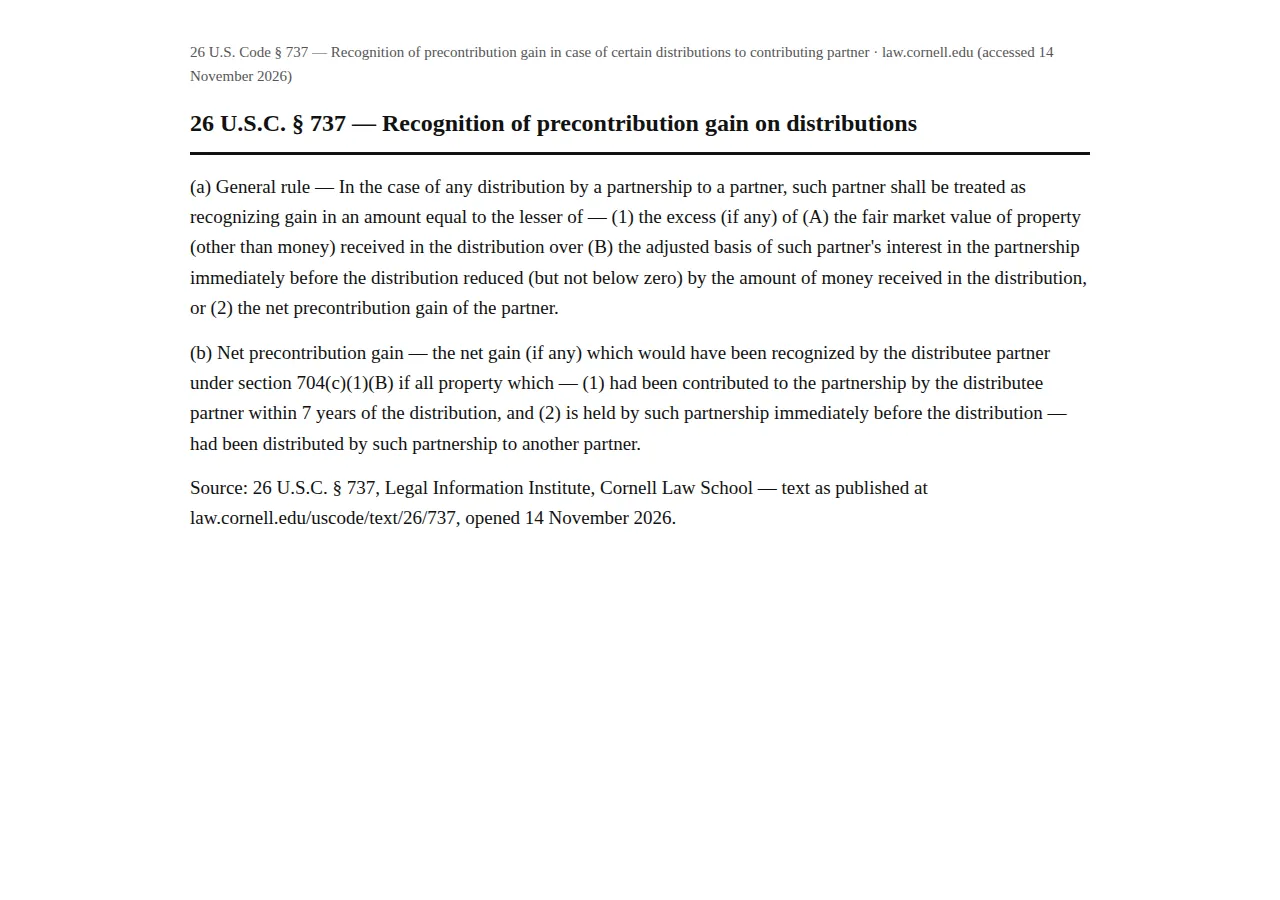
Second, Section 737: if the partnership distributes other property back to the contributor within seven years, gain is the lesser of the excess of the fair market value of property other than money received over outside basis before the distribution, reduced by money received, or net precontribution gain — the Section 704(c)(1)(B) gain if all property contributed within seven years and still held had gone to another partner. Work it: property contributed at $300,000 fair market value and $120,000 basis gives $180,000 of net precontribution gain; three years later the partnership distributes other property worth $250,000 plus $20,000 cash against a $200,000 outside basis.
The $70,000 is recognized in addition to any Section 731 gain on money over basis, and Section 737(c) increases outside basis by the gain. Section 737(d) excepts property the partner previously contributed, and Section 737 does not apply where Section 751(b) does. Both backstops expire after seven years; put the dates in the agreement.
7. The disguised-sale boundary
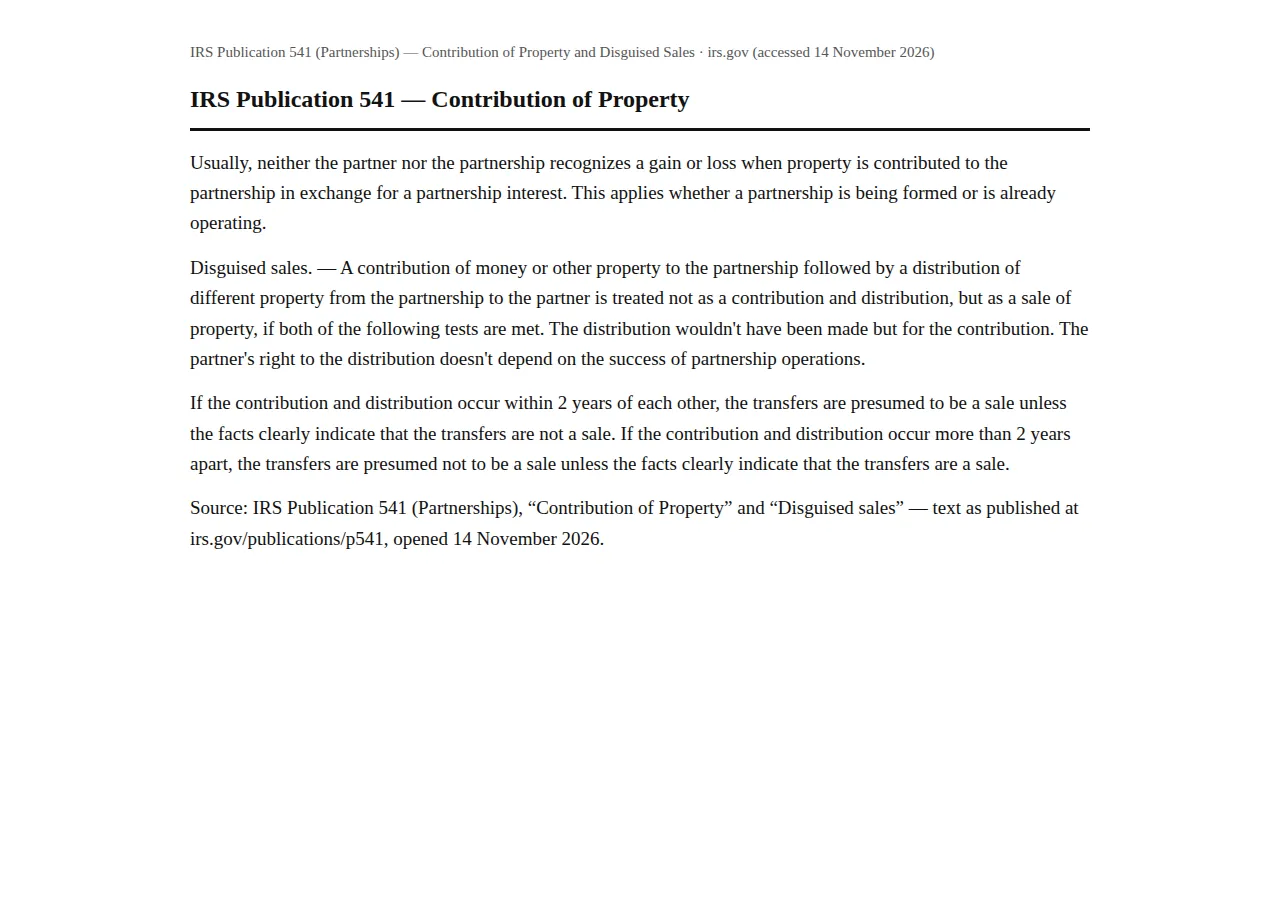
Section 707(a)(2)(B) polices the pair that is really a sale: contribution followed by a related distribution of different property. Publication 541 states the tests — the distribution would not have been made but for the contribution, and the right to it does not depend on partnership operations. Within two years, presumed a sale unless the facts clearly show otherwise; beyond two years, presumed not a sale unless the facts clearly show one.
Property worth $400,000 with a $100,000 basis carries $300,000 of built-in gain. At a stated 20 percent rate and 5 percent discount over five years (assumptions, not IRS figures):
The deferral is worth about $12,989 — real money, not a reason to disguise a sale. A partner must attach Form 8275 if the partnership transfers money or other consideration within two years either side of the contribution (Treas. Reg. § 1.707-3(c)(2)). File it: the penalty for an undisclosed disguised sale is worse than the tax on a disclosed one. Run the same arithmetic with the tax estimator.
Founder & CEO Insight — Enow A. Jovial
8. The investment-company trap
Section 721(b) is the one exception inside Section 721 itself: subsection (a) does not apply to gain on a transfer to a partnership which would be treated as an investment company, within the meaning of Section 351, if incorporated. Publication 541 states the working test — a partnership is generally an investment company if over 80 percent of asset value is held for investment in readily marketable items, including money, stocks, and interests in regulated investment companies and REITs — measured immediately after the transfer. Five founders each contributing listed stocks to a partnership holding 85 percent of its value in marketable securities each recognize gain on the spot. The fix is structural: contribute operating assets or real estate alongside the securities so the share stays below 80 percent.
Section 721(c) adds a second gate for cross-border contributions: gain on a transfer to a foreign partnership can be denied nonrecognition unless the gain deferral method under Reg. § 1.721(c)-1 is used, and Publication 541 requires Form 8865 where the contributor holds at least a 10 percent interest immediately after the contribution, or the FMV contributed exceeds $100,000 with other contributions in the preceding twelve months. Elect the deferral method before the transfer, not after the return is due.
9. Who should not contribute
Four cases where Section 721 is the wrong tool. A contributor who needs the property back within seven years should sell it to the partnership and pay the tax: Sections 704(c)(1)(B) and 737 will tax the same gain anyway. A contributor with a built-in loss should not contribute: Section 721 blocks the loss and Section 704(c)(1)(C) quarantines it to the contributor, while a sale outside the partnership would recognize it immediately. A portfolio above the 80 percent line fails Section 721(b) outright. A services-only contributor has nothing Section 721 can receive: a capital interest for services is ordinary income under Section 61.
10. The contribution protocol
Work the protocol in order; each step produces a document the next step needs.
- Value the property — obtain a written appraisal or documented FMV, dated within 90 days, for the property and its liabilities.
- Run the Section 752 calculation — debt assumed, each partner's liability share, and the resulting outside basis, signed off by the CPA.
- Test the Section 721(b) line — measure marketable investment assets against total value right after the transfer; confirm below 80 percent.
- Price property and services separately — if any interest is for services, state property and services values separately.
- Draft and sign the contribution agreement — property, FMV, basis, liabilities, 704(c) method, seven-year calendar with anniversary dates.
- Record Section 704(b) capital accounts — book at fair market value, tax at carryover basis, for every partner.
- File and report — record the deed, issue the interest, and carry the contribution into Form 1065 and Schedule K-1, with Form 8275 attached if any related transfer falls inside two years.
11. Execution checklist
- [x] Appraisal on file: fair market value in writing, dated within 90 days.
- [x] Section 752 worksheet complete: relief, re-share, and outside basis computed.
- [x] 721(b) test passed: investment assets below 80 percent, measured right after transfer.
- [x] Contribution agreement signed: property, basis, liabilities, 704(c) method, seven-year dates.
- [x] Section 704(b) capital accounts opened: book at FMV, tax at carryover basis.
- [x] Services separated: services interest priced apart from property.
- [x] Form 8275 assessed: disclosure attached if a related transfer falls within two years.
- [x] Seven-year calendar set: no property out or back before the anniversary without a tax review.
The partnership obtains an EIN on Form SS-4, then files Form 1065 by the 15th day of the third month after its tax year ends — March 15 for a calendar-year partnership — extendable on Form 7004. A multi-member LLC is taxed as a partnership by default; Form 8832 elects otherwise. Each partner receives a Schedule K-1 carrying the Section 704(c) allocations and any Section 737 gain. A partner's distributive share is not subject to FICA withholding; partners pay self-employment tax on operating income. The Form 1065 partnership return playbook covers the return mechanics this playbook builds on.
The bottom line
Section 721 is the cheapest way to move appreciated property into a partnership and the easiest provision to lose by accident. Work the Section 752 math before signing, elect the Section 704(c) method in the agreement, separate services from property in writing, and put the seven-year dates on a calendar the partnership watches. Done that way, the $300,000 of built-in gain on the warehouse stays deferred until a sale.