A sole shareholder puts $40,000 into an S corporation, the company loses $90,000 in its second year, and the shareholder deducts the full $90,000. The deduction is wrong by $25,000: section 1366(d) caps the loss at stock basis plus debt basis, and the excess is suspended. Form 7203 is the form that proves the cap, line by line. Mandatory starting with 2021 returns, it replaced the three-part worksheet in the Schedule K-1 instructions.
What Form 7203 is, and the four triggers
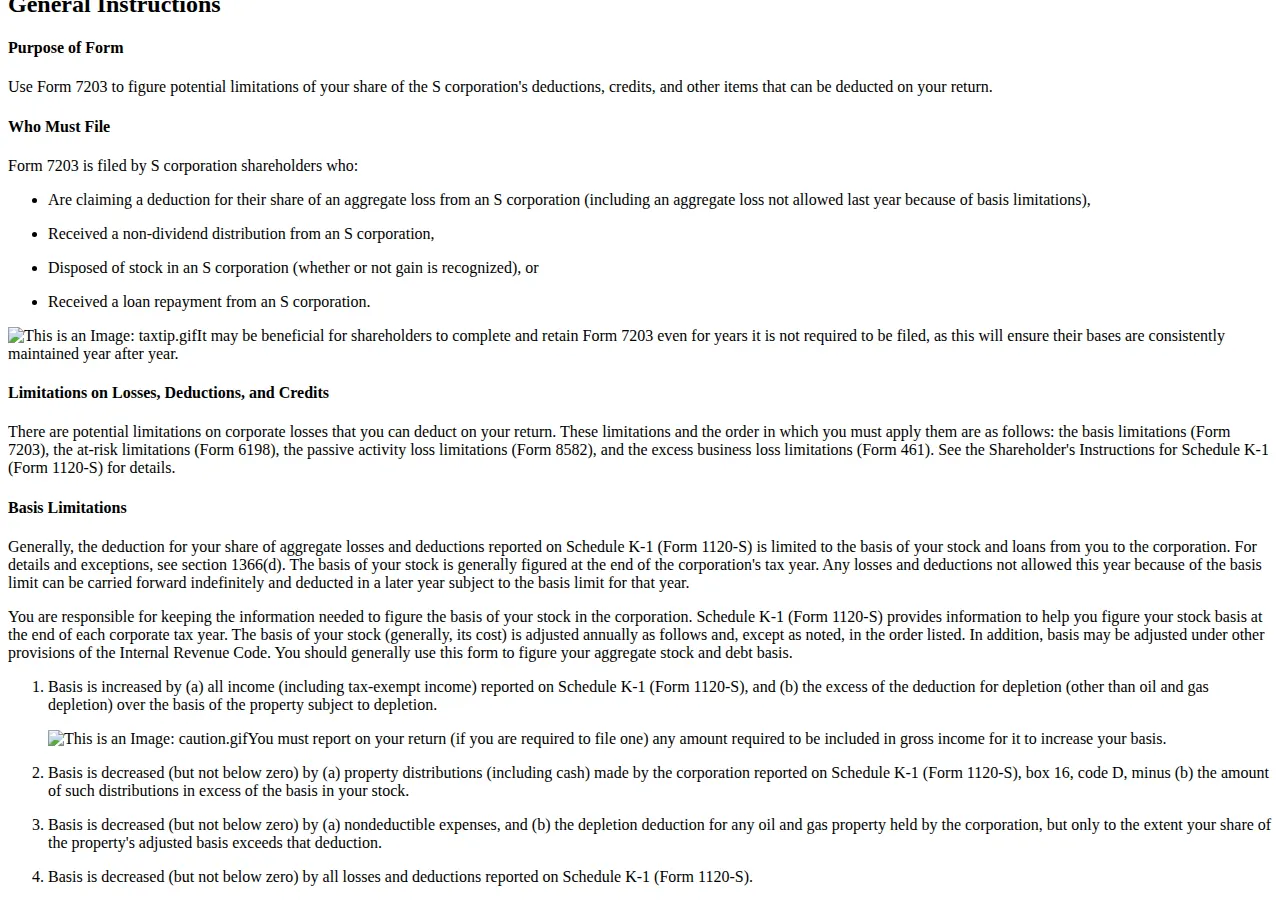
Form 7203, S Corporation Shareholder Stock and Debt Basis Limitations, figures the potential limitations on the shareholder share of S-corporation deductions, credits, and other items deductible on the individual return. It has three parts: Part I stock basis, Part II debt basis, Part III the allocation of allowable items and the carryforward. It is filed with the shareholder individual return, not with the corporation Form 1120-S.
The Instructions for Form 7203 (revised December 2022, live on irs.gov as of 14 November 2026) list four events that require the form: claiming an aggregate-loss deduction, including a prior-year suspended loss; receiving a non-dividend distribution; disposing of stock, gain or not; and receiving a loan repayment. The IRS advises completing and retaining the form even when not required: basis is cumulative from the S election. Since March 2025, K-1 box 13 code H amounts are also reported on Form 7203.
The statute: section 1366(d) and section 1367
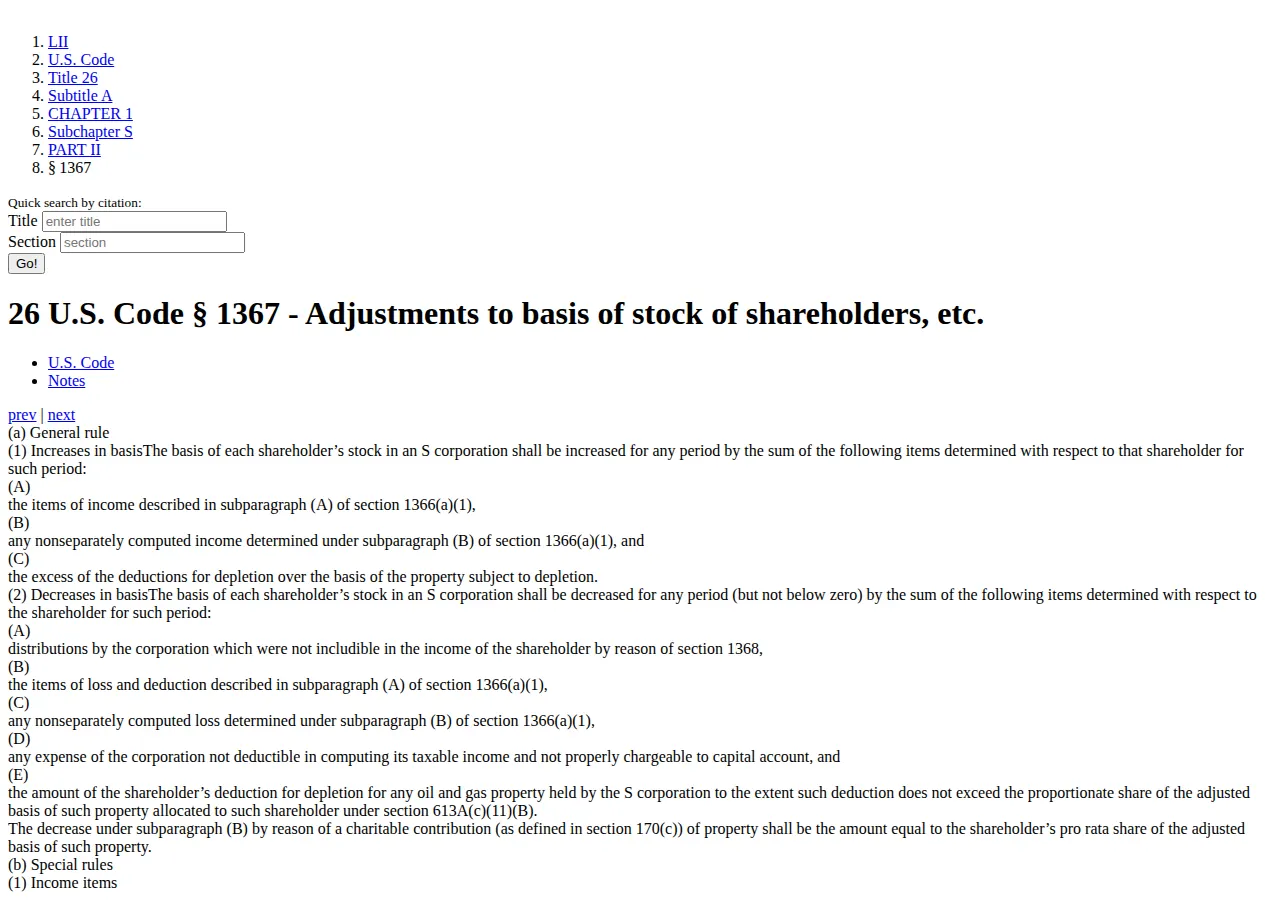
Section 1366(d)(1) imposes the cap: aggregate losses and deductions taken into account for any taxable year shall not exceed the sum of the adjusted basis of the shareholder stock plus the adjusted basis of any indebtedness of the corporation to the shareholder. Section 1366(d)(2) carries any disallowed loss or deduction forward indefinitely.
Section 1367(a)(1) increases stock basis by income items, nonseparately computed income, and excess depletion deductions. Section 1367(a)(2) decreases it, never below zero, by: (A) distributions not includible in income under section 1368; (B) items of loss and deduction; (C) nonseparately computed loss; (D) nondeductible expenses not properly chargeable to capital account; (E) oil-and-gas depletion to the section 613A(c)(11)(B) share. Section 1367(b)(2)(A) sends the excess of (B)–(E) over what zeroes stock basis against debt basis; (B) restores it, applying any later-year net increase to the debt-basis reduction before any of it may increase stock basis.
The ordering: Reg. § 1.1367-1(f) and the (g) election
The statute lists the adjustments but does not sequence them. Treas. Reg. § 1.1367-1(f) does, for tax years beginning on or after 18 August 1998: (1) increases from income items; (2) decreases from distributions; (3) decreases from noncapital nondeductible expenses and oil-and-gas depletion; (4) decreases from losses and deductions.
The election in Reg. § 1.1367-1(g) lets a shareholder take step-4 losses before step-3 nondeductible expenses; any nondeductible amount that then exceeds stock and debt basis is treated as a step-3 amount next year. It is made by statement on a timely filed return and binds future years unless the IRS agrees to revoke it.
The decision table
| Situation | Form 7203 result | Authority |
|---|---|---|
| Loss exceeds stock basis only | Excess against debt basis | § 1366(d)(1); § 1367(b)(2)(A) |
| Loss exceeds stock plus debt basis | Remainder suspended | § 1366(d)(2); Part III, column (e) |
| Distribution exceeds stock basis (no E&P) | Excess is capital gain | § 1368(b)(2); Instructions, line 6 |
| Distribution with accumulated E&P | AAA tax-free, then dividend, then basis | § 1368(c); § 1368(e)(1) |
| Nondeductible expenses exceed stock and debt | Excess vanishes, unless (g) election | Instructions, line 28; Reg. § 1.1367-1(g) |
| Profitable year after a debt-basis reduction | Net increase restores debt first | § 1367(b)(2)(B); Reg. § 1.1367-2(c) |
Worked examples: A1 to A6
A1, A2, A3, and A6 use a sole shareholder in a calendar-year S corporation; A4 and A5 reproduce the regulation examples exactly. All figures are recomputed in the figures file.
— Example A1: the full-year ordering, stock basis only. Opening stock basis is $40,000. Income is $60,000 ($50,000 ordinary, $10,000 tax-exempt), distribution $30,000, nondeductible $8,000, losses $45,000. Under Reg. § 1.1367-1(f): 40,000 + 60,000 = 100,000 − 30,000 = 70,000 − 8,000 = 62,000 − 45,000 = 17,000. Ending stock basis $17,000; losses allowed in full.
— Example A2: the loss-limitation trap. Opening stock basis $12,000; the shareholder holds a $50,000 formal note with debt basis $50,000. Income $5,000, no distribution, nondeductible $2,000, losses $90,000. Income first: 12,000 + 5,000 = 17,000; less nondeductible: 17,000 − 2,000 = 15,000 of stock basis for losses. Losses of $90,000 against $15,000 allow $15,000; stock basis goes to zero. The $75,000 excess goes to debt basis under section 1367(b)(2)(A): $50,000 allowed, debt basis to zero; the remaining $25,000 is suspended under section 1366(d)(2). Allowed: $65,000. Suspended: $25,000.
— Example A3: the distribution that becomes a gain. Opening stock basis $20,000, income $15,000, distribution $50,000 cash; no E&P, AAA covers it. Section 1368(d) measures basis with the year income first: 20,000 + 15,000 = 35,000. The first $35,000 is tax-free return of basis under section 1368(b)(1); stock basis falls to zero. The excess, 50,000 − 35,000 = $15,000, is gain from the sale or exchange of property under section 1368(b)(2) — capital gain on Form 8949 and Schedule D — and does not increase stock basis.
— Example A4: debt-basis restoration and the repayment that produces no gain. Per Reg. § 1.1367-2(e), Example 2: Debt No. 3, face $4,000, basis reduced to $800 — a prior reduction of $3,200. Debt No. 3 is repaid in full on 1 July; net increase for the year is $4,500. Under Reg. § 1.1367-2(c)(2), the net increase first restores the debt repaid in the year: $3,200 brings basis to $4,000 immediately before repayment, so the repayment produces zero gain. The remaining 4,500 − 3,200 = $1,300 goes to the outstanding debts in proportion to their unrestored reductions ($5,800 total): $224 to Debt No. 1, $1,076 to Debt No. 2. Ending debt bases: $224 and $1,276; stock basis stays at zero.
— Example A5: the regulation own per-share example. Reg. § 1.1367-1(h), Example 2: two blocks of 50 shares at $6 and $8 basis, opening basis $700. Income $300, distribution $100, nondeductible $200, losses $300. Per share: +$3.00, −$1.00, −$2.00, −$3.00 — first block ends at $3.00, second at $5.00; total 50 × 3 + 50 × 5 = $400. Example 3 spillover: a $30 share with a $36.50 loss goes to zero; the $6.50 excess spreads $3.25 each to the two remaining shares, leaving them at $3.55 each.
— Example A6: the (g) election flips the outcome. Take A1 and raise nondeductible expenses from $8,000 to $70,000, keeping losses at $45,000, no debt basis. Default order: 100,000 − 30,000 − 70,000 = zero; the $45,000 of losses has no basis left, so all $45,000 is suspended. With the (g) election, losses come first: 70,000 − 45,000 = 25,000, so all $45,000 of losses are allowed; the $70,000 of nondeductible expenses then meets $25,000 of basis, and the $45,000 excess is treated as a step-3 amount next year.
Debt basis: the second wall
Debt basis exists only for money the shareholder personally lent to the corporation, by formal note or open account. Two rules do the most damage when ignored. First, distributions do not reduce loan basis — only the section 1367(a)(2)(B)–(E) items do, after stock basis is exhausted. Second, a guarantee is not a loan: a shareholder who guarantees a $200,000 bank line has zero debt basis from it until the shareholder pays on it.
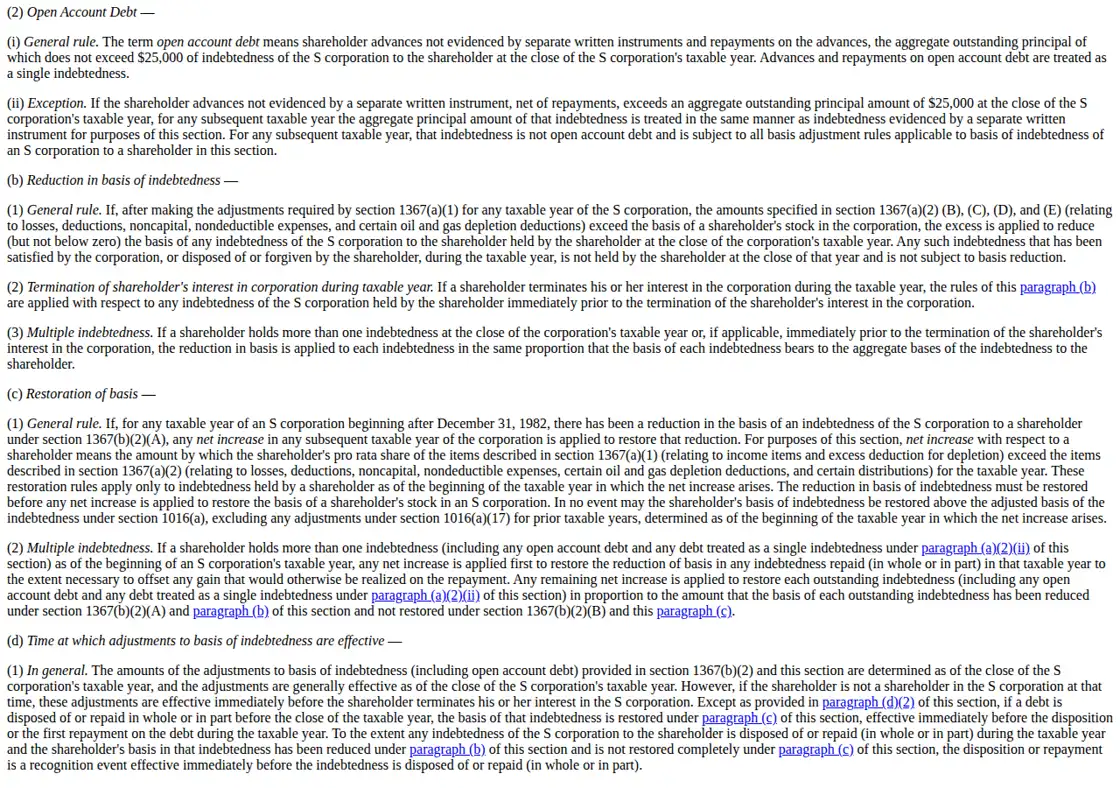
Open account debt is the informal kind: advances not evidenced by separate written instruments, netted at year-end, treated as a single indebtedness while aggregate outstanding principal does not exceed $25,000 at year-end. Cross $25,000 and the balance is treated as a formal note for subsequent years. On repayment the distinction matters: a formal note produces capital gain on Form 8949 and Schedule D, open account debt ordinary gain on Form 4797, and gain on repayment does not increase basis. With several loans, reduction spreads by each loan basis and restoration by each loan unrestored reduction — except that a repaid loan is restored first, as A4 shows.
At-risk: the second gate after basis
Clearing Form 7203 does not finish the loss. The instructions state the limitation order: basis (Form 7203), then at-risk (Form 6198), then passive activity (Form 8582), then excess business loss (Form 461). Section 465(a)(1) allows a loss only to the extent of the amount at risk at year-end, and section 465(a)(2) carries a disallowed loss to the first succeeding year. The amount at risk under section 465(b) includes money and property contributed and personally-liable borrowings — but section 465(b)(4) excludes amounts protected against loss through nonrecourse financing, guarantees, or stop-loss agreements.
— Example A7: the two gates, with a labelled assumption. A shareholder has a $40,000 K-1 loss, $30,000 of stock basis after the section 1367 adjustments, and an assumed at-risk amount of $18,000 (the figure on Form 6198). The basis gate allows $30,000 and suspends $10,000 under section 1366(d)(2). The at-risk gate then allows $18,000 of the $30,000 and suspends $12,000 under section 465(a)(2). Deductible: $18,000; suspended across the two gates: $22,000. The $18,000 at-risk figure is an illustrative assumption, not a sourced number.
Distributions and section 1368: AAA, E&P, and the dividend trap
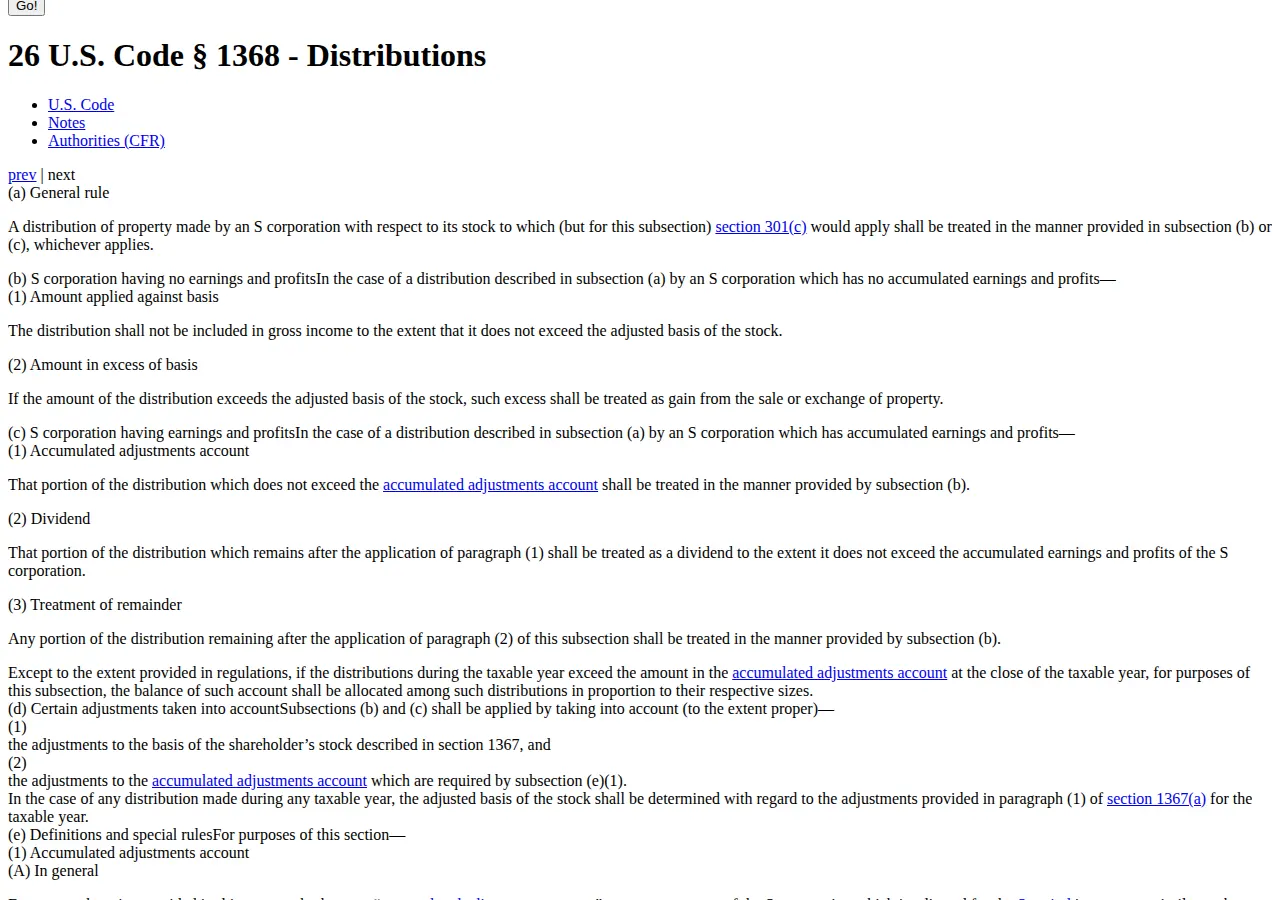
Section 1368 sorts every distribution, and the order is fixed. With no accumulated earnings and profits, section 1368(b) applies: the distribution is tax-free to the extent of stock basis, and the excess is gain from the sale or exchange of property. With accumulated E&P — typically a former C-Corp — section 1368(c) applies in sequence: first the portion up to the accumulated adjustments account (AAA) is treated as under (b); then the remainder is a dividend to the extent of accumulated E&P; then whatever is left is treated as under (b) again.
The AAA is the corporation-level twin of stock basis, adjusted for the S period like section 1367, except that no adjustment is made for tax-exempt income and the "but not below zero" floor is disregarded; section 1368(e)(1)(C) adds that the year-end AAA ignores any net negative adjustment for the year, so a loss year does not shrink it.
The filing sequence: K-1 to 7203 to the 1040
- The corporation files Form 1120-S and issues Schedule K-1 (Form 1120-S).
- Carry the K-1 figures onto Form 7203: income onto Part I, line 3; distributions from box 16, code D onto line 6; nondeductible expenses from box 16, code C onto line 8a.
- Enter prior-year suspended losses into Part III, column (b).
- Carry the allowable amounts from Part III to the individual return.
Basis adjustments are determined at the close of the corporation taxable year — or immediately before disposition, if stock is disposed of during the year — and the per-share, per-day allocation means a mid-year purchase buys only the days it owns.
Execution checklist
- [x] Carry the prior-year ending stock and debt basis to this year line 1 and line 21.
- [x] Put every K-1 figure on the right line: income to line 3, box 16 code D to line 6, box 16 code C to line 8a, prior-year suspended losses to Part III (b).
- [x] Run the Reg. § 1.1367-1(f) order exactly — income, distributions, nondeductible, losses — and decide the (g) election before filing.
- [x] Test the loss against stock basis, then debt basis, then at-risk on Form 6198; record the suspended remainder in Part III column (e).
- [x] Before any loan repayment, check whether this year net increase restores a prior-year debt-basis reduction first.
- [x] Before any distribution, measure it against stock basis and the AAA, and check for accumulated E&P.
Who this playbook is not for
A shareholder whose S corporation earns a profit every year, distributes less than basis, and carries no shareholder loans will file Form 7203 rarely. An LLC taxed as a partnership needs the partnership basis rules under sections 704 and 752, not this form.
Related reading: IRS Form 2553 S-Corp Election Deadline Playbook, S-Corp Election Tax Savings Threshold, and Section 1361 S-Corp Eligibility Playbook.
Founder & CEO Insight — Enow A. Jovial