IRC Section 987 Foreign-Currency QBU Translation: Remittances, Recognition & Form 8858
A U.S. corporation runs a London branch that earns £120,000, keeps its books in pounds, and sends £40,000 home. Tax on that £120,000 is already paid, translated at the yearly average rate. The remittance triggers a second question: did the pound move between the day the branch earned the money and the day it sent it home? That question is section 987.
What section 987 actually says
Section 987 provides that, for a taxpayer with one or more qualified business units with a functional currency other than the dollar, taxable income is determined (1) by computing the taxable income or loss separately for each such unit in its functional currency, (2) by translating the income or loss so computed at the appropriate exchange rate, and (3) by making proper adjustments for transfers of property between qualified business units having different functional currencies — including treating post-1986 remittances as made pro rata out of post-1986 accumulated earnings, and treating the resulting gain or loss as ordinary, sourced by reference to the source of the income giving rise to those earnings. Added by the Tax Reform Act of 1986 (Pub. L. 99-514), amended in 1988.
Three consequences follow: income is measured in pounds before any dollar appears, the rate for income is not the rate for basis, and the gain or loss on a remittance is ordinary, sourced from the earnings it came out of. For the pricing side, see the section 482 transfer-pricing playbook.
Who counts as a section 987 QBU
Treas. Reg. § 1.987-1(b)(3)(i) defines the unit: a section 987 QBU is an eligible QBU that has a functional currency different from its owner. An eligible QBU is a qualified business unit not subject to the U.S. dollar approximate separate transactions method of § 1.985-3 — a separate unit of a trade or business with its own books and records. A corporation, partnership, trust, estate, or disregarded entity is not itself a QBU, but its activities can be.
A QBU with the same functional currency as its owner is not a section 987 QBU; a disregarded entity that only holds stock and services a loan is not a trade or business and is not a QBU. Attribution follows the books under § 1.987-2(b)(1), except non-portfolio stock (10% or more), partnership interests, and acquisition debt under § 1.987-2(b)(2).
From FEEP to the final regulations
The 2006 proposed regulations introduced the foreign exchange exposure pool (FEEP) method: a balance-sheet approach counting only assets and liabilities economically exposed to currency movement, with nonmonetary assets at historic rates. The 2023 proposal adopted modified FEEP, the owner functional currency net value (OFCNV) calculation; the December 10, 2024 final regulations (T.D. 10016) apply to years beginning after December 31, 2024, under § 1.987-15(a)(1). FEEP as a label does not appear in the current regulations; what survives is its logic — the ten-step computation in § 1.987-4.
The translation rate map
Three rates run the operation, defined in § 1.987-1(c).
| Rate | What it translates | Authority |
|---|---|---|
| Yearly average exchange rate | Income, gain, deduction, loss; COGS (simplified inventory method) | § 1.987-3(c)(1), (c)(2)(iv)(A) |
| Historic rate | Recovery of basis: depreciation, depletion, amortization, sale | § 1.987-3(c)(2)(i) |
| Spot rate | Marked items and transfers to or from the QBU (a convention approximating spot, up to 3 months, is allowed) | § 1.987-5(f)(2); § 1.987-3(b)(2) |
The yearly average rate is any reasonable method — daily, monthly, or quarterly averaging. The historic rate for an asset is the yearly average for the year acquired; for a liability, the year incurred.
Marked items versus historic items
Whether an asset or liability is marked or historic decides its rate at every step. Under § 1.987-1(d), a marked item is an asset or liability attributable to the QBU, denominated in or determined by reference to the QBU's functional currency, that would be a section 988 transaction if held directly by the owner; a prepaid expense or advance-payment liability of one year or less; a section 988 transaction of the QBU; an insurance reserve; or a separate account asset. A historic item is everything else. A current rate election under § 1.987-1(d)(2) treats all attributable items as marked, which can suspend section 987 loss.
The ten-step pool: net unrecognized section 987 gain or loss
Section 1.987-4 computes the pool: the net unrecognized section 987 gain or loss for a taxable year equals the accumulated unrecognized gain or loss for all prior years plus the current year's, determined in the owner's functional currency through ten steps: (1) change in owner functional currency net value; (2) add assets transferred to the owner; (3) subtract assets transferred to the QBU; (4) subtract liabilities transferred to the owner; (5) add liabilities transferred to the QBU; (6) subtract income, add loss; (7) add nondeductible expenses; (8) subtract tax-exempt income; (9) adjust non-balance-sheet items; (10) residual adjustment at the yearly average rate.
Worked math 1: the regulation's own example, recomputed
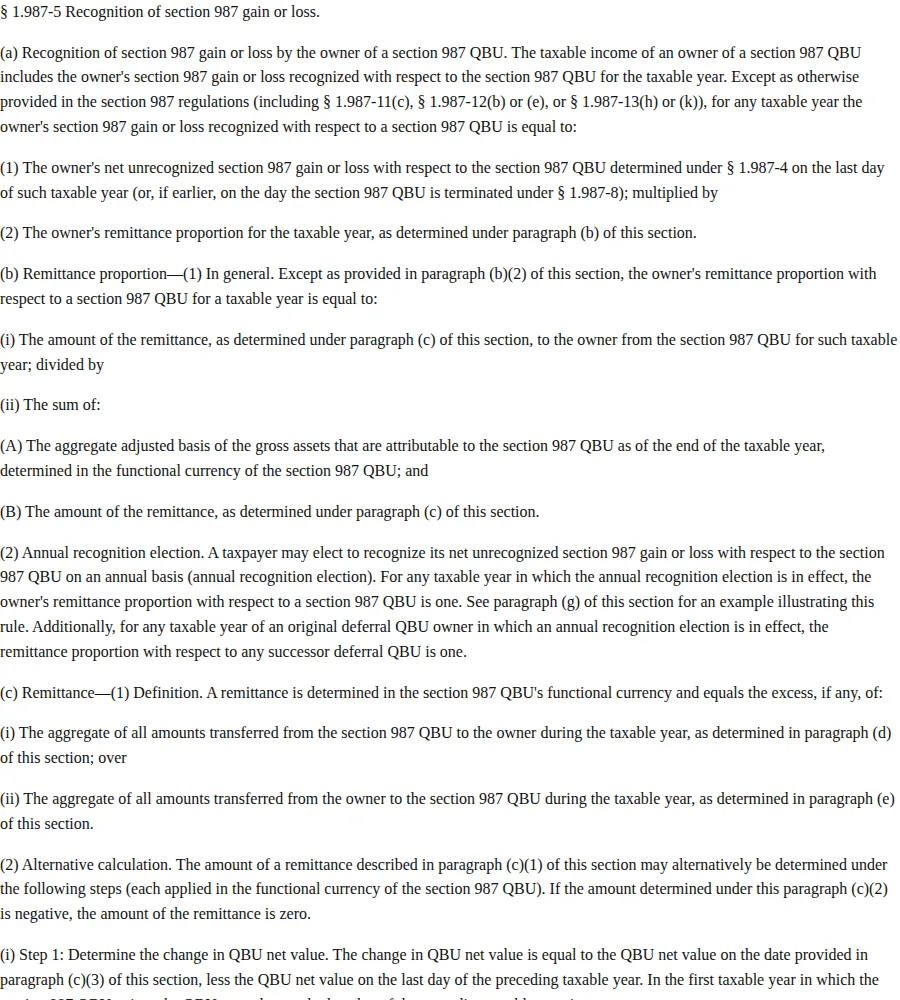
Treas. Reg. § 1.987-5(g) works the recognition formula. U.S. Corp, a domestic corporation with the dollar as its functional currency, operates Business A, a section 987 QBU with the pound as its functional currency. The net unrecognized section 987 gain for Business A at the end of year 2 is $80. U.S. Corp sent £300 and a £2,000-basis truck to Business A; Business A sent a £500-basis machine and £2,300 to U.S. Corp. At year end, Business A holds £2,850 cash, a £500 computer, and the £2,000 truck — gross assets £5,350.
The remittance is transfers out less transfers in:
The remittance proportion divides the remittance by gross assets plus the remittance:
Recognized gain is the proportion times the net unrecognized gain:
500 divided by 5,850 is 0.08547, rounded to 0.085, and 0.085 times 80 is exactly $6.80. A £500 remittance against a £5,850 base recognizes only 8.5% of the pool; with the annual recognition election, all $80 would be recognized.
Worked math 2: yearly average versus historic rate, in dollars
Take Business B, a QBU with the euro as its functional currency and U.S. Corp as owner. This year the euro's yearly average rate is €1 = $1.08 and the year-end spot rate is €1 = $1.14. Business B earns €120,000 of income and holds a machine bought when the yearly average rate was €1 = $1.02, with a €60,000 basis and a ten-year life — €6,000 of depreciation per year.
Income is translated at the yearly average rate under § 1.987-3(c)(1):
At the year-end spot rate it would be $136,800 — a $7,200 difference. That $7,200 is not income; it is currency movement, and it belongs in the section 987 pool. Depreciation uses the historic rate under § 1.987-3(c)(2)(i):
Over ten years the difference totals $3,600. The machine's cost was fixed in dollars the year it was bought, so translating its depreciation at the current rate would invent $360 of deduction a year. Check what a remittance does to the bottom line with the profit calculator before bringing cash home.
Character, source, and the post-1986 earnings rule
Section 987(3)(B) fixes character and source: gain or loss is ordinary, sourced by reference to the income giving rise to post-1986 accumulated earnings. Section 1.987-6 carries it out: a remittance is treated as made pro rata out of post-1986 accumulated earnings, so foreign-source earnings produce foreign-source gain.
Founder & CEO Insight — Enow A. Jovial
The decision table: which election fits which operator
| Situation | Election or method | Authority |
|---|---|---|
| Recognize the whole pool every year | Annual recognition election | § 1.987-5(b)(2) |
| Translate all assets and liabilities at spot | Current rate election | § 1.987-1(d)(2) |
| Mark section 988 transactions to market | Section 988 mark-to-market election | § 1.987-3(b)(4)(ii) |
| Combine same-currency QBUs | Section 987 QBU grouping election | § 1.987-1(b)(3)(ii) |
| No election | Default: yearly average income, historic basis, spot transfers | § 1.987-3(c) |
Elections are made for the owner and a taxable year, apply to every section 987 QBU the owner holds, and remain in effect until revoked (§ 1.987-1(g)). The current rate, annual recognition, and section 988 mark-to-market elections need no Commissioner consent if the statement is filed on or before the first day of the taxable year; once made, none may be revoked without consent for any taxable year beginning within 60 months, and every other section 987 election requires the Commissioner's consent.
Partnerships and S corporations: the boundary most operators miss
The final regulations generally do not apply to partnerships. Section 1.987-7(b) states it plainly: except as otherwise provided in that section, the section 987 regulations do not apply to a partnership, or to an eligible QBU if a partnership owns the QBU's assets and liabilities. Instead, a taxpayer must apply sections 987 and 989(a) in a reasonable manner, consistently year to year.
Only some provisions apply: character and source under § 1.987-6, the suspended-loss, deferral, and termination rules of §§ 1.987-11 through 1.987-13, and the applicability dates of § 1.987-15. A loss that would otherwise be recognized under section 987(3) is generally suspended under § 1.987-7(d), unless historic items do not give rise to section 987 gain or loss under the method used. S corporations are treated as partnerships under § 1.987-7(f). For the partnership capital-account rules, see the section 704(b) capital account playbook.
Form 8858 reporting: Schedule C-1
Form 8858 is the reporting vehicle. Under the Instructions for Form 8858 (12/2024), U.S. persons that own a foreign disregarded entity or operate a foreign branch file it to satisfy sections 6011, 6012, 6031, and 6038, with a separate form for each FDE or FB. Categories 1–6 cover direct owners and operators, indirect ownership through FDE tiers, Form 5471 or Form 8865 filers, partners applying section 987 at the partner level (page 1 and Schedule C-1), and U.S. corporation partners with the dual consolidated loss box on Schedules K-2 and K-3.
Schedule C-1 is the section 987 schedule: line 2b reports gain or loss recognized from a remittance or a termination, and line 3b reports amounts deferred under § 1.987-12. Failure to file carries a $10,000 penalty per annual accounting period, plus $10,000 per 30-day period after a 90-day notice, capped at $50,000. For the CFC reporting that often sits next to Form 8858, see the Form 5471 foreign corporation reporting playbook.
Termination: the proportion becomes one
A termination ends the deferral: under § 1.987-5(c)(4), a termination under § 1.987-8 is treated as a remittance of all the QBU's gross assets to the owner on the termination date, and the remittance proportion is one. The entire net unrecognized balance is recognized in the termination year, subject to §§ 1.987-11 through 1.987-13.
Who this is for, and who must avoid it
This playbook is for a U.S. individual or C-Corp that owns a foreign branch or foreign disregarded entity (an LLC) keeping books in foreign currency — the CPA translates the QBU books under GAAP (FASB ASC 830), files Form 8858 under the owner's EIN, and tracks FX per remittance. It is not for a partnership-owned branch, which needs the reasonable-method analysis of § 1.987-7, or for a taxpayer whose foreign operations are all in corporations, where section 987 never applies because a corporation is not a QBU. An S-Corp branch uses § 1.987-7 instead.
Run the operation
- Identify every QBU and its functional currency under § 1.985-1; decide the grouping election before the year starts.
- Classify every balance-sheet item as marked or historic under § 1.987-1(d) and (e).
- Compute section 987 taxable income in the QBU currency; run the ten steps of § 1.987-4.
- Track every transfer between owner and QBU; compute the remittance proportion at year end.
- Decide the elections deliberately: three lock for 60 months once made.
- File Form 8858 with Schedule C-1, one form per FDE or FB.
The year-end checklist
- [x] Every QBU identified, functional currency recorded
- [x] Marked and historic items classified
- [x] Taxable income at the yearly average rate
- [x] Ten-step computation done
- [x] Remittance proportion from actual transfers
- [x] Form 8858 and Schedule C-1 filed
The decision in advance
Section 987 rewards the operator who keeps two ledgers and confuses neither: profit in the branch currency, currency movement in the pool. Income at the yearly average rate, basis at the historic rate, transfers at spot — and only the proportion the remittance pulls out is recognized.