IRC §752 Partnership Debt & Outside Basis: Recourse, Nonrecourse & the Constructive-Liquidation Test
A partnership borrows money, but the tax effect lands on the partners one by one. Section 752 moves each dollar of partnership debt into a partner's outside basis, or pulls it back out — deciding how much loss the partner may deduct, how much of a distribution is tax-free, and the gain on a sale. Treasury Regulation section 1.752-2 runs the allocation through one hypothetical: liquidate the partnership, value every asset at zero, and ask who pays.
Who this playbook is for
This playbook is for a partner in a domestic partnership or a multi-member LLC taxed as a partnership — the structure a two-founder SaaS business or a real-estate holding LLC usually takes. An S-Corp shareholder gets no basis from corporate debt under section 752, and takes basis from stock and direct loans to the corporation instead. A C-Corp shareholder is further removed: corporate debt never reaches the shareholder's basis. If your entity is an LLC, check its tax election first: a single-member LLC is disregarded, and section 752 has nothing to allocate until a second member joins. Every allocation lands on a Schedule K-1, and every return carries the partnership EIN.
Founder & CEO Insight — Enow A. Jovial
The statute in one paragraph
Section 752(a) treats an increase in a partner's share of partnership liabilities as a contribution of money; section 752(b) treats a decrease as a distribution of money. Section 752(c) caps one measurement: a liability to which property is subject counts only to the extent of the property's fair market value. Section 752(d) covers the exit: on a sale of a partnership interest, liabilities are treated as in the sale of property outside partnerships, so debt relief is part of the amount realized. Under section 705, outside basis is the section 722 contribution basis, increased by the partner's share of income and decreased, but not below zero, by distributions and losses; section 752 plugs the debt share in as a deemed contribution or distribution.
Recourse vs nonrecourse: one question decides the share
A liability is recourse if a partner bears the economic risk of loss on it; it is nonrecourse if no partner does, because the lender's only remedy is the partnership property. The loan documents' label does not decide it — the regulation does.
| Debt type | Who bears the loss | How the share is found | Authority |
|---|---|---|---|
| Recourse | A partner or related person | Economic risk of loss, constructive-liquidation test | Reg. § 1.752-2(a)(1), (b) |
| Nonrecourse | The lender | Three tiers: minimum gain, § 704(c) gain, excess by profits | Reg. § 1.752-3(a) |
| Qualified nonrecourse financing | No partner; at-risk for real property | Share of financing secured by real property | IRC § 465(b)(6) |
| Debt on contributed property | Contributor, to the extent of FMV | Counts only to the property's fair market value | IRC § 752(c) |
| Debt relief on sale of an interest | The selling partner | Relief counts in the amount realized | IRC § 752(d) |
The third row is the one partners miss most often: qualified nonrecourse financing leaves the section 752 allocation unchanged, but changes the section 465 at-risk result for holding real property.
The constructive-liquidation test
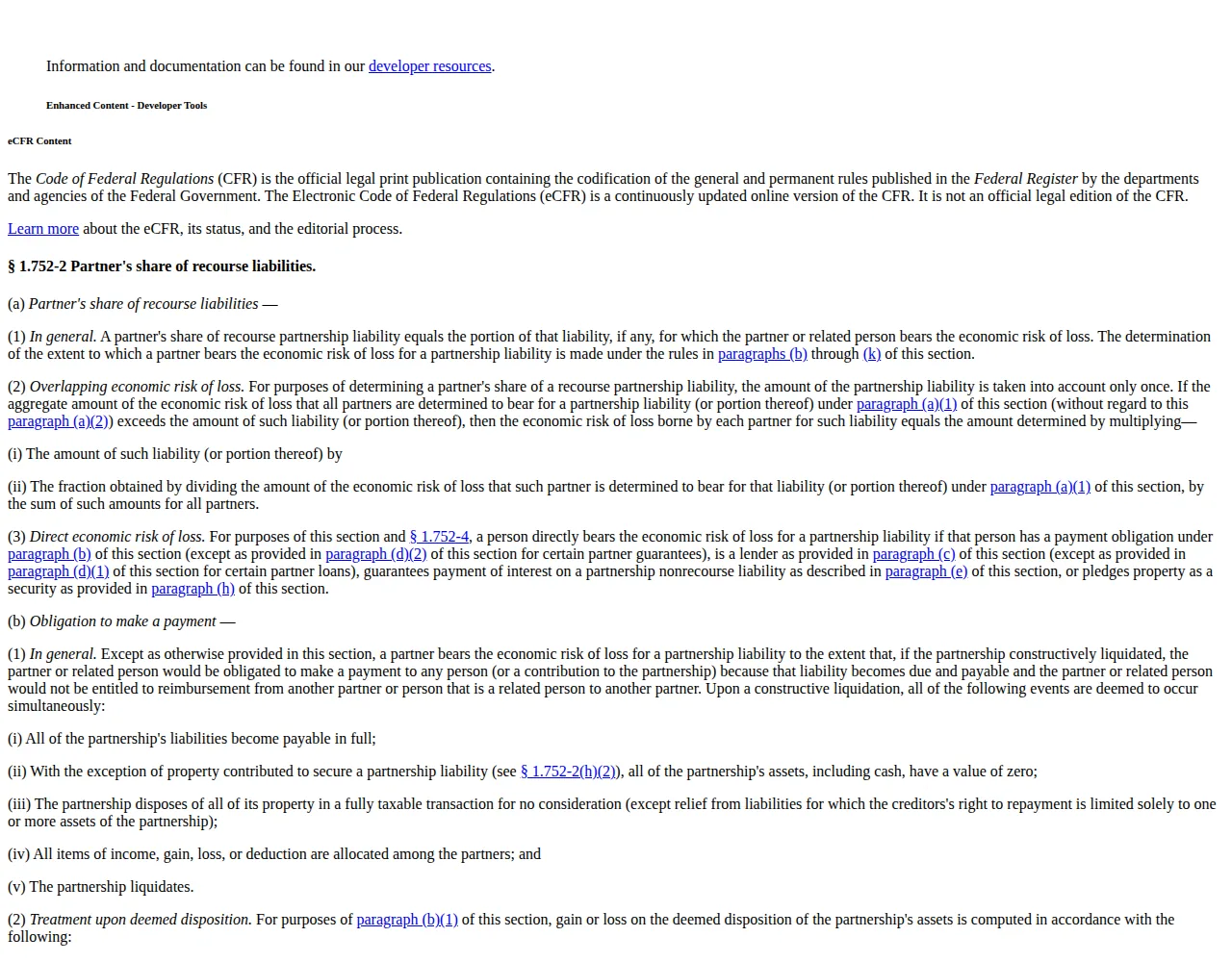
Regulation section 1.752-2(b)(1) answers the recourse question with a hypothetical liquidation: a partner bears the economic risk of loss to the extent that, if the partnership constructively liquidated, the partner or a related person would be obligated to pay because the liability becomes due and payable, with no right of reimbursement. Five events are deemed to occur at once: all liabilities become payable in full; all assets, including cash, are worth zero; the partnership disposes of all property for no consideration; all tax items are allocated; and the partnership liquidates.
A personal guarantee is a payment obligation: the lender calls the loan, the assets are worth nothing, and the guarantor pays. A deficit-restoration obligation is a payment obligation too: the liquidation drives the capital account negative, and the partner must restore it. A partner who signed nothing, promised nothing, and pledged nothing pays nothing, and that partner's recourse share is zero — whatever the profit percentages say. Where more than one partner bears risk on the same liability, the regulation counts the liability only once: if the aggregate risk exceeds the liability, each share is scaled down pro rata.
Worked example A: a guaranteed loan and the basis it creates
Take a two-member LLC taxed as a partnership. Ana manages the business and personally guarantees the bank loan; Ben is a passive member who guarantees nothing and pledged no outside property. The partnership borrows 600,000 dollars on a recourse term loan, fully guaranteed by Ana, and each member contributes 100,000 dollars in cash. Ana bears the economic risk of loss for the full 600,000 dollars; Ben bears none of it.
The same 600,000 dollar loan gives Ana 600,000 dollars of basis and Ben none, though the two contributed equal cash. Allocate an 80,000 dollar loss to each member in year one: section 704(d)(1) allows a loss only to the extent of the partner's adjusted basis at year end, so both losses pass — Ben's only just. Had Ben been allocated a 120,000 dollar loss, section 704(d)(1) would allow 100,000 dollars and section 704(d)(2) would carry the remaining 20,000 dollars forward. The loss rules in full are in the K-1 pass-through income playbook; the filing mechanics in the Form 1065 return playbook. A deficit-restoration obligation works the same way: if Ana had guaranteed nothing but agreed to restore a deficit up to 50,000 dollars, her recourse share would be 50,000 dollars.
Nonrecourse debt and the three tiers
Nonrecourse debt cannot be allocated by economic risk of loss, because no partner bears it. Regulation section 1.752-3(a) allocates it in three tiers: tier one, the partner's share of partnership minimum gain — broadly, the excess of nonrecourse debt over the adjusted basis of the property it secures; tier two, the gain that would be allocated under section 704(c) if the partnership sold the property for the debt alone; tier three, the partner's share of the excess nonrecourse liabilities, allocated as the partners share profits.
Worked example B: the three tiers on a building purchase
The same LLC buys a building for 1,000,000 dollars, paying 200,000 dollars in cash and taking an 800,000 dollar nonrecourse mortgage. Ana and Ben share profits 60 percent and 40 percent. At purchase the mortgage is less than the building's 1,000,000 dollar adjusted basis, so partnership minimum gain is zero, and no property was contributed with a built-in gain, so tier two is zero. The whole 800,000 dollars falls to tier three and follows the profit shares:
Years pass and depreciation brings the building's adjusted basis to 650,000 dollars while the mortgage still stands at 800,000 dollars. Partnership minimum gain is now 150,000 dollars: tier one allocates it — 90,000 dollars to Ana and 60,000 dollars to Ben — and tier three shrinks to 650,000 dollars. The totals do not move: Ana still holds 480,000 dollars and Ben 320,000 dollars. The tiers reallocate between themselves as minimum gain grows, but the total allocated never exceeds the debt.
Capital accounts: the ledger underneath the debt
None of this works without capital accounts maintained under section 704(b). Section 704(a) leaves the distributive share to the agreement, but section 704(b) takes it back when the allocation lacks substantial economic effect. Substantial economic effect requires capital accounts under Regulation section 1.704-1(b)(2)(iv), liquidation by positive capital accounts, and a deficit-restoration obligation or a qualified income offset. The capital account is a book ledger, not tax basis: it can go negative where outside basis cannot, since section 705(a) floors basis at zero. That difference is why the deficit-restoration obligation matters — a partner who must restore a negative 50,000 dollar capital account has 50,000 dollars of economic risk, while a partner with no such obligation walks away at zero.
At-risk: basis is not the same as risk
Passing the basis gate does not mean the loss is deductible. Section 465(a)(1) allows a loss only to the extent of the amount the taxpayer is at risk at year end, with disallowed losses carried to the next year under section 465(a)(2). Section 465(b)(2) counts borrowed amounts only to the extent the taxpayer is personally liable or has pledged property other than property used in the activity. Return to example A: Ana's amount at risk is her 100,000 dollar cash contribution plus the 600,000 dollar loan she guaranteed — 700,000 dollars, the same as her basis — while Ben's is his 100,000 dollar contribution only. In example B, the nonrecourse mortgage gives both partners basis but raises neither partner's amount at risk. The exception is qualified nonrecourse financing of real property under section 465(b)(6). The audit regime is covered in the BBA audit regime playbook.
Debt relief is a distribution
Section 752(b) surprises partners: when the partnership pays down a loan, refinances it into a smaller balance, or shifts a liability away from a partner, that partner's share of liabilities decreases — and the statute treats the decrease as a distribution of money, even though no cash arrives. The deemed distribution lowers outside basis under section 705, and if it exceeds basis, section 731(a)(1) taxes the excess as gain.
Worked example C: a paydown that produces gain
A partner holds an outside basis of 50,000 dollars. In one year the partnership distributes 70,000 dollars in cash to the partner and pays down debt so that the partner's share of liabilities falls by 30,000 dollars: the cash distribution is 70,000 dollars, the deemed distribution under section 752(b) is 30,000 dollars, and the total is 100,000 dollars. The partner's basis immediately before the distribution is 50,000 dollars, so the excess is gain:
The partner owes tax on 50,000 dollars of gain and ends the year with zero basis, without receiving 100,000 dollars in cash — only 70,000 dollars arrived, and 30,000 dollars of it is debt relief the statute counts as money. Had the liability share fallen by only 10,000 dollars instead, the gain would have been 30,000 dollars. The same arithmetic governs a sale of the interest: under section 752(d), the relief from the seller's share of liabilities counts in the amount realized. Run the exposure with the Break-Even Analysis Calculator — a CPA review costs less than a surprise gain.
Execution checklist
- [ ] List every partnership liability, with lender, balance, recourse or nonrecourse, and every guarantee and deficit-restoration obligation.
- [ ] Run the constructive-liquidation test on each recourse liability and record who bears the risk.
- [ ] Allocate nonrecourse debt through the three tiers and check the tiers sum to the debt.
- [ ] Recompute outside basis under section 705 with the debt share included, and confirm it never goes below zero.
- [ ] Test each allocated loss against section 704(d) basis, then section 465 at-risk.
- [ ] Track every debt paydown and refinancing as a potential section 752(b) deemed distribution.
- [ ] Reconcile the GAAP books to the section 704(b) capital accounts.
- [ ] Keep the guarantee, loan agreement, and partnership agreement with the return workpapers.
Run the section 752 operation
- Inventory the debt: pull the loan agreements and guarantees, and classify each liability on the regulation's test, not the loan's label.
- Run the constructive liquidation: apply the five deemed events of Regulation section 1.752-2(b)(1).
- Allocate the nonrecourse debt: work the three tiers of Regulation section 1.752-3(a) and confirm the tiers sum to the liability.
- Recompute outside basis: apply section 705 with the section 752(a) increases and 752(b) decreases, floored at zero.
- Clear the loss gates in order: section 704(d) basis first, then section 465 at-risk, carrying forward whatever each gate suspends.
- Flag the deemed distributions: treat every debt paydown and refinancing as a section 752(b) event and test it against section 731.
The decision in advance
Section 752 is an allocation statute, not a borrowing statute: it does not tell the partnership how much to borrow, it tells the partners who carries the tax weight of what was borrowed. Read the loan documents, run the constructive liquidation, allocate the nonrecourse debt through the three tiers, keep the capital accounts honest, and test every loss against basis and at-risk in that order. The debt share that looks like free basis in the borrowing year becomes a deemed distribution in the paydown year.