Section 754 Election: The Partnership Basis Adjustment Playbook
A partnership owns a building worth $600,000 that it bought for $400,000, plus $200,000 in cash. Partner A sells her half to C for $400,000. C now owns half a building with $200,000 of basis behind it, though she just paid $400,000 — and when the partnership sells the building, C is handed $100,000 of gain that accrued before she ever joined. The Section 754 election fixes that with a one-page statement attached to a tax return.
Founder & CEO Insight — Enow A. Jovial
The decision in one table
| Your position | The move | Result | Authority |
|---|---|---|---|
| Buying above your share of inside basis | Elect; § 743(b) steps the buyer up | No tax on pre-arrival gain | §§ 754, 743(b) |
| Inheriting at a stepped-up value | Elect; § 743(b) steps the estate up | No tax on pre-death gain | §§ 743(b), 1014 |
| Distributing property above distributee basis | Elect; § 734(b) lifts retained basis | Kept property carries the lost basis | § 734(b)(1) |
| Distributing cash above outside basis | Elect; § 734(b) lifts retained basis | Taxed gain raises kept basis | §§ 731(a)(1), 734(b)(1)(A) |
| Built-in loss or basis reduction over $250,000 | No election needed; forced | Adjustment applies anyway | §§ 743(d), 734(d) |
| Election made, later regretted | Apply to revoke on Form 15254 | Needs approval | Treas. Reg. § 1.754-1(c) |
Inside basis and outside basis
A partnership keeps two sets of books on the same assets. Inside basis is the partnership's basis in its property — what it paid, less depreciation. Outside basis is a partner's basis in her interest — what she contributed, plus her share of income, less distributions and losses. The two drift apart the moment anything changes value: a partner contributes $100,000, the partnership buys land, the land doubles, and her outside basis stays $100,000 while her half of the inside basis stays $50,000. Publication 541 states the default: "a partnership's basis in its assets is not affected by a transfer of an interest in the partnership, whether by sale or exchange or because of the death of a partner," unless the partnership elects the optional adjustment. That gap is the whole subject. The election closes it for the incoming partner only — the adjustment under section 743(b) "shall constitute an adjustment to the basis of partnership property with respect to the transferee partner only" — and it follows her alone until the property is sold or she leaves.
The Section 743(b) adjustment on a sale
Section 743(b) states the formula in two halves: increase the basis of partnership property by the excess of the transferee's outside basis over her proportionate share of inside basis, and decrease it by the excess the other way. Her share follows her interest in partnership capital, with section 704(c) for contributed property. Worked example: the partnership from the opening — building basis $400,000, value $600,000; cash $200,000; inside basis $600,000, total value $800,000; A sells her half to C for $400,000.
Section 755 allocates that $100,000 to the building, where value sits above basis. C's share of building basis moves from $200,000 to $300,000 — exactly half the building's $600,000 value. When the partnership later sells the building for $600,000, C's $100,000 share of the gain is wiped out by her adjustment, so she reports zero; A already paid tax on her half. The gain is taxed once, to the person who earned it.
Buy below the inside share and the adjustment turns negative: a $250,000 price against a $300,000 share gives a negative $50,000 adjustment. Death works the same way, with the step-up doing the work. Four equal partners own land (basis $400,000, value $1,000,000). Partner D dies. The estate's outside basis is its value at death, $250,000 — one quarter of $1,000,000 — against a $100,000 share of inside basis.
The $150,000 attaches to the land for the estate alone. On a later sale for $1,000,000, the estate's $150,000 share of the $600,000 gain is cancelled by the adjustment; without the election, the estate would pay tax on $150,000 of inherited gain.
The Section 734(b) adjustment on a distribution
Distributions create the mirror-image problem: the distributee can take property at a lower basis than the partnership carried, and the difference evaporates unless the election catches it. Section 734(b) raises the basis of the property kept by the gain recognized under section 731(a)(1) and by the excess of the partnership's basis in distributed property over the distributee's basis, and lowers it by the loss recognized under section 731(a)(2) and by the excess of the distributee's basis over the partnership's basis.
Worked example: the partnership holds cash $40,000, equipment (basis $80,000, value $120,000) and a building (basis $200,000, value $300,000). Partner F, outside basis $100,000, receives $40,000 cash plus the equipment in a non-liquidating distribution. Under section 732(a)(2), her basis in the equipment is the lower of the partnership's $80,000 basis and her remaining outside basis after the cash, $60,000. The $20,000 difference is not lost — section 734(b)(1)(B) adds it to the building kept.
The other two limbs: partner G, outside basis $50,000, receives $80,000 cash in liquidation and recognizes a $30,000 gain under section 731(a)(1), so section 734(b)(1)(A) raises the kept basis by $30,000; partner H, outside basis $50,000, receives $30,000 cash and recognizes a $20,000 loss, so section 734(b)(2)(A) lowers it by $20,000.
How Section 755 allocates the adjustment
Section 755 decides which property receives the adjustment: allocate "in a manner which has the effect of reducing the difference between the fair market value and the adjusted basis of partnership properties." The adjustment goes where the value-basis gap is widest. Section 755(b) adds the like-character rule: adjustments from capital and section 1231(b) property go to property of the same character, and the rest go to other property. No property's basis can be reduced below zero, and an unabsorbed decrease applies to later-acquired property of the same character.
Section 755(c), added in 2004, bars any decrease under section 734(b) from being allocated to stock in a corporate partner, or to a related person; the amount goes to other property instead, and if it exceeds the basis of all other property, the partnership recognizes gain to the extent of the excess.
The $250,000 tripwires: when the adjustment is forced
Congress added mandatory adjustments in 2004 because partnerships elected out of decreases while keeping increases. Two tests force the adjustment even with no election, and both turn on $250,000.
| Test | Trigger | Statute |
|---|---|---|
| Substantial built-in loss | Basis exceeds FMV by more than $250,000, or transferee loss over $250,000 at FMV | § 743(d)(1) |
| Substantial basis reduction | Section 734(b)(2) amounts exceed $250,000 | § 734(d)(1) |
Worked test, section 743(d)(1)(A): property with a basis of $900,000 and a value of $600,000 carries an excess of $300,000 — more than $250,000 — so a substantial built-in loss exists and the adjustment is mandatory with no election. At $700,000 of basis and $500,000 of value, the excess is $200,000. Prong B catches the case prong A misses: the partnership may sit inside $250,000 overall while one transferee's share still exceeds it.
Worked test, section 734(d): a distribution produces a $100,000 loss under section 731(a)(2) plus a $180,000 excess of distributee basis over partnership basis — $280,000 in total, more than $250,000, so the reduction is mandatory. At $100,000 plus $120,000, the sum is $220,000. Question 10d asks whether the partnership had to make such a reduction, entered as a positive number.
Two carve-outs sit beside them. An electing investment partnership under section 743(e) is never treated as having a substantial built-in loss while its election is in effect; instead the transferee's later losses are deferred to the extent of the transferor's recognized loss. A securitization partnership under section 743(f) is never treated as having either. Both are narrow — an investment partnership must meet nine conditions, including 95 percent money contributions.
Making the election
The election is a statement, not a form, filed with the timely filed return, including extensions, for the tax year of the distribution or transfer, under Regulation § 1.754-1(b)(1). The 2025 Instructions for Form 1065 require the partnership's name and address and a declaration electing under section 754 to apply sections 734(b) and 743(b). Once made, it applies to all distributions and transfers in that year and every later year.
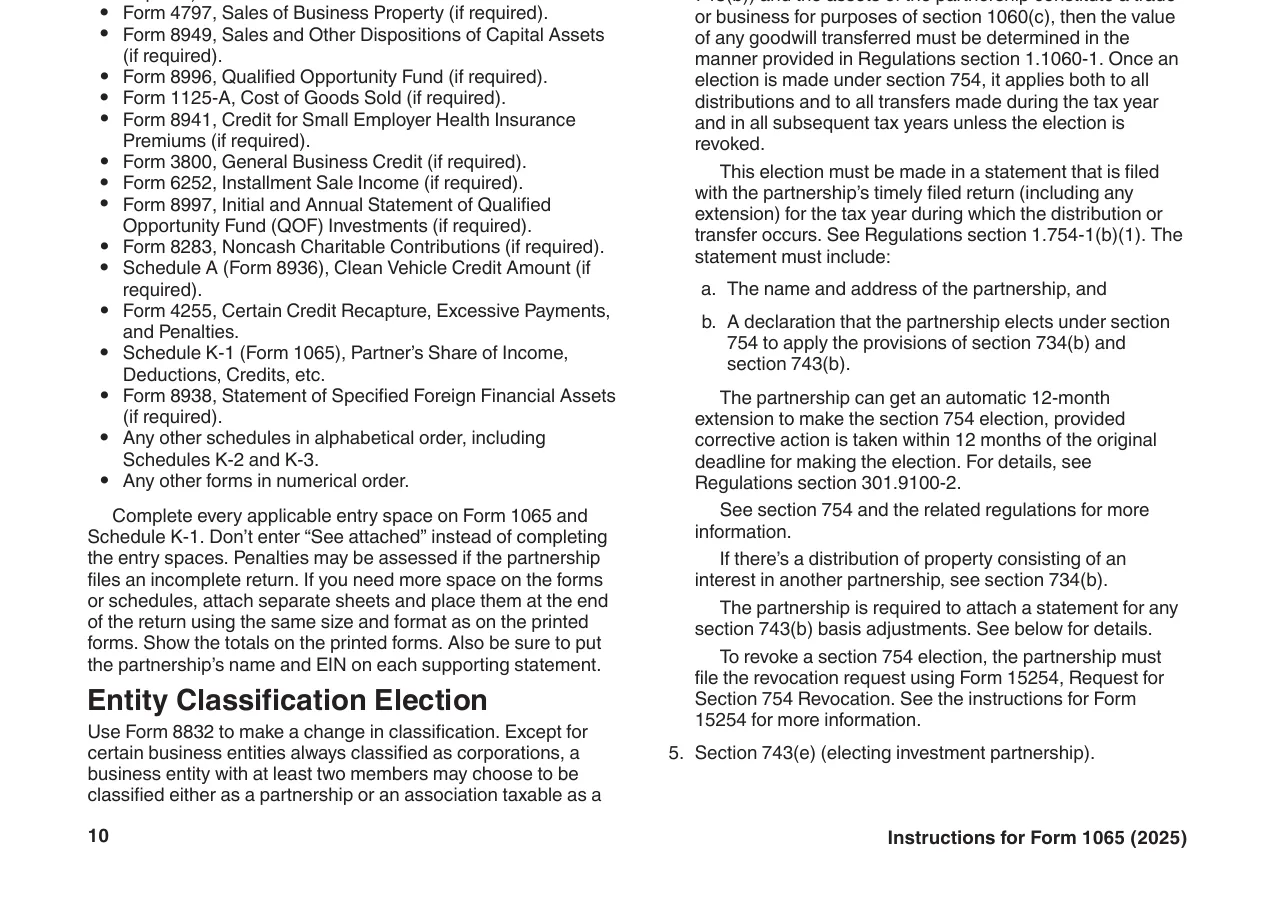
Timing is the whole game. The election must be in place for the year of the first transfer or distribution it covers — a 2026 sale needs the election on the 2026 return, filed by March 15, 2027 for a calendar-year partnership, or September 15, 2027 on extension. File it a year late and the buyer's adjustment for the 2026 sale is gone. One rescue exists: an automatic 12-month extension under Regulation § 301.9100-2, provided corrective action is taken within 12 months of the original deadline — a return due March 15, 2027 can still be corrected by March 15, 2028.
The return also reports the adjustments. Schedule K-1, question 10a, asks whether the partnership is making or has made a section 754 election. Question 10b covers section 743(b) adjustments, with a statement naming the transferee, giving her EIN or SSN, and showing the computation and the properties. Question 10c covers section 734(b) adjustments with the computation, the class of property, and the properties. Question 10d reports the mandatory adjustments.
Revocation works in reverse. An election that made sense for appreciated property can turn against the partnership when values fall: every later transfer then forces a downward adjustment. Section 754 allows revocation "subject to such limitations as may be provided by regulations," and Regulation § 1.754-1(c) sets them: apply to the district director where the return is filed, state the grounds, and file no later than 30 days after the close of the tax year revocation is to take effect, signed by any one partner. The 2025 Instructions for Form 1065 route the request through Form 15254. Revocation is not automatic — sufficient grounds include a change in the partnership business and a substantial increase in administrative burden. Worked timing: revocation effective for 2028 must be filed by January 30, 2029, or the election stays in effect. And revoking does not switch off sections 743(d) and 734(d): a partnership with a built-in loss over $250,000 still makes the downward adjustment.
The risk layer
First, the missed first transfer: the election reaches only the year it is filed and later years, so the classic failure is a sale in year one, an election in year two. Second, the forgotten statement: a return filed without it is a return filed without an election — the 12-month extension is the only cheap fix. Third, the unmodeled decrease: an election made for an appreciated building also forces a decrease when a partner later buys in below inside basis, cutting the remaining partners' depreciation. Fourth, the section 751 blind spot: the adjustment does not change the ordinary-income slice of a sale — unrealized receivables and inventory are ordinary income under section 751 either way.
The execution checklist
- Measure the gap — incoming price against share of inside basis.
- Elect on the first return — attach the statement with the name and address and the declaration applying sections 734(b) and 743(b).
- Compute the adjustment per transferee — outside basis less share of inside basis; keep it transferee-only.
- Allocate under section 755 — where value sits furthest above basis, by like character.
- Test the $250,000 tripwires — sections 743(d) and 734(d).
- Report on the return — Schedule K-1 questions 10a through 10d, plus attached statements.
- Calendar the revocation window — Form 15254 within 30 days after year-end, signed by any one partner.
- Revisit after every distribution — a section 734(b) adjustment changes the kept basis for the next sale.
C paid $400,000 for half of $800,000 in value and, with the election, pays tax on none of the pre-arrival gain. The books still show the building at $400,000; C's layer shows $300,000 for her half. One statement, filed on time, is the difference. Run the Form 1065 partnership return playbook for the return the election rides on, the Section 469 passive activity loss rules playbook for whether the partner can use the losses the adjusted basis shelters, and the Section 465 at-risk rules playbook for the other limit on deductions.