IRS Form 1065 Schedule K-1 Pass-Through Income Playbook: Basis, At-Risk, and Passive Limits
A partnership files Form 1065 and pays no income tax itself. The tax lands on the partners, one Schedule K-1 at a time. The partner instructions state it plainly: you may owe tax on your share of partnership income, whether or not distributed.
That sentence is why this playbook exists: read the K-1 as a cash receipt and you will underpay, over-deduct, or both; read it as separately stated items, each with its own character and limitation, and you can plan around it.
Who this playbook is for, and who should not run it
This playbook is for a partner in a domestic partnership or a multi-member LLC taxed as a partnership.
It is not for everyone. A publicly traded partnership partner follows PTP guidance. A foreign partner faces section 1446 withholding and Schedule K-3 reporting this playbook only flags.
Founder & CEO Insight — Enow A. Jovial
Reading the K-1 box by box
Section 702(a) requires each partner to take into account separately eight categories of items, and section 702(b) preserves each item's character as if you had realized it directly from the source.
| Box | What it reports | Where it lands | Authority |
|---|---|---|---|
| Box 1 | Ordinary business income or loss | Schedule E, line 28 | IRC § 702(a)(8) |
| Box 2 | Net rental real estate income or loss | Schedule E | IRC § 702(a)(8) |
| Box 4a / 4b / 4c | Guaranteed payments | Ordinary income; Schedule SE | IRC § 707(c) |
| Box 5 | Interest income | Schedule B | IRC § 702(a)(7) |
| Box 6a | Ordinary dividends | Schedule B | IRC § 702(a)(5) |
| Box 14 | Self-employment earnings | Schedule SE | IRC § 1402(a) |
| Box 16 | Foreign transactions | Form 1116; Schedule K-3 | IRC § 702(a)(6) |
| Box 20, code Z | Section 199A information | Form 8995 / 8995-A | IRC § 199A |
Box 20, code Z carries the section 199A (QBI) information; the phaseout rules are in the section 199A QBI deduction SSTB phaseout playbook. Box 14 reports self-employment earnings, where guaranteed payments to a general partner meet SECA tax; see the IRS Form 1040 Schedule SE self-employment tax playbook.
Item K1 reports your share of partnership liabilities at year start and year end, the inputs to the outside-basis worksheet. Item L reports your capital account, bookkeeping under section 704(b), not tax basis.
Capital accounts and substantial economic effect
Section 704(a) leaves the distributive share to the partnership agreement. Section 704(b) takes it back when the allocation lacks substantial economic effect, and the share is then determined by the partner's interest in the partnership. The regulations grant substantial economic effect only when three conditions hold: capital accounts maintained under Regulation section 1.704-1(b)(2)(iv), liquidation by positive capital accounts, and deficit restoration on liquidation, or a qualified income offset.
An allocation that moves tax without moving capital accounts fails and is reallocated by the partner's interest in the partnership.
Worked basis math under sections 705 and 704(d)
Outside basis decides how much loss you may deduct and how much of a distribution is tax-free: contributions, plus your share of liabilities under section 752(a), plus income allocated, minus distributions and losses.
Example A, from stated inputs. A partner contributes 50,000 dollars in cash. The partnership borrows 200,000 dollars on a recourse loan; the partner's 50,000 dollar share is a deemed contribution under section 752(a). The partnership earns 80,000 dollars of ordinary income; the partner's 25 percent share is 20,000 dollars. The partner receives a 10,000 dollar cash distribution. Ending outside basis is 50,000 plus 50,000 plus 20,000 minus 10,000, or 110,000 dollars, more than double the cash contributed.
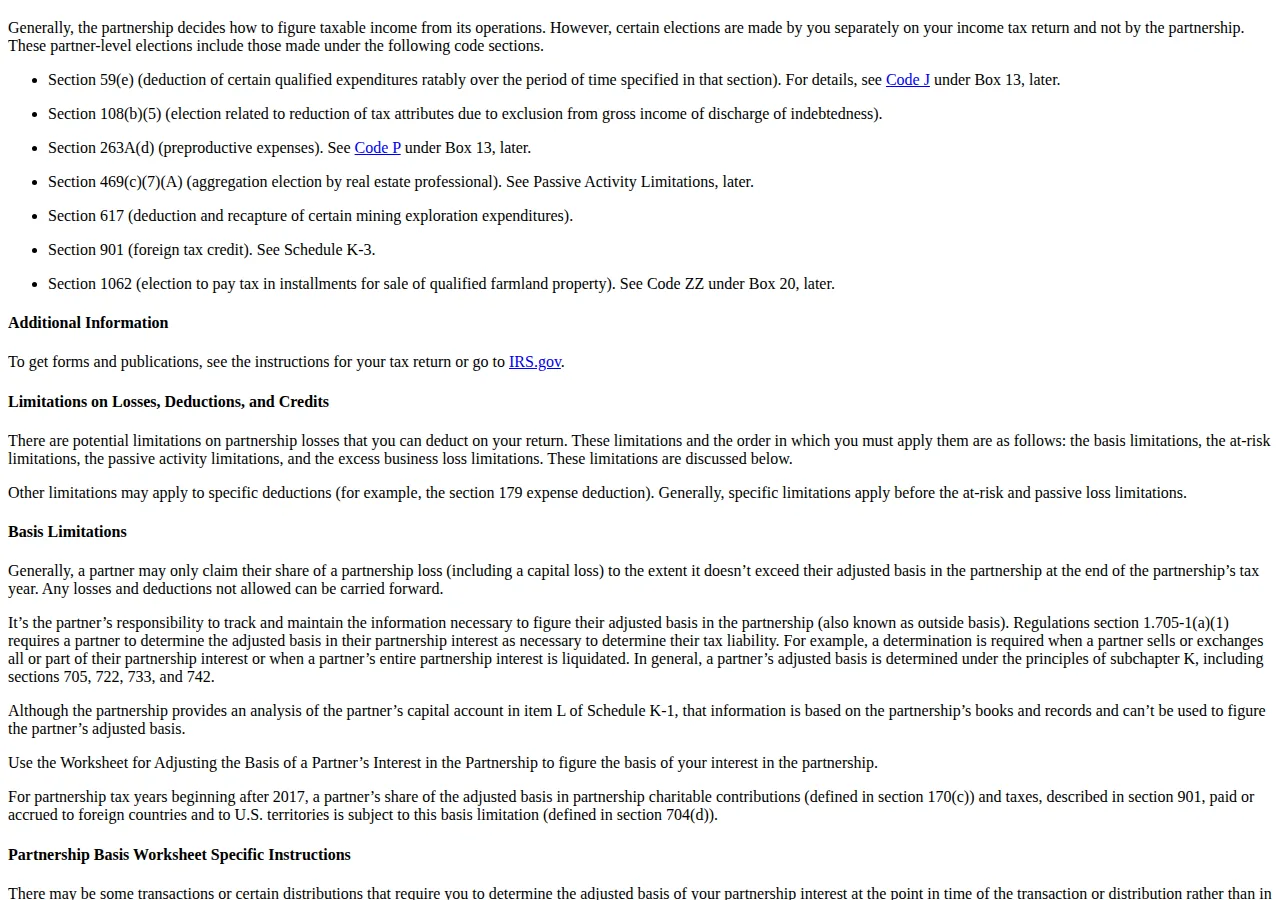
Example B, the section 704(d) suspension. The same partner, basis 110,000 dollars, is allocated a 140,000 dollar loss the following year. Section 704(d)(1) allows the loss only to the extent of adjusted basis at year end, so 110,000 dollars is deductible and the remaining 30,000 dollars is suspended under section 704(d)(2) until basis is restored. The suspended loss is parked, not lost.
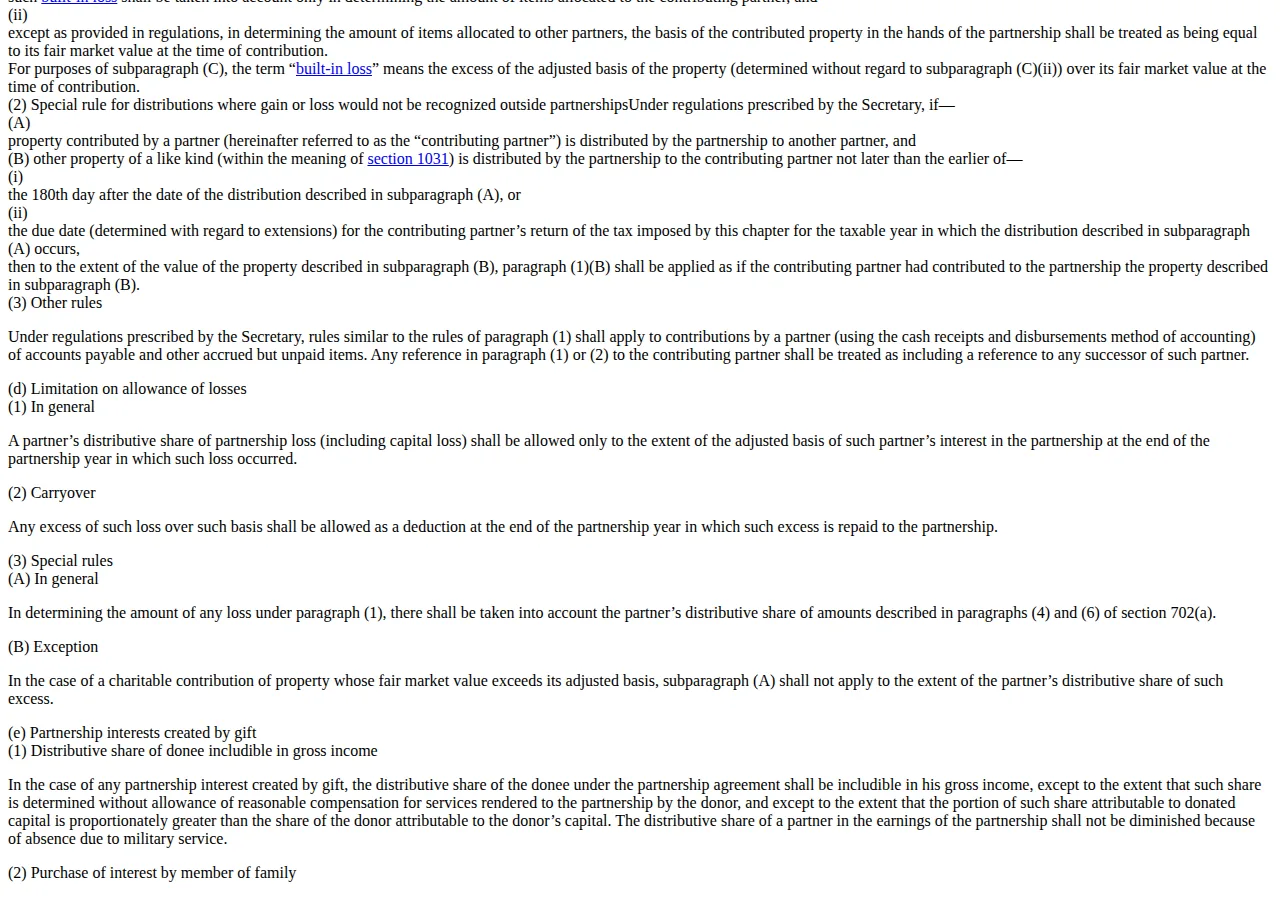
A distribution is tax-free only to the extent of basis: under section 731, money above outside basis is gain from the sale of the interest, so the 10,000 dollar distribution in example A is tax-free while a 120,000 dollar distribution would produce 10,000 dollars of gain.
The four-gate loss gauntlet
Each gate applies to what survives the previous one.
| Gate | Statute | What it measures | What frees it |
|---|---|---|---|
| 1. Basis | IRC § 704(d) | Adjusted basis at year end | New contributions, debt share, income |
| 2. At-risk | IRC § 465(a) | Amount at risk | Cash at risk, personal liability |
| 3. Passive | IRC § 469(a) | Material participation | Passive income; disposition |
| 4. Excess business loss | IRC § 461(l) | Business losses above the threshold | Later-year NOL carryforward |
Gate 2 surprises partners who did the basis math right. Section 465(a)(1) allows a loss only to the extent of the aggregate amount with respect to which the taxpayer is at risk at the close of the taxable year. A share of liabilities raises outside basis under section 752, but it does not raise the amount at risk unless the partner bears the economic risk of loss on that debt; nonrecourse debt generally does not count, with a narrow exception for qualified nonrecourse financing of real estate.
Example C, from stated inputs. A partner contributes 20,000 dollars in cash and takes a 90,000 dollar share of a nonrecourse loan that is not qualified nonrecourse financing: outside basis 110,000 dollars, amount at risk 20,000 dollars. The partner is allocated a 60,000 dollar loss. Gate 1 passes, since 60,000 dollars is less than 110,000 dollars of basis. Gate 2 allows only 20,000 dollars; the remaining 40,000 dollars is suspended under section 465 and carried to the succeeding year under section 465(a)(2).
Gate 3, section 469, disallows passive activity losses for individuals, estates, trusts, closely held C corporations, and personal service corporations. A rental activity is passive by default, and a trade or business is passive unless the taxpayer materially participates; the temporary regulation at section 1.469-5T(a)(1) sets the common test at more than 500 hours in the year. The section 469(c)(7) real estate professional exception requires a majority of personal services in real property trades or businesses and 750 hours in them. Suspended passive losses carry forward under section 469(b), freed by passive income or a fully taxable disposition of the entire interest.
Guaranteed payments under section 707(c)
Section 707(c) covers payments to a partner for services or the use of capital, determined without regard to partnership income. The partnership treats the payment as made to a non-partner for gross income under section 61(a) and, subject to section 263, as a trade or business expense under section 162(a). Three consequences: ordinary income even in a loss year; not a distributive share; reported in Box 4a for services and Box 4b for capital, total in Box 4c.
Example D, from stated inputs. A partner receives a 60,000 dollar guaranteed payment for services and a 25 percent distributive share of 120,000 dollars of ordinary income, which is 30,000 dollars, for total K-1 income of 90,000 dollars. If the partnership had lost 120,000 dollars instead, the partner would still report the 60,000 dollars and take a 30,000 dollar distributive loss, subject to the four gates.
For a general partner, guaranteed payments for services are generally subject to self-employment tax, which is why Box 14 matters. For a limited partner, section 1402(a)(13) decides. FICA applies to employees, SECA to the self-employed partner, and getting the classification wrong costs tax or an audit adjustment.
Deadlines, extensions, and penalties
A domestic partnership must file Form 1065 by the 15th day of the 3rd month after its tax year ends: March 15 for a calendar-year partnership; March 16, 2026 for the 2025 year, because March 15 falls on a Sunday. File Form 7004 by the regular due date for a 6-month automatic extension, to September 15. The extension covers filing, not the K-1s. The return carries the partnership EIN; each K-1 the partner SSN or ITIN.
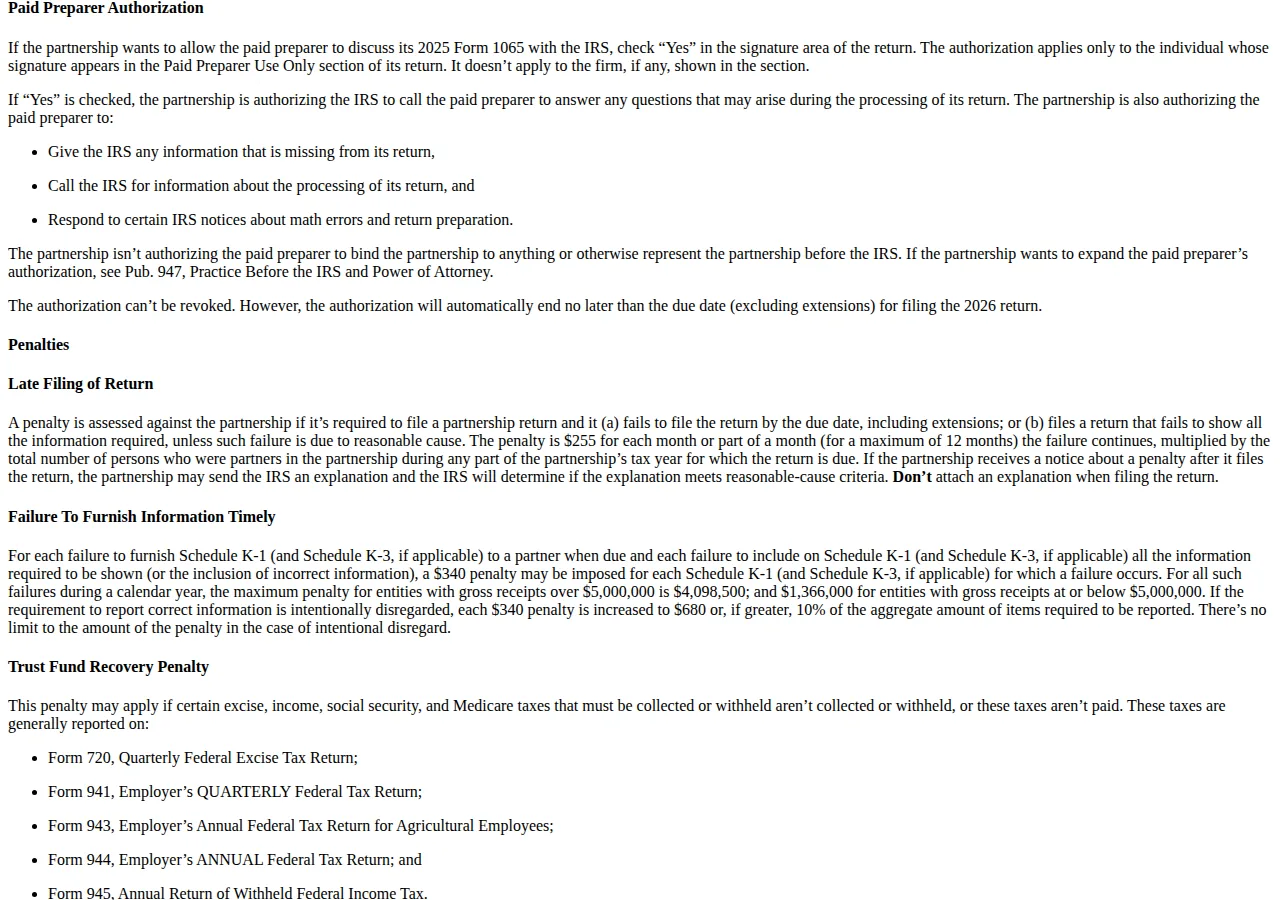
The penalty math is per partner, per month. Under section 6698, the late-filing penalty is 255 dollars per month or part of a month, for a maximum of 12 months, times the number of partners: four partners three months late owe 255 times 3 times 4, or 3,060 dollars, before reasonable-cause relief. Failure to furnish a correct K-1 on time carries a 340 dollar penalty per K-1, capped annually at 4,098,500 dollars for gross receipts over 5,000,000 dollars and 1,366,000 dollars at or below; four late K-1s cost 1,360 dollars. Intentional disregard raises each penalty to 680 dollars or, if greater, 10 percent of the aggregate items required to be reported, with no maximum. Run the exposure with the Break-Even Analysis Calculator before deciding a preparer fee is too expensive.
An amended return is filed on Form 1065-X, or the partnership files an administrative adjustment request under section 6227. A partner who reports an item differently from the partnership must file Form 8082 with the original or amended return, or the accuracy-related penalty applies on top of the tax. If the K-1 itself is wrong, ask the partnership for a corrected K-1; do not edit your copy.
The BBA audit regime
The Bipartisan Budget Act of 2015 replaced TEFRA with the centralized audit regime, effective for tax years beginning after 2017. Section 6221(a) states the default: adjustments to partnership-related items are determined, and tax assessed and collected, at the partnership level. The default consequence is an imputed underpayment paid by the partnership in the adjustment year, falling on the current partners.
Two exits exist. First, election out under section 6221(b): a partnership furnishing 100 or fewer K-1s may elect out if every partner is an individual, a C corporation, a foreign entity treated as a C corporation if domestic, an S corporation, or an estate of a deceased partner, the election is made with a timely filed return disclosing each partner's name and taxpayer identification number, and each partner is notified.
Second, the push-out election under section 6226: within 45 days of the notice of final partnership adjustment, the partnership may furnish each reviewed-year partner a statement of that partner's share, and each partner takes the correction into account on the partner's own return.
| Audit path | Who pays | When it is chosen | Authority |
|---|---|---|---|
| Default: imputed underpayment | The partnership, in the adjustment year | Automatic | IRC §§ 6221(a), 6225 |
| Push-out election | Reviewed-year partners, on their own returns | Within 45 days of the final adjustment notice | IRC § 6226(a) |
| Election out of the regime | Each partner, at the partner level | Timely return, 100 or fewer K-1s | IRC § 6221(b) |
Run the K-1
- Read the boxes: identify Box 1, Box 4, Box 14, and Box 20 code Z, and keep character separate under section 702(b).
- Compute outside basis: run the worksheet, include the liability share under section 752, never below zero.
- Clear the four gates in order: sections 704(d), 465, 469, and 461(l).
- Separate guaranteed payments and test distributions: Box 4 as ordinary income under section 707(c); every distribution against basis under section 731.
- Set the deadlines and the audit posture: Form 1065 due March 15, Form 7004 for the 6-month extension, K-1s on time; election out, representative, 45-day push-out.
- Flag inconsistency: disclose any item reported differently on Form 8082.
Failure modes: how good K-1s still go wrong
Most K-1 failures are bookkeeping errors with statutory consequences. Item L mistaken for basis: the partner deducts a loss the capital account seems to support. Nonrecourse debt counted as at-risk: the partner passes the basis gate and fails the at-risk gate, exactly as in example C. Late K-1s: the return is filed on time, the K-1s go out in May, and the 340 dollar per-K-1 penalty arrives separately.
The decision in advance
The K-1 operation is a sequence, not a single form: read the boxes, preserve character, maintain capital accounts, compute outside basis, clear the four gates, separate guaranteed payments, meet the March 15 deadline, and know your audit posture before the IRS does. Foreign partners go on Schedule K-3; the filing side for a foreign-owned U.S. LLC is in the Form 5472 filing guide for foreign-owned LLCs. Payroll is separate, covered in the IRS Form 941 quarterly payroll tax filing playbook.