A partnership can hand a partner cash, land, equipment or securities and, most of the time, nobody owes tax. Section 731 treats a distribution as a return of the partner's own investment, not a sale, until the money exceeds the partner's basis. Four tripwires guard it: section 731(c), section 737, section 704(c)(1)(B) and section 751(b).
The section 731(a) gate
Section 731(a)(1) states the partner-side rule in one sentence: gain is not recognized except to the extent that any money distributed exceeds the adjusted basis of the partner's interest immediately before the distribution. Section 731(a)(2) allows a loss only on a liquidating distribution of nothing but money, unrealized receivables and inventory. Gain or loss under section 731(a) is treated as gain or loss from the sale of the partnership interest. Section 731(b) gives the partnership the same nonrecognition.
Treasury Regulation section 1.731-1(a)(1)(i) gives the textbook illustration: a partner with a $10,000 basis who receives $8,000 cash and property worth $3,000 recognizes no gain, but $11,000 cash would produce $1,000 of gain. A cash distribution wired by ACH is still money for this test.
Worked example one. Partner Dana has an outside basis of $120,000 and receives $150,000 cash — a $30,000 capital gain, and her outside basis falls to zero.
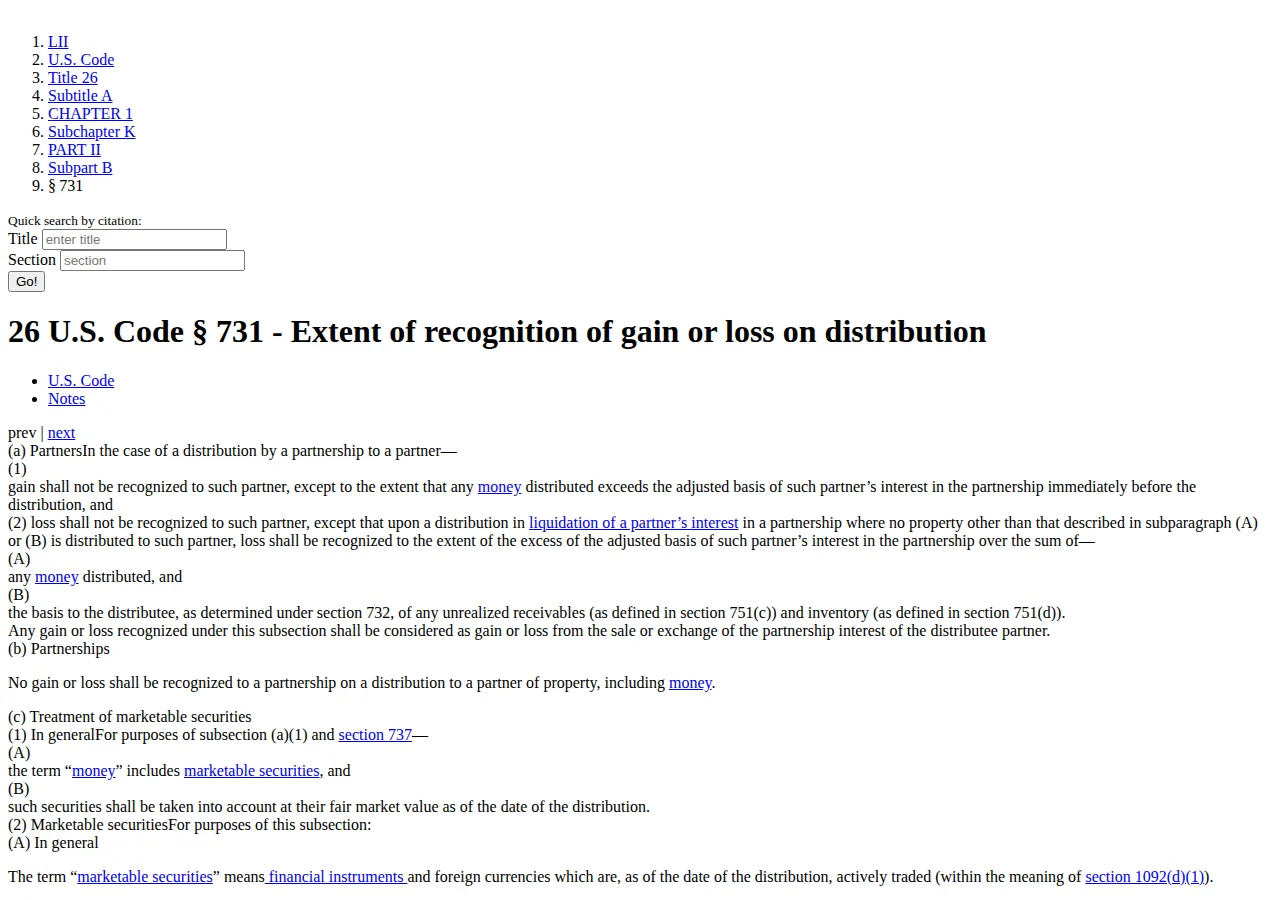
Source: 26 U.S.C. § 731, Cornell LII, 2026-11-14.
Section 731(c): marketable securities
The most common way founders trip the section 731(a) gate is by distributing something taxed like cash. Section 731(c)(1) provides that, for purposes of section 731(a)(1) and section 737, the term money includes marketable securities, taken into account at fair market value on the date of the distribution. Marketable securities means actively traded financial instruments and foreign currencies, plus interests in common trust funds and regulated investment companies and instruments readily convertible into money.
Worked example two. Partner Eli has an outside basis of $40,000 and receives listed shares worth $55,000. The shares count as $55,000 of money, so Eli recognizes $15,000 of gain with no cash changing hands. Section 731(c)(3)(B) caps that gain by the partner's share of the net gain that would be recognized if all securities of the same class and issuer held by the partnership were sold immediately before the distribution, minus the partner's share of the gain in the securities still held after.
Section 733: the basis ledger
Section 733 is the ledger rule: on a distribution other than in liquidation, the adjusted basis of the partner's interest is reduced, but not below zero, by the money distributed and by the basis to the partner of distributed property other than money, as determined under section 732. A partner with a $120,000 outside basis who receives $90,000 cash and $20,000 of property basis ends the day with a $10,000 outside basis. Distributions never create basis; they only spend it. The partner's Schedule K-1 (Form 1065) reports the income and loss that move outside basis under section 705.
Section 732: basis of distributed property
Section 732 answers what basis the property carries into the partner's hands. On a current distribution, section 732(a)(1) gives the property the partnership's own adjusted basis, capped by section 732(a)(2) at the partner's outside basis minus any money distributed in the same transaction. On a liquidating distribution, section 732(b) makes the property a plug: its basis equals the adjusted basis of the partner's interest reduced by any money distributed.
Worked example three, current distribution. Partner Femi has an outside basis of $80,000 and receives $20,000 cash plus equipment with a partnership basis of $45,000 and a fair market value of $70,000. The cap is $60,000 and does not bind, so the equipment takes a $45,000 basis and Femi's outside basis falls to $15,000.
Worked example four, liquidating distribution. Partner Grace liquidates a one-quarter interest with an outside basis of $100,000, receiving $30,000 cash plus land (partnership basis $40,000, fair market value $90,000). The land takes a $70,000 basis — a $30,000 step-up paid for by her own outside basis. The loss variant: $60,000 cash and inventory with a $10,000 basis to her, and nothing else, would produce a $30,000 loss.
Section 732(c) allocates basis when several properties are distributed: first to receivables and inventory at the partnership's basis, then to other property by appreciation and fair market value.
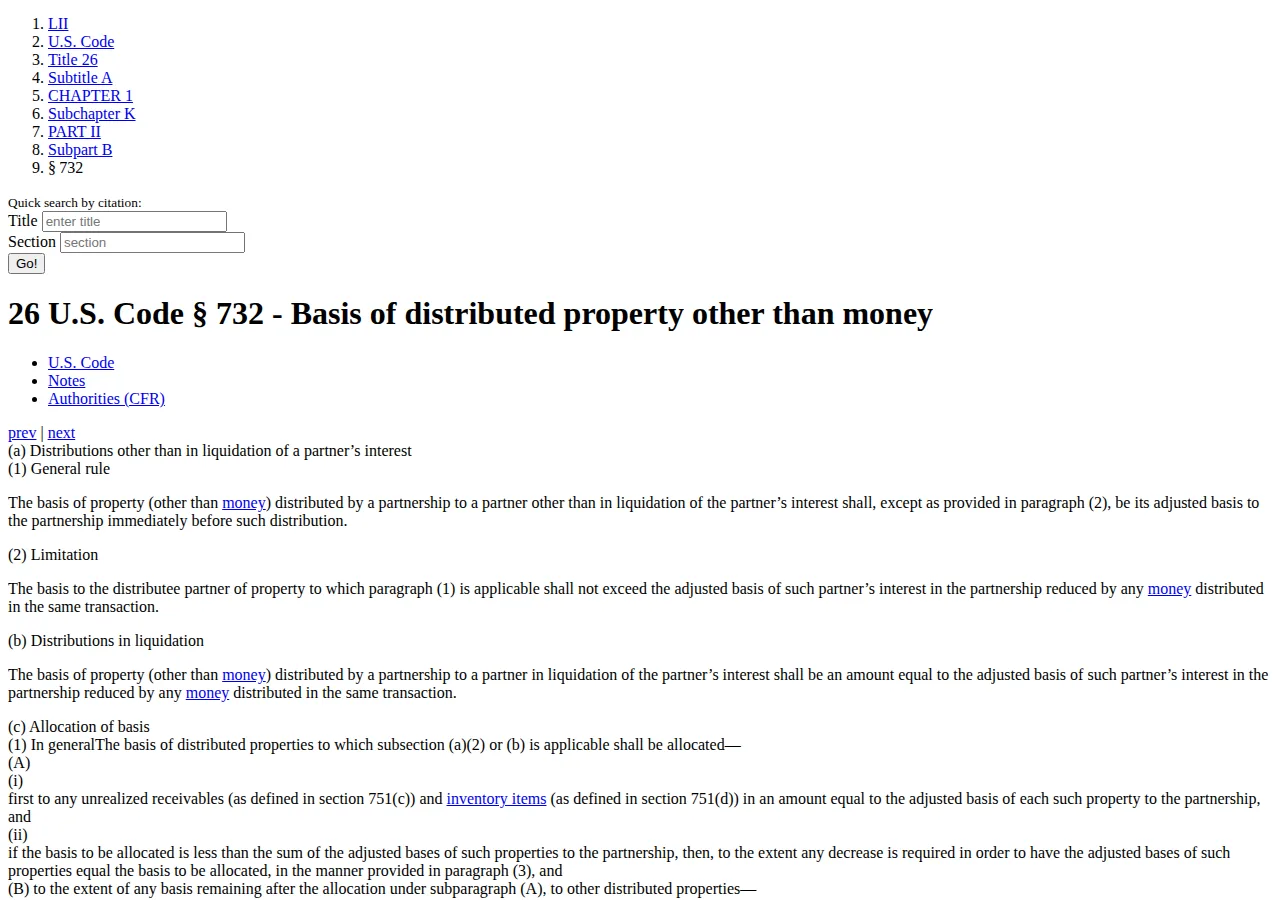
Source: 26 U.S.C. § 732, Cornell LII, 2026-11-14.
Section 737: the backstop
Section 737 stops a partner from contributing appreciated property and then taking other property out tax-free. It applies when a partner receives property other than money while the partnership still holds property that partner contributed within the last 7 years. The gain is the lesser of the excess of the fair market value of the other property received over the partner's outside basis reduced by money received, and the partner's net precontribution gain — the gain the partner would have recognized under section 704(c)(1)(B) if all property contributed within 7 years had been distributed to another partner. Gain under section 737 is in addition to any gain under section 731.
Worked example five. Partner Hana contributed land three years ago with a basis of $50,000 and a fair market value of $130,000, so her net precontribution gain is $80,000. The partnership still holds the land. Hana now receives other property with a fair market value of $110,000 plus $10,000 cash, and her outside basis immediately before the distribution is $90,000. The excess is $110,000 minus $80,000, or $30,000, and the gain is the lesser of $30,000 and $80,000 — $30,000. Section 737(c)(1) then increases her outside basis by the $30,000 gain, to $120,000 for the section 732 computation.
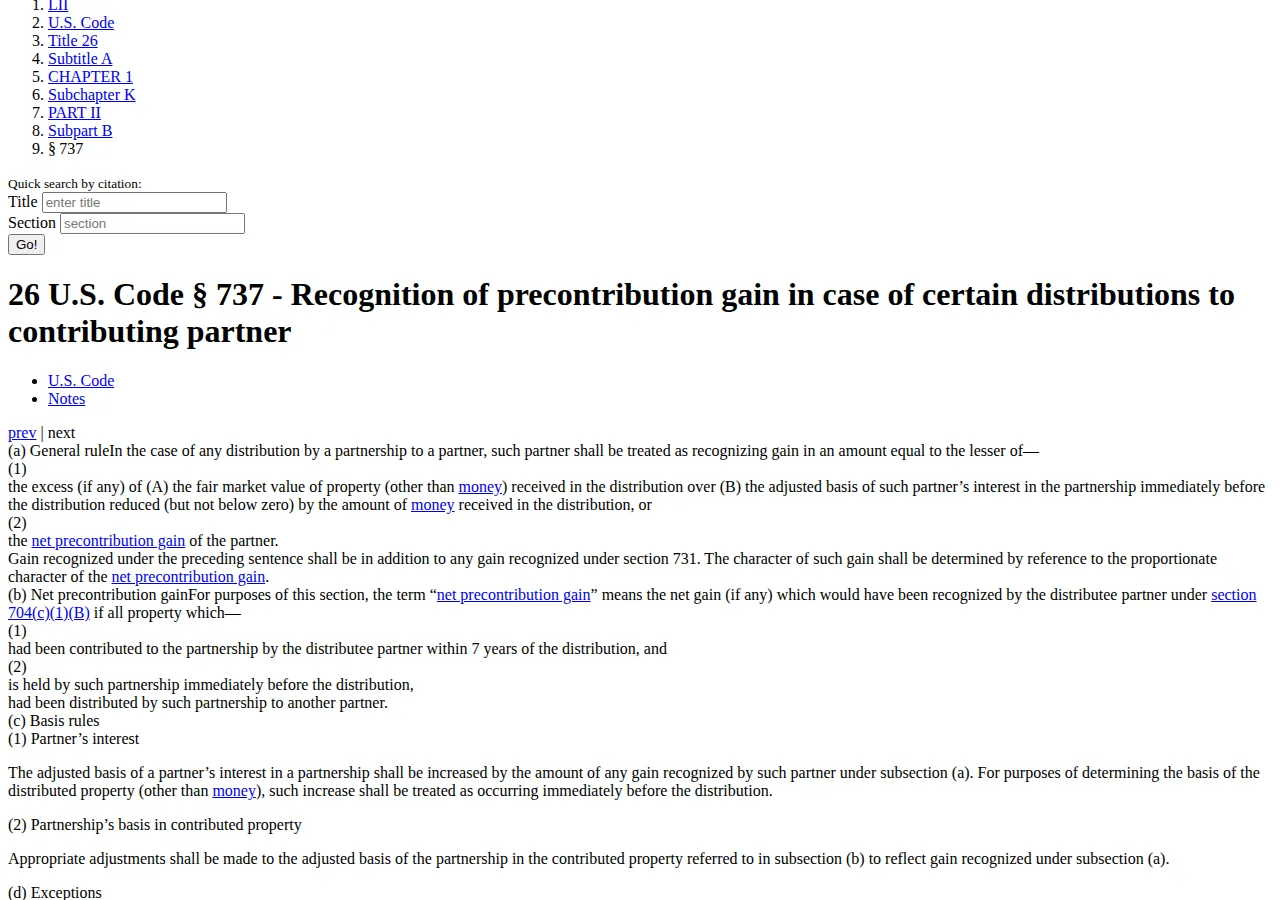
Source: 26 U.S.C. § 737, Cornell LII, 2026-11-14.
Section 704(c)(1)(B): the 7-year tripwire
Section 704(c)(1)(B) taxes the contributing partner when the contributed property itself goes out to someone else. If property a partner contributed is distributed to another partner within 7 years of being contributed, the contributing partner is treated as recognizing gain or loss from the sale of the property, in the amount that would have been allocated under section 704(c)(1)(A) by reason of the variation between basis and fair market value at contribution.
Worked example six. Hana's land again: basis $50,000, fair market value $130,000 at contribution, built-in gain $80,000. Three years later the partnership distributes the land to a different partner when its fair market value is $150,000. Hana recognizes $80,000 — the built-in gain, the variation at contribution. If the distribution had happened after 7 years, Hana would recognize nothing. The 7-year period replaced a 5-year period in the Taxpayer Relief Act of 1997.
Section 751(b): hot assets
Section 751(b) is the rule that overrides section 731 entirely. To the extent a partner receives unrealized receivables or substantially appreciated inventory in exchange for other partnership property, or receives other property or money for an interest in receivables or inventory, the transaction is treated as a sale between the distributee and the partnership. Unrealized receivables under section 751(c) are rights to payment for goods or services, to the extent not previously includible in income — the unbilled fees of a cash-method partnership, which carry a zero basis. Inventory is substantially appreciated under section 751(b)(3)(A) when its fair market value exceeds 120 percent of its adjusted basis.
Worked example seven. A partnership holds inventory (basis $100,000, fair market value $130,000), unrealized receivables worth $60,000 with a zero basis, and land worth $410,000 with a basis of $300,000. The 120 percent test: 1.20 times $100,000 is $120,000, and the inventory's $130,000 fair market value exceeds it, so the inventory is substantially appreciated. Hot assets total $190,000. Partner Imani holds a one-third interest and receives $200,000 cash, giving up her $63,333 share of the hot assets, and that slice is treated as a sale. Her ordinary income is her share of the built-in gain — one-third of the $60,000 receivables gain plus one-third of the $30,000 inventory gain — $20,000 plus $10,000, or $30,000 of ordinary income. Section 751(b)(2) excepts two cases: a distribution of property the distributee contributed, and payments under section 736(a) to a retiring partner or a deceased partner's successor.
Section 707(a)(2)(B): disguised sale
Under section 707(a)(2)(B), a contribution of property and a related distribution of money or other consideration are treated as a sale of the property to the partnership. Treasury Regulation section 1.707-3(c) supplies the timing presumptions: transfers within a 2-year period are presumed to be a sale, and transfers more than 2 years apart are presumed not to be a sale. Both presumptions are rebuttable on the facts and circumstances. A contribution of appreciated land followed 18 months later by a cash distribution of nearly the same value, funded by a loan secured by that land, is the classic disguised sale.
The decision table
| Distribution | Partner result | Authority |
|---|---|---|
| Cash at or below outside basis | No gain | § 731(a)(1); Reg. § 1.731-1(a)(1)(i) |
| Cash above outside basis | Gain equal to the excess | § 731(a)(1) |
| Property, current distribution | No gain; capped basis | § 732(a) |
| Property, liquidating distribution | No gain; basis is the plug | § 732(b) |
| Liquidation, only money, receivables and inventory | Loss of excess basis | § 731(a)(2) |
| Marketable securities | Money at FMV | § 731(c) |
| Other property to the contributing partner within 7 years | Gain, lesser of excess and precontribution gain | § 737(a) |
| Contributed property to another partner within 7 years | Contributor recognizes built-in gain | § 704(c)(1)(B) |
| Disproportionate distribution of hot assets | Deemed sale; ordinary income on the slice | § 751(b) |
| Contribution plus related distribution within 2 years | Presumed disguised sale | § 707(a)(2)(B); Reg. § 1.707-3(c) |
Who this playbook is for — and who must avoid it
This playbook is for a partner in a US partnership — an LLC taxed as a partnership, a limited partnership, or a general partnership — who is taking cash or property out and needs to know the tax cost before the distribution is made. It assumes the partnership files Form 1065 under its EIN. It also assumes the distribution is not a payment for services, a section 736 retirement payment, or a distribution from an S-Corp or a C-Corp. Avoid this playbook's shortcuts for an eligible partner of an investment partnership, a contribution-and-distribution pair inside 2 years, or a partnership with a section 754 election. A distribution never frees a loss suspended under section 704(d). A distribution never creates an NOL and never triggers FICA withholding.
For the contribution side, read the Section 721 partnership contribution nonrecognition playbook. For debt basis, read the Section 752 partnership debt basis allocation playbook. For capital accounts, see the Section 704(b) capital account maintenance playbook. Before taking a large distribution, estimate the tax with the Self-Employed Tax & Quarterly Estimator.
Founder & CEO Insight — Enow A. Jovial
Execution checklist
- [x] Have your CPA pull the partner's outside basis from the section 705 ledger and confirm it against the latest K-1.
- [x] List every property the partner contributed in the last 7 years, with dates and basis.
- [x] Test section 751(b) first and compute the ordinary-income slice.
- [x] Run the section 737 lesser-of computation and apply the basis increase.
- [x] Value marketable securities at fair market value.
- [x] Check the 2-year disguised-sale presumption under Regulation section 1.707-3(c).
The IRS Publication 541 chapter on partnership distributions follows the same sequence this playbook uses: effect on the partner's basis, then the partner's gain or loss, then the basis of distributed property.
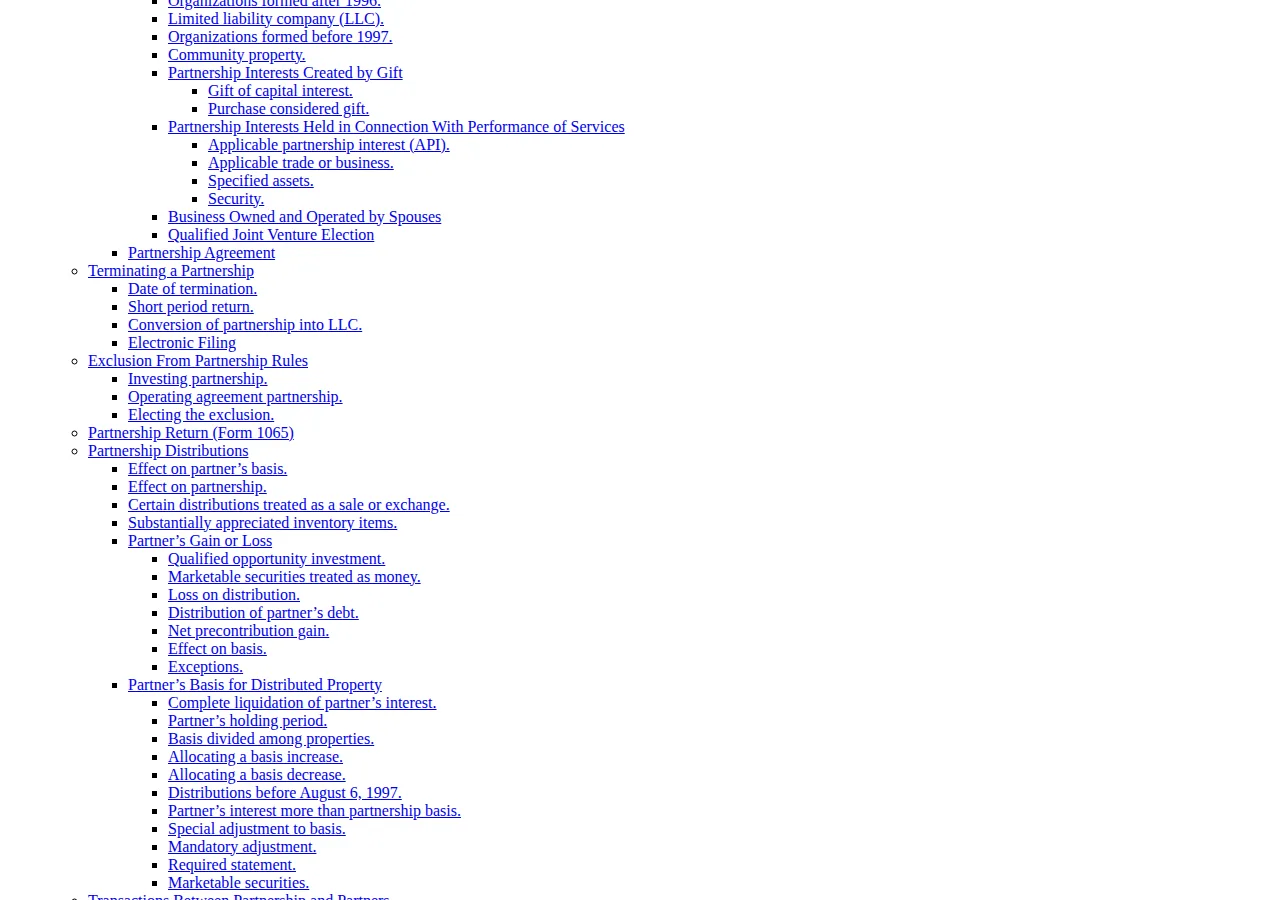
Source: IRS Publication 541, 2026-11-14.