Section 6651 charges 5 percent a month for filing late and 0.5 percent a month for paying late, and both charges run on the same unpaid balance at the same time. A return filed four months late with nothing paid does not cost 5 percent. It costs 20 percent in failure-to-file penalties, plus interest — and the meter does not stop at the filing deadline, because the filing deadline is not the payment deadline.
That is the trap the statute sets. An extension of time to file is not an extension of time to pay. Form 4868 moves the filing date to October 15 and leaves the payment date exactly where it was: April 15. Every day past April 15 with tax unpaid accrues the failure-to-pay penalty, and every month past the filing date with no return filed accrues the failure-to-file penalty. The sections below price both, show how the statute offsets them, and show the two legal ways to cut the rate — an installment agreement and a first-time abatement — before the balance grows past the tax itself.
Founder & CEO Insight — Enow A. Jovial
The two penalties, in one statute
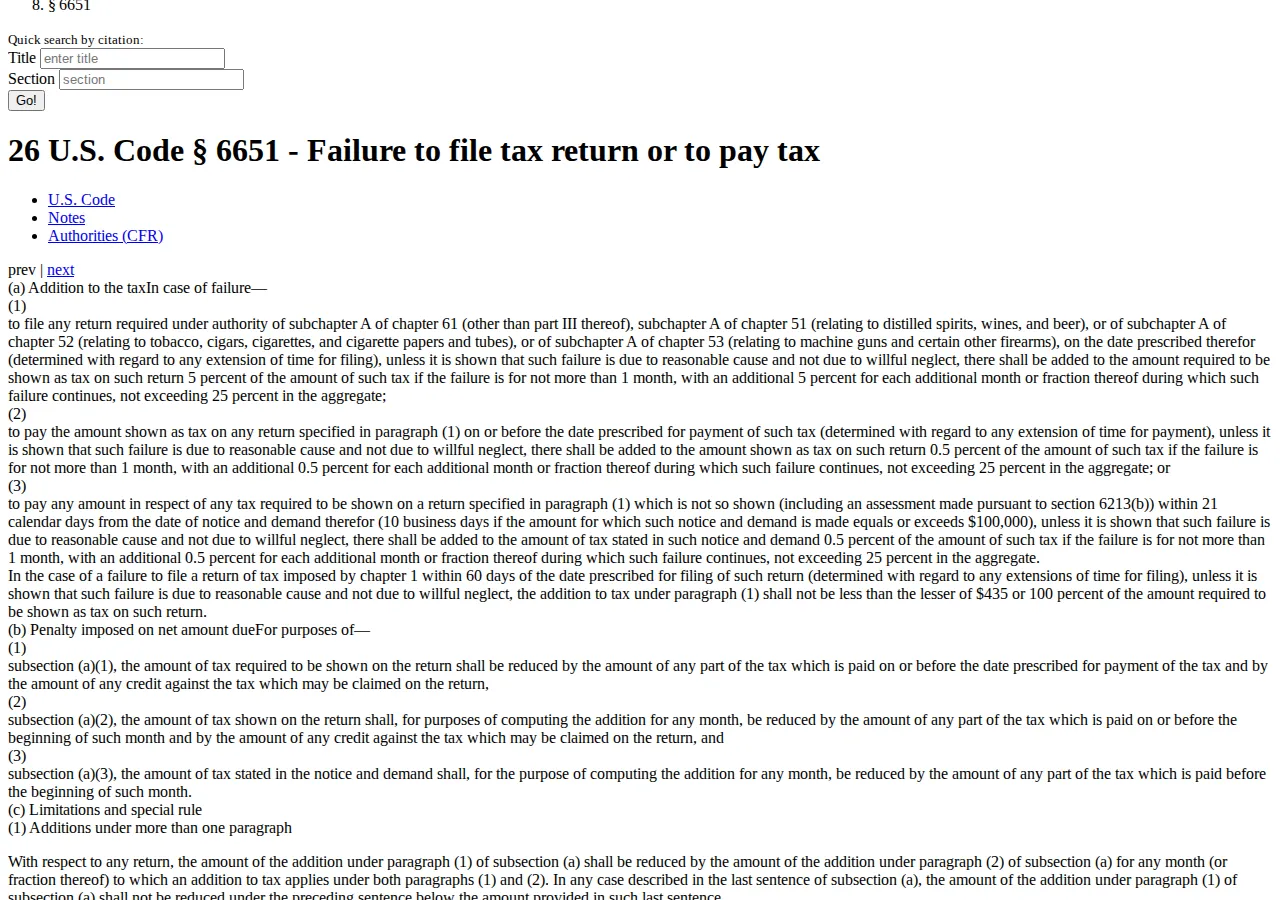
Section 6651(a) holds three additions to tax. Paragraph (1) is the failure-to-file penalty: 5 percent of the net tax due for each month or fraction of a month the return is late, capped at 25 percent. Paragraph (2) is the failure-to-pay penalty: 0.5 percent of the amount shown as tax for each month it remains unpaid, capped at 25 percent. Paragraph (3) is the same 0.5 percent on amounts the return did not show, running from 21 calendar days after notice and demand.
The base matters more than the rate. Under § 6651(b)(1), the failure-to-file penalty is computed on the net amount: the tax required to be shown, less any tax paid on time, less any refundable credits. Withholding and estimated payments made on time reduce the base before the first 5 percent is computed. A taxpayer who owes $40,000, had $30,000 withheld, and files late pays the penalty on $10,000. The failure-to-pay base under § 6651(b)(2) is the amount shown as tax, reduced by amounts paid on or before the beginning of each month.
| Penalty | Rate | Cap | Base | Authority |
|---|---|---|---|---|
| Failure to file | 5% per month or fraction | 25% | Net tax due (tax less timely payments and credits) | § 6651(a)(1), (b)(1) |
| Failure to pay (amount shown) | 0.5% per month or fraction | 25% | Amount shown as tax, less amounts paid | § 6651(a)(2), (b)(2) |
| Failure to pay (amount not shown) | 0.5% per month or fraction | 25% | Amount in notice and demand, after 21 days | § 6651(a)(3) |
| Fraudulent failure to file | 15% per month or fraction | 75% | Net tax due | § 6651(f) |
| Failure to pay under installment agreement | 0.25% per month or fraction | 25% | Amount shown as tax | § 6651(d) |
Example: a single-member LLC taxed as an S-Corp files Form 1120-S on time but pays nothing on a $40,000 balance: the CPA's reasonable-salary calculation left no cash for the April 15 payment, and the EIN-linked IRS online account shows the balance the day the return posts. The failure-to-pay penalty is $200 a month and the interest is 7 percent compounded daily, so the fix is Form 9465 the same week — the agreement halves the rate to 0.25 percent, or $100 a month, while the S-Corp's quarterly estimated payments keep next year's balance from repeating the pattern. A C-Corp in the same position files Form 1120 and faces the same rates; the entity changes the form, not the penalty. A month, meanwhile, means a month or any fraction of one: a return filed one day into the second month is charged for two months.
The offset rule: why the two penalties never add to 5.5 percent
Section 6651(c)(1) is the one paragraph that saves the taxpayer money. When both penalties apply in the same month, the failure-to-file penalty is reduced by the failure-to-pay penalty for that month. The IRS states it plainly: instead of a 5 percent failure-to-file penalty, it applies 4.5 percent failure-to-file and 0.5 percent failure-to-pay. The combined charge is 5 percent a month, not 5.5 percent.
The two penalties separate after five months. The failure-to-file penalty hits its 25 percent cap at month five and stops. The failure-to-pay penalty keeps accruing at 0.5 percent a month until its own 25 percent cap, which takes 50 months.
The worked case on a $40,000 balance with nothing paid and nothing withheld:
The $800 failure-to-pay charge is real but invisible inside the combined 5 percent. The taxpayer who files on time and pays four months late owes only the $800. The taxpayer who files four months late and pays the same day owes $8,000. Filing late is ten times as expensive as paying late for the same four months, on the same dollars.
The 60-day minimum: $525 even on a small balance
A chapter 1 return filed more than 60 days after its due date (including extensions) carries a minimum addition to tax: the lesser of a fixed dollar amount or 100 percent of the tax required to be shown. The statute prints the base figure as $435, and the IRS publishes the inflation-adjusted figure each year. For returns due after December 31, 2025 the minimum is $525; for 2025 it was $510, and for 2024 it was $485.
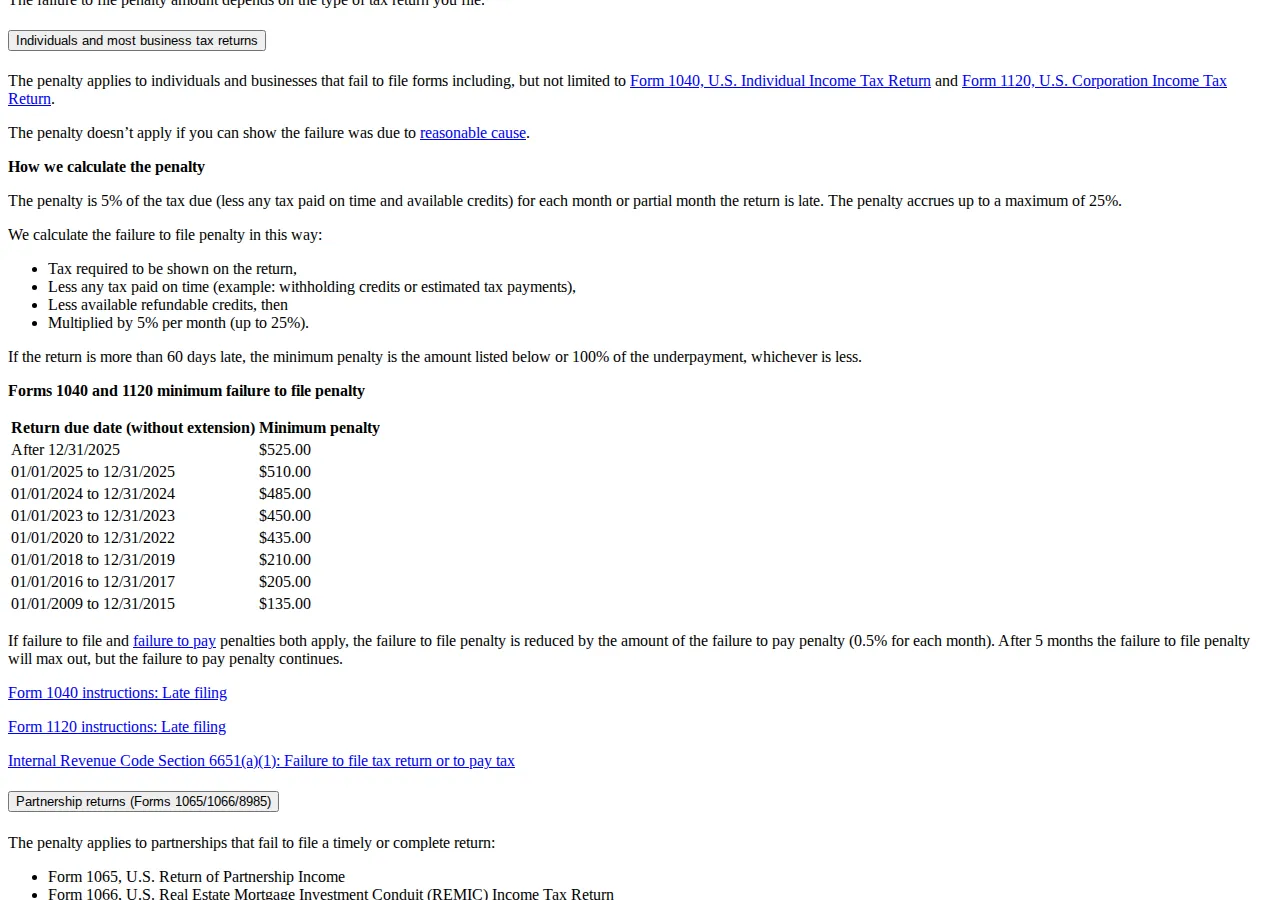
The minimum bites hardest on small balances, because it is a floor, not a percentage. A taxpayer who owes $200 and files 70 days late pays $200 — 100 percent of the tax. A taxpayer who owes $2,000 pays $525. A taxpayer who owes $40,000 pays the percentage penalty, $4,000 for two months.
Interest: the third charge, running from April 15
Penalties are not the whole bill. Interest under § 6601 runs on the unpaid tax from the original due date until it is paid, compounded daily, at a rate the IRS resets quarterly. For the quarter beginning October 1, 2026, the underpayment rate for individuals is 7 percent per year, compounded daily, and it keeps running while the penalties accrue.
The simple-interest approximation, $40,000 × 7% × 4/12 = $933, understates the charge by $14. On the worked case, the four-month bill is $40,000 of tax, $8,000 of penalties, and $947 of interest: $48,947, or 22.4 percent more than the tax itself. The rate moves with the federal short-term rate and is reset quarterly — 7 percent is the fourth-quarter 2026 rate, not a permanent one.
The installment-agreement cut: 0.25 percent a month
Section 6651(d) is the cheapest paragraph in the statute to use. For an individual who files on or before the due date, including extensions, and then enters into an installment agreement under § 6159, the failure-to-pay penalty drops from 0.5 percent to 0.25 percent a month for every month the agreement is in effect. Default on the agreement and the rate returns to 0.5 percent.
The agreement saves $100 a month on a $40,000 balance, $1,200 over a year, and the saving scales with the balance: $250 a month on $100,000. Interest still accrues at 7 percent, and the agreement carries a user fee, but the penalty saving repays the fee several times over on any balance above a few thousand dollars. The installment agreement playbook runs the filing itself — Form 9465, the streamlined thresholds, the online setup fee, and the default and reinstatement rules. A second rate change sits at the other end of the scale: if the taxpayer does not pay within 10 days after a notice of intent to levy, the failure-to-pay penalty rises to 1 percent a month.
Fraudulent failure: 15 percent a month, 75 percent cap
Section 6651(f) replaces the 5 percent rate with 15 percent and the 25 percent cap with 75 percent when the failure to file is fraudulent. On a $40,000 balance, five months of fraudulent failure costs $30,000 — 75 percent of the tax — before interest. The fraud determination is the IRS's to make and the taxpayer's to contest. Ordinary lateness is expensive; fraudulent lateness is ruinous. The § 6662 accuracy-related penalties playbook covers the accuracy side of the same ladder, and the trust fund recovery penalty playbook covers the personal liability that follows unpaid payroll taxes.
Reasonable cause and first-time abatement
Both penalties are waived if the taxpayer shows the failure was due to reasonable cause and not willful neglect. Reasonable cause is a facts-and-circumstances test: the IRS looks at what happened, what the taxpayer did to comply, and whether the failure was beyond the taxpayer's control. A death or serious illness, a natural disaster, reliance on a tax professional's advice, or an IRS error can qualify; a busy schedule, a forgotten deadline, or a belief that an extension covered the payment cannot. The request is made by calling the IRS, sending a written statement, or filing Form 843.
First-time abatement is the administrative shortcut. A taxpayer with three years of timely filing and payment history can have a failure-to-file, failure-to-pay, or failure-to-deposit penalty abated for one year, without proving reasonable cause. In the summer of 2026 the IRS began replacing the request-based abatement with Automatic Exemption from Penalty: a taxpayer who files or pays late in the current year but timely filed returns and paid tax due for the three prior years — or 12 consecutive quarters for quarterly filers — is not assessed the penalty at all, automatically, with no call and no form. The taxpayer still owes the tax and the interest. The penalty is what the relief removes, and the relief is available once — a second late year in a row has no clean history to stand on.
Who this is for, and who should stop here
This playbook is for a founder, freelancer, or operator who owes tax, is late, or expects to be late, and wants the penalty priced before deciding what to do. It is for the person choosing between filing now and paying later, between an installment agreement and an offer in compromise, and between requesting abatement and paying the penalty. It is not for a taxpayer facing a fraud determination, a criminal referral, or a levy — those need a tax attorney before any filing. It is not a substitute for the Form 4868 extension playbook or the offer in compromise playbook.
- [x] Step 1: File the return now, even unpaid — filing on time removes the 5% failure-to-file penalty and leaves only the 0.5% failure-to-pay charge.
- [x] Step 2: Pay what you can by April 15 — every dollar paid on time reduces the penalty base under § 6651(b).
- [x] Step 3: Price the balance — run the net tax due through the tax estimator at 5% a month for filing plus 0.5% for paying, with the 5% combined ceiling.
- [x] Step 4: File Form 9465 — an approved agreement halves the failure-to-pay rate to 0.25% a month while it runs.
- [x] Step 5: Check the three-year history — three years of timely filing and payment means first-time abatement, or the automatic exemption from summer 2026, may remove the penalty.
- [x] Step 6: Request reasonable-cause relief in writing — if a specific event caused the failure, document it and file Form 843 or call the IRS.
- [x] Step 7: Do not let the levy notice land — pay within 10 days of a notice of intent to levy or the failure-to-pay rate doubles to 1% a month.
The penalties under § 6651 are priced in the statute, capped in the statute, and cut in half by a one-page form. The only way to pay the full rate is to do nothing.