The payroll tax your company withholds from an employee's paycheck was never your company's money. Once withholding hits the payroll account, 26 U.S.C. § 7501 declares it "a special fund in trust for the United States" — held only long enough to deposit it. When a business spends that money on rent, suppliers, or the next payroll instead of the deposit, the debt does not stay with the business. IRC § 6672 converts it into a personal penalty against the human beings who decided where the money went, equal to 100 percent of the unpaid trust fund tax.
Founder & CEO Insight — Enow A. Jovial
What counts as trust fund tax — and what does not
The penalty reaches only the trust fund portion of the payroll tax bill. The table splits a payroll tax bill the way IRM 5.7.3 splits it.
| Payroll tax component | Trust fund? | Authority |
|---|---|---|
| Federal income tax withheld from wages | Yes | 26 U.S.C. § 7501; IRM 5.7.3.1.1 |
| Employee share of Social Security (6.2%) | Yes | 26 U.S.C. § 7501; IRM 5.7.3.1.1 |
| Employee share of Medicare (1.45%) | Yes | 26 U.S.C. § 7501; IRM 5.7.3.1.1 |
| Collected excise taxes (e.g., Form 720) | Yes | IRM 5.7.3.2 |
| Employer share of Social Security | No | IRM 5.7.3.1.1 — employer share is a business debt |
| Employer share of Medicare | No | IRM 5.7.3.1.1 — employer share is a business debt |
| FUTA (federal unemployment tax) | No | Employer-only tax, not withheld from wages |
The split, not the total, decides the personal exposure.
Worked example: one quarter of missed deposits becomes a $29,475 personal penalty
Take a 10-person company, $50,000 monthly gross payroll, withholding 12 percent for federal income tax. One month:
The employer share for the same month is $3,825 — business debt, not trust fund money. Over one quarter:
The penalty is the full unpaid trust fund balance, plus interest from the assessment date under IRC § 6601 — at 8 percent, 18 months of interest on $29,475 adds $3,537. The business still owes its own $11,475 employer share for the quarter, plus failure-to-deposit penalties under IRC § 6656 on the Form 941 return. The TFRP does not replace those; it stacks on top of them, and it follows the person, not the company. If the company later pays part of the trust fund balance, the penalty drops dollar for dollar — IRM 5.7.3.1.1 states the full unpaid amount "will be collected only once," whether from the business, from one responsible person, or from several combined.
The two-element test: responsibility and willfulness
IRM 5.7.3.4 states the rule plainly: a person is liable only if the revenue officer establishes two things. First, the person must be "responsible." Second, the responsible person must have "willfully" failed to collect or pay over the tax. Miss either element and there is no penalty. That two-part structure is the whole defense — and the whole trap.
Responsibility is status, duty, and authority
Responsibility, per IRM 5.7.3.4.1, "is a matter of status, duty, and authority" and turns on the facts of each case. The officer looks for duty to perform, power to direct collection, authority to pay, and authority to choose which creditors get paid. The IRM's list is deliberately wide: a corporate officer or employee, a partner or employee of a partnership, a director or shareholder, an LLC member, manager or employee, a surety lender, a payroll service provider (PSP) and the persons inside it, a professional employer organization (PEO) and the persons inside it, and the persons inside the common-law employer that hired the PSP or PEO.
Title, stock ownership, and check-signing authority do not decide responsibility on their own — check-signing "does not, in and of itself, establish responsibility" (IRM 5.7.3.4.1.1). What matters is whether the person could exercise independent judgment over the company's financial affairs. The IRM's own examples draw the line:
- The bookkeeper who only pays the bills she is handed is not responsible. She signs checks and pays every bill the treasurer gives her, but she cannot choose which bills to pay. She performs a ministerial act under supervision. IRM 5.7.3.4.1.2.
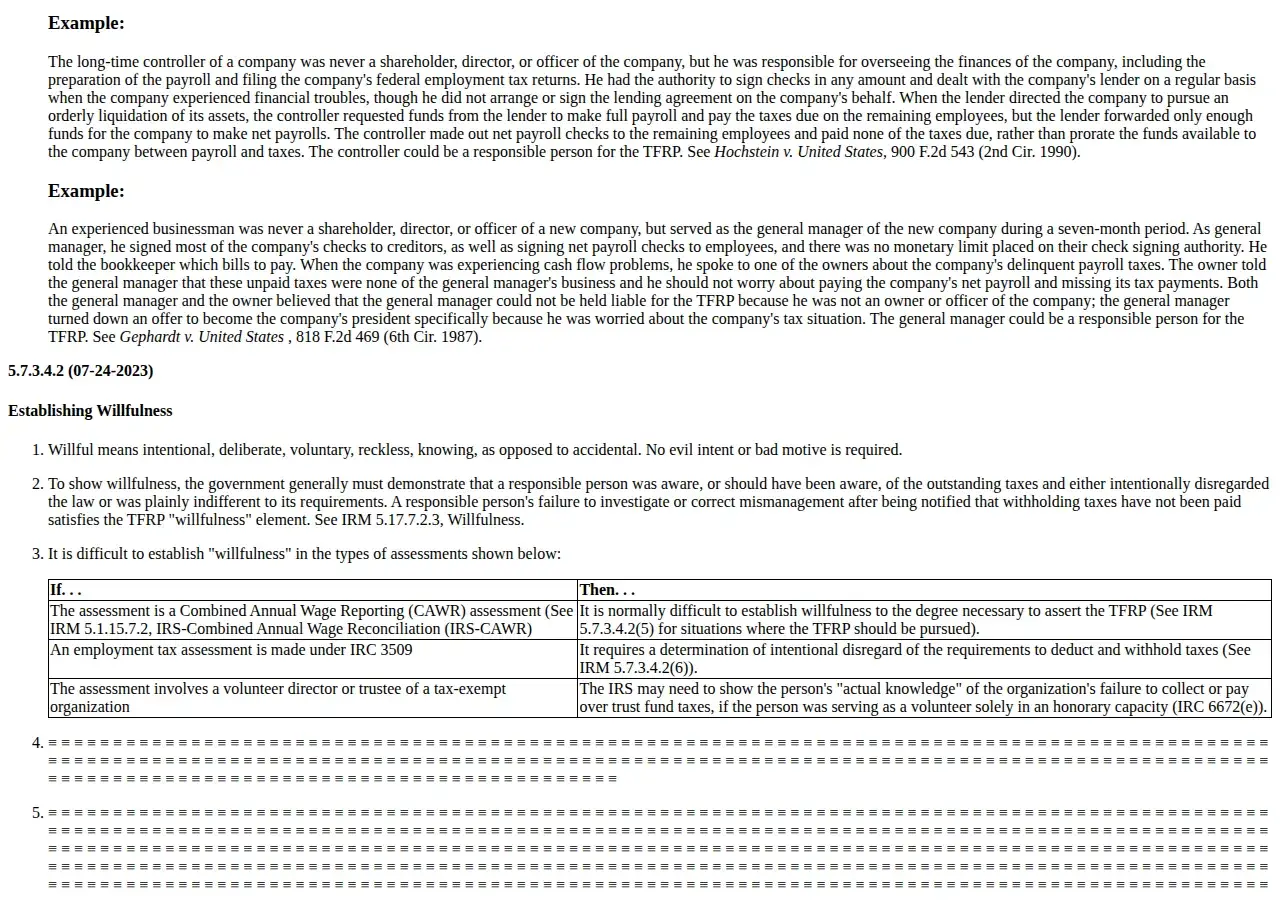
- The controller who ran the finances is responsible, though he owned nothing. In Hochstein v. United States, 900 F.2d 543 (2d Cir. 1990), a controller with no shares, directorship, or officer title oversaw payroll, filed the returns, and signed checks in any amount. When the lender sent only enough for net payroll, he paid net payroll and none of the taxes.
- The general manager who refused the presidency to avoid the tax problem is still responsible. In Gephardt v. United States, 818 F.2d 469 (6th Cir. 1987), a general manager signed most checks, told the bookkeeper which bills to pay, and turned down the presidency over the tax situation.
Delegation does not save a person with ultimate authority. IRM 5.7.3.4.1.1 states that people with ultimate authority over financial affairs "may generally not avoid responsibility by delegating that authority to someone else."
LLCs get no special shelter. IRM 5.7.3.4.1 states the TFRP "is available and may be appropriately asserted when the taxpayer is organized as a Limited Liability Company." For a disregarded single-member LLC, the owner is personally liable for employment taxes on pre-2009 wages; for later wages the LLC is treated as a corporation, so the investigation runs against the individuals inside it. Charging-order protection does not protect members from their own payroll decisions.
Willfulness needs no evil intent
Willfulness under IRM 5.7.3.4.2 means "intentional, deliberate, voluntary, reckless, knowing, as opposed to accidental. No evil intent or bad motive is required." The government must show the person was aware, or should have been aware, of the outstanding taxes and either intentionally disregarded the law or was plainly indifferent to it.
The most common willfulness fact is also the most ordinary: the business paid other creditors while the taxes sat unpaid. The IRS's own TFRP page states it directly — "Using available funds to pay other creditors when the business is unable to pay the employment taxes is an indication of willfulness." That is the cash-flow triage every struggling founder performs — supplier, landlord, staff — while the deposit slides, and it is the exact fact pattern the revenue officer writes up. The deposit was never in the queue; it was money held in trust, and spending it on a creditor is spending someone else's money.
Willfulness is hard to establish in only a few situations: a Combined Annual Wage Reporting (CAWR) assessment, an assessment under IRC § 3509, and a volunteer director of a tax-exempt organization, where the IRS may need to show actual knowledge. IRC § 6672(e) protects an unpaid volunteer board member who serves solely in an honorary capacity, takes no part in day-to-day or financial operations, and has no actual knowledge — but not if it would leave no person liable at all.
The investigation: Form 4180, Letter 1153, and the 60-day clock
In a TFRP investigation, the centerpiece is the interview. IRM 5.7.4.2.4 names it: Form 4180, the Report of Interview with Individual Relative to Trust Fund Recovery Penalty. The officer walks through the person's duties, who hired and fired, who signed checks and returns, who chose which creditors were paid, and when the person first learned the deposits were behind. Every answer is measured against the responsibility and willfulness elements above. The interview is not a formality; it is the record the assessment is built on.
If the officer determines the person is responsible, the IRS sends Letter 1153, the preliminary notice required by IRC § 6672(b). The statute requires that notice to precede any notice and demand by at least 60 days. The letter gives 60 days to appeal — 75 days if addressed outside the United States — under Publication 5, Your Appeal Rights and How to Prepare a Protest if You Disagree. With no response, the IRS assesses the penalty and sends a Notice and Demand for Payment. The assessment statute is § 6501's three years, extended by § 6672(b)(3) to the later of 90 days after the notice or 30 days after the final determination on a timely protest.
The escape hatch: pay the divisible tax, then sue
IRC § 6672(c) gives a responsible person one disciplined way to get the liability in front of a court. The TFRP is a divisible tax: instead of paying the whole $29,475, the person pays the trust fund tax attributable to a single employee for a single quarter, files a refund claim on Form 843, and — if the claim is denied or six months pass — sues for a refund in district court or the Court of Federal Claims. Under IRC § 6532(a), that suit must begin within two years of the mailing of the notice of disallowance. A win on the divisible portion defeats the whole assessment.
Worked example: one employee, $15,000 of quarterly wages, 12 percent withheld and 7.65 percent employee FICA:
That is the point of the procedure. There is a price for the pause it buys: under § 6672(c)(1), the person must also furnish a bond equal to 1.5 times the excess of the penalty over the payment, or the IRS may levy for the remainder while the suit is pending. On the worked numbers:
The bond is refundable if the person wins; the levy it prevents is not. Run this with a tax attorney: a Form 843 on the wrong quarter, or a suit a day past the two-year window, ends the challenge before it starts.
Contribution, and the one-collection rule
Where more than one person is liable, IRC § 6672(d) gives each person who paid a right of contribution against the others for their proportionate share — but only in a separate proceeding, never joined with the government's collection action. The government collects the trust fund amount only once: if the business pays $10,000 of the $29,475, every person's penalty drops by $10,000.
Execution checklist: what to do the week the deposits slip
- [x] Step 1 — Stop the bleed today: make the current period's deposit through EFTPS before spending another dollar on any creditor.
- [x] Step 2 — Measure the trust fund balance: pull the last four Form 941 returns and total the unpaid withheld income tax plus employee FICA per quarter — that is the personal exposure.
- [x] Step 3 — Separate the employer share: track the employer FICA share and FUTA as business debt, not mixed into the trust fund figure.
- [x] Step 4 — Freeze the payment order: no creditor gets paid from funds that include withheld tax. Put it in writing to every person with check-signing authority.
- [x] Step 5 — File every unfiled Form 941: unfiled returns accelerate the investigation and add failure-to-file penalties under IRC § 6651. The filing operation is the Form 941 playbook.
- [x] Step 6 — Get a CPA or tax attorney before Form 4180: do not attend the interview alone.
- [x] Step 7 — Calendar Letter 1153 the day it arrives: 60 days to protest (75 outside the United States), Publication 5 for the protest format.
- [x] Step 8 — Price the installment route: if the business can pay over time, the Form 9465 installment agreement playbook covers the payment-plan fees and the 0.25 percent penalty rate for timely filers.
- [x] Step 9 — Know the settlement alternative: if the business cannot pay in full, the Offer in Compromise playbook covers settling the business liability for less under IRC § 7122, which also shrinks the trust fund balance behind the TFRP.
- [x] Step 10 — Preserve the divisible-tax option: keep one employee's one-quarter trust fund figure computed, so the § 6672(c) refund suit can be filed cleanly.
Who should not rely on this playbook
This playbook is for owners, officers, controllers, and senior employees of businesses with employees and withheld taxes. It does not apply to a sole proprietor with no employees — there is no withholding to hold in trust. It does not help a person who already paid the full penalty and missed the two-year suit window under § 6532(a); that door is closed by statute. And it is not a substitute for counsel once Letter 1153 arrives: the protest, the Form 4180 interview, and the divisible-tax suit are procedures where a wrong filing costs more than the professional who would have filed it right. Run the tax estimator to size the exposure, then take it to a CPA the same week.