A tax bill you cannot pay in full is not the end of the story. It is the start of a negotiation the law already wrote for you. Form 9465, the Installment Agreement Request, is how an individual taxpayer asks the Internal Revenue Service to accept the full amount owed in monthly payments instead of all at once. The authority is 26 U.S.C. § 6159, and the form is the paper route into the same agreement the IRS Online Payment Agreement tool creates online.
The first decision is whether you need the form at all. If you can pay the full balance within 180 days and you owe less than $100,000 in combined tax, penalties, and interest, the short-term plan costs $0 to set up and Form 9465 is the wrong tool. Form 9465 is for the long-term plan: monthly payments over more than 180 days, up to 72 months for a streamlined agreement.
What Form 9465 actually buys
An installment agreement buys three things. First, it stops the worst of the collection machinery: while an agreement is pending or in effect, the IRS is generally prohibited from levying, and the collection clock is suspended — including for 30 days after a request is rejected or a plan is terminated, and for the whole period an appeal is pending. Second, it cuts the failure-to-pay penalty in half: under IRC § 6651(h), the rate drops from 0.5 percent a month to 0.25 percent a month while an approved agreement is in effect, for a return filed on time. Third, it fixes a monthly number you can budget against.
Interest is not paused. It and the reduced penalty keep accruing until the balance is paid in full, and future refunds are applied to the debt. The monthly amount must clear the balance plus the accruing interest, or the last months will still show a balance when the term ends.
The fee table: the same plan costs $29 or $178
The IRS charges a one-time user fee when it approves a long-term plan. The amount depends entirely on two choices you control: how you apply and how you pay. The figures below are the current schedule from the IRS payment-plans page, updated March 3, 2026, and the December 2026 instructions (PDF) print the same schedule.
| Plan | Apply online | Apply by phone, mail, or in person |
|---|---|---|
| Short-term (180 days or less) | $0 (individuals only) | $0 |
| Long-term, direct debit (DDIA) | $29 | $107 |
| Long-term, other payment method | $69 | $178 |
| Low income, long-term, direct debit | Waived | Waived |
| Low income, long-term, other method | $43, may be reimbursed | $43, may be reimbursed |
| Revise an existing plan | $6 ($0 for DDIA changes) | $89 ($43 low income) |
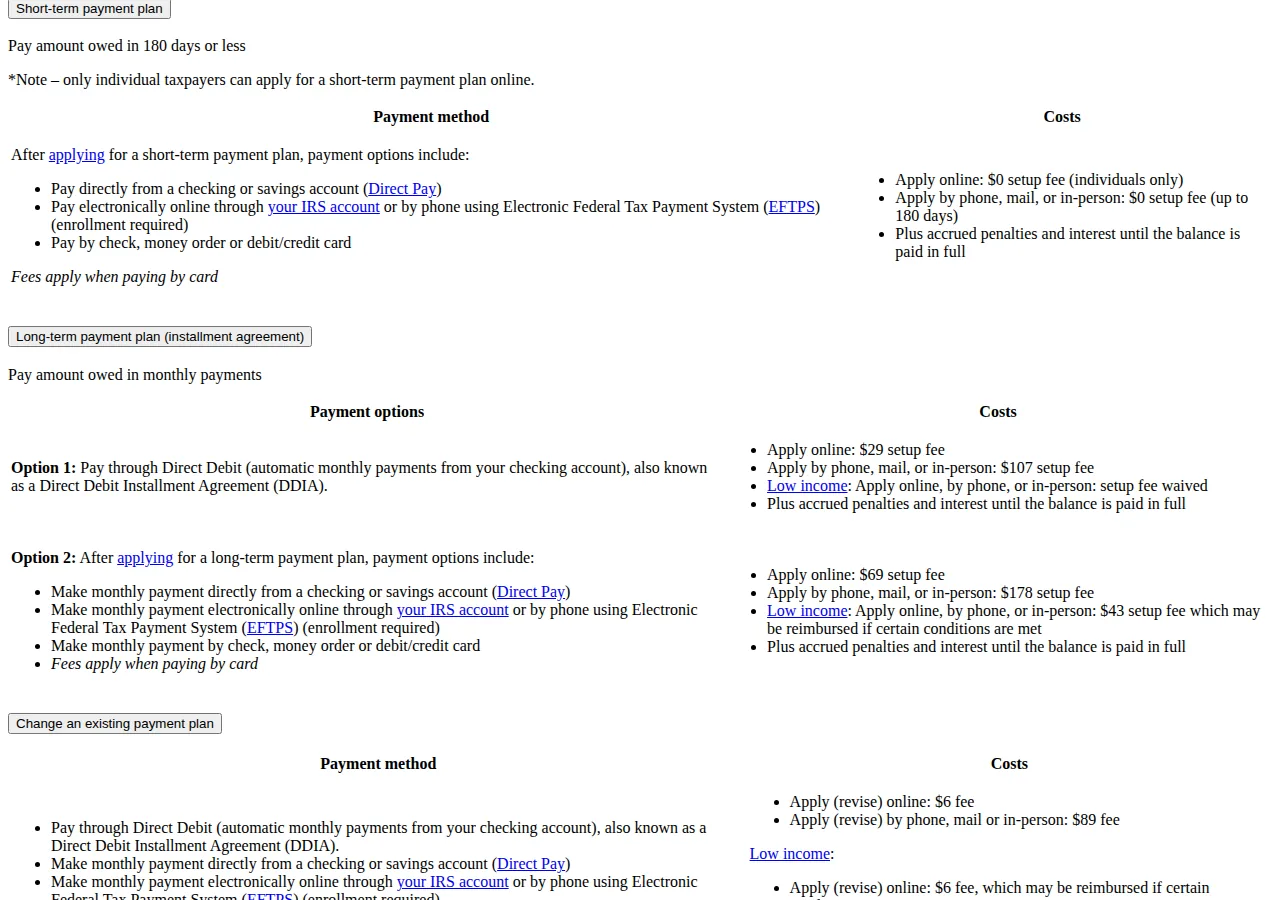
The same agreement and the same 72 months — filed online with direct debit it costs $29; filed on paper without direct debit it costs $178. The $149 difference buys nothing.
Low-income treatment is a separate track. If your adjusted gross income is at or below 250 percent of the applicable federal poverty level, the fee is waived entirely for a direct-debit agreement; for a non-direct-debit plan it drops to $43 and may be reimbursed when the agreement is completed. If the system does not identify you as low-income, file Form 13844 within 30 days of the acceptance letter and ask for reconsideration.
The three tiers: guaranteed, streamlined, and full disclosure
The IRS sorts requests into three tiers by balance, and the tier decides how much of your financial life you must show. The balance is always the combined total — tax plus penalties plus interest.
| Tier | Balance | Term | Financial disclosure |
|---|---|---|---|
| Guaranteed | $10,000 or less (tax only) | Full payment within 3 years | None — the IRS must accept it |
| Streamlined | $50,000 or less | Up to 72 months | None — no financial disclosure |
| Non-streamlined | Over $50,000 | Negotiated | Form 433-F required |
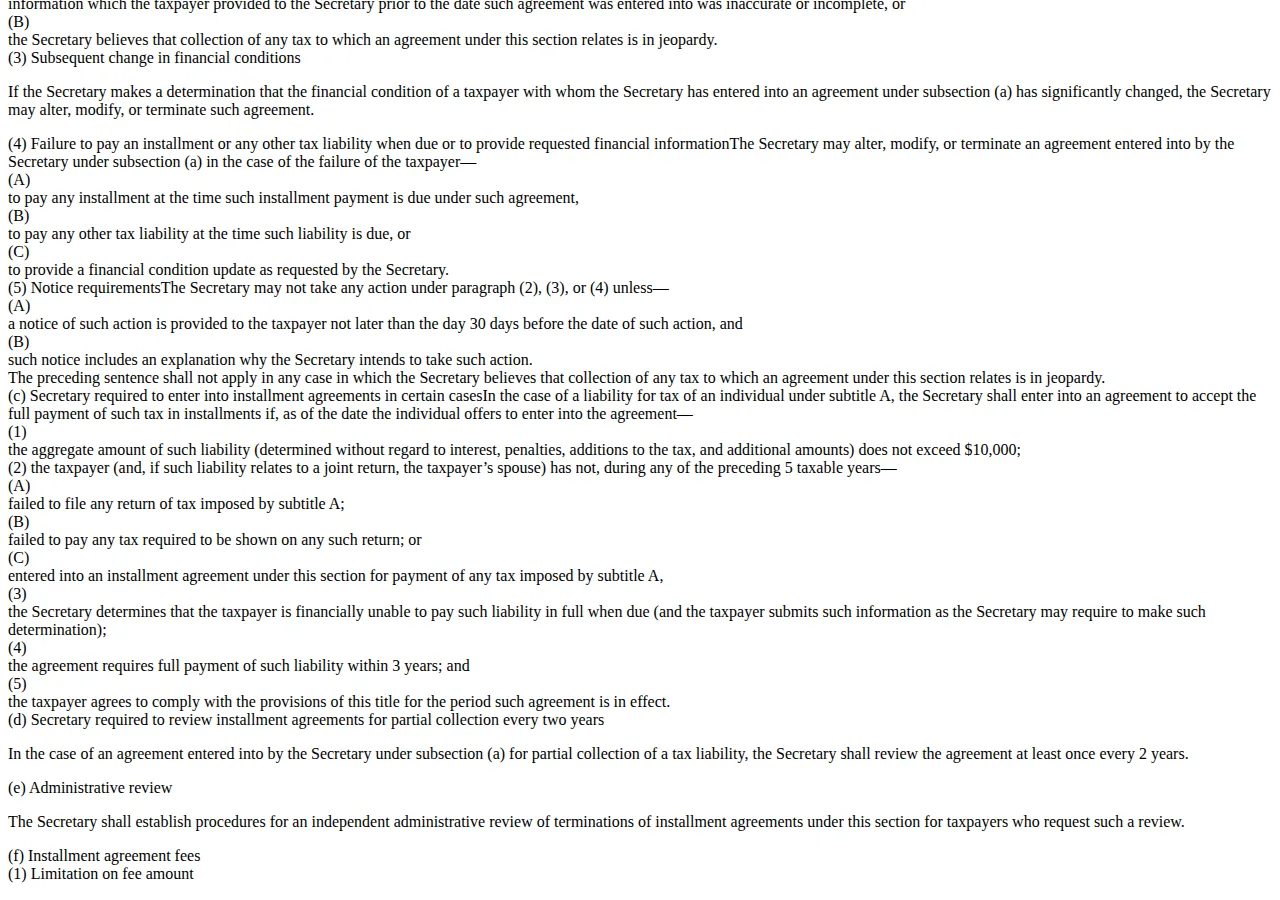
The guaranteed tier is the strongest right in the whole system. Under 26 U.S.C. § 6159(c), the Secretary shall enter into an agreement when the liability of an individual under subtitle A does not exceed $10,000, the taxpayer has not failed to file or pay in any of the preceding five taxable years, the taxpayer is financially unable to pay in full when due, the agreement requires full payment within three years, and the taxpayer agrees to stay compliant. Five conditions, all checkable — and when they are met, the IRS has no discretion to refuse.
The streamlined tier is the workhorse. Owe $50,000 or less, have every required return filed, and propose a monthly payment that clears the balance within 72 months — approved without bank statements, asset lists, or a Form 433-F. Above $50,000 the process stops being streamlined: Form 433-F opens your income, expenses, and assets to the collector, and the monthly amount is negotiated against your allowable living expenses, not proposed by you. Note the vintage: older guides cite a $25,001–$50,000 direct-debit requirement from the July 2024 instructions, but the current December 2026 instructions do not state it — direct debit is the cheapest way to pay, not a condition of approval.
Founder & CEO Insight — Enow A. Jovial
The worked example: three balances, three plans
Take three constructed illustrations — invented balances, real rules and rates.
Example 1: $9,000, guaranteed. The balance is under $10,000 and the taxpayer filed and paid on time for five years, so the guaranteed tier applies and the plan must clear the balance within three years.
Filed online with direct debit, the setup fee is $29. The failure-to-pay penalty runs at 0.25 percent a month instead of 0.5 percent, which on $9,000 is $22.50 a month instead of $45 — a saving that repays the $29 fee in under two months.
Example 2: $36,000, streamlined. The balance is under $50,000, so no Form 433-F is required, and the plan may run the full 72 months.
In practice propose $550 to $600, because interest accrues for six years; the extra retires the interest as it accrues.
Example 3: $75,000, non-streamlined. The balance is over $50,000, so Form 433-F is required and the monthly amount is negotiated. The 72-month streamlined ceiling does not apply; the term is whatever the collector agrees, bounded by the collection statute. Expect the IRS to ask for bank statements, pay stubs, and assets — and the payment to be set from allowable expenses, not from what feels affordable.
The penalty saving scales with the balance. At 0.5 percent a month, a $20,000 balance accrues $100 a month in failure-to-pay penalty; at the 0.25 percent agreement rate it accrues $50.
That $600 a year is the real return on filing promptly. Every month spent deciding is a month at the full 0.5 percent rate. And under IRC § 6651(d), the penalty rises to 1 percent a month after a levy notice is issued — another reason to file before the notice, not after it.
How to file: the sequence, in order
- File every missing return first. The IRS will not approve a long-term plan while any required return is unfiled — the most common reason a streamlined request is rejected, and entirely avoidable.
- Pay what you can today. Any payment before approval reduces the balance interest and penalty accrue on.
- Choose the route: online if you can. An individual who owes $50,000 or less and has filed all required returns can apply through the IRS Online Payment Agreement tool with an SSN or ITIN. A business taxpayer — an LLC, S-Corp, or C-Corp — files with its EIN and calls 800-829-4933. A sole proprietor applies as an individual.
- Choose direct debit. The DDIA is the cheapest fee ($29 online) and the lowest default risk: an ACH debit leaves the account on the due date. Have the bank routing and account numbers ready.
- Propose a payment that clears the balance in 72 months or less. Divide the combined balance by the months you propose, then add a margin for the interest that will accrue.
- If you must file paper, file Form 9465 with the return or separately. Attach Form 433-F if the balance is over $50,000. Keep a copy of everything, including proof of mailing.
- Watch for the acceptance letter, then check the plan online. The IRS online account shows the plan type, the due dates, and the amount due. Confirm the first direct-debit date before it arrives.
- [x] Every required return filed — no missing years, no unfiled quarters.
- [x] Balance confirmed — tax, penalties, and interest, from the notice or the online account.
- [x] Route chosen — online with direct debit for the $29 fee, unless paper or a phone call is forced.
- [x] Payment proposed — balance divided by months, plus a margin for accruing interest.
- [x] Form 433-F attached if required — balance over $50,000.
- [x] First payment date confirmed — in the online account, before the debit is due.
What breaks a plan: the termination triggers
An agreement is a conditional promise, and 26 U.S.C. § 6159(b) lists the conditions that let the Secretary alter, modify, or terminate it: information you provided before the agreement was inaccurate or incomplete; the Secretary believes collection of any covered tax is in jeopardy; your financial condition has significantly changed; you fail to pay an installment or any other tax when due; or you fail to provide a financial-condition update when asked. Before acting, the IRS must generally give notice at least 30 days ahead, with its reasons — except where collection is in jeopardy.
Default has a price beyond the lost protection. There may be a reinstatement fee, and reinstatement is not automatic: you apply online, call 800-829-1040, or have your CPA call, and if the new monthly amount does not meet the requirements you will be directed to complete Form 433-F, Form 433-B for a business, or Form 433-H. The plan also requires ongoing compliance — file all required returns on time, keep payroll (FICA) deposits current if you have employees, and pay all new taxes in full and on time. Future refunds are applied to the debt until it is paid in full, even while you keep making the scheduled payments.
Form 9465 against the alternatives
| Option | When it fits | Cost | Authority |
|---|---|---|---|
| Short-term plan (180 days) | Balance under $100,000, payable within 6 months | $0 setup fee | IRS payment-plans page (updated Mar 3, 2026) |
| Form 9465 / long-term plan | Balance payable in full over 7–72 months | $29–$178 setup fee | 26 U.S.C. § 6159; Form 9465 |
| Offer in compromise | Balance cannot be paid in full even over 72 months | $205 application fee + first payment | IRC § 7122; OIC playbook |
| Extension (Form 4868) | Need more time to file, not to pay | $0, but interest and penalties keep running | Extension playbook |
| Do nothing | Never | 0.5% penalty a month, 1% after a levy notice, plus interest and a lien | IRC § 6651; § 6651(d) |
Form 4868 extends the time to file, not the time to pay: the tax is still due on the original date, and interest and the failure-to-pay penalty accrue from that date. If the return is ready but the money is not, file the return on time, pay what you can, and file Form 9465 for the rest.
Who should not file Form 9465
Do not file it if you can pay within 180 days — the short-term plan is free and faster. Do not file it if the balance is under $10,000 and you meet the five guaranteed conditions: the online tool approves the same agreement for $29 without the paper form. Do not file it if you cannot pay the proposed amount every month for the whole term — a plan you will default on costs you the setup fee, the reinstatement fee, and the levy protection. Do not file it as a delaying tactic while you wait for an offer in compromise, and do not file it if a required return is still unfiled — file the return first, or the request will be rejected for a reason that has nothing to do with the money.
The operator boundary is simple. Form 9465 is for a taxpayer who owes a fixed, known balance, has filed everything, and can pay a fixed monthly amount until the balance — plus the interest that accrues along the way — is gone. If any of those three conditions fails, fix that condition first. Run the numbers through the tax estimator, confirm the balance in your IRS online account, and file online with direct debit.