What Form 4868 actually buys
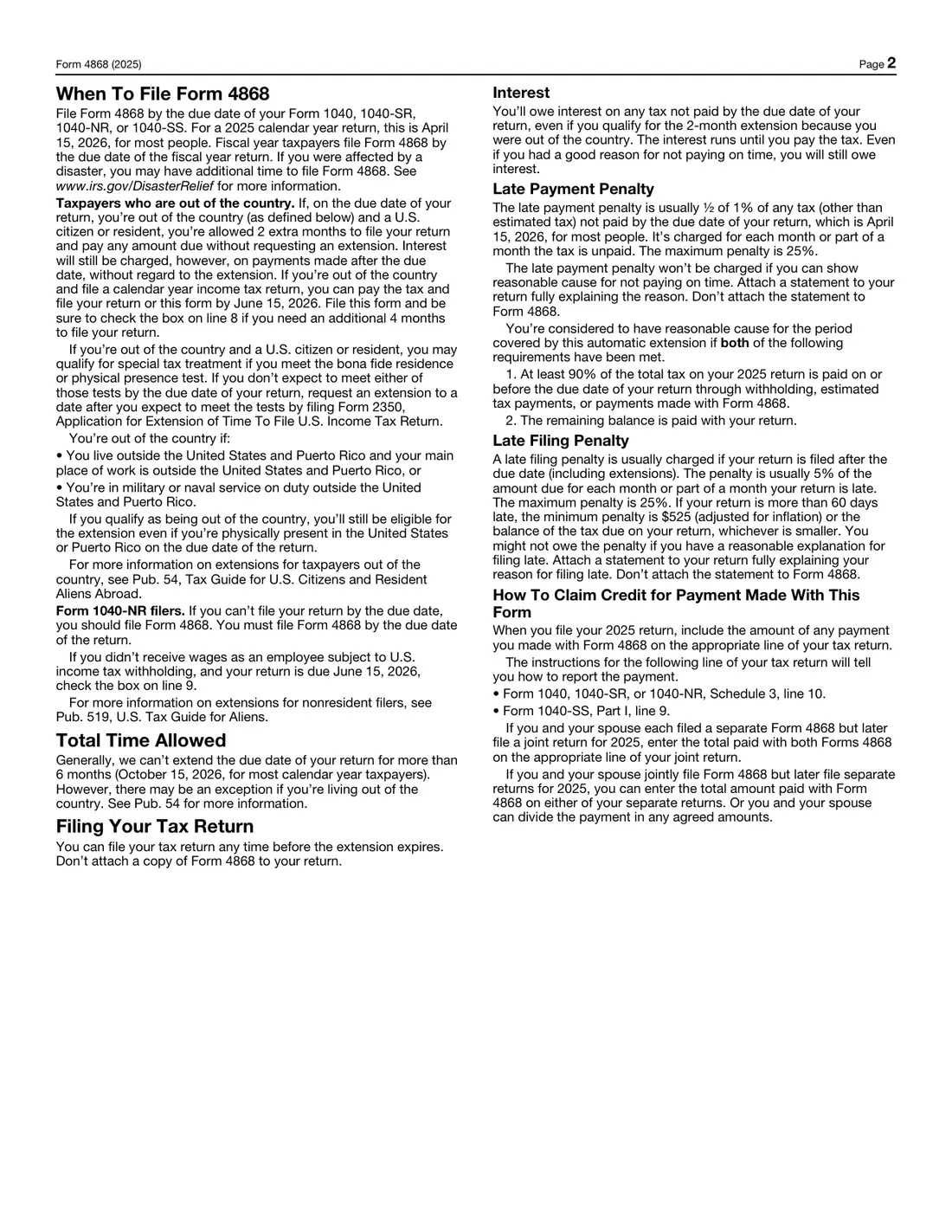
Form 4868 buys six months to file an individual income tax return. That is the whole purchase: no extra time to pay, no pause on interest, no protection past the extended date. For the 2026 tax year the operating dates are Thursday, April 15, 2027 to file the form and Friday, October 15, 2027 to file the return — the same April 15 to October 15 pattern the 2025 Form 4868 sets for 2025 returns, under the six-month ceiling in 26 U.S.C. § 6081(a). One honest limit: the IRS had not yet released the 2026 Form 4868 when this article was written on November 8, 2026, so every form figure below comes from the current 2025 edition, and the 2026 dates follow the statutory pattern rather than a published 2026 form.
The form covers Form 1040, 1040-SR, 1040-NR, and 1040-SS.
Three ways to get the extension
Topic No. 304 and the form itself list three routes. First, pay all or part of the estimated income tax due electronically and indicate the payment is for an extension — through IRS Direct Pay, an IRS online account, EFTPS, a card, or a digital wallet. The IRS automatically processes the extension when the payment lands, and no Form 4868 is filed at all. Keep the confirmation number — the only proof the extension exists. Second, e-file Form 4868 through tax software or a tax professional, and keep the electronic acknowledgment. E-filing asks for prior-year adjusted gross income for verification. Third, file a paper Form 4868 with an optional payment enclosed — the only route for fiscal-year taxpayers, per Topic No. 304. No reason is required. Two filers should not file at all: a taxpayer who wants the IRS to figure the tax, and a taxpayer under a court order to file by the due date.
Lines 4 to 7: the estimate that decides everything
Form 4868 is a worksheet with four numbers. Line 4 is the estimate of total tax liability for the year — Form 1040 line 24. Line 5 is total payments already made — withholding plus estimated tax payments, excluding the payment made with this form. Line 6 is the balance due: line 4 minus line 5, floored at zero. Line 7 is the amount being paid with the form. The estimate on line 4 carries a tripwire: "Make your estimate as accurate as you can with the information you have. If we later find that the estimate wasn't reasonable, the extension will be null and void." A null extension means the return was never extended — the deadline snaps back to April 15, and the 5-percent failure-to-file penalty runs from there. Build line 4 from the prior-year return: start with last year's line 24, adjust for known changes, and write the working.
The 90-percent safe harbor, worked
The late-payment penalty is 0.5 percent per month, but the form builds in a safe harbor that turns the extension period penalty-free for a filer who paid nearly everything on time. Both parts must hold: at least 90 percent of the total tax was paid on or before the due date through withholding, estimated tax, or a payment with Form 4868; and the remaining balance is paid with the return. Meet both and the IRS treats the filer as having reasonable cause for the extension period — no late-payment penalty for those months. Interest still runs from April 16. The safe harbor waives the penalty, never the interest.
Worked example: a single filer expects $28,400 of total tax for 2026, with $22,000 already paid through withholding and estimates. Line 4 is $28,400, line 5 is $22,000, line 6 is $6,400. She pays $4,000 with Form 4868 on April 15, 2027, so $26,000 was paid by the due date. Ninety percent of $28,400 is $25,560, and $26,000 clears the bar by $440. If she files by October 15, 2027 and pays the remaining $2,400 with the return, no late-payment penalty applies — though interest still accrues on that $2,400 from April 16. The margin matters: had she paid $3,500 instead of $4,000, paid-by-April-15 would be $25,500 — $60 short — and the safe harbor would fail in full, leaving $87.00 of penalty over six months, plus interest.
The two penalties, side by side
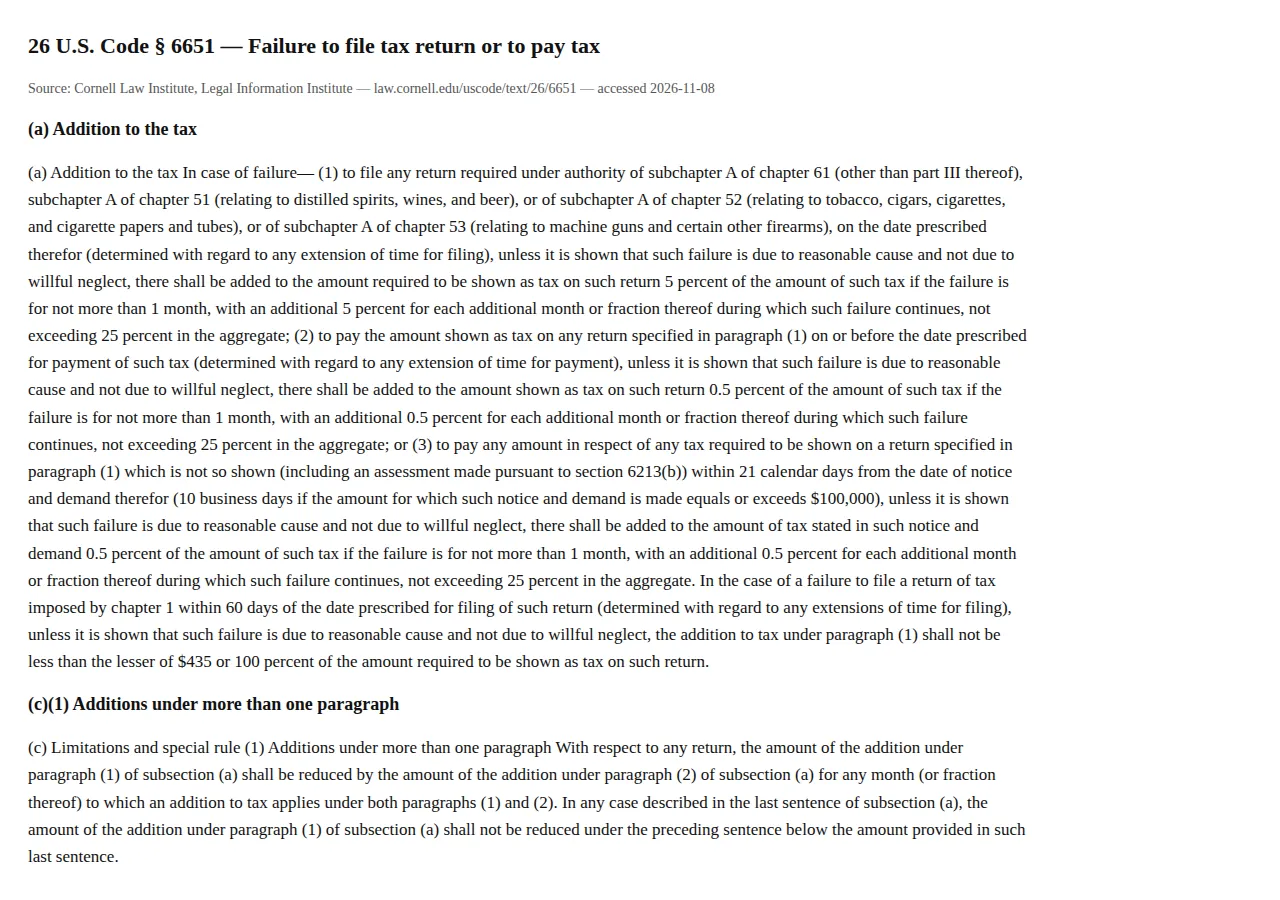
Section 6651(a) writes both penalties in the same subsection. Failure to file runs at 5 percent of the net tax due for each month or part of a month, capped at 25 percent. Failure to pay runs at 0.5 percent for each month or part of a month, also capped at 25 percent. A part of a month counts as a full month. Both are computed on the net amount due under section 6651(b) — tax required to be shown, minus amounts paid on or before the payment due date and minus credits claimed. Pay the tax in full and both penalties are zero, however late the return is.
| Penalty | Monthly rate | Cap | 60-day minimum | Authority |
|---|---|---|---|---|
| Failure to file | 5% of net tax due | 25% (5 months) | Lesser of $525 or 100% of tax due (2025 returns) | § 6651(a)(1) |
| Failure to pay | 0.5% of tax shown | 25% (50 months) | None | § 6651(a)(2) |
| Both in the same month | 5% combined (file piece cut to 4.5%) | 25% combined | Minimum still applies | § 6651(c)(1) |
Two numbers circulate for the minimum. The statute reads "the lesser of $435 or 100 percent of the amount required to be shown as tax" — that $435 is the unadjusted base figure in the Code. The 2025 Form 4868 states the minimum as $525; the $485 figure in older guides was the 2024 amount. For 2026 returns the adjusted figure comes in a later Revenue Procedure and was not published when this article was written. The minimum applies only when the return arrives more than 60 days after its due date, including extensions. When both penalties run in the same month, section 6651(c)(1) cuts the file piece by the pay piece, so the combined rate is 5 percent a month, not 5.5 percent:
Section 6651(h) halves the pay penalty to 0.25 percent a month for a timely filer paying under an approved installment agreement under section 6159; section 6651(d) raises it to 1 percent after a levy notice.
Worked example: no extension, no payment
A filer owes $18,000 for 2026, pays nothing by April 15, 2027, files no Form 4868, and files the return on November 20, 2027 — seven months and five days late, or eight month-periods, because a part of a month counts as a whole month. The failure-to-file penalty is 8 times 5 percent, which is 40 percent, capped at 25 percent: $4,500. The failure-to-pay penalty is 8 times 0.5 percent, which is 4 percent: $720. Section 6651(c)(1) cuts the file piece by the pay piece for the same months, so the file piece becomes 25 percent minus 4 percent, which is 21 percent, or $3,780, and $3,780 plus $720 is $4,500 — a quarter of the tax — plus interest from April 16 on the full $18,000.
Worked example: extension filed, payment short
A filer owes $12,000 for 2026, paid $6,000 by April 15, 2027, filed Form 4868 on time, and files the return on December 20, 2027. The 90-percent test fails: 90 percent of $12,000 is $10,800, and $6,000 is only 50 percent. The unpaid balance is $6,000, and the failure-to-pay penalty runs from April 16 at 0.5 percent per month:
April 16 to December 20 is nine month-periods, so the pay penalty is $270. The failure-to-file penalty starts only at the extended deadline: October 16 to December 20 is three month-periods, so the file piece is 3 times 5 percent of $6,000, which is $900, cut by the pay penalty for those same three months — $90 — leaving $810. Total penalty is $810 plus $270, which is $1,080. The first filer lost $4,500 on $18,000; the second lost $1,080 on $12,000 — and $270 of that was avoidable by paying $4,800 more by April 15 to clear the $10,800 safe-harbor line.
Out of the country: two months, then four more
A U.S. citizen or resident alien who is out of the country on the return due date gets two extra months automatically — generally to June 15 — to file and pay without requesting an extension. For the 2026 tax year that date is Tuesday, June 15, 2027. "Out of the country" means living outside the United States and Puerto Rico with a main place of work there, or being in military or naval service on duty outside the United States and Puerto Rico. Form 4868 adds four more months on top of the two: check the box on line 8 and the total extension is six months to October 15, 2027. A filer who does not expect to meet the bona fide residence or physical presence test by the due date should file Form 2350 instead.
Form 4868 is not Form 7004, and not Form 1040-X
Form 4868 extends an individual return; Form 7004 extends a business return; Form 1040-X amends a return already filed. Filing the wrong one buys nothing.
Form 4868 asks for the SSN or ITIN — a single-member LLC files under the owner's SSN, and an S-Corp or C-Corp shareholder files an individual extension. Pay by ACH; the SECA tax is due April 15 too, and the extension never defers SECA.
If the return was already filed and an error is found, the fix is our IRS Form 1040-X amended return playbook — not another extension. If the shortfall is in quarterly payments, see our quarterly estimated tax payments guide. Self-employed filers estimating line 4 should work from Schedule C first; see our IRS Form 1040 Schedule C playbook.
State extensions: California is automatic, the rest are not
A federal extension does not extend a state return unless state law says so. California is the generous case: the Franchise Tax Board automatically allows a six-month extension for individuals to file, with no form required, and FTB 3519 is used only to make a payment — "An extension to file your tax return is not an extension to pay." The payment is still due April 15. Other states vary: some accept the federal extension, some require their own form or voucher, and a few grant no extension at all. Check the state revenue agency before April 15.
Who should not rely on the extension
The extension is the wrong tool in three cases. A filer who cannot pay: the extension defers only the file penalty, while interest and the pay penalty keep running — an installment agreement under section 6159, which halves the pay penalty to 0.25 percent, is the tool that cuts the cost. A filer expecting a refund: the extension is harmless but pointless, since a refund return draws no penalty. A filer whose estimate is a guess, or who needs more than six months: a void extension is worse than none, and section 6081 caps the extension at six months.
Filing sequence: April 15 to October 15
- [x] Step 1: Estimate total tax for 2026. Start from the prior-year Form 1040 line 24, adjust for known changes, and write the working down — this is line 4.
- [x] Step 2: Total payments already made. Add withholding plus estimated tax payments — this is line 5; exclude the payment made with this form.
- [x] Step 3: Compute the balance and the 90-percent line. Line 6 is line 4 minus line 5. Multiply line 4 by 0.9; if payments by April 15 clear that line, the safe harbor holds.
- [x] Step 4: File or pay by April 15, 2027. Pay electronically with the extension designation, e-file Form 4868, or mail the paper form — California filers with a payment mail to P.O. Box 931300, Louisville, KY 40293-1300; without one, to Ogden, UT 84201-0045. Keep the confirmation number.
- [x] Step 5: Pay the balance with the return. File Form 1040 by October 15, 2027, pay the balance with it, and claim the Form 4868 payment on Schedule 3, line 10. Before quoting any figure, run it through the tax estimator.
- [x] Step 6: If the return will still be late, attach the reason. A reasonable-cause statement goes on the return itself, never on Form 4868, and addresses the file penalty only — not interest or the pay penalty.
Founder & CEO Insight — Enow A. Jovial