What § 6662 actually charges
Section 6662(a) adds to the tax "an amount equal to 20 percent of the portion of the underpayment to which this section applies." The penalty is charged on the underpayment — tax that should have been shown minus tax shown, less amounts already paid — on top of the tax itself plus interest under § 6601, which keeps running through the examination. The IRS does not have to prove intent.
The section applies to the portion of an underpayment attributable to one of six grounds in § 6662(b): negligence or disregard of rules or regulations; a substantial understatement of income tax; a substantial valuation misstatement under chapter 1; a substantial overstatement of pension liabilities; a substantial estate or gift tax valuation understatement; and a disallowance of claimed tax benefits for a transaction lacking economic substance under § 7701(o). The penalty applies ground by ground, portion by portion: one item can carry a negligence penalty and another a valuation penalty, each 20%.
The § 482 transfer pricing methods and penalties playbook prices the same 20% and 40% rates inside the transfer-pricing rules, where the thresholds are stricter. The § 461(l) excess business loss limitation playbook covers a limitation rule that creates understatements § 6662 then penalises.
The substantial-understatement test
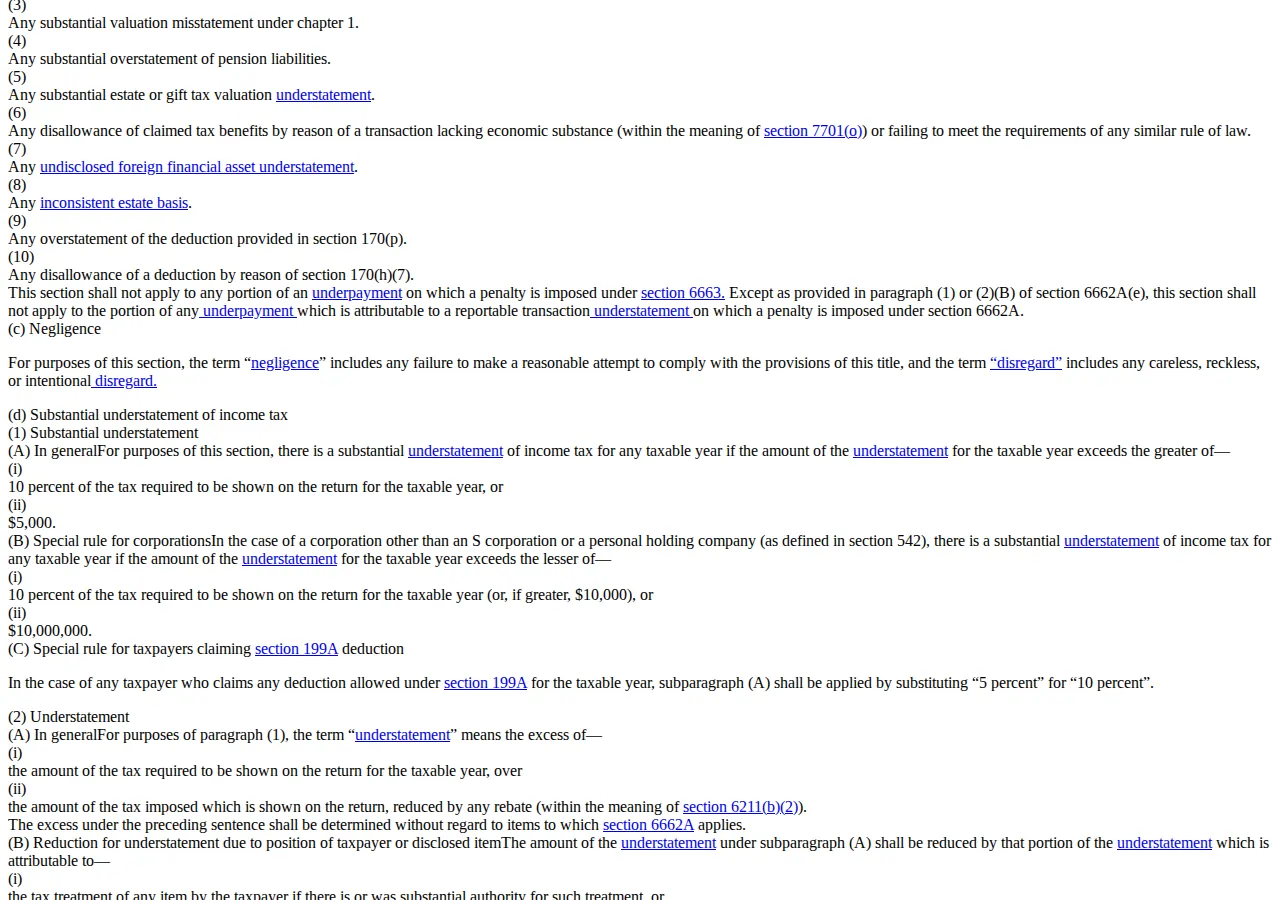
The most commonly applied ground is the substantial understatement of income tax in § 6662(d)(1): the excess of the tax required to be shown over the tax actually shown, reduced by any rebate. A § 199A claimant faces a stricter test: § 6662(d)(1)(C) substitutes 5% for 10%, so a QBI claimant crosses the threshold at half the understatement a non-claimant would need.
| Taxpayer | Substantial when the understatement exceeds | Authority |
|---|---|---|
| Individual | Greater of 10% of tax required or $5,000 | § 6662(d)(1)(A) |
| C-Corp | Lesser of 10% of tax required (or $10,000 if greater) or $10,000,000 | § 6662(d)(1)(B) |
| § 199A claimant | Greater of 5% of tax required or $5,000 | § 6662(d)(1)(C) |
| S-Corp / personal holding company | Individual test — the corporate rule excludes them | § 6662(d)(1)(B) |
Worked example: three taxpayers, one $20,000 mistake
Take an individual whose return should have shown $180,000 of tax and showed $160,000: a $20,000 understatement against a threshold of the greater of 10% of $180,000 ($18,000) or $5,000. The $20,000 exceeds $18,000, so it is substantial, and the penalty is:
Now a C-Corp whose return should have shown $2,000,000 of tax, with a $150,000 understatement. The corporate threshold is the lesser of 10% of $2,000,000 ($200,000) or $10,000,000. A $150,000 understatement is below it, so no penalty attaches. At $250,000 it would exceed $200,000, and the penalty would be 20% of $250,000, or $50,000. The same dollar error is free for the corporation and $4,000 for the individual: the threshold is a percentage of the tax at stake.
Add the § 199A twist: if that individual claimed a § 199A deduction, the threshold drops to the greater of 5% of $180,000 ($9,000) or $5,000, so a $10,000 understatement that was safe at the 10% test is now substantial, and the penalty is 20% of $10,000, or $2,000. Run the threshold through the tax estimator before filing — the time to discover the return is at 9.5% is before filing, not after the notice.
Negligence and disregard: the ground that needs no threshold
Negligence under § 6662(c) is any failure to make a reasonable attempt to comply with the tax law. It has no dollar threshold and no percentage test: a $400 understatement from a position the taxpayer never checked can carry the 20% penalty, where the same $400 would never trigger the substantial-understatement test. Treas. Reg. § 1.6662-3 gives the examples: inadequate books and records, unsubstantiated items, and a position without a reasonable basis. Disregard is the careless, reckless, or intentional disregard of rules or regulations, including a position contrary to a regulation without disclosure. A position with a reasonable basis is not negligence even if the IRS disagrees; a position with no basis is negligence even if the taxpayer believed it.
Valuation misstatements: when the number itself is the offence
Section 6662(e) penalises valuations, not positions. For income tax, a substantial valuation misstatement exists when the value or adjusted basis claimed is 150% or more of the correct amount, and the penalty does not attach unless the underpayment attributable exceeds $5,000 — $10,000 for a corporation other than an S-Corp or a personal holding company. For a § 482 transaction, the threshold is stricter: the claimed price must be 200% or more, or 50% or less, of the correct price, or the net § 482 adjustment must exceed the lesser of $5,000,000 or 10% of gross receipts.
Section 6662(h) doubles the rate for gross valuation misstatements — 400% for 200%, 25% for 50%, $20,000,000 for $5,000,000, 20% for 10% — and the rate becomes 40% instead of 20%. For estate and gift tax, § 6662(g) sets the threshold at the other end: a substantial understatement exists when the value claimed is 65% or less of the correct value, with the same $5,000 underpayment floor.
| Misstatement | Substantial at | Gross at | Rate | Authority |
|---|---|---|---|---|
| Income-tax valuation | Claimed value 150%+ of correct | 400%+ of correct | 20% / 40% | § 6662(e)(1)(A), (h) |
| § 482 transfer price | 200%+ or 50%− of correct price, or net adjustment over lesser of $5M / 10% receipts | 400%+ or 25%−, or net adjustment over lesser of $20M / 20% | 20% / 40% | § 6662(e)(1)(B), (h) |
| Estate / gift valuation | Claimed value 65%− of correct | 40%− of correct | 20% / 40% | § 6662(g), (h) |
Worked example: the $1,500,000 basis that was $900,000
A taxpayer claims a $1,500,000 basis for property whose correct basis is $900,000, producing a $63,000 underpayment. The ratio is:
At 166.7% it clears the 150% threshold, and $63,000 clears the $5,000 floor, so the penalty is:
Had the claim been $3,600,000, the ratio would be 400% — a gross misstatement — and the same $63,000 would carry a 40% penalty of $25,200. The valuation did not change the tax; it changed the rate.
The § 482 variant runs the same arithmetic on a price. A US parent charges its foreign subsidiary $2,000,000 for services the IRS prices at $800,000 under § 482. The ratio is 250%, clearing the 200% threshold, and if the net § 482 adjustment for the year is $1,200,000 against gross receipts of $8,000,000, it also clears the alternative test — $1,200,000 exceeds the lesser of $5,000,000 or 10% of $8,000,000, which is $800,000. Either test alone is enough, and contemporaneous documentation under Treas. Reg. § 1.6662-6(d), delivered within 30 days of a request, blocks the penalty even when the price was wrong.
The fraud boundary: § 6663 at 75%
Section 6663 is the line past which § 6662 stops applying. Where any part of an underpayment is due to fraud, the penalty is 75% of the portion attributable to fraud. Section 6663(b) reverses the burden once the IRS establishes fraud on some portion: the entire underpayment is treated as fraud unless the taxpayer establishes that a portion is not. The IRS must prove fraud by clear and convincing evidence — concealed income, false documents, repeated understatement — but once it does, the 75% rate applies to the whole underpayment, not just the fraudulent slice.
The boundary is intent. A valuation that is wrong because the appraiser used the wrong comparable is a § 6662 case at 20% or 40%. A valuation supported by a backdated appraisal the taxpayer knew was false is a § 6663 case at 75% — and fraud and good faith cannot coexist on the same facts, so the § 6664(c) defence does not reach it.
The defence: § 6664(c), substantial authority, and Form 8275
No penalty under § 6662 or § 6663 is imposed on any portion if the taxpayer shows reasonable cause for that portion and acted in good faith. That is § 6664(c)(1), the only defence covering every ground in the section. Reasonable cause is a facts-and-circumstances test, and the most important factor is how hard the taxpayer tried to assess the correct liability. Reliance on a qualified professional counts when the advice rested on all the facts supplied, the adviser was competent, and the taxpayer did not know it was wrong. Reliance on a valuation is reasonable cause when the appraiser was qualified and the valuation was not obviously inflated.
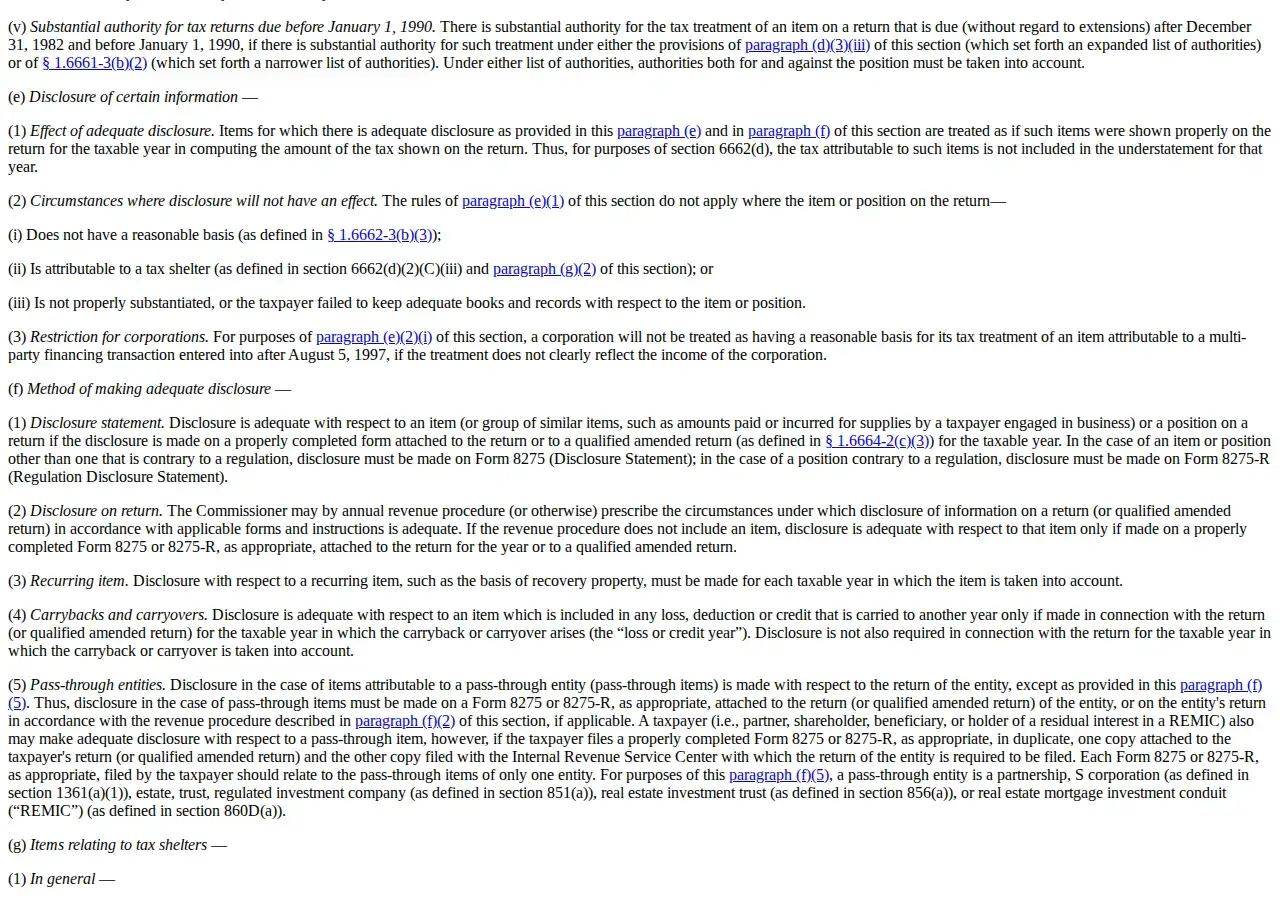
Two defences work before the examination ever starts. The first is substantial authority under Treas. Reg. § 1.6662-4(d): a position supported by the Code, regulations, revenue rulings, or court decisions at a standard more stringent than reasonable basis. A position with substantial authority cannot be penalised for substantial understatement, even if the IRS disagrees. The second is adequate disclosure: a position disclosed on Form 8275, Disclosure Statement — or on Form 8275-R for a position contrary to a regulation — reduces the understatement by the amount attributable to the disclosed item, which can pull the return below the threshold entirely. Disclosure does not help a position with no reasonable basis or a valuation misstatement, but for a debatable legal position it is the cheapest insurance in the Code.
For a net § 482 adjustment, reasonable cause needs the documentation of § 6662(e)(3)(B): contemporaneous records in existence when the return was filed, covering the method selected and the data supporting it, delivered within 30 days of a request. Documentation created after the examination starts does not count.
Founder & CEO Insight — Enow A. Jovial
The pre-filing sequence
Run this sequence before the return is filed, not after the notice arrives:
- Compute the threshold first. Apply the 10% or $5,000 test for individuals, the corporate test, or the 5% test for § 199A claimants, and write the threshold on the workpapers.
- Test every valuation against its ratio. Claimed over correct value: 150% income tax, 200% or 50% § 482 prices, 65% estate and gift tax. Any ratio near its threshold gets a second appraisal before filing.
- Check the position for substantial authority. If the authority is thin, disclose on Form 8275 — or on Form 8275-R if the position is contrary to a regulation.
- Assemble the reasonable-cause file. Books, receipts, the LLC operating agreement, the CPA's advice, the appraiser's qualifications, the transfer-pricing documentation — in existence on the filing date, not created for the examination.
- Price the penalty in the decision. A position saving $10,000 of tax and risking a $2,000 penalty is a different decision from one risking $4,000 because the return also claims § 199A.
- File the disclosure, keep the proof. Form 8275 goes with the return; the workpapers stay with the file. If the examination comes, the defence is the paper, not the memory.
The penalty checklist
- [x] Threshold computed: individual greater of 10% or $5,000; corporation lesser of 10% or $10,000,000; § 199A 5%.
- [x] Negligence checked: books and records exist, positions have a reasonable basis, nothing contrary to a regulation undisclosed.
- [x] Valuations ratio-tested: 150% income tax, 200%/50% § 482, 65% estate and gift, $5,000/$10,000 floor applied.
- [x] Gross rate priced: 400%/25%/$20,000,000 at 40%, § 6663 fraud at 75% understood.
- [x] Defence assembled: substantial authority identified, Form 8275 or 8275-R filed, reasonable-cause file existing on the filing date.
- [x] § 482 documentation delivered: contemporaneous study, best-method analysis, 30-day clock understood.
The penalty is not a judgment on character. It is a price list in the statute, with thresholds computable in advance and defences buildable before filing.
For the surrounding landscape, the IRS offer in compromise playbook covers what happens when tax, penalty, and interest together exceed what can be paid, and the Form 941 quarterly payroll tax filing playbook covers the separate failure-to-deposit ladder — 2%, 5%, 10%, 15% — on a different clock from § 6662.