What an offer in compromise is — and what it is not
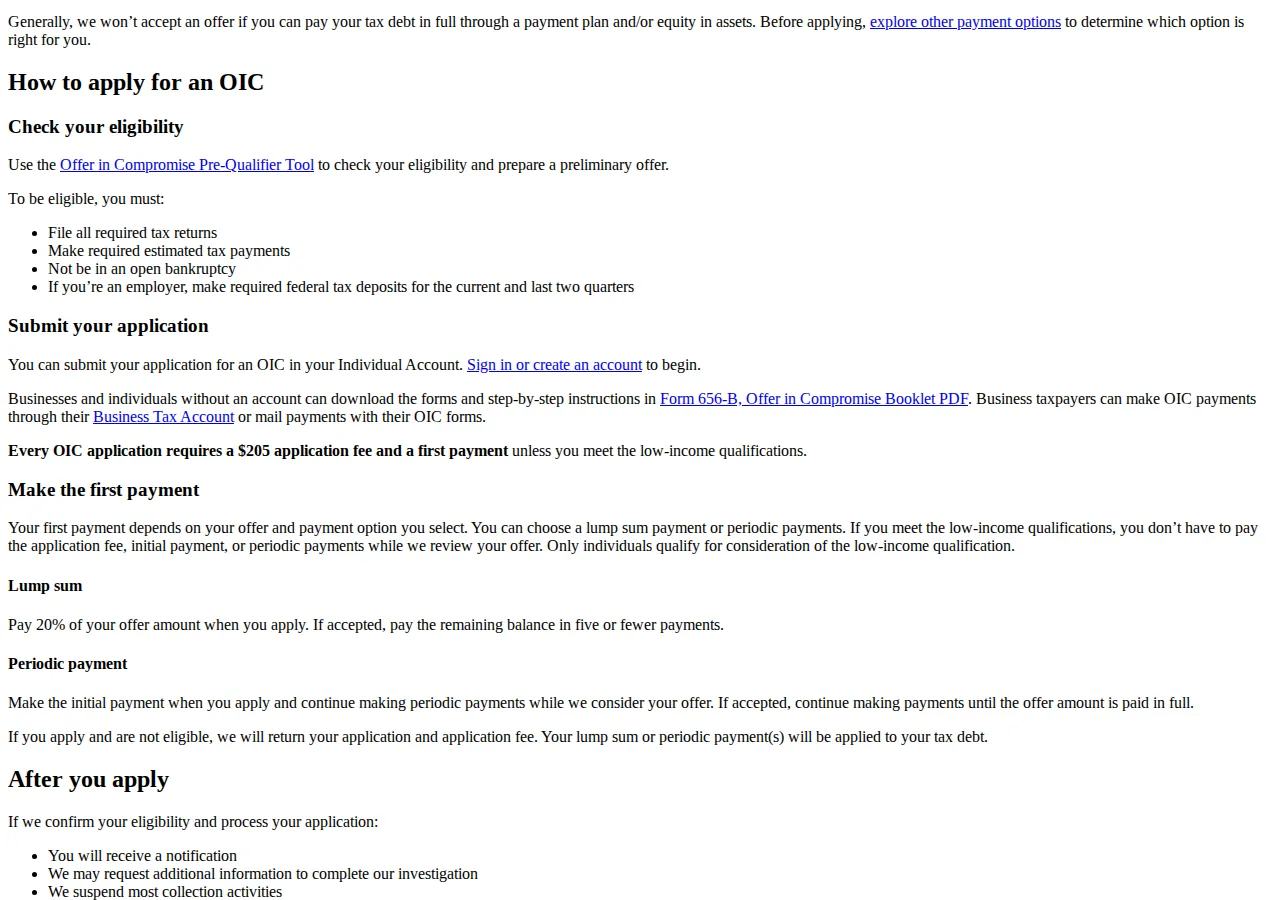
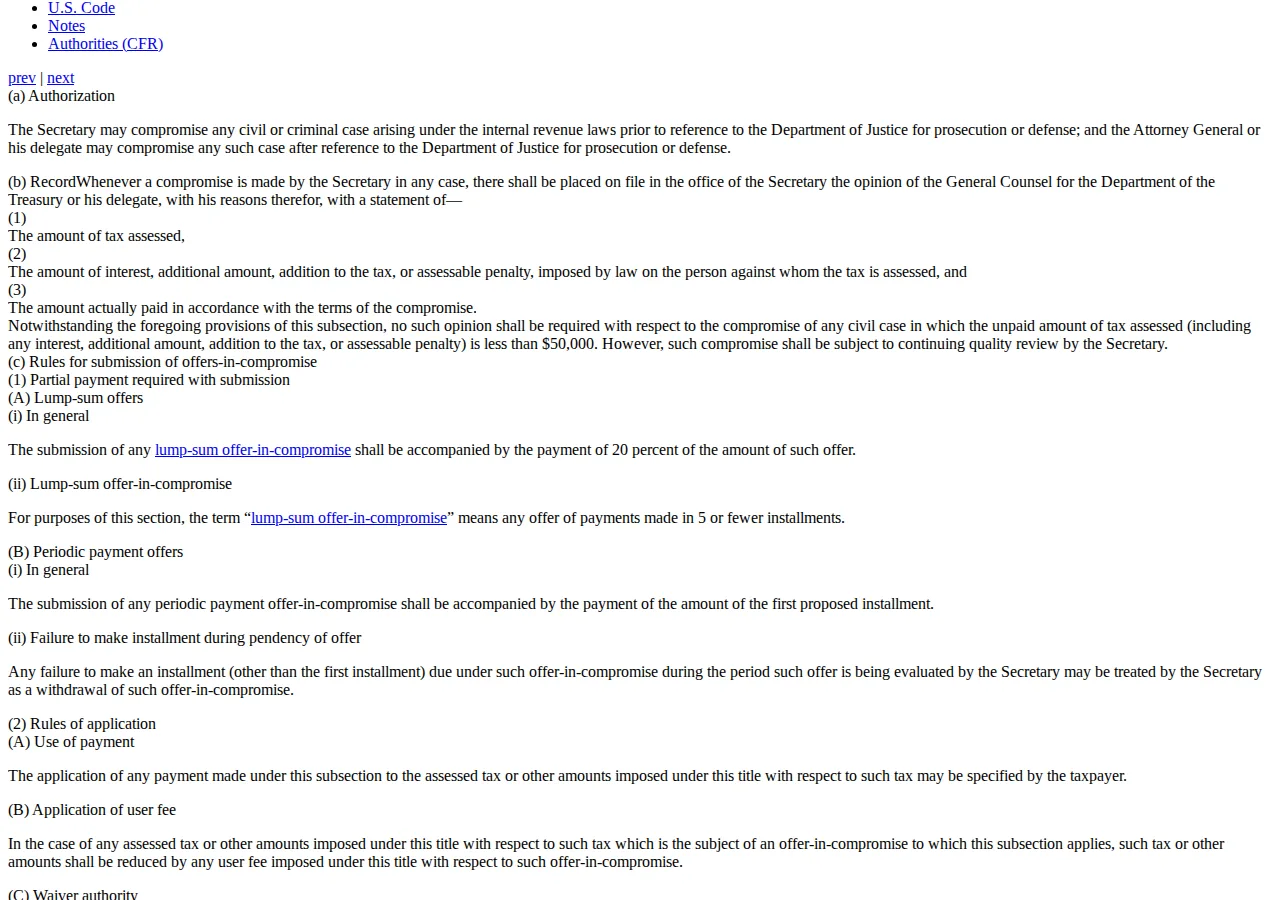
An offer in compromise is a written agreement between a taxpayer and the Internal Revenue Service that settles a tax liability for less than the full amount owed. The authority is 26 U.S.C. § 7122(a): the Secretary may compromise any civil or criminal case arising under the internal revenue laws before the case is referred to the Department of Justice for prosecution or defense. The statute gives the IRS discretion, and the regulations and the Form 656 booklet turn that discretion into a procedure with fixed gates.
The offer is not a plea for mercy and it is not a way to buy time. The IRS states plainly in Form 656-B, the Offer in Compromise Booklet, that it will generally not accept an offer if you can pay the tax debt in full through an installment agreement, equity in assets, or both. The test is collectibility: if the money is there — in a bank account, in home equity, in future income — the IRS collects it. The offer exists for the taxpayer whose assets and income are less than the full liability, which is the exact ground the regulation names as doubt as to collectibility.
The three grounds: Treas. Reg. § 301.7122-1
The regulation recognizes three grounds for compromise, and every offer must name one. Most founder offers are filed on the second.
| Ground | What it means | Who it fits | Authority |
|---|---|---|---|
| Doubt as to liability | A genuine dispute over whether the tax is owed or how much | The assessment itself is wrong | Treas. Reg. § 301.7122-1(b)(1) |
| Doubt as to collectibility | Assets and income are less than the full liability | The balance exceeds lifetime repayment capacity | Treas. Reg. § 301.7122-1(b)(2) |
| Effective tax administration | Full collection is possible but would cause economic hardship | Full payment would destroy health, welfare, or the business that produces income | Treas. Reg. § 301.7122-1(b)(3); § 301.6343-1 |
Doubt as to liability does not exist where the liability has been established by a final court decision or judgment. If the Tax Court has already ruled, that ground is closed — file on collectibility instead. Effective tax administration is the narrowest ground: the IRS must determine that collection in full would cause economic hardship within the meaning of § 301.6343-1, or that exceptional circumstances make full collection unjust.
The eligibility gates: file first, then offer
Before the IRS evaluates a dollar of your offer, it checks four gates. Fail one and the application is returned, the fee is returned with it, and no evaluation happens.
- File all required tax returns. Every return the law required you to file must be filed. A missing year is a returned application, not a rejected offer.
- Make all required estimated tax payments. Current-year estimates must be current.
- Do not be in an open bankruptcy. An open bankruptcy case bars the offer entirely.
- Employers: make all required federal tax deposits. An employer must be current on deposits for the current quarter and the prior two quarters.
These are the IRS's own published eligibility conditions, and the practical consequence is sequencing: the offer is the last step in a compliance repair, not the first. File the missing returns, bring estimates current, close or wait out the bankruptcy, then offer.
The RCP formula: the number that decides the offer
Reasonable collection potential is the IRS's measure of what it could collect from you over the collection period. The Form 656-B worksheet computes it in two parts: the equity in your assets, and your future remaining income.
The multiplier depends on how you will pay:
A lump-sum offer is one paid in five or fewer installments within five months. A periodic-payment offer is paid in monthly installments over six to twenty-four months. The multiplier is the whole price of time: the IRS counts twelve months of your future income for a fast payment and twenty-four months for a slow one. The same taxpayer, the same income, the same assets — and the periodic offer costs exactly twelve more months of remaining income than the lump-sum offer.
Remaining monthly income is gross monthly income minus allowable living expenses, and the allowances are not your actual spending. The IRS Collection Financial Standards — effective June 29, 2026 — set national standards for food, clothing, and other items by family size, allowed in full without questioning what you actually spent, and local standards for housing, utilities, and transportation that vary by location, where you are allowed the lesser of what you actually spent or the standard.
Example: the same taxpayer, two offer prices
A self-employed operator owes $120,000 in assessed tax, penalties, and interest. Her Form 433-A collection information statement shows $20,000 of available assets after secured debts, and remaining monthly income of $800 after the national and local standards are applied. The worksheet gives two minimums:
| Payment option | Calculation | Minimum offer |
|---|---|---|
| Lump sum (5 or fewer payments, 5 months) | $20,000 + ($800 × 12) | $29,600 |
| Periodic (6 to 24 monthly payments) | $20,000 + ($800 × 24) | $39,200 |
The periodic offer costs $9,600 more — twelve months of $800 — for the privilege of paying slowly. That is the first decision the playbook forces: if you can raise the lump sum, the same balance settles for $9,600 less. If you cannot, the periodic offer still settles a $120,000 balance for $39,200, and the monthly payment is $39,200 divided by the number of months you propose — $1,633 a month over 24 months.
The first payment: what it costs to file
Every offer requires a $205 application fee and a first payment, unless you meet the low-income qualifications — and only individuals qualify for low-income treatment. A low-income taxpayer pays no application fee, no initial payment, and no periodic payments while the IRS reviews the offer.
For everyone else, the first payment is set by the payment option:
| Payment option | First payment with the application | If accepted |
|---|---|---|
| Lump sum | 20% of the offer amount + $205 fee | Remaining balance in 5 or fewer installments |
| Periodic payment | First monthly installment + $205 fee | Monthly installments continue through review and to completion |
The 20% rule comes from § 7122(c)(1)(A): the submission of a lump-sum offer must be accompanied by payment of 20 percent of the amount of the offer, and a lump-sum offer is any offer of payments made in five or fewer installments. The example above makes the cash cost concrete: a $29,600 lump-sum offer costs $5,920 plus the $205 fee — $6,125 — to file. The $39,200 periodic offer costs the first installment of $1,633 plus the $205 fee — $1,838 — to file, and the installments continue every month while the IRS evaluates.
The 24-month clock: deemed acceptance
Section 7122(f) sets a deadline the IRS must meet: any offer is deemed accepted if the Secretary does not reject it before the date 24 months after the date of submission. Periods when the liability is in dispute in a judicial proceeding do not count toward the 24 months. The deemed-acceptance rule is the taxpayer's protection against an offer that sits unexamined — but it is not a strategy. An offer filed at a number below RCP will be rejected long before month 24. The clock matters for the offer that is correctly computed and properly documented: it guarantees an answer.
If the IRS rejects the offer, the taxpayer has 30 days to request an appeal with the IRS Independent Office of Appeals. The appeal is where a rejected offer is most often reversed: the appeals officer re-runs the RCP computation, and a common reversal is an expense the examiner disallowed that the standards actually permit. Most OIC balances are born in an audit: an assessment that survives the IRS tax audit defense playbook becomes a collectible balance, and the offer is the collection-stage answer to it.
The five-year tail: what acceptance obligates
Acceptance is not the end of the obligations. The taxpayer must meet all filing and payment obligations through the fifth year after the offer is accepted, and failure during that period may result in the IRS defaulting the offer — a defaulted offer revives the full original liability, less the payments already made. The five-year tail is the part founders underestimate: the settlement buys a clean balance sheet, but only if the next five tax years are filed on time and paid in full. Run your own balance through the tax estimator before you file, so the offer starts from a number you computed, not one the IRS hands you.
The offer also has a return path that is not a rejection. If you have filed your returns but have not yet received a bill for at least one tax debt included in the offer, the IRS may return the offer and the application fee, and apply any initial payment to the tax debt. That is an administrative return, not a denial — refile once the bill arrives.
Founder & CEO Insight — Enow A. Jovial
The filing sequence
The forms are Form 656, Offer in Compromise, with Form 433-A (OIC) for individuals or Form 433-B (OIC) for businesses. The Form 656-B booklet carries the step-by-step instructions and the RCP worksheet. A taxpayer represented by a CPA or attorney files Form 2848 with the offer; the Form 2848 power of attorney playbook covers the authorization and the CAF number.
The statement demands the full paper trail: payroll registers showing FICA withholding, the LLC operating agreement or the S-Corp election on Form 2553, the C-Corp board minutes behind the deductions, bank statements tracing each ACH and Wire transfer, and the CPA workpapers behind the filed return.
- [x] Step 1 — Repair compliance: file all required returns, pay current estimates, confirm no open bankruptcy, and bring employer deposits current for the current and prior two quarters.
- [x] Step 2 — Complete Form 433-A (OIC): six pages, sections 1 through 7 for a self-employed individual, with bank statements, pay stubs, and asset valuations attached.
- [x] Step 3 — Apply the Collection Financial Standards: national standards for food, clothing, and other items by family size; local standards for housing and transportation by location.
- [x] Step 4 — Compute the RCP: available assets plus remaining monthly income times 12 for a lump-sum offer or times 24 for a periodic-payment offer.
- [x] Step 5 — Choose the payment option: lump sum if the 20% first payment and the five-month balance are affordable; periodic if the monthly installment is the only affordable path.
- [x] Step 6 — File Form 656 with the fee and first payment: $205 plus 20% of a lump-sum offer, or $205 plus the first installment of a periodic offer; low-income individuals file without either.
- [x] Step 7 — Pay every installment on time during review: a missed installment can be treated as a withdrawal.
- [x] Step 8 — Appeal within 30 days if rejected: the Independent Office of Appeals re-runs the RCP computation.
- [x] Step 9 — Keep the five-year tail clean: file and pay on time for five years after acceptance, or the offer defaults and the full balance revives.
Who should not file an offer
An offer is the wrong instrument when the balance is payable in full through an installment agreement, when returns are unfiled, when a bankruptcy is open, or when the taxpayer is an employer behind on federal tax deposits. It is also wrong when the liability itself is disputed: that is a doubt-as-to-liability case, argued on the assessment, not settled on collectibility. And it is wrong when the taxpayer cannot keep the five-year tail — a defaulted offer is worse than no offer, because the payments made are kept and the full balance, less those payments, comes back with interest still running.