IRS Form 1065: Partnership Tax Return Playbook
A partnership pays no federal income tax. That sentence is the trap. Because the partnership itself owes no tax, founders treat Form 1065 as paperwork — and then the penalty arrives, priced per partner, per month, for up to twelve months, on a return that reported zero tax due. The 2025 return for a calendar-year partnership is due March 16, 2026. Miss it by three months with four partners: $3,060. Miss it by a year with ten: $30,600.
Who files, and what the return is
Every partnership must file a return for each taxable year. That is 26 U.S.C. § 6031(a), and it covers every domestic partnership as defined in § 761(a) — general and limited partnerships, LLPs, and every multi-member LLC that has not elected to be taxed as a corporation.
Form 1065 is an information return. It reports income under the partnership's EIN; it does not pay tax on it. The income flows through to the partners, who report their shares on their own returns. That pass-through structure is why the filing obligation is easy to underestimate: no tax bill is attached to the form, so no payment deadline forces attention.
> [!KEY TAKEAWAY]
> Form 1065 is an information return, not a tax payment. The partnership reports the income and the IRS taxes the partners — but the filing deadline, the K-1 delivery deadline, and the $255-per-partner-per-month penalty all run against the partnership itself, even on a zero-tax return.
The deadline machine
The deadline rule is one sentence in the IRS Instructions for Form 1065: a domestic partnership must file by the 15th day of the 3rd month following the date its tax year ended. For a calendar-year partnership, that is March 15. When March 15 falls on a Saturday, Sunday, or legal holiday, the return is timely if filed on the next day that is none of those. March 15, 2026 is a Sunday, so the 2025 return is due March 16, 2026.
Fiscal-year partnerships use the same arithmetic on their own year-end: a tax year ending June 30 files by September 15, and a short tax year uses the same rule measured from the short year-end.
The extension is Form 7004, Application for Automatic Extension of Time To File Certain Business Income Tax, Information, and Other Returns. File it by the regular due date and it extends the filing deadline by six months: for the 2025 calendar-year return, from March 16, 2026 to September 15, 2026. The extension covers filing only. It does not extend the time to pay any tax the partners owe — and it does not create a separate, later K-1 deadline, because the K-1 clock and the return clock are the same clock.
$
\text{Due date} = \text{Tax year end} + \text{2 months and 15 days}
$
$
\text{Extended due date} = \text{Regular due date} + \text{6 months (Form 7004)}
$
| Return | Calendar-year due date | Extended due date (Form 7004) |
| :--- | :--- | :--- |
| Form 1065, 2025 tax year | March 16, 2026 | September 15, 2026 |
| Form 1065, fiscal year ending June 30 | September 15 | March 15 following |
Schedule K-1: where the income lands
Schedule K is the partnership's summary of everything it earned, deducted, and credited. Schedule K-1 is the per-partner statement, showing that partner's distributive share of each item. The allocation follows the partnership agreement, and the K-1 is the document the partner uses to report the income on a personal return.
The allocation math is simple arithmetic with real consequences. Take a three-partner consulting LLC taxed as a partnership with $240,000 of ordinary business income and a 40/35/25 profit split:
$
\text{Partner A (40\%)} = \$240{,}000 \times 0.40 = \$96{,}000
$
$
\text{Partner B (35\%)} = \$240{,}000 \times 0.35 = \$84{,}000
$
$
\text{Partner C (25\%)} = \$240{,}000 \times 0.25 = \$60{,}000
$
Each partner reports that amount as SECA-taxed ordinary income whether or not the partnership distributed a dollar of it. A partner allocated $96,000 who received $40,000 in distributions still owes tax on $96,000. That gap — tax on money never received — is the most common surprise in partnership taxation, and it is entirely lawful: the tax follows the allocation, not the cash. Partners who want cash to cover the tax negotiate tax distributions in the operating agreement before the year starts, not after the K-1 arrives.
The K-1 also carries the items that do not fit in ordinary income: net rental real estate income, interest, dividends, royalties, capital gains and losses, § 179 expense, credits, and the partner's share of partnership liabilities. Guaranteed payments — fixed amounts paid to a partner for services or for the use of capital, reported on K-1 line 4 — are ordinary income to the recipient and deductible by the partnership, paid regardless of profit.
!IRS Instructions for Form 1065, When To File section
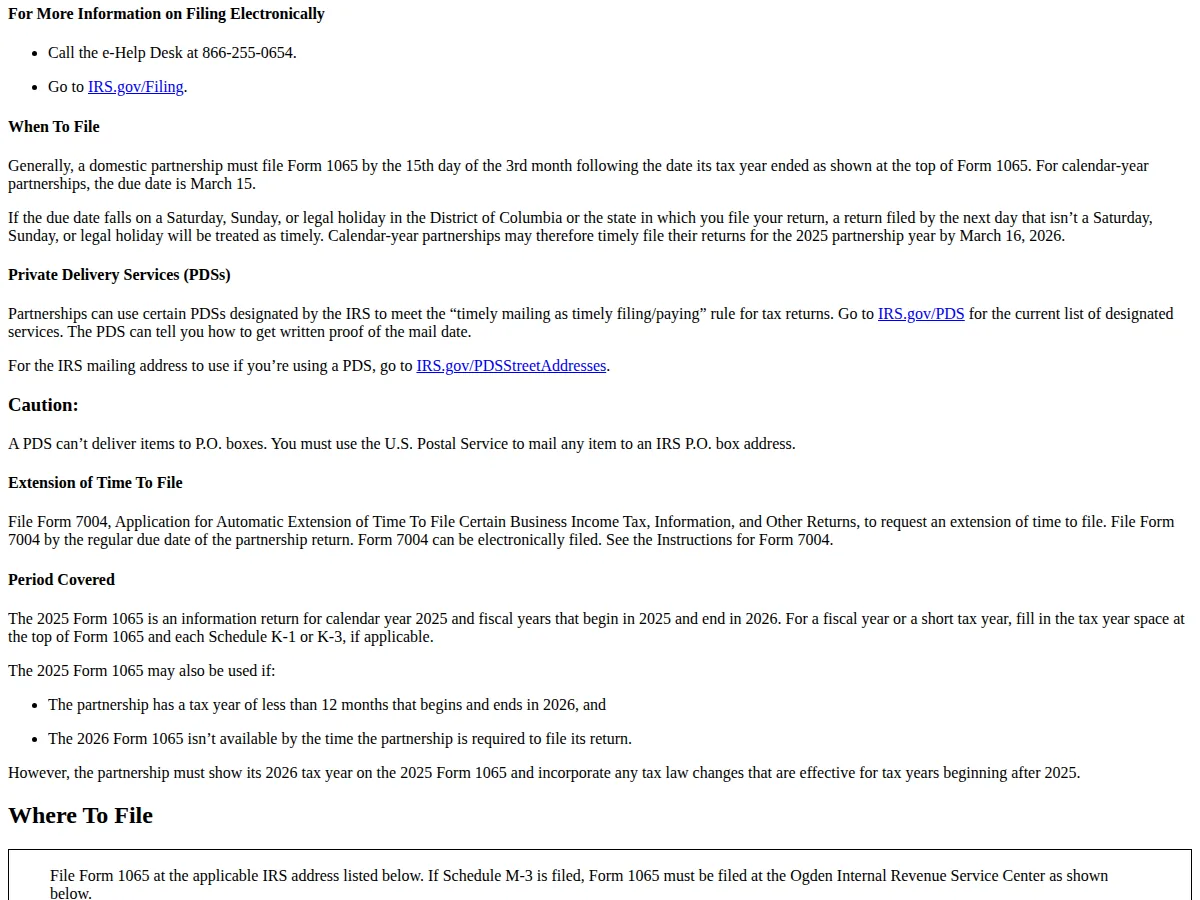
The IRS Instructions for Form 1065 state the deadline rule: file by the 15th day of the 3rd month following the tax year end — March 16, 2026 for the 2025 return, because March 15, 2026 is a Sunday.
A wrong K-1 is corrected with an amended K-1. Under the centralized audit regime, a partnership that discovers an error after filing generally corrects it through an Administrative Adjustment Request (AAR) rather than an amended return, and the AAR route decides whether the partnership or the partners absorb the resulting tax. The practical rule is blunt: the K-1 is the partner's tax return input, so a K-1 error is a partner's tax error.
> [!WARNING]
> A partnership that files Form 1065 on time but sends the Schedule K-1s late has still broken the law. Section 6031(b) requires the K-1s to reach the partners on or before the return due date, and the failure-to-furnish penalty under § 6722 is charged per statement. File the return, furnish the K-1s, and do both on the same day.
The penalty machine: § 6698
The late-filing penalty for a partnership return is 26 U.S.C. § 6698. The statute sets a base figure of $195 per partner per month, adjusted annually for inflation and rounded down to the nearest $5. For returns required to be filed in 2026 — the 2025 tax-year return due March 16, 2026 — the inflation-adjusted figure is $255 per partner per month. The penalty runs for each month or fraction of a month the failure continues, capped at twelve months, and it applies even when the partnership owes no tax.
$
\text{Late-filing penalty} = \$255 \times \text{number of partners} \times \text{months late (max 12)}
$
$
\text{Maximum per partner} = \$255 \times 12 = \$3{,}060
$
| Partners | 1 month late | 3 months late | 6 months late | 12 months late |
| :--- | :--- | :--- | :--- | :--- |
| 10 | $2,550 | $7,650 | $15,300 | $30,600 |
Two details make the penalty worse than the table suggests. First, a fraction of a month counts as a full month: a return filed one day into the second month is charged for two months. Second, the partner count is everyone who was a partner at any time during the tax year, not just the partners remaining at year-end. A partner who left in February still counts.
The relief paths are narrow. Reasonable cause — a fire, a death, destroyed records, reliance on a tax professional who failed — can abate the penalty if the partnership shows it exercised ordinary business care and the failure was nevertheless unavoidable. Rev. Proc. 84-35 gives small partnerships a further path: ten or fewer partners, each a natural person or an estate, with no special allocations and no tiered partners, that files late but shows reasonable cause may avoid the penalty. Neither path is automatic; both require asking in writing, with facts.
The audit regime: BBA and the partnership representative
Since the Bipartisan Budget Act of 2015, partnership audits happen at the partnership level. Section 6221(a): any adjustment to a partnership-related item is determined, and any tax attributable to it is assessed and collected, at the partnership level. The IRS audits the partnership, not the individual partners, and the resulting tax — the imputed underpayment — is generally paid by the partnership in the year the audit closes, unless the partnership elects to push the adjustment out to the reviewed-year partners.
The hinge of the regime is the partnership representative. Section 6223 requires every partnership to designate a partner or other person with a substantial presence in the United States as the representative, who has the sole authority to act for the partnership in the audit. If no designation is in effect, the IRS may select any person. The representative binds the partnership and every partner by their actions — including settling the audit. Name the representative in the operating agreement and never leave the designation blank.
Small partnerships can elect out. Section 6221(b) lets a partnership with 100 or fewer partners elect out for a taxable year, provided every partner is an eligible partner — an individual, a C corporation, a foreign entity that would be a C corporation, an S corporation, or an estate — and the partnership must furnish 100 or fewer K-1s. A partner that is itself a partnership, a trust, or a disregarded entity kills the election.
!26 U.S.C. § 6031, the partnership return requirement
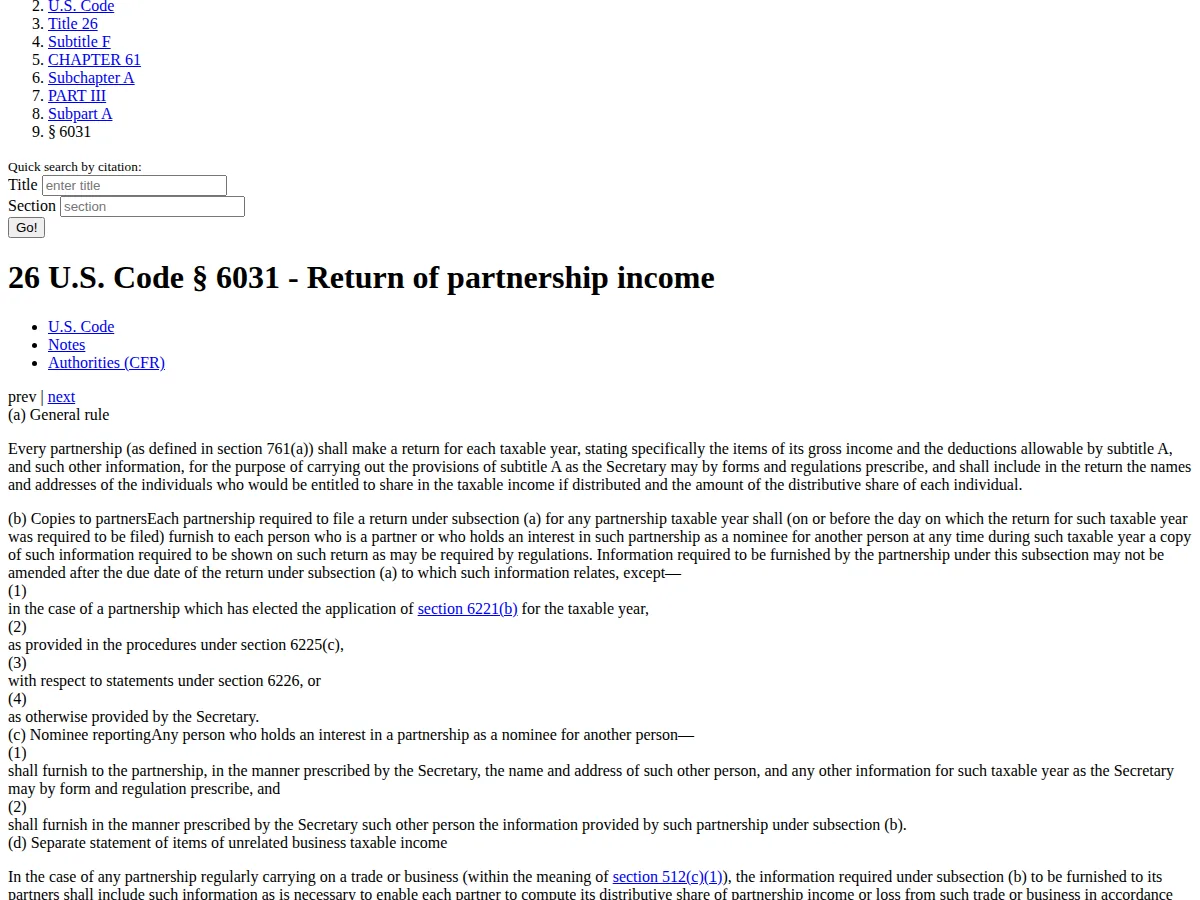
26 U.S.C. § 6031(a) requires every partnership to file a return stating its gross income and deductions, and § 6031(b) requires the K-1s to reach the partners on or before the return due date.
Basis and the § 754 election
A partner's outside basis — the tax basis in the partnership interest — decides whether a distribution is tax-free and whether a loss is deductible. It starts with the capital contribution, increases by the partner's share of income and of liabilities under § 752, and decreases by distributions and by the partner's share of losses. A distribution above outside basis is gain; a loss above it is suspended until basis is restored.
The § 754 election keeps a buyer's basis from being taxed twice. When a partner sells an interest, the buyer takes a cost basis in the interest, but the partnership's inside basis in its assets does not change — so the buyer can be taxed on the same gain again when the partnership later sells the asset. A § 754 election lets the partnership adjust the inside basis for that buyer under § 743(b). The election is made with a timely filed return, applies to that year and all later years, and can be revoked only with IRS consent.
$
\text{§ 743(b) adjustment} = \text{buyer's cost basis in the interest} - \text{buyer's share of inside basis}
$
Worked example: a partner buys a 25% interest for $150,000, and the inside basis attributable to that share is $100,000. With a § 754 election in effect, the partnership records a $50,000 § 743(b) adjustment for the buyer — the buyer is not taxed again on that $50,000 when the partnership sells the asset. The election is not free: it requires a § 755 allocation among the partnership's assets, applies to every later transfer and distribution while in effect, and can produce a negative adjustment when a buyer pays less than the inside basis.
Decision table: which return, which deadline, which penalty
| Entity | Return | Calendar-year due date | Late-filing penalty |
| :--- | :--- | :--- | :--- |
| Partnership / multi-member LLC | Form 1065 | March 16, 2026 (2025 year) | $255 per partner per month, 12-month cap (§ 6698) |
| S corporation | Form 1120-S | March 16, 2026 (2025 year) | $255 per shareholder per month, 12-month cap (§ 6699) |
| C corporation | Form 1120 | April 15, 2026 (2025 year) | 5% of unpaid tax per month, 25% cap (§ 6651) |
Operator boundaries: who should not treat this as routine
Do not file Form 1065 late on the theory that the partnership owes no tax. The penalty is priced in partners and months, and a zero-tax return is the most expensive kind to file late: no tax offsets the penalty and no payment deadline forces the filing. Do not leave the representative designation blank. Do not elect § 754 when interests are changing hands below inside basis without pricing the negative adjustment. Do not assume the BBA election-out is available: a single tiered partner kills it.
The adjacent decisions: the IRS Form 2553 S-corp election deadline playbook works the 2-month-15-day election window from the statute; the § 199A QBI deduction guide prices the K-1 income at 20% for qualifying businesses; and the quarterly payroll tax filing guide prices the payroll taxes on guaranteed payments.
> [!FOUNDER]
> "The partnership return is the one filing where doing nothing costs the most. A C corporation that files late pays a percentage of tax it owes. A partnership pays per partner per month for reporting income it already gave away. File on time, send the K-1s the same day, and name your representative before the IRS names one for you."
> — Enow A. Jovial, Founder & Chief Executive Officer
Execution checklist
Run the penalty exposure for your own partner count and delay through the tax estimator before deciding whether a late filing is worth the wait.
> [!TIP]
> File the return and furnish the K-1s on the same day, from the same sitting, and keep the delivery confirmations with the return workpapers. The partnerships that get hurt file on March 16 and mail the K-1s in April — the return is timely, the furnishing is late, and the penalty is per statement.