Section 461(l) Excess Business Loss Limitation Playbook: The $256,000 Cap, the NOL Carryforward, and the 2026 Reset
A sole proprietor closes 2026 with an $800,000 business loss and $200,000 of W-2 wages. This year she may deduct only $256,000 of that loss — down from $313,000 in 2025 — and the rule behind the number is now permanent. The other $544,000 becomes a net operating loss, a NOL, carried forward under section 172, but it can never shelter more than 80 percent of a future year's taxable income.
The statute in one paragraph
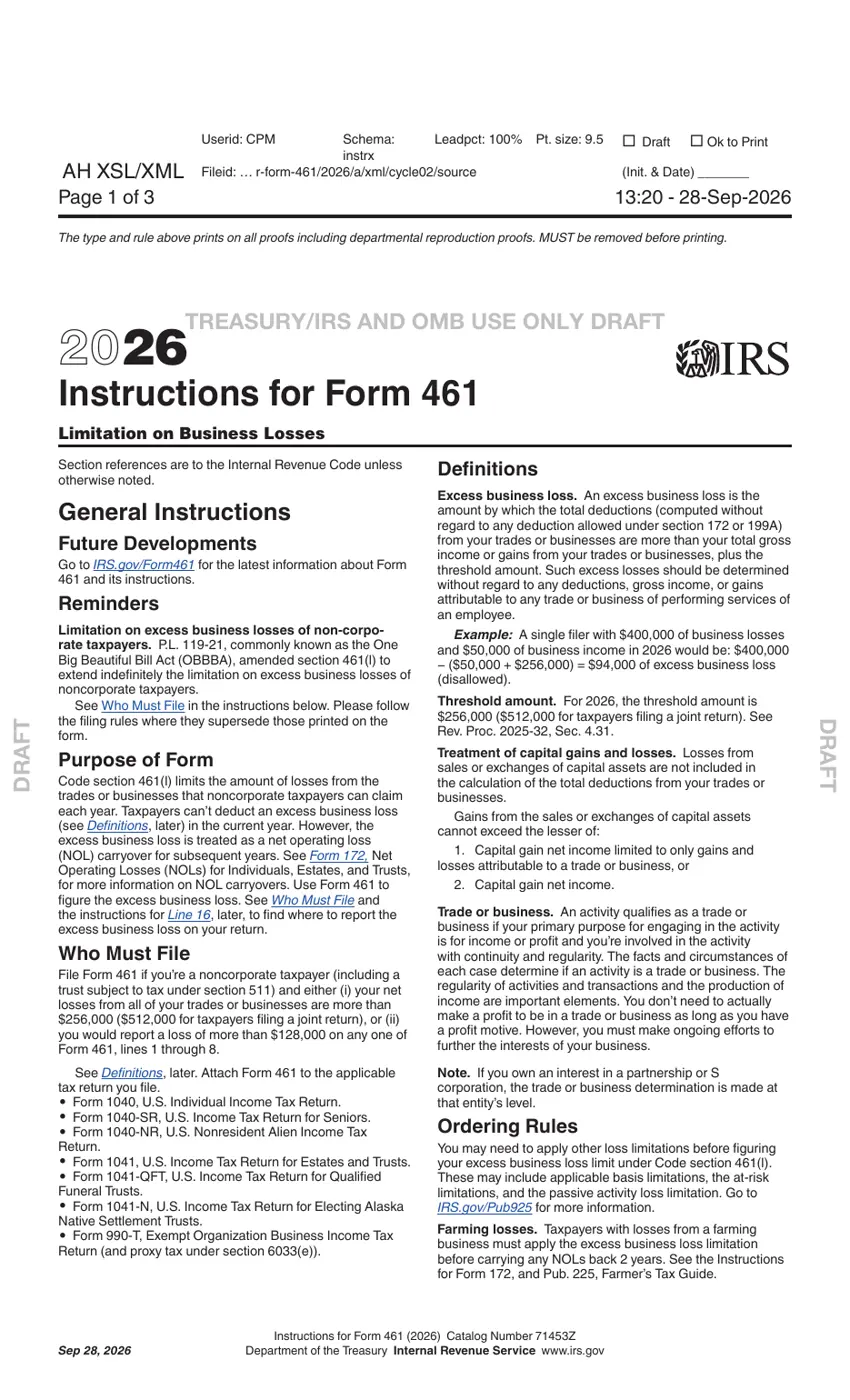
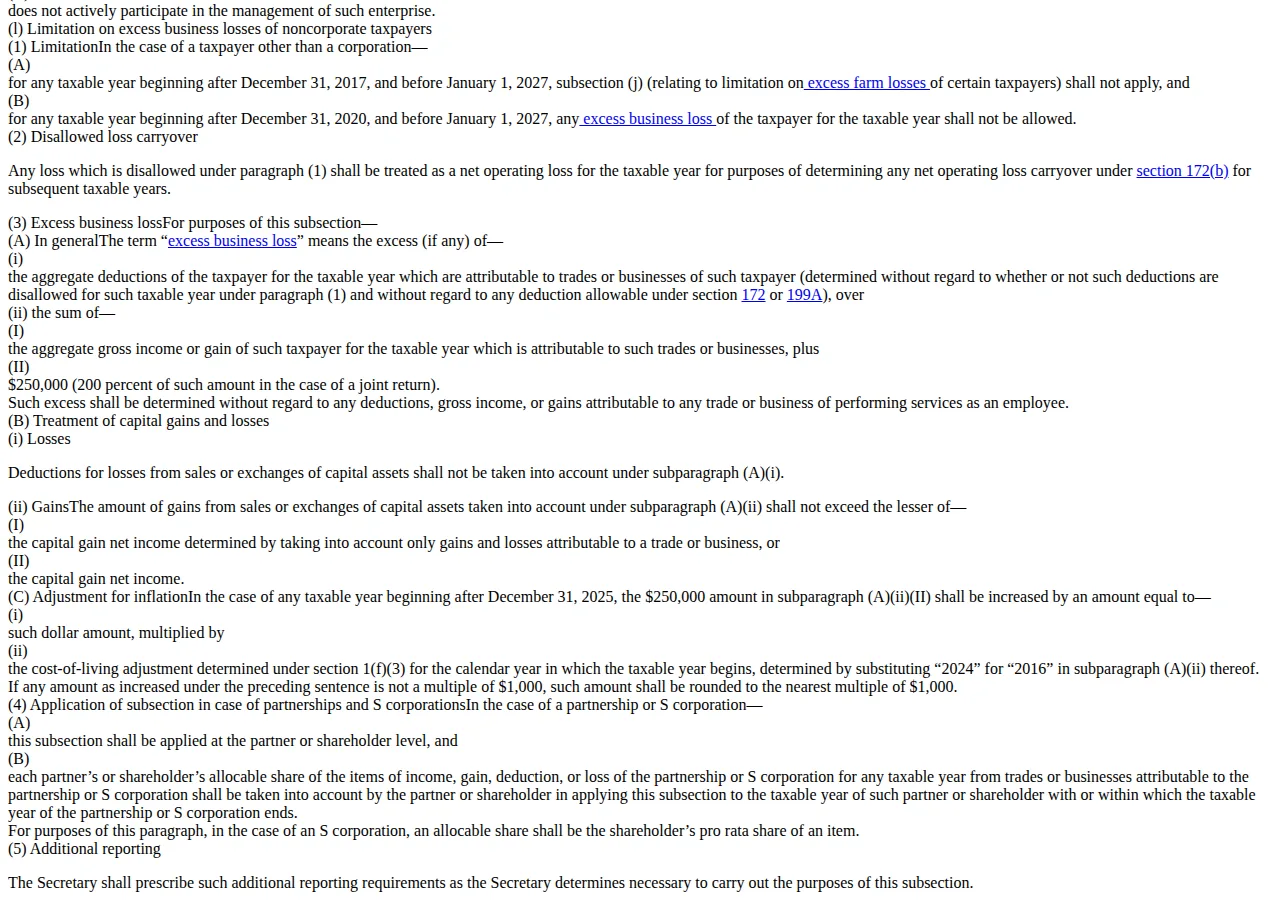
Section 461(l)(1) provides that, for a taxpayer other than a corporation, "any excess business loss of the taxpayer for the taxable year shall not be allowed." Section 461(l)(2) gives the disallowed loss its second life: it "shall be treated as a net operating loss" for purposes of the section 172(b) carryover. Section 461(l)(3)(A) defines the excess as the amount by which aggregate business deductions exceed aggregate business gross income or gain plus the threshold — $250,000 as the base, doubled to $500,000 for a joint return, then adjusted for inflation. Two carve-outs shape the computation: deductions are counted "without regard to any deduction allowable under section 172 or 199A," so neither a NOL deduction nor the qualified business income deduction can shrink the excess; and employee-service income is excluded — W-2 wages, the pay that carries FICA withholding, sit outside the test. The formula is:
Section 461(l)(4) applies the test at the partner or shareholder level — the pro rata share for an S-Corp. Section 461(l)(6) applies the subsection after section 469.
The 2026 reset: why the cap fell while prices rose
The One Big Beautiful Bill Act, P.L. 119-21, signed July 4, 2025, changed section 461(l) through its section 70601. Subsection 70601(a) struck "and before January 1, 2029" from section 461(l)(1), making the limitation permanent for taxable years beginning after December 31, 2026. Subsection 70601(b) reset the inflation base years from 2018 and 2017 to 2025 and 2024, so the threshold is indexed from the original $250,000 and $500,000 starting points — which is why the 2026 numbers dropped. The draft 2026 Instructions for Form 461 confirm both changes: P.L. 119-21 "amended section 461(l) to extend indefinitely the limitation on excess business losses of noncorporate taxpayers." The draft instructions also carry the Service's own worked example: a single filer with $400,000 of losses and $50,000 of income has $94,000 of excess business loss.
| Tax year | Single / head of household | Married filing jointly | Authority |
|---|---|---|---|
| 2025 | $313,000 | $626,000 | Rev. Proc. 2024-40, §3.32 |
| 2026 | $256,000 | $512,000 | Rev. Proc. 2025-32, §4.31 |
| 2027 | $264,000 | $528,000 | Rev. Proc. 2026-35, §3.33 |
The drop from 2025 to 2026 is $57,000 for a single filer and $114,000 for a joint return — 18.2 percent in both cases. A loss between $256,000 and $313,000, fully deductible in 2025, is partly disallowed in 2026. The 2027 figures recover only $8,000 and $16,000, or 3.1 percent: $256,000 sits just 2.4 percent above the $250,000 base. The threshold is per return, not per business or per spouse — a couple running two ventures shares one $512,000 ceiling in 2026.
Worked example 1: the $800,000 loss
Take the sole proprietor from the opening: single filer, 2026, $800,000 of business deductions, no business income, $200,000 of W-2 wages. Her net business loss is $800,000:
She deducts $256,000 of the loss against her wages and other income this year. The $544,000 excess is disallowed for 2026 and becomes a NOL carryover to 2027 under section 172. Under the 2025 threshold the same facts give $800,000 − $313,000 = $487,000 disallowed and $313,000 deductible — in 2026 she deducts $57,000 less and carries $57,000 more. Suppose her 2027 taxable income, computed without regard to any NOL deduction, is $700,000. The Instructions for Form 172 limit a post-2017 NOL deduction to the lesser of the NOL carried to the year or 80 percent of that taxable income:
Her available NOL is $544,000, below the $560,000 cap, so the full $544,000 is deductible in 2027, leaving taxable income of $156,000 and a remaining NOL of zero. If her 2027 taxable income were $500,000 instead, the cap would be $400,000 and $144,000 would carry forward to 2028. The NOL carries forward indefinitely, but the 80 percent ceiling means a large carryforward can take several profitable years to absorb.
Worked example 2: the married couple
A married couple filing jointly in 2026 runs two businesses. Spouse A owns a restaurant with $700,000 of deductions and $100,000 of gross income; Spouse B runs a consulting practice with $150,000 of gross income and no deductions. Section 461(l) aggregates all trades or businesses on the joint return before the threshold is applied:
The result is negative, so there is no excess business loss: the couple's net loss of $450,000 is fully deductible this year, even though one business alone lost $600,000. Change one number and the answer flips: if the restaurant's deductions were $1,200,000, the excess becomes $438,000, disallowed for 2026 and carried forward as a NOL, while $762,000 remains deductible. A couple that nets profitable and unprofitable ventures on one return gets the benefit of aggregation.
The four gates, in order
Section 461(l) is the last gate a loss must pass, not the first. The Instructions for Form 461 state the order: "First, apply the at-risk rules; next, apply the passive activity loss rules; and then apply the excess business loss rules." A loss that fails an earlier gate never reaches section 461(l).
| Gate | Where it bites | Authority |
|---|---|---|
| Basis | A partner or S-Corp shareholder with zero basis deducts nothing | §704(d); §1366(d) |
| At-risk | Financing that does not put the owner at risk supports no deduction | §465 |
| Passive activity | A rental or silent-partner loss is suspended until passive income or a disposition frees it | §469; §461(l)(6) |
| Excess business loss | A non-passive, at-risk loss above $256,000 single or $512,000 joint is partly deferred | §461(l)(1)–(3) |
What section 461(l) does to the section 199A deduction
The qualified business income deduction under section 199A is computed after section 461(l): the section 461(l) computation is made "without regard to any deduction allowable under section 172 or 199A," so a QBI deduction of up to 20 percent of qualified business income cannot shrink an excess business loss. A sole proprietor with $600,000 of business income and $900,000 of deductions in 2026: the excess is $44,000, carried forward as a NOL, and the section 199A deduction is computed on the allowed result — it does not reduce the $44,000. Separately, section 199A(c)(2) treats a negative net QBI amount as "a loss from a qualified trade or business in the succeeding taxable year" — a QBI loss carryforward distinct from the section 172 NOL, which offsets up to 80 percent of taxable income while the QBI loss offsets future QBI for the 20 percent deduction. For the full QBI computation, see the companion guide on the section 199A QBI deduction and SSTB phaseout.
What section 461(l) does to section 163(j) interest
Business interest is limited before section 461(l) ever sees it: section 163(j)(1) caps the deduction at business interest income plus 30 percent of adjusted taxable income plus floor plan financing interest, and section 163(j)(2) carries disallowed interest to the succeeding year. Only interest actually allowed under section 163(j) enters the section 461(l) computation. A business with adjusted taxable income of $1,000,000, business interest expense of $400,000, no business interest income, and no floor plan financing interest may deduct:
The remaining $100,000 is disallowed for the year and carried forward under section 163(j)(2); the section 461(l) computation includes the $300,000 of allowed interest and excludes the $100,000 entirely. For the interest limit in full, see the companion guide on the section 163(j) business interest limitation.
Where the disallowed loss goes
The disallowed amount is not forfeited: section 461(l)(2) treats it as a NOL for purposes of the section 172(b) carryover, and the limitation applies only in the year the loss arises — the carryforward is not re-tested later. Three rules govern its use: a post-2017 NOL carries forward indefinitely but may not be carried back; the NOL deduction in any carryforward year is limited to 80 percent of taxable income computed without regard to the NOL deduction or sections 199A or 250; and the carryforward is tracked on Form 172, the excess on Form 461. Form 461 line 16 is the excess, reported as a positive number on the "Other income" line with "ELA" on the dotted line — Schedule 1 (Form 1040), line 8p. A noncorporate taxpayer must file Form 461 if net losses from all trades or businesses exceed the threshold — $256,000, or $512,000 on a joint return, for 2026 — or a loss of more than $128,000 would appear on any one of Form 461 lines 1 through 8. Keep the EIN, the K-1s, and the Form 461 workpapers in one file; the quarterly payroll mechanics are covered in the companion guide on IRS Form 941 quarterly payroll tax filing.
Who should NOT rely on this
Section 461(l) limits noncorporate taxpayers, and the exclusions matter as much as the coverage. A C-Corp is outside the provision entirely — section 461(l)(1) applies to "a taxpayer other than a corporation." A taxpayer whose loss is already suspended at the basis, at-risk, or passive gate gains nothing from studying the threshold: the loss never reaches section 461(l). An employee with only W-2 wages has no business loss to limit. An investor whose only losses are capital losses is likewise outside it: section 461(l)(3)(B) excludes deductions for losses from sales or exchanges of capital assets. A founder who expects the NOL carryforward to produce a refund should stop: a carryforward offsets future taxable income, it does not generate cash. A taxpayer in a state that does not conform to the federal change should not assume the federal threshold applies there.
The execution checklist
- [x] Aggregate every trade or business. Add all business deductions and gross income across every Schedule C — including a single-member LLC — Schedule E, Schedule F, and every partnership and S-Corp K-1, before applying any threshold.
- [x] Run the earlier gates first. Confirm basis, at-risk, and passive-activity treatment; only the surviving loss enters the section 461(l) computation.
- [x] Apply the right year's threshold. Use $313,000/$626,000 for 2025, $256,000/$512,000 for 2026, $264,000/$528,000 for 2027 — and confirm the figure in the Revenue Procedure, not from memory.
- [x] Compute the excess on Form 461. Complete lines 1 through 8 for each business, combine them, and carry the excess to line 16.
- [x] Report the excess correctly. Enter it as a positive number on the "Other income" line with "ELA" — Schedule 1 (Form 1040), line 8p — and attach Form 461.
- [x] Open the NOL schedule on Form 172. Record the carryforward, its year of origin, and the 80 percent ceiling; do not re-test it under section 461(l).
- [x] Time income and deductions before year end. A profitable venture's income shelters a losing venture's deductions on the same return.
- [x] Have a CPA review the return when the excess exceeds $100,000. The section 199A, state return, and NOL schedule interaction is where a five-figure error hides.
Founder & CEO Insight — Enow A. Jovial
Three numbers carry the whole provision: the threshold — $256,000 single and $512,000 joint in 2026; the disallowance — every dollar of net business loss above it, carried forward as a NOL; and the ceiling — 80 percent of taxable income in any year the carryforward is used. Run the forward years through the tax estimator to see how many profitable years the carryforward actually needs.