Section 482 Transfer Pricing: Arm's-Length Methods & Penalties
A US parent sells widgets to its own subsidiary in Ireland for $50 each. The same widget sells to an unrelated distributor for $100. The $50 gap is $50 of profit per unit moved out of the United States, and Section 482 exists to take it back. The statute is one paragraph, but it lets the IRS rewrite the price of any transaction between related parties, and Section 6662(e) and (h) add a 20% or 40% penalty. Sources, 2026-11-13: § 482, § 6662, and Treasury regulations § 1.482-1, § 1.482-3, § 1.482-4, and § 1.482-5 on Cornell's Legal Information Institute, Rev. Proc. 2015-41, and the IRS instructions for Forms 5471 and 5472.
What Section 482 actually says
The operative sentence of 26 U.S.C. § 482 reads, in full: "In any case of two or more organizations, trades, or businesses (whether or not incorporated, whether or not organized in the United States, and whether or not affiliated) owned or controlled directly or indirectly by the same interests, the Secretary may distribute, apportion, or allocate gross income, deductions, credits, or allowances between or among such organizations, trades, or businesses, if he determines that such distribution, apportionment, or allocation is necessary in order to prevent evasion of taxes or clearly to reflect the income of any of such organizations, trades, or businesses."
Three features decide almost every dispute: the reach is wide; the trigger is control by the same interests, not a percentage threshold; and the standard is disjunctive. The statute adds that income from a transfer or licence of intangible property "shall be commensurate with the income attributable to the intangible."
The arm's-length standard and the best method rule
Treas. Reg. § 1.482-1(b): the controlled transaction must produce the results uncontrolled taxpayers would have realized in the same transaction under the same circumstances. Because identical transactions can rarely be located, the result is generally determined by reference to comparables. One narrow right: results may be reported on a timely filed return, including extensions, at prices different from those actually charged, if that is necessary to reflect an arm's length result. The method is chosen under the best method rule in § 1.482-1(c): the most reliable measure, judged on comparability, data quality, and assumptions.
The decision table: six specified methods
| Method | When it is the best method | Authority |
|---|---|---|
| Comparable uncontrolled price (CUP) | Identical property sold to uncontrolled buyers | § 1.482-3(b) |
| Resale price method | Distributor resells with little added value | § 1.482-3(c) |
| Cost plus method | Manufacturer sells to a related party; reliable markup observable | § 1.482-3(d) |
| Comparable profits method (CPM) | No reliable price; comparable margins observable | § 1.482-5 |
| Profit split method | Both sides own valuable intangibles | § 1.482-6 |
| Comparable uncontrolled transaction (CUT) | Intangible licensed; comparable licence exists | § 1.482-4(c) |
Tangible-property methods live in § 1.482-3, intangible methods in § 1.482-4, services in § 1.482-9 — see the transfer pricing services playbook.
Founder & CEO Insight — Enow A. Jovial
Worked math 1: the comparable uncontrolled price method
CUP is the most direct method and the hardest to use, because it needs a genuinely comparable uncontrolled sale. Treas. Reg. § 1.482-3(b): the method "evaluates whether the amount charged in a controlled transaction is arm's length by reference to the amount charged in a comparable uncontrolled transaction." Take the opening example: the same widget sells to an unrelated distributor at $100 per unit — that price is the CUP.
The IRS would allocate $50,000,000 of additional income to the US parent. The weakness is comparability: volume, geography, warranty, credit terms, and market level all require adjustment.
Worked math 2: the comparable profits method and the interquartile range
When no reliable price exists, most real transfer pricing work runs through the comparable profits method. Treas. Reg. § 1.482-5 tests the tested party — usually the simpler side, the distributor or the contract manufacturer — against the operating margins of uncontrolled companies. The result is a range, narrowed to its interquartile range.
A US distributor buys finished goods from its foreign parent and resells them in the United States. Annual sales are $40,000,000; operating profit is $400,000, a 1.0% margin. Eight comparables show margins of 2% to 6%, interquartile range 3% to 5%, median 4%.
The tested margin of 1.0% sits below the entire range, so the IRS adjusts the distributor's income upward by $1,200,000, to the median. A taxpayer reporting inside the range, 3% to 5% on these facts, generally faces no adjustment. For the unit economics, run the totals through the Break-Even Analysis Calculator: a 1% margin leaves no room for a volume miss.
The other specified methods, in brief
The resale price method works backwards from the uncontrolled resale price: if the distributor resells the widget for $100 and comparables earn a 20% gross margin, the arm's length price is $80. The cost plus method works forwards from cost: a manufacturer incurring $60 of cost per unit, where comparables earn a 15% markup, charges $69.
The profit split method divides the combined profit in proportion to each party's contributions, usually by first paying each side a routine return. It is for the case where both sides own something valuable. The comparable uncontrolled transaction method is the CUP for intangibles. Treas. Reg. § 1.482-4 defines an intangible as an asset with substantial value independent of the services of any individual. A trademark licensed to an unrelated franchisee at a 5% royalty is a CUT for a licence of the same trademark to a related subsidiary, provided the rights, territory, and term are comparable.
Intangibles: commensurate with income
The intangible paragraph is where the largest modern adjustments live. The commensurate-with-income standard means the income from a transfer or licence must match the income the intangible actually produces: a patent licensed for $1,000,000 a year that generates $100,000,000 of profit is not commensurate. The double-taxation risk is real — the same profit can be taxed twice if the other country disagrees — which is why the foreign tax credit playbook belongs in the same conversation.
Documentation: the only penalty shield that works
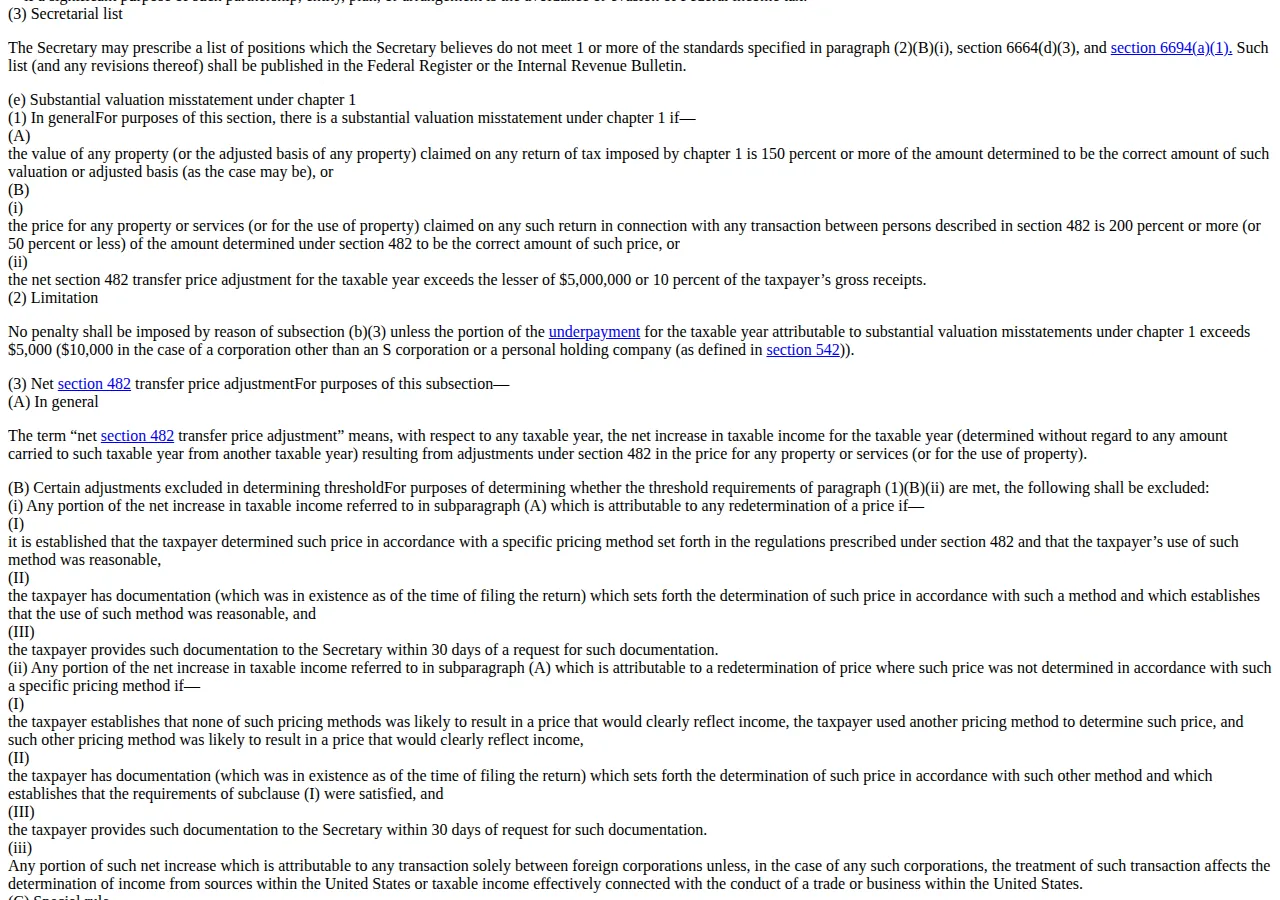
Section 6662(e)(3)(B) is the most valuable paragraph for any company with related-party transactions. Three conditions must all hold: the price was determined under a specific pricing method in the Section 482 regulations and its use was reasonable; the documentation was in existence when the return was filed; and the taxpayer provides it to the Secretary within 30 days of a request. Documentation written during the audit does not qualify.
Penalty tiers: the 20% and 40% math
Section 6662(a) imposes a 20% penalty on the underpayment portion to which it applies. Section 6662(e)(1) defines a substantial valuation misstatement two ways: the price test, where the price claimed is 200% or more, or 50% or less, of the correct Section 482 price; and the size test, where the net Section 482 adjustment for the year exceeds the lesser of $5,000,000 or 10% of gross receipts. Either test alone triggers the 20% tier, subject to a floor in Section 6662(e)(2): no penalty unless the underpayment portion exceeds $5,000 ($10,000 for a corporation other than an S corporation or a personal holding company). Section 6662(h) doubles the rate to 40% for a gross valuation misstatement: 400% or more, or 25% or less, of the correct price, and the lesser of $20,000,000 or 20% of gross receipts.
The widget example: claimed price $50, correct price $100, adjustment $50,000,000, gross receipts $300,000,000.
The claimed price is exactly 50% of the correct price, so the price test is met at the 20% tier, and the $50,000,000 adjustment exceeds the $5,000,000 threshold, so the size test is met as well. At the 21% rate in § 11(b):
Change one fact: the claimed price is $25 instead of $50. The ratio becomes 25% of the correct price, meeting the gross valuation misstatement test, and the penalty doubles to $4,200,000.
The APA program: certainty, priced in advance
An advance pricing agreement is the alternative to litigating the price after the fact. Under Rev. Proc. 2015-41, published at 2015-35 I.R.B. 263, a taxpayer asks the IRS's Advance Pricing and Mutual Agreement Program — APMA, formed in February 2012 from the former APA program and the competent authority staff — to agree the method in advance, starting with a pre-filing conference held on a named or anonymous basis and ending with an agreement binding the IRS to the method for the years covered, with a rollback to prior years available. As issued in 2015, the fee was $60,000 for each APA request, $35,000 for a renewal that does not substantially expand scope or change the covered method, and $30,000 for a small-case APA; confirm the current fee schedule before filing. What it buys is an agreement that the method itself will not be challenged.
Forms 5471 and 5472: the reporting that exposes the price
Form 5471, Information Return of U.S. Persons With Respect to Certain Foreign Corporations, is filed by US persons who control or own stock in a foreign corporation. Filers fall into categories: Category 1, US shareholders of specified foreign corporations; Category 4, a US person who had control of a foreign corporation during the year; Category 5, US shareholders of a controlled foreign corporation. The penalty is $10,000 per annual accounting period of each foreign corporation, plus $10,000 per 30-day period after the 90-day notice period, capped at an additional $50,000 per failure.
Form 5472, Information Return of a 25% Foreign-Owned U.S. Corporation or a Foreign Corporation Engaged in a U.S. Trade or Business, is the domestic mirror image. A reporting corporation is a 25% foreign-owned US corporation — including a foreign-owned US disregarded entity — or a foreign corporation engaged in a trade or business within the United States, and it must report its transactions with a related party. The IRS identifies the reporting corporation by its EIN on the form. The penalty is $25,000 for failure to file, plus $25,000 per related party per 30-day period after 90 days following IRS notification, and a substantially incomplete form counts as a failure to file.
Who faces Section 482: entity and scope
Section 482 does not care about the entity's label. A C-Corp with a foreign subsidiary faces it on every intercompany deal. An LLC taxed as a corporation faces it the same way. An S-Corp faces it too, and the penalty floor treats an S corporation at the $5,000 threshold rather than the $10,000 corporate one. A single-member LLC that is a disregarded entity does not escape it either.
The question arrives early. A SaaS company that moves its development team into a foreign subsidiary and charges that subsidiary for the use of its platform has created a Section 482 transaction the moment the first invoice is issued. The API that bills the subsidiary per call, the services agreement, and the royalty for the brand all need a price, and the price needs a method, before the first return that reports them is filed. That is when a CPA should be involved. Under GAAP, the same transactions must be eliminated in consolidation, so the transfer price reaches the consolidated statements only through the tax provision.
Run the operation
- Map every controlled transaction: each sale, licence, loan, and service between related parties.
- Assign each transaction a method: apply the best method rule in § 1.482-1(c); record why it is most reliable.
- Build the benchmarking: comparable prices or margins; identify the interquartile range before the year closes.
- Test the result against the range: if the tested party falls outside it, true the price to the median on the timely filed return.
- Run the penalty test: the price ratio and the size test — the lesser of $5,000,000 or 10% of gross receipts.
- Assemble the documentation file: agreements, functional analysis, method memo, benchmarking study, and true-up calculation, all dated before filing.
- File the reporting forms: confirm Forms 5471 and 5472 cover every entity and transaction; calendar the 30-day delivery obligation.
- Re-price every year: re-run the benchmarking annually.
The decision in advance
Section 482 gives the IRS a short statute and a long reach: any price between related parties, repriced to what strangers would have charged, with a 20% penalty at 200% or 50% of the right price and a 40% penalty at 400% or 25%. The defence is equally short: the best method, applied honestly, documented before the return is filed, and delivered within 30 days when asked.