The return is not the payment
The most expensive misunderstanding in payroll compliance is treating Form 941 as the payment. It is not. Form 941, the Employer Quarterly Federal Tax Return, is the quarterly report of wages paid, federal income tax withheld, and the employer and employee shares of Social Security and Medicare taxes, known together as FICA. The money itself moves separately, on a deposit schedule, through the Electronic Federal Tax Payment System, or EFTPS, usually days or weeks before the return is due. A return filed on time with deposits made late still draws a failure-to-deposit penalty, and deposits made on time with a return filed late still draw a failure-to-file penalty. Both rails have to run on time, and they run on different clocks.
This playbook covers both rails for a standard employer: the 2026 rates, the worked quarterly liability for one ten-person payroll, the monthly and semiweekly deposit schedules, the $100,000 next-day rule, the penalty ladder in worked dollars, the trust fund recovery penalty, and the correction route. It does not cover household employers, agricultural employers on Form 943, or annual filers on Form 944, and it does not replace a CPA review of your first quarter.
> [!KEY TAKEAWAY]
> Form 941 reports the quarter; EFTPS deposits pay it, on a monthly or semiweekly schedule set by a $50,000 lookback threshold. Miss a deposit and IRC section 6656 charges 2, 5, 10, or 15 percent of the unpaid deposit, with the tiers never stacking. File the return by the last day of the month after the quarter ends, and keep the deposit record, because the deposit schedule, not the form, is where most employers lose money.
Who this playbook is for, and who should stop here
This playbook is for founders, finance leads, and payroll operators who run payroll for employees in the United States and file Form 941 themselves or review a provider's work. Every rate below is the IRS figure for the 2026 tax year, not a vendor default. If you use a payroll provider, the playbook is still worth reading, because the liability stays with the employer even when the provider files: a provider error does not transfer the penalty.
Stop here and hire a payroll tax professional instead if you have employees in many states, pay tips, third-party sick pay, or group-term life insurance for former employees, use a certified professional employer organization, or have already missed deposits and received an IRS notice. Those situations change the liability lines and the correction rules. If you have not yet chosen how payroll will run, compare providers first in the payroll provider cost playbook.
What the return reports, at 2026 rates
Form 941 reports, for one calendar quarter, the number of employees, total wages, tips, and other compensation, federal income tax withheld, and the taxable Social Security and Medicare wages on lines 5a through 5e, plus adjustments, nonrefundable credits, total deposits, and any balance due or overpayment. The 2026 instructions state the rates plainly: the Social Security tax rate is 6.2 percent each for the employee and employer, on a wage base limit of $184,500, and the Medicare tax rate is 1.45 percent each for the employee and employer, with no wage base limit for Medicare. Additional Medicare Tax withholding of 0.9 percent applies to wages above $200,000 paid to an employee in the calendar year, withheld from the employee only, with no employer match.
Those rates give the worked payroll its shape. Take a ten-person company paying each employee $6,000 a month, or $18,000 a quarter, for quarterly wages of $180,000. No employee approaches the $184,500 annual wage base, so the full quarterly wage is subject to Social Security tax, and no employee crosses the $200,000 Additional Medicare threshold in the quarter. The employer share and the employee share are equal, so the combined FICA rates are 12.4 percent for Social Security and 2.9 percent for Medicare:
$
\text{Social Security Tax} = \$180{,}000 \times 12.4\% = \$22{,}320
$
$
\text{Medicare Tax} = \$180{,}000 \times 2.9\% = \$5{,}220
$
$
\text{Quarterly Employment Tax} = \$22{,}320 + \$5{,}220 + \text{Federal Income Tax Withheld}
$
If federal income tax withheld for the quarter is $27,000, a figure that depends on each employee's Form W-4 and is stated here as an assumption, not an IRS figure, the total tax for the quarter, the line 12 figure before credits, is $54,540. That single number drives everything that follows: the deposit schedule, the $2,500 threshold, the $100,000 rule, and the penalty math. Re-run the two formulas on your own wages if headcount or pay differs, because the wage base caps Social Security employee by employee, not on the company total.
| Line group | What it reports | 2026 rate or rule | Authority |
| :--- | :--- | :--- | :--- |
| Line 5a | Taxable Social Security wages | 12.4 percent combined, 6.2 percent each, wage base $184,500 | Instructions for Form 941 |
| Line 5c | Taxable Medicare wages and tips | 2.9 percent combined, 1.45 percent each, no wage base | Instructions for Form 941 |
| Line 5d | Wages subject to Additional Medicare withholding | 0.9 percent employee-only above $200,000 | Publication 15 |
| Line 12 | Total taxes after adjustments and nonrefundable credits | The deposit and penalty base | Instructions for Form 941 |
| Line 13 | Total deposits and refundable credits | Compared against line 12 for balance due | Instructions for Form 941 |
The deposit schedule is the real deadline
Deposits are governed by the lookback period, not by the quarter being filed. If you reported $50,000 or less in employment taxes during the lookback period, you are a monthly schedule depositor: deposits for wages paid in a month are due by the 15th day of the following month. If you reported more than $50,000, you are a semiweekly schedule depositor, and the deposit deadline depends on the payday: wages paid on Wednesday, Thursday, or Friday are deposited by the following Wednesday, and wages paid on Saturday, Sunday, Monday, or Tuesday are deposited by the following Friday. New employers are monthly schedule depositors. Semiweekly schedule depositors attach Schedule B, Form 941, listing the tax liability for each day of the quarter, and the quarter checked on Schedule B must match the quarter on the return.
Two thresholds override the schedule. If total taxes for the quarter are less than $2,500, and the prior quarter was not also under that figure in the way the instructions describe, the employer may pay the amount with a timely filed return instead of depositing, and the instructions warn that a liability under $2,500 with a prior quarter also under $2,500 still requires deposits on the monthly or semiweekly rules to avoid penalties.
In practice, the crossing that catches growing employers is the lookback threshold. Take a twelve-person LLC that starts the year as a monthly schedule depositor, paying by ACH through EFTPS, with its CPA reconciling each month. Mid-year hiring pushes its lookback employment taxes over $50,000, so it becomes a semiweekly schedule depositor and must attach Schedule B, reporting liability by day. Its S-Corp peers face the same switch, and a C-Corp with the same payroll faces it too, because the threshold turns on taxes reported, not entity type. This scenario's lesson: flip the schedule the quarter the lookback crosses, not at year end, and match the EIN on every deposit to the EIN on the return. The worked payroll above, at $54,540 a quarter, is far above the $2,500 threshold and deposits on its schedule regardless. The second override is the $100,000 next-day deposit rule: if accumulated employment taxes reach $100,000 on any day, the deposit is due by the close of the next business day, whatever the regular schedule says, and the employer becomes a semiweekly schedule depositor for the remainder of that year and the following year.
| Situation | Deposit rule | Deadline |
| :--- | :--- | :--- |
| Lookback $50,000 or less | Monthly schedule | 15th of the following month |
| Lookback over $50,000 | Semiweekly schedule | Wednesday payday group by following Wednesday; other paydays by following Friday |
| Quarter liability under $2,500 | Pay with timely return, with the prior-quarter condition | Return due date |
| Accumulated liability hits $100,000 | Next-day deposit, then semiweekly for the rest of that year and the next | Close of the next business day |
| Semiweekly filer | Schedule B attached | Liability by day, quarter matching the return |
At $54,540 a quarter, monthly liability is about $18,180, so a monthly schedule depositor sends $18,180 by the 15th of each following month, and the return reconciles $54,540 of liability against $54,540 of deposits. A semiweekly depositor with the same payroll deposits after each payday instead, with Schedule B proving the daily pattern. Either way, line 13 must equal deposits actually made; a mismatch between line 12 and line 13 is the first thing the IRS notices.
The penalty ladder, in worked dollars
The failure-to-deposit penalty under IRC section 6656 is calculated on the unpaid deposit, and the tiers do not add up: a deposit more than 15 days late draws 10 percent, not 2 plus 5 plus 10. The IRS penalty page states the ladder and the non-stacking rule explicitly, and the table below follows it exactly.
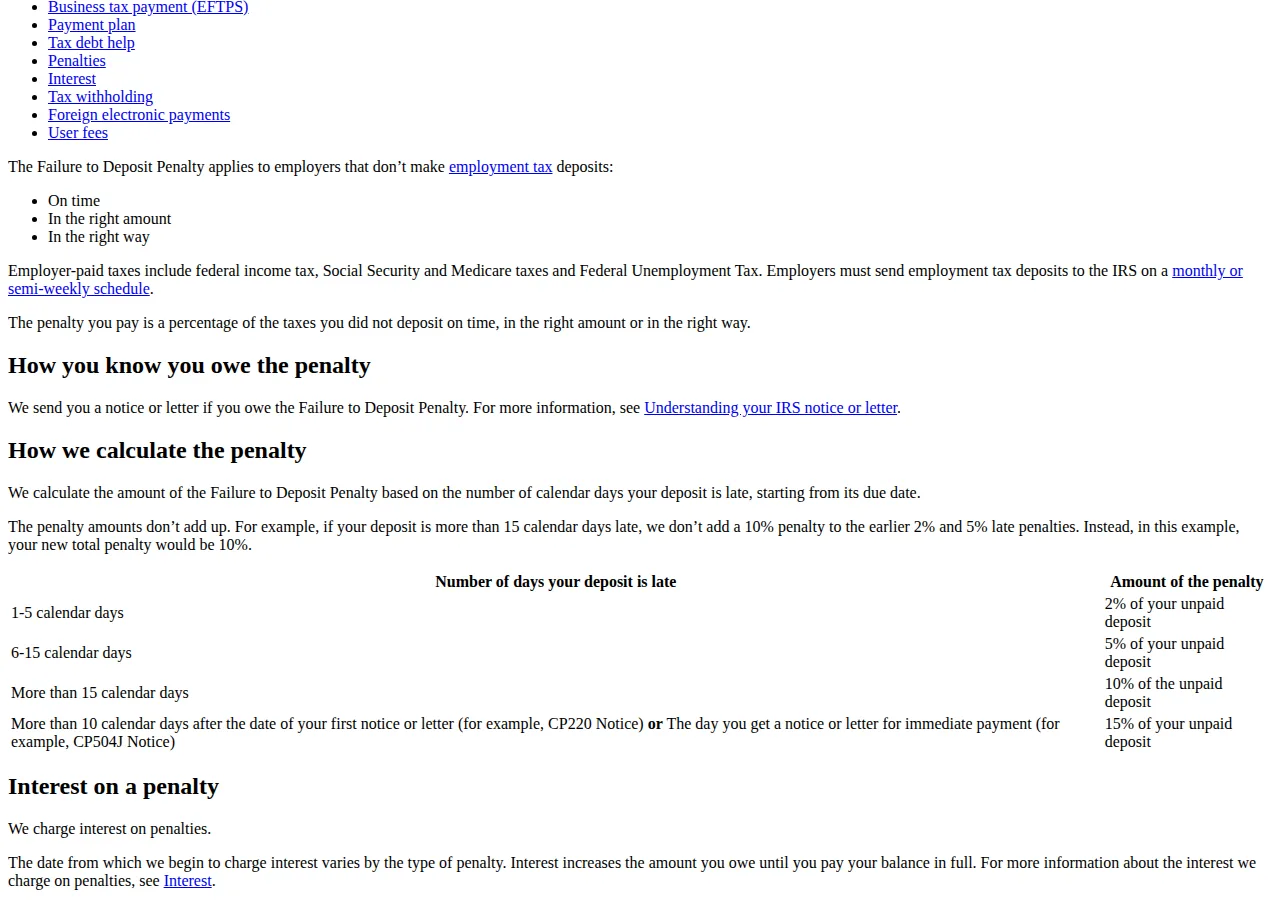
| Days late | Penalty rate | On a $18,180 monthly deposit | On the $54,540 quarter |
| :--- | :--- | :--- | :--- |
| 1 to 5 calendar days | 2 percent | $363.60 | $1,090.80 |
| 6 to 15 calendar days | 5 percent | $909.00 | $2,727.00 |
| More than 15 calendar days | 10 percent | $1,818.00 | $5,454.00 |
| Unpaid more than 10 days after first notice, or on demand for immediate payment | 15 percent | $2,727.00 | $8,181.00 |
Run this line before deciding whether a late deposit can wait until the return:
$
\text{Failure-to-Deposit Penalty} = \text{Unpaid Deposit} \times \text{Highest Applicable Rate}
$
Interest also accrues on unpaid tax and penalties, so the penalty figure is a floor, not the total cost. Reasonable cause can support relief, but it is a facts-and-circumstances showing, not a form: make the deposit first, then request relief, because every additional day moves the tier. The failure-to-file penalty for a late return is a separate penalty on a separate base, so a late return and a late deposit can both be charged on the same quarter.
> [!WARNING]
> The trust fund recovery penalty is personal. Federal income tax, Social Security tax, and Medicare tax withheld from employees are trust fund taxes, held in trust for the United States, and if they are not withheld, deposited, or paid, the penalty under IRC section 6672 can be 100 percent of the unpaid trust fund taxes, assessed against a responsible person individually. It is not limited to the company, and it is not discharged by closing the business. A cash shortage is never a reason to spend withheld taxes on operations: the withheld money was never the company's money.
Filing mechanics, corrections, and the year-end tie-out
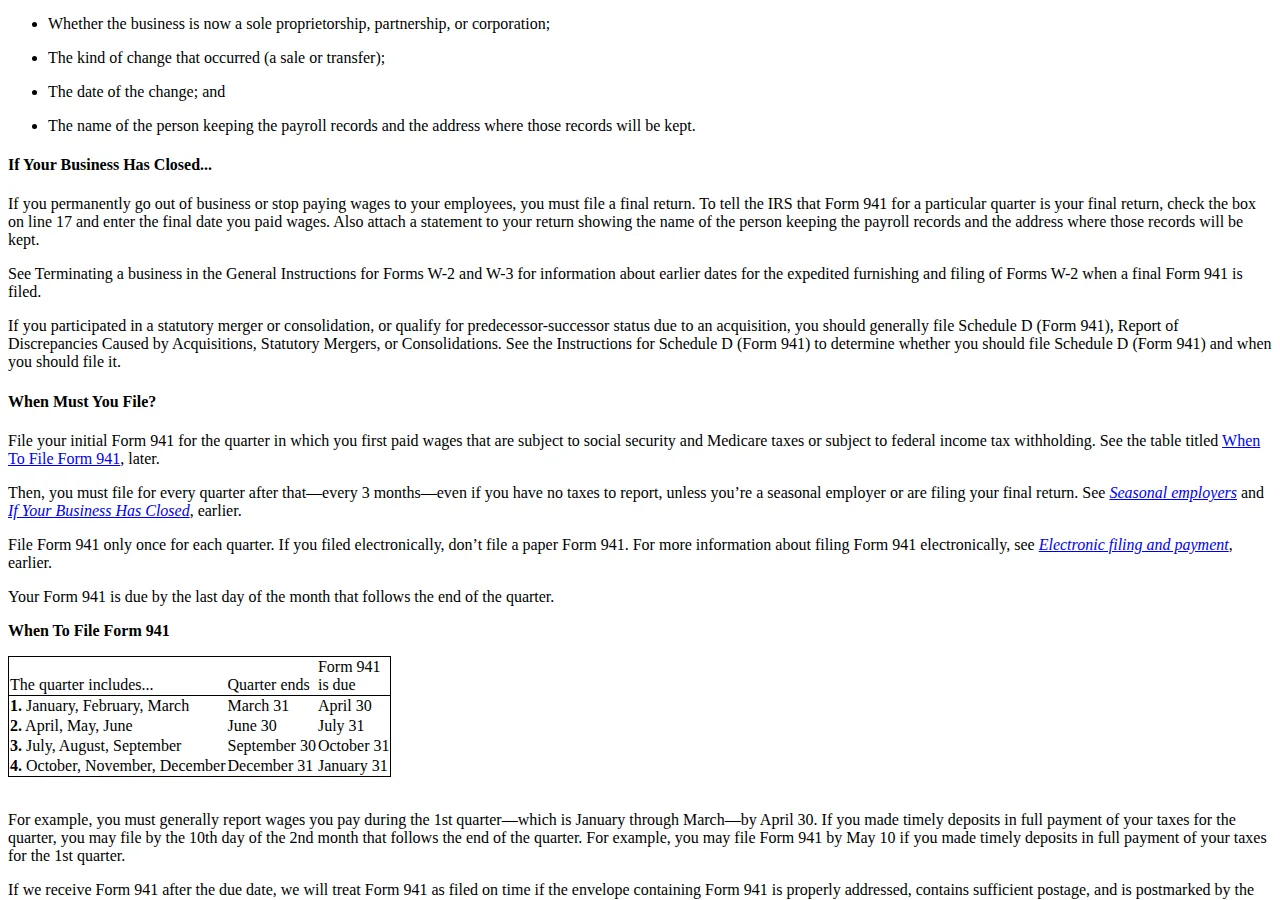
File Form 941 once per quarter, never twice for the same quarter to fix an error. If timely deposits paid the quarter in full, the instructions allow filing by the 10th day of the second month following the quarter, so a first-quarter return may be filed by May 10. A balance due is paid with the return, but a balance payment is not a deposit, and paying with the return does not cure a missed deposit deadline.
Corrections go on Form 941-X: use it to correct a prior quarter's wages, tax, or credits, or to claim a refund, and keep the original return, the 941-X, the deposit records, and the payroll registers together. At year end, the four quarters of Form 941 must reconcile to Forms W-2 and W-3, subject to the reconciling items the IRS instructions list, such as third-party sick pay and tips. A mismatch is the most common trigger for an employment tax notice, and it is cheapest to fix in the fourth quarter, before the W-2s go out. For the annual picture, including FUTA on Form 940 and state withholding accounts, see the remote payroll nexus guide, and to estimate the total tax picture before the quarter closes, run the tax estimator.
> [!FOUNDER]
> "Payroll tax is the one bill where paying late costs more than the tax itself, and where the person who signs the checks can owe it personally. Founders treat the deposit schedule as paperwork; the IRS treats it as a trust. Deposit on the schedule, reconcile every month, and never let withheld wages fund a short month, because the quarter that teaches that lesson is the quarter that also bills for it."
> — Enow A. Jovial, Founder & Chief Executive Officer
Operator boundaries: who should not run this alone
Do not run payroll tax alone if deposits have already been missed and a notice has arrived, because the notice starts the 15 percent clock. Do not file a closing quarter's Form 941 without checking line 17 and the final-wages date, or the account stays open and the notices keep coming. Do not use the $2,500 pay-with-return rule as a planning strategy; it depends on the prior quarter's figure and is conditioned narrowly. Do not assume a provider's filing proves the deposits: the EFTPS confirmation is the proof, and the employer should hold a copy of every one.
> [!TIP]
> Set the deposit calendar from the payday, not from the quarter. Attach the deposit deadline to the payday entry itself, and review the lookback figure every January, because a growing payroll crosses the $50,000 threshold quietly and becomes semiweekly without anyone changing a setting.
For the deduction that payroll itself can create, see our Section 199A QBI deduction playbook, which runs the wage-and-capital limit that W-2 wages feed into. For the retirement plan that sits on top of that payroll, see our Solo 401(k) vs SEP IRA playbook, which runs the deferral-plus-employer math at $120,000 and $300,000 of net earnings.