Section 409A Deferred Compensation Playbook
Section 409A Deferred Compensation Playbook
A founder promises a key hire \$100,000 payable in five years. Nobody pays tax until the cash arrives — that is the promise of nonqualified deferred compensation, and Section 409A of the Internal Revenue Code decides whether it works as planned or detonates into immediate tax, a 20 percent additional tax, and interest. Section 409A does not ban deferred pay. It fences it: a plan that follows the statute defers tax until payment; a plan that breaks any one of its rules is taxed at vesting, as if the money had been paid years early.
This playbook covers the statute as written in 26 U.S.C. § 409A and the Treasury regulations under § 1.409A-1 and § 1.409A-3, read 12 November 2026: what counts as deferred compensation, the six payout events, the six-month delay, the election deadlines, the short-term deferral safe harbor, and the failure math on a \$100,000 deferral. For the equity side of the same conversation, see the Section 83(b) election playbook, which covers taxing restricted stock at grant instead of vesting.
Step 1: Decide whether the plan is deferred compensation at all
Section 409A reaches any plan under which a service provider has a legally binding right to compensation payable in a later taxable year — a right the employer cannot unilaterally cut. A discretionary bonus the board may or may not declare is not deferred compensation, because there is nothing binding to defer. Once the right is binding and payment sits in a later year, the plan is inside Section 409A unless an exception applies.
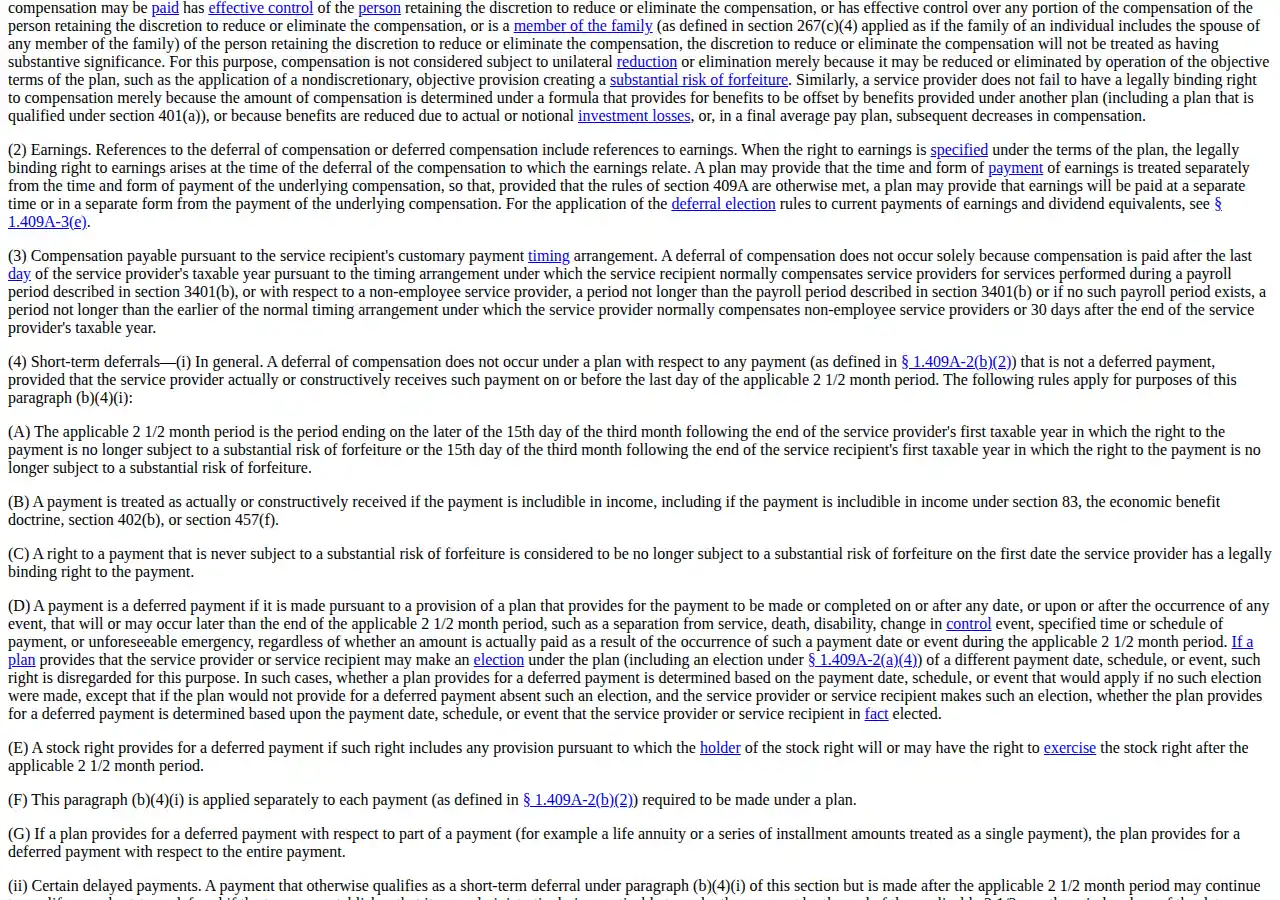
The most-used exception is the short-term deferral rule in Treas. Reg. § 1.409A-1(b)(4): a payment is not deferred compensation if made within the 2½-month period ending on the later of the 15th day of the third month following the end of the service provider's, or the service recipient's, first taxable year in which the right is no longer subject to a substantial risk of forfeiture. For a calendar-year employee and company, a bonus vesting 31 December 2025 must be paid by 15 March 2026 to stay outside the statute. Pay it on 16 March and every rule applies.
A substantial risk of forfeiture means the right is conditioned on future services or on a condition related to the purpose of the compensation — staying employed for two more years, or hitting a revenue target the employee can still miss. A condition the employee controls does not count. The vesting date is the day the risk lifts: it starts the 2½-month clock and, for payroll tax purposes, is the date the amount becomes wages.
Step 2: Pay only on one of the six permitted events
Section 409A(a)(2)(A) lists six events on which a plan may distribute. A plan that permits payment on any other event — "when the board feels the company can afford it," "on the founder's request" — fails the statute:
| Permitted distribution event | Statutory hook | What it means in practice |
|---|---|---|
| Separation from service | § 409A(a)(2)(A)(i) | The employee leaves; the regulations define separation as a permanent reduction in services, generally below 20 percent of the prior average level |
| Disability | § 409A(a)(2)(A)(ii) | Unable to engage in substantial gainful activity for at least 12 months, or expected to result in death, per § 409A(a)(2)(C) |
| Death | § 409A(a)(2)(A)(iii) | Payment to the estate or beneficiary on the participant's death |
| A specified time or fixed schedule | § 409A(a)(2)(A)(iv) | A date or schedule fixed in the plan at deferral, such as "1 January 2030" or five annual installments from that date |
| Change in ownership or effective control | § 409A(a)(2)(A)(v) | A change in ownership or effective control, or in the ownership of a substantial portion of assets, as the Secretary provides |
| Unforeseeable emergency | § 409A(a)(2)(A)(vi) | Severe financial hardship from illness, accident, casualty loss, or similar extraordinary circumstances beyond the participant's control |
The fixed-schedule event is the workhorse for founders: a promise to pay on a stated date is compliant if the date was fixed when the deferral was made. The change-in-control event is the trap — a sale only triggers payment if the plan defines the event the way the regulations do. When the entity winds up entirely, the plan terminates and pays out under the plan-termination rules; the corporate dissolution and tax clearance playbook covers the wind-up sequence.
Step 3: Hold the six-month delay for specified employees
Section 409A(a)(2)(B)(i) adds a special rule for specified employees: on separation from service, distributions may not be made before the date that is six months after the date of separation, or the date of death if earlier. A specified employee is a key employee under Section 416(i) — generally an officer above the indexed compensation threshold, a 5-percent owner, or a 1-percent owner above the threshold. In a startup, the founders and first executives are specified employees; the rank-and-file usually are not.
Worked dates: an executive separates on 15 March 2026; six months after that date is 15 September 2026, so the earliest permitted payment date is 15 September 2026. Pay on 14 September and the plan fails. The delay applies only to separation-triggered payments: a payment on a fixed date of 1 January 2027 is unaffected by a March separation, because the fixed schedule, not the separation, is the triggering event.
The consequence is a cash-flow gap to plan for: the executive leaves in March, the amount is due in September, and the company holds the cash in the meantime. A plan promising payment "on separation" without the six-month delay sentence is defective from the day it is signed — the defect is in the document, and the tax applies at vesting whether or not any money has moved.
Step 4: Make the election before the year of service, and redefer only on the statute's terms
Section 409A(a)(4) governs elections. An initial deferral election must be made before the taxable year in which the services are performed — an election to defer 2027 salary must be signed before 1 January 2027. A first-year-of-eligibility election has a 30-day window after the employee first becomes eligible, and performance-based compensation earned over at least 12 months may be elected up to six months before the period ends. Each window is a deadline, not a guideline: a late election is no election, and the compensation is taxed as if it had never been deferred.
A subsequent election — changing the time or form of a payment already deferred — is harder. Section 409A(a)(4)(C) permits it only if three conditions are all met: the election takes effect at least 12 months after it is made; for a payment not triggered by death, disability, or unforeseeable emergency, the payment is deferred at least five years; and for a fixed-schedule payment, the election is made at least 12 months before the first scheduled payment.
Worked example. A payment of \$100,000 is scheduled for 1 January 2028 and the participant wants to push it to 2033. The redeferral election must be made no later than 1 January 2027, and the new payment date must be no earlier than 1 January 2033. Elect on 2 January 2027 and the redeferral fails; elect in time but pick 1 January 2032 and it fails on the five-year rule.
Step 5: Price the failure before you sign the plan
If a plan fails, all compensation deferred under the plan for the taxable year and all preceding years is includible in gross income for the year of the failure, to the extent not subject to a substantial risk of forfeiture and not previously included. The tax is then increased by interest at the underpayment rate plus one percentage point, plus 20 percent of the compensation required to be included.
Worked failure on a \$100,000 deferral, assuming a 37 percent marginal rate:
\\text{Income tax on inclusion} = 100{,}000 \\times 0.37 = \\$37{,}000
\\text{Additional tax} = 100{,}000 \\times 0.20 = \\$20{,}000
\\text{Total before interest} = \\$37{,}000 + \\$20{,}000 = \\$57{,}000
Interest is then added at the underpayment rate plus one percentage point, running from the year the amount should have been included. The employer faces its own exposure too: the amount is wages for FICA when it vests under the special timing rule, and the employer that failed to withhold owes the employment tax. A quarterly payroll filing that never reported the amount will need correction, and the correction carries its own penalty ladder.
Step 6: Decide whether deferral is worth anything at all
Deferral is not a discount. When the tax rate is the same at deferral and at payment, and the return equals what the employee would have earned after tax, deferral is exactly neutral. Take \$100,000, a 37 percent rate, and a 5 percent annual return for five years:
\\text{Deferred value} = 100{,}000 \\times 1.05^5 = \\$127{,}628
\\text{Net after 37 percent tax at payout} = 127{,}628 \\times (1 - 0.37) = \\$80{,}406
\\text{Take now, invest after tax} = 63{,}000 \\times 1.05^5 = \\$80{,}406
Identical. The gain from deferral comes only from a rate difference — 37 percent today against 24 percent in retirement — or from the employer earning a higher return on the retained cash. At a 24 percent payout rate the deferred net is \$127,628 times 0.76, or \$96,997, against \$80,406 for taking the cash now: a \$16,591 gain, and the whole economic case for the plan. Run the same comparison for any offer through our ROI calculator before signing.
Entity choice changes the payroll side of the same promise. An LLC taxed as a sole proprietorship pays SECA tax on the owner's share, an S-Corp pays FICA only on the reasonable salary while distributions escape payroll tax, and a C-Corp pays FICA on the salary it sets. The deferred amount itself is wages for FICA at vesting under 26 U.S.C. § 3121(v)(2) in every entity form, so the bookkeeping — the EIN on the W-2, the ACH deposit schedule, the Wire for a large payout — is the same; what differs is the base. A CPA should confirm the treatment before the plan is drafted: a deferred promise inside an S-Corp with a thin salary and a large NOL carryforward sits differently on the GAAP books than the same promise inside a C-Corp, where FASB rules still require the liability on the balance sheet and the NOL does not shelter payroll tax.
| Vehicle | Tax at contribution | Tax at payout | Section 409A risk | Who bears the failure tax |
|---|---|---|---|---|
| Nonqualified deferred compensation | Deferred until payment | Ordinary income at payout | Full — document, election, and distribution rules apply | Employee, 20 percent plus interest |
| Qualified plan (401(k), SEP IRA) | Deferred until distribution | Ordinary income at distribution | None — governed by ERISA and § 401, not § 409A | N/A; contribution limits apply instead |
| Current cash bonus | Taxed in the year earned | N/A | None if paid within the 2½-month window | N/A |
| Restricted stock with § 83(b) election | Taxed at grant on the spread | Capital gain on later appreciation | None under § 409A if timely | Employee, if the election is late or missed |
| Authority | § 409A(a)(1); Treas. Reg. § 1.409A-1(b)(4) | § 409A(a)(2); § 402(a) for qualified plans | § 409A(a)(2)–(4) | § 409A(a)(1)(B) |
For founders choosing between deferring cash and granting equity, the comparison is usually decided by the rate-arbitrage math above and by the Solo 401(k) versus SEP IRA playbook, which covers the qualified-plan limits that cap deferral without Section 409A entering the picture.
Founder & CEO Insight — Enow A. Jovial
Execution checklist
- [x] Confirm the plan is deferred compensation: a binding right, payable in a later year, no exception applying.
- [x] Check the 2½-month window: if the amount can be paid within it, pay it and stay outside the statute.
- [x] Fix one of the six distribution events in the document: separation, disability, death, fixed date, change in control, or unforeseeable emergency.
- [x] Add the six-month delay for specified employees: no distribution before six months after separation, or death if earlier.
- [x] Date every election: initial elections before the year of service; redeferrals 12 months before the first scheduled payment and five years out.
- [x] Run the failure math on the full balance: 37 percent income tax plus 20 percent additional tax plus interest, before anyone signs.
- [x] Coordinate FICA timing with payroll: the amount is wages for FICA when it vests, even though income tax waits until payment; confirm the deposit schedule with your CPA.