> [!FOUNDER]
> "Founders treat closing a company as an admin errand: file a form, move on. That is backwards. Dissolution is the last distribution decision a company ever makes, and the order matters more than the form. Creditors first, members last, tax accounts closed in the right sequence, and only then the cancellation filing. File the cancellation first and you have ended the legal person that still owed money, still held contracts, and still had a tax account open."
> — Enow A. Jovial, Founder & Chief Executive Officer
Dissolved, wound up, cancelled: three different states
Most closing mistakes come from using one word for three states. Dissolution is the event that starts the end: a vote, an operating-agreement trigger, a court decree, or the passage of 90 consecutive days with no members in Wyoming. Winding up is the work after that event: finishing business, collecting receivables, paying or providing for liabilities, and distributing what remains. Cancellation is the filing that ends the certificate of formation with the state. A company can be dissolved but not yet wound up, and wound up but not yet cancelled, and each state has different consequences.
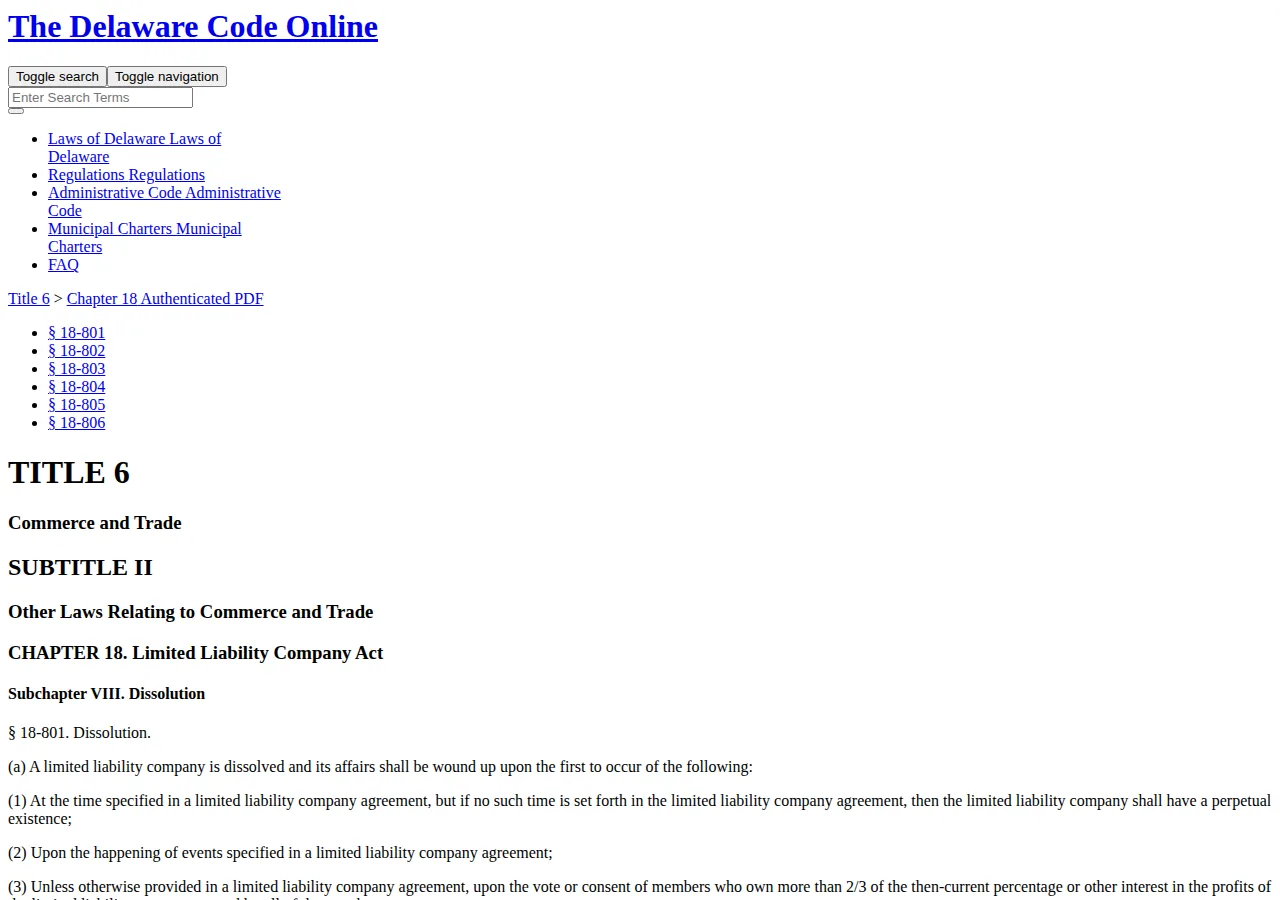
Delaware states the sequence in the statute itself. Section 18-203(a) of the Delaware LLC Act provides that a certificate of formation "shall be canceled upon the dissolution and the completion of winding up" and that a certificate of cancellation "shall be filed" to accomplish that cancellation, setting out the company name, the date of filing of its certificate of formation, and related details. The order is not decorative: cancellation is the consequence of completed winding up, not a shortcut around it.
> [!KEY TAKEAWAY]
> Never file a cancellation to escape winding up. Dissolve by the proper trigger, wind up in the statutory distribution order, close the tax accounts, withdraw foreign qualifications, and only then cancel. Every shortcut in that chain becomes a personal or successor liability later.
The two statutes, side by side
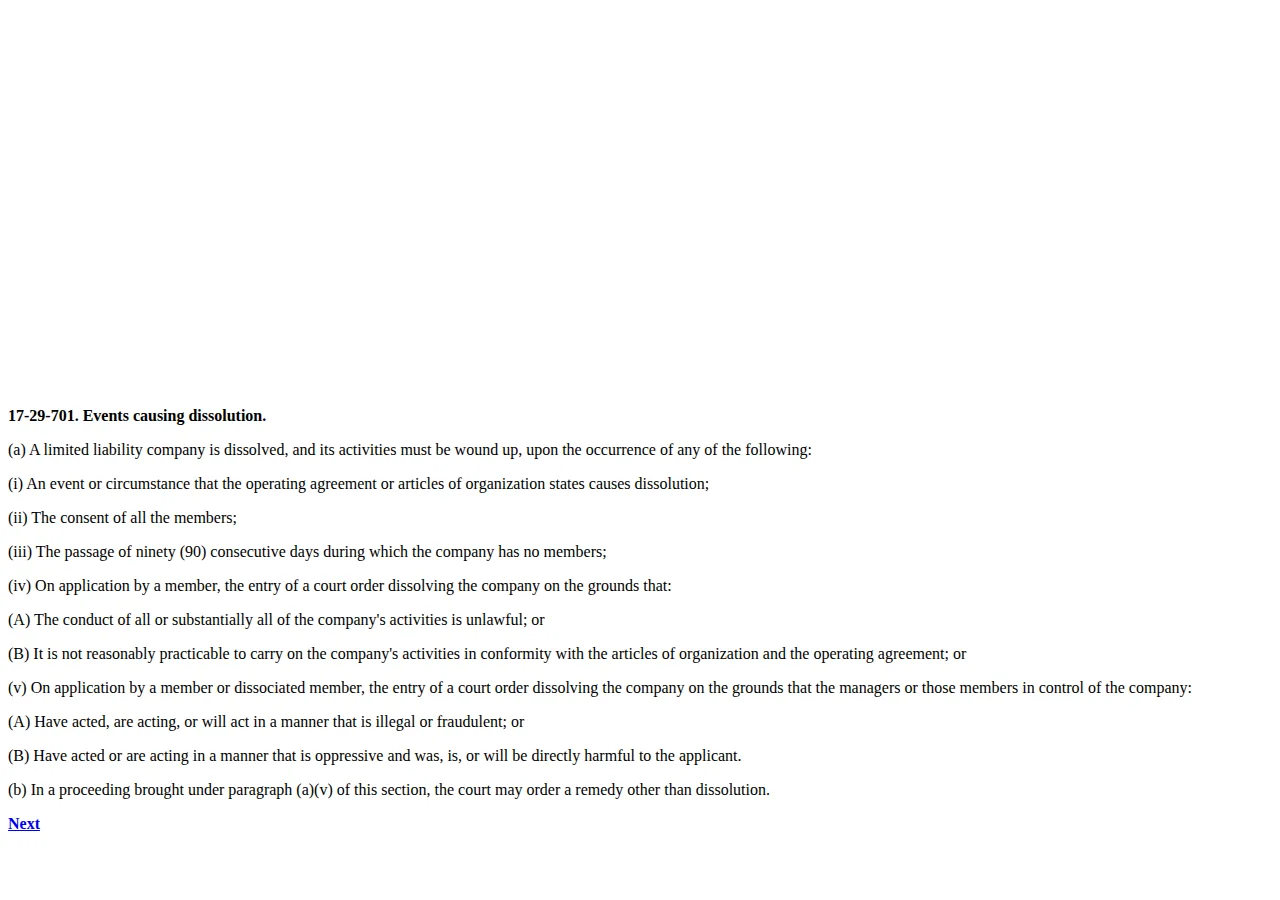
Delaware's dissolution triggers sit in 6 Del. C. § 18-801: the time or event specified in the operating agreement, the happening of specified events, member consent as the operating agreement provides, and judicial dissolution on application of a member or manager. Wyoming is stricter on consent: § 17-29-701(a)(ii) lists "the consent of all the members" as a dissolution event, and § 17-29-701(a)(iii) adds the passage of 90 consecutive days with no members. Section 18-803 then governs winding up: unless the operating agreement provides otherwise, a manager who has not wrongfully dissolved the company, or members owning more than 50 percent of the profit interests, may wind up the affairs, and the Court of Chancery may wind up on cause shown. Section 18-804 sets the distribution order on winding up, reproduced in the table below because it is the rule that decides who gets paid when the money runs out.
Wyoming's parallel provisions are W.S. § 17-29-701, events causing dissolution, and § 17-29-702, winding up. !Wyoming Statutes § 17-29-701, events causing dissolution, including consent of all members and 90 days with no members
Wyoming's Secretary of State publishes a dedicated Articles of Dissolution form, revised June 2021, on which the filer certifies compliance with W.S. § 17-29-701 and that all requirements for dissolution and winding up under the Wyoming LLC Act have been met. The filing fee on that form is $60. That certification is the Wyoming equivalent of Delaware's sequence rule: you are swearing the winding-up work is done, not merely started.
The decision table: dissolve, abandon, or keep dormant
| Attribute | Formal dissolution + cancellation | Abandonment (stop filing, stop paying) | Keep dormant |
| :--- | :--- | :--- | :--- |
| Legal existence ends | Yes, on cancellation after winding up | No — the state eventually voids or administratively dissolves it, on its own timetable | No |
| Delaware state cost to exit | $220 certificate of cancellation filing, plus the full $400 annual tax for the cancellation year if not already paid | $400 per year of unpaid annual tax accrues, plus penalties, until the state acts | $400 per year, every year |
| Wyoming state cost to exit | $60 articles of dissolution filing | $60 per year annual report charge accrues until administrative dissolution | $60 per year minimum |
| Creditor exposure | Closed in statutory order, with provision for contingent claims | Left open; creditors can pursue the entity and, in veil-piercing cases, its owners | Preserved, because the entity still exists |
| Tax accounts | Closed deliberately, final returns filed | Left open; notices, penalties, and EIN records linger | Must still file or report as required |
| Revival possible | Only by forming anew or, in Delaware, by revival filing with back taxes and fees | Revival filing with back taxes, penalties, and fees | N/A — it never ended |
| Regulatory / Operational Authority | 6 Del. C. §§ 18-801, 18-803, 18-804, 18-203; W.S. §§ 17-29-701, 17-29-702 | State administrative dissolution rules | State annual report and tax rules |
Two fee corrections belong in this table because older guides still print the wrong Delaware numbers. Delaware's LLC annual tax is $400, raised from $300 effective January 1, 2026, and the certificate of cancellation filing fee is $220 on the fee schedule revised August 1, 2026 — older guides that print $200 are out of date. For the other side of the same ledger — what the $400 a year costs while the company is alive, in Delaware, Wyoming, and Nevada — see the Delaware vs Wyoming vs Nevada LLC annual compliance cost playbook. Section 18-1107(c) requires the full annual tax for the calendar year in which the certificate becomes effective to be paid before it is filed, and the tax is not pro-rated. That creates a hard timing rule, worked out below.
The exposed math: the wind-up reserve and the December 31 rule
Before any member receives a dollar, the company must be able to pay or provide for everything ahead of members in the § 18-804 order. Our editorial analysis frames the reserve as a formula, not a feeling:
$
\text{Wind-Up Reserve} = \text{Known Liabilities} + \text{Contingent Provision} + \text{Tax Clearance} + \text{Wind-Up Costs}
$
$
\text{Distributable to Members} = \text{Remaining Assets} - \text{Wind-Up Reserve}
$
If the reserve exceeds remaining assets, the distributable amount is zero and members receive nothing — and any distribution already made ahead of creditors is recoverable. The contingent provision is the line founders skip: pending litigation, warranty claims, unexpired contract obligations, and tax years still open to audit are liabilities even though no invoice has arrived.
The Delaware timing rule follows from the non-pro-rated tax:
$
\text{Cost of Waiting Past December 31} = \$400
$
Worked example. A Delaware LLC decides in November 2026 to close. Its 2026 annual tax of $400 was already paid by June 1, 2026. If it completes winding up and files its certificate of cancellation in December 2026, its state exit cost is the $220 filing fee. If it drifts into January 2027 before filing, § 18-1107(c) requires the full 2027 annual tax of $400 to be paid before the certificate can be filed, so the same closure costs $220 + $400 = $620 in state charges. Delay does not buy a cheaper exit; it buys a second tax year. The same logic in reverse: a company that has already decided to close should not file a rushed December cancellation before winding up is genuinely complete merely to save $400, because a premature cancellation with unpaid creditors costs far more than $400 to unwind.
A second worked example shows the distribution order doing real work. A Delaware LLC winds up with $180,000 in remaining assets, $120,000 in trade and loan liabilities, a $25,000 contingent warranty provision, $10,000 of tax clearance and filing costs, and two equal members. The reserve is $120,000 + $25,000 + $10,000 = $155,000. The distributable amount is $180,000 - $155,000 = $25,000, or $12,500 per member. If the members had instead distributed $90,000 each before paying creditors, $155,000 of that distribution would have gone to parties ahead of them in the § 18-804 order, and the shortfall would follow the members, not disappear with the company.
Who this is for, and who should not dissolve yet
Formal dissolution fits a company whose business is genuinely finished, whose contracts are complete or assignable, whose debts are known and payable, and whose owners want a clean end to state fees, tax filings, and registered-agent charges. It fits a single-purpose vehicle after an asset sale, a failed venture with no pending claims, and a company being replaced by a successor entity with its contracts properly novated.
It does not fit the following, and our editorial analysis is blunt about each one:
> [!WARNING]
> Distributing assets to members before creditors are paid or provided for is the single most expensive dissolution mistake. Delaware § 18-804 puts creditors first, then distribution liabilities, then return of contributions, then profit interests. Members who take early distributions can be pursued for the shortfall after the company is gone, when there is no entity left to hide behind.
The sequence, in order
> [!TIP]
> Put the December 31 decision in the calendar the day dissolution is first discussed. If winding up will genuinely finish in December, finish it in December and save the next year's $400 Delaware tax. If it will not finish, do not force it — a clean January filing at $620 in state charges beats a premature December filing that leaves a creditor unpaid.
What happens if you just walk away
Walking away feels free and is the most expensive option in the table. Delaware does not cancel a certificate of formation for non-payment on a founder-friendly timetable: unpaid annual tax accrues, the entity is eventually voided, and revival requires paying back taxes, penalties, and the revival filing fee. Meanwhile the entity still exists for creditor and tax purposes, its registered agent still receives service, and its owners still answer notices for a business they stopped running. Abandonment also destroys the clean record a future lender, acquirer, or licensing authority will ask about. Formal dissolution costs $220 in Delaware or $60 in Wyoming; abandonment costs years of accrued charges plus the story you have to explain later.
Related reading on this site: the single-member LLC charging order protection guide for why the entity's existence matters to creditor remedies in the first place, the LLC operating agreement breakdown for the vote and distribution clauses that govern Step 1, and the FinCEN BOI reporting guide for non-residents for a filing duty that does not automatically end at cancellation. To model the wind-up reserve before promising any member a figure, run the numbers through the tax estimator and the business loan calculator for any debt payoff in the reserve.
The estate tax exemption $15 million playbook covers what happens to the owner interest at death: the $15,000,000 exclusion, the portability election, and the nine-month Form 706 clock.