> [!FOUNDER]
> "The 83(b) election is the cheapest tax decision a startup employee ever makes and the easiest to lose. It costs a stamp and a signature, and it is worthless on day 31. Every founder I have watched lose it lost it the same way: they waited for vesting, for the lawyer, for the paperwork to feel finished. The clock does not wait for any of those." — Enow A. Jovial, Founder & Chief Executive Officer
The default rule, and why early exercise exists
Under IRC § 83(a), when property is transferred in connection with services and remains subject to a substantial risk of forfeiture, you are generally taxed when the risk lapses — at vesting — on the spread between fair market value at vesting and the amount you paid. For an employee who exercises options only at vesting, that means ordinary income at each vesting date, at whatever the company is worth then.
Early exercise inverts the sequence. You exercise unvested options immediately, pay the exercise price now, and receive shares subject to the company's right to repurchase them at cost if you leave before vesting. The shares are transferred now, while their value is usually low. A Section 83(b) election then lets you report the spread at transfer as ordinary income now, instead of waiting for vesting. Everything after that point — the appreciation from transfer value to exit value — is measured as capital gain, provided the holding-period and qualification rules are met. Without the election, early exercise buys you almost nothing: you still get taxed at vesting on the vesting-date value, and you have already parted with the exercise cash.
> [!KEY TAKEAWAY]
> The election is not a vesting-date filing. It is a transfer-date filing. Transfer happens when you exercise and receive the shares, and the 30-day clock in IRC § 83(b)(2) starts that day, whether or not anyone at the company reminds you.
The regulation, line by line
Treas. Reg. § 1.83-2 is short, and every paragraph does work. Read it before you exercise, not after.
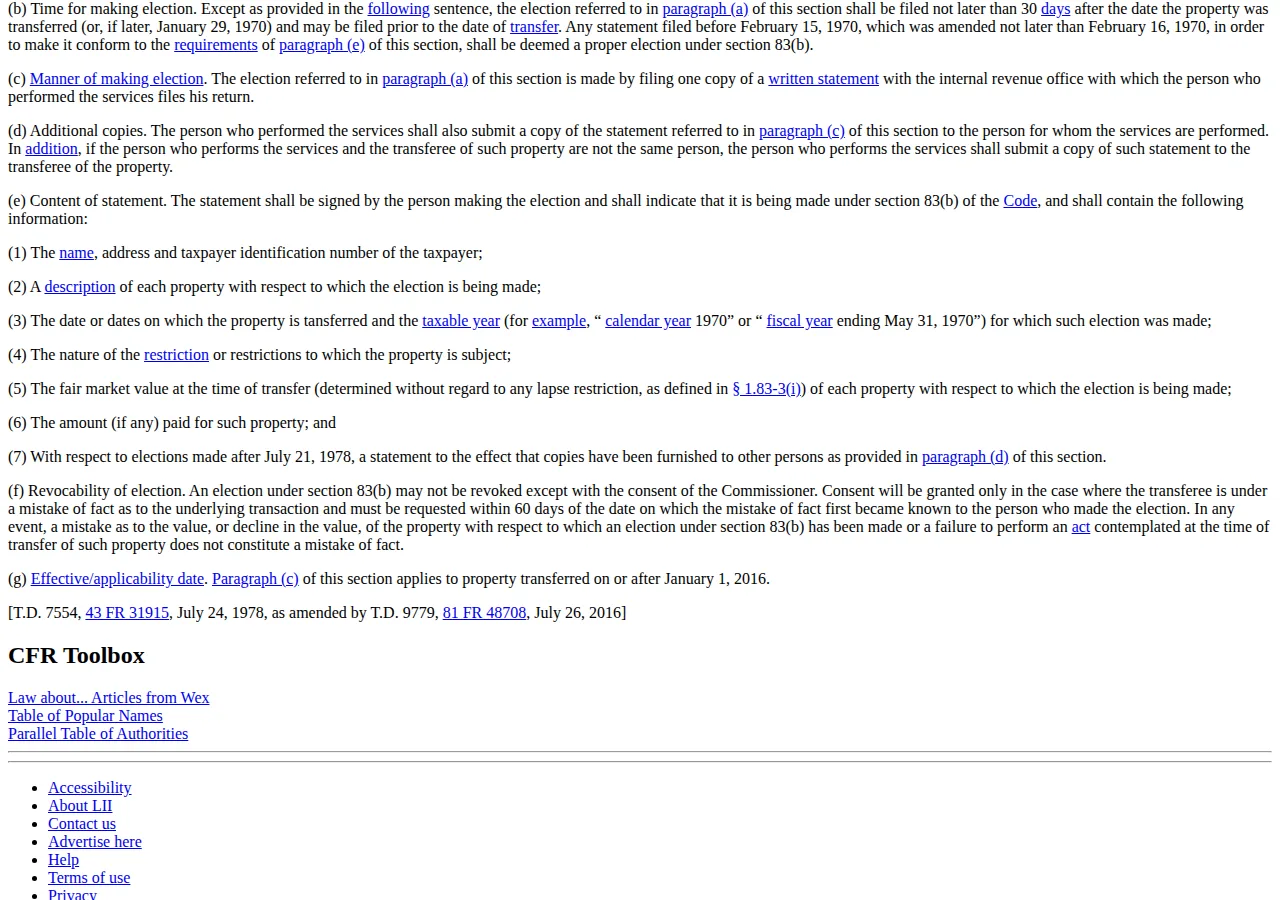
The statute confirms the same deadline in plainer language. IRC § 83(b)(2) provides that an election "shall be made in such manner as the Secretary prescribes and shall be made not later than 30 days after the date of such transfer," and that it "may not be revoked except with the consent of the Secretary." In Alves v. Commissioner, 79 T.C. 864 (1982), affirmed 734 F.2d 478 (9th Cir. 1984), the courts upheld this regulatory structure, including its strict timing. Treat any adviser who describes the deadline as flexible as uninformed on this point.
The exposed math: election vs no election
Take a concrete early exercise. You exercise 10,000 options at $0.50 per share when fair market value is $0.50 per share. You pay $5,000. Four years later, at full vesting, fair market value is $8.00 per share.
$
ext{Spread at Transfer} = ext{Shares} imes ( ext{FMV at Transfer} - ext{Exercise Price})
$
$
ext{Spread at Transfer} = 10{,}000 imes ($0.50 - $0.50) = $0
$
With a timely 83(b) election, you report $0 of ordinary income at transfer. The later appreciation is not ordinary income at vesting. At exit, your gain is measured from the $0.50 basis you established, and the character of that gain follows the holding-period rules for the shares.
Without the election, the same exercise produces ordinary income at vesting:
$
ext{Ordinary Income at Vesting} = 10{,}000 imes ($8.00 - $0.50) = $75{,}000
$
That $75,000 is ordinary income in the vesting year, taxed at your marginal ordinary rate, and it arrives whether or not you can sell shares to pay it. The election's value in this example is the difference between $75,000 of ordinary income and $0 of ordinary income at the relevant dates, plus the conversion of later appreciation from ordinary character to capital character. That is the whole arbitrage, and it is why the filing matters more than the exercise price.
Now change one input. Suppose fair market value at transfer is $2.00, not $0.50, and the exercise price is still $0.50:
$
ext{Ordinary Income at Transfer} = 10{,}000 imes ($2.00 - $0.50) = $15{,}000
$
With the election, you report $15,000 of ordinary income now and pay tax on it now, in cash, out of pocket. If you leave before vesting and forfeit the shares, that $15,000 of reported income does not come back as a deduction. Your loss is generally limited to the $5,000 you paid. The forfeiture cost of this election is therefore $15,000 of income taxed with no shares to show for it, plus the $5,000 exercise price at risk. Early exercise is only cheap when the transfer-date spread is small; as the spread grows, the election becomes a cash bet on staying.
ISO vs NSO vs restricted stock: the decision table
| Attribute | ISO early exercise + 83(b) | NSO early exercise + 83(b) | Restricted stock + 83(b) | No election (any form) |
| :--- | :--- | :--- | :--- | :--- |
| Ordinary income at transfer | Generally none for regular tax; spread counts for AMT | Spread at transfer, taxed as wages | Spread at transfer, taxed as compensation | None at transfer |
| Ordinary income at vesting | None on the elected shares | None on the elected shares | None on the elected shares | Full spread at vesting-date FMV |
| AMT trap | Yes — transfer spread is an AMT adjustment | No separate AMT adjustment | No separate AMT adjustment | AMT at exercise for ISOs without election |
| Forfeiture cost | Reported AMT income not recovered; exercise cash at risk | Reported ordinary income not recovered; exercise cash at risk | Reported ordinary income not recovered | No income reported, nothing to lose |
| Holding period start | Transfer date for capital-gain purposes | Transfer date for capital-gain purposes | Transfer date for capital-gain purposes | Vesting date |
| Regulatory / Operational Authority | IRC § 83(b), § 422; Reg. § 1.83-2 | IRC § 83(b); Reg. § 1.83-2 | IRC § 83(b); Reg. § 1.83-2 | IRC § 83(a) default rule |
The ISO row deserves its own warning. Incentive stock options are famous for producing no regular-tax income at exercise, and employees repeat that slogan into the AMT. For AMT purposes, the spread at exercise — fair market value minus exercise price — is an adjustment in the exercise year, and an 83(b) election fixes that spread at transfer value rather than eliminating it. In the $2.00 example above, an ISO holder who elects still carries a $15,000 AMT adjustment. Model the AMT before exercising, not after the Form 6251 surprise. The tax estimator on this site is a starting point for the regular-tax arithmetic; AMT modelling belongs with a tax adviser who has your full return in front of them.
> [!WARNING]
> The 30-day deadline is statutory, and a missed deadline is, for practical purposes, final. Relief under Treas. Reg. § 301.9100-3 is rarely granted for § 83(b) because the period is fixed by IRC § 83(b)(2) itself. Do not exercise on a Friday, go on holiday, and plan to file "when you get back" — day 30 does not pause for travel, and the IRS office that receives the statement does not accept intent as a filing.
The payroll and reporting tail most guides skip
For NSOs and restricted stock, the spread at transfer is wage income, not a capital item that settles itself. The company reports it on your W-2, withholds income tax, and applies FICA — Social Security and Medicare taxes — where the wage rules require it. That payroll treatment is a second cash cost on top of the income tax, and it is easy to miss when you only model the federal income-tax rate. Your statement itself must carry your taxpayer identification number, your SSN or, for a nonresident without one, your ITIN, and the company's records should tie the exercise to its own EIN so the W-2, the withholding, and the election statement all describe the same transaction. Have a CPA reconcile the three documents — election statement, exercise confirmation, and W-2 — before you file the return for the transfer year, because a mismatch between them is the kind of discrepancy that draws a notice long after the 30-day clock has closed.
Who should not early-exercise
Early exercise with an 83(b) election is a leveraged bet on three things: that you will stay until vesting, that the company will be worth more later, and that you can fund the tax and the exercise price without selling anything. It is a poor fit when any of those fails:
> [!TIP]
> File in week one, by certified mail with return receipt or another trackable method, and keep the receipt with a copy of the signed statement and the company's acknowledgment. The statement is cheap; the proof that you filed it on time is the asset. Calendar day 0 as the transfer date, count 30 calendar days forward, and treat day 21 as your personal deadline so a postal delay cannot become a tax disaster.
Filing and execution checklist
Related reading on this site: the Delaware C-Corp founder stock vesting and 83(b) timing guide, which covers founder restricted stock rather than employee option exercise, and the QSBS Section 1202 founder guide, because a timely 83(b) election also starts the QSBS holding period on the grant date rather than on each vesting date. For the cash-flow side, test the vesting-year tax bill in the tax estimator and the cost of funding the exercise itself in the break-even calculator.