The retirement question that costs five figures when answered late
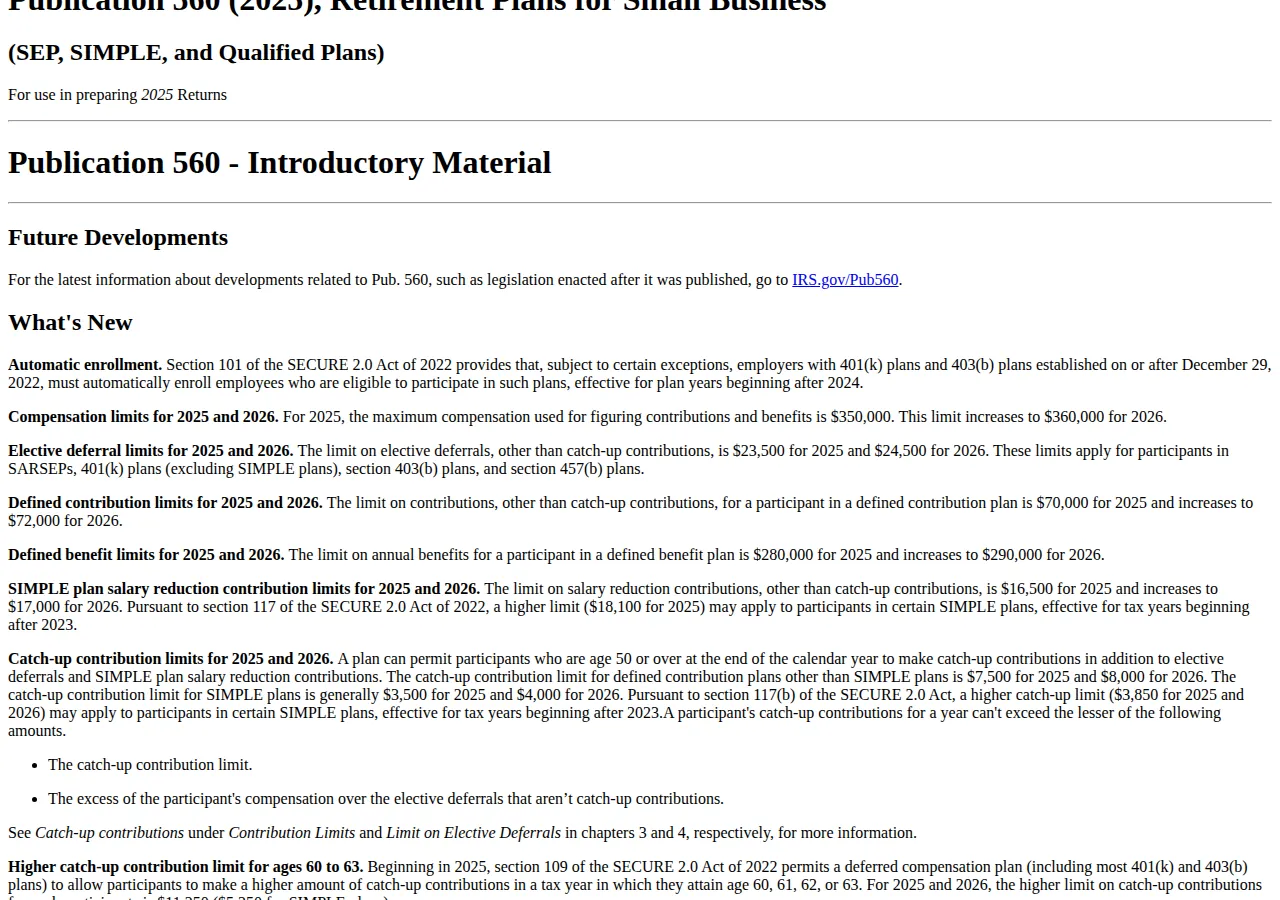
A self-employed founder with no employees has two retirement plans that look similar from the outside and behave very differently on the tax return. A SEP IRA takes one kind of contribution: the employer's. A Solo 401(k) takes two: the owner's elective deferral as an employee, plus the employer's contribution on top. That second bucket is the whole story. At moderate income the Solo 401(k) shelters roughly $23,500 more than a SEP IRA in the same year, and at high income it hits the overall defined-contribution ceiling while the SEP IRA is still climbing toward it.
The choice is not about which plan is "better" in the abstract. It is about income level, whether you have employees, whether you need a Roth bucket or a loan feature, and whether you will fund the plan before the deadline that actually applies.
> [!KEY TAKEAWAY]
> A Solo 401(k) shelters more at the same income because it adds an elective deferral of $23,500 for 2025 ($24,500 for 2026) on top of the employer contribution, before the overall $70,000 ceiling for 2025 ($72,000 for 2026) caps the total. A SEP IRA has no deferral bucket, so its maximum is the employer contribution alone. The SEP IRA wins on simplicity and on late funding: it can be set up and funded as late as the tax return due date including extensions, while a Solo 401(k) must be established by December 31 of the plan year.
Who this guide is for, and who should stop here
This guide is for a self-employed owner with no eligible employees other than a spouse: a sole proprietor, a single-member LLC taxed as a sole proprietorship, or a partner in a small partnership. It is written around IRS Publication 560 (2025), the IRS SEP plan page, and 26 U.S.C. §§ 401(k) and 408(k), with figures for the 2025 and 2026 tax years. If you run an S-Corp, the same plans exist but the employer contribution is computed on W-2 wages, not on net self-employment income, so the worked math below must be re-run on your salary figure, not your business profit.
Stop here and talk to a CPA before choosing if you have employees who would be eligible under a SEP, if you already maintain another qualified plan, or if you are covered by a spouse's employer plan and need to coordinate limits across plans. A Solo 401(k) is a one-participant plan by definition: the moment you hire an employee who meets the plan's eligibility rules, the plan stops being a one-participant plan and the compliance picture changes entirely. A SEP IRA, by contrast, must cover every eligible employee at the same percentage you contribute for yourself, so hiring turns a cheap personal plan into a payroll cost.
The two plans, side by side
| Attribute | Solo 401(k) | SEP IRA | Authority |
| :--- | :--- | :--- | :--- |
| Contribution buckets | Employee elective deferral + employer contribution | Employer contribution only | 26 U.S.C. § 401(k); 26 U.S.C. § 408(k) |
| Elective deferral limit | $23,500 for 2025; $24,500 for 2026 | None | IRS Publication 560 (2025), "What's New" |
| Catch-up, age 50 or over | $7,500 for 2025; $8,000 for 2026 | None | IRS Publication 560 (2025), "What's New" |
| Catch-up, ages 60 to 63 | $11,250 for 2025 and 2026 | None | SECURE 2.0 Act § 109, via Publication 560 |
| Overall defined-contribution limit | $70,000 for 2025; $72,000 for 2026, including both buckets | $70,000 for 2025; $72,000 for 2026, employer bucket only | IRS Publication 560 (2025), "What's New" |
| Employer contribution rate | Up to 25% of compensation | Up to 25% of compensation | IRS Publication 560 (2025) |
| Compensation ceiling | $350,000 for 2025; $360,000 for 2026 | $350,000 for 2025; $360,000 for 2026 | IRS Publication 560 (2025), "What's New" |
| Roth option | Designated Roth elective deferrals, if the plan allows | Roth SEP IRA treatment available under SECURE 2.0 | IRS SEP plan page; 26 U.S.C. § 402A |
| Loan feature | Permitted if the plan allows, generally up to $50,000 or 50% of the vested balance under IRC § 72(p) | No loans from an IRA | IRC § 72(p); IRA rules |
| Setup deadline | Establish by December 31 of the plan year | Set up by the return due date including extensions | IRS Publication 560 (2025) |
| Funding deadline | Elective deferrals by December 31; employer contributions by the return due date including extensions | By the return due date including extensions | IRS Publication 560 (2025) |
| Annual filing | Form 5500-EZ when plan assets exceed $250,000 at year-end | No annual plan return | IRS Publication 560 (2025) |
| Employees | Owner and spouse only, as a one-participant plan | Every eligible employee, at the same percentage | IRS SEP plan page |
The table hides one trap that deserves its own paragraph. For a self-employed owner, "25% of compensation" does not mean 25% of net profit. Compensation for a self-employed individual is net earnings from self-employment minus one-half of self-employment tax minus the employer's own contribution. Because the contribution reduces the compensation it is computed on, a 25% plan rate works out to a 20% effective rate on net adjusted income. The derivation is:
$
\text{Employer Contribution} = 0.25 \times (\text{Net Adjusted Income} - \text{Employer Contribution})
$
$
\text{Employer Contribution} = \frac{0.25}{1.25} \times \text{Net Adjusted Income} = 0.20 \times \text{Net Adjusted Income}
$
Any calculator or advisor quote that applies 25% straight to net profit overstates a self-employed owner's employer contribution by a quarter. That overstatement is the most common error in Solo 401(k) and SEP IRA planning, and it is why the worked examples below start from net adjusted income, not from gross profit.
Worked math: the same owner on both plans
Take a sole proprietor with $120,000 of net earnings from self-employment in 2025. Self-employment tax is computed on 92.35% of net earnings, so the taxable base is $110,820, the tax at 15.3% is $16,955, and one-half of that tax is $8,478. Net adjusted income is therefore $111,522. The employer contribution at the 20% effective rate is:
$
\text{Employer Contribution} = 0.20 \times \$111,522 = \$22,304
$
On a SEP IRA, $22,304 is the entire 2025 contribution. On a Solo 401(k), the owner adds the $23,500 elective deferral on top:
$
\text{Solo 401(k) Total} = \$23,500 + \$22,304 = \$45,804
$
$
\text{SEP IRA Total} = \$22,304
$
The Solo 401(k) shelters $23,500 more at the same income, because the deferral bucket is pure addition until the overall ceiling binds. At a 22% marginal rate, that extra $23,500 of deduction is worth about $5,170 of federal tax in the year, before state tax and before any effect on the qualified business income deduction, which is computed after the retirement deduction and therefore shrinks when the deduction grows.
Now take the same owner at $300,000 of net earnings in 2025. The self-employment tax base is $277,050, and because the Social Security wage base caps the 12.4% portion, the tax is about $29,871, so one-half is $14,935 and net adjusted income is $285,065. The employer contribution at 20% is $57,013. The Solo 401(k) total before the ceiling is $23,500 plus $57,013, or $80,513, which exceeds the $70,000 overall limit for 2025, so the Solo 401(k) contribution is capped at $70,000. The SEP IRA contribution is $57,013, uncapped. The gap narrows to $12,987, and it narrows further as income rises, because the SEP IRA keeps climbing toward the same ceiling while the Solo 401(k) is already parked at it.
An owner age 50 or over adds a $7,500 catch-up for 2025 or $8,000 for 2026 to the deferral bucket, and an owner who attains age 60, 61, 62, or 63 in the year may add up to $11,250 instead, if the plan permits it. The SEP IRA has no catch-up bucket at any age, so the age advantage belongs entirely to the Solo 401(k).
Scenario: the hire that breaks the plan
Consider a founder who opens a Solo 401(k) in January, defers the full $23,500 during the year, and hires a full-time employee in September. The Solo 401(k) was a one-participant plan when it was established, and it does not stay one once an eligible employee joins. The founder now faces a plan amendment, a different plan document, and nondiscrimination testing that a one-participant plan never needed. The cost of unwinding that mistake dwarfs the tax saved by the deferral.
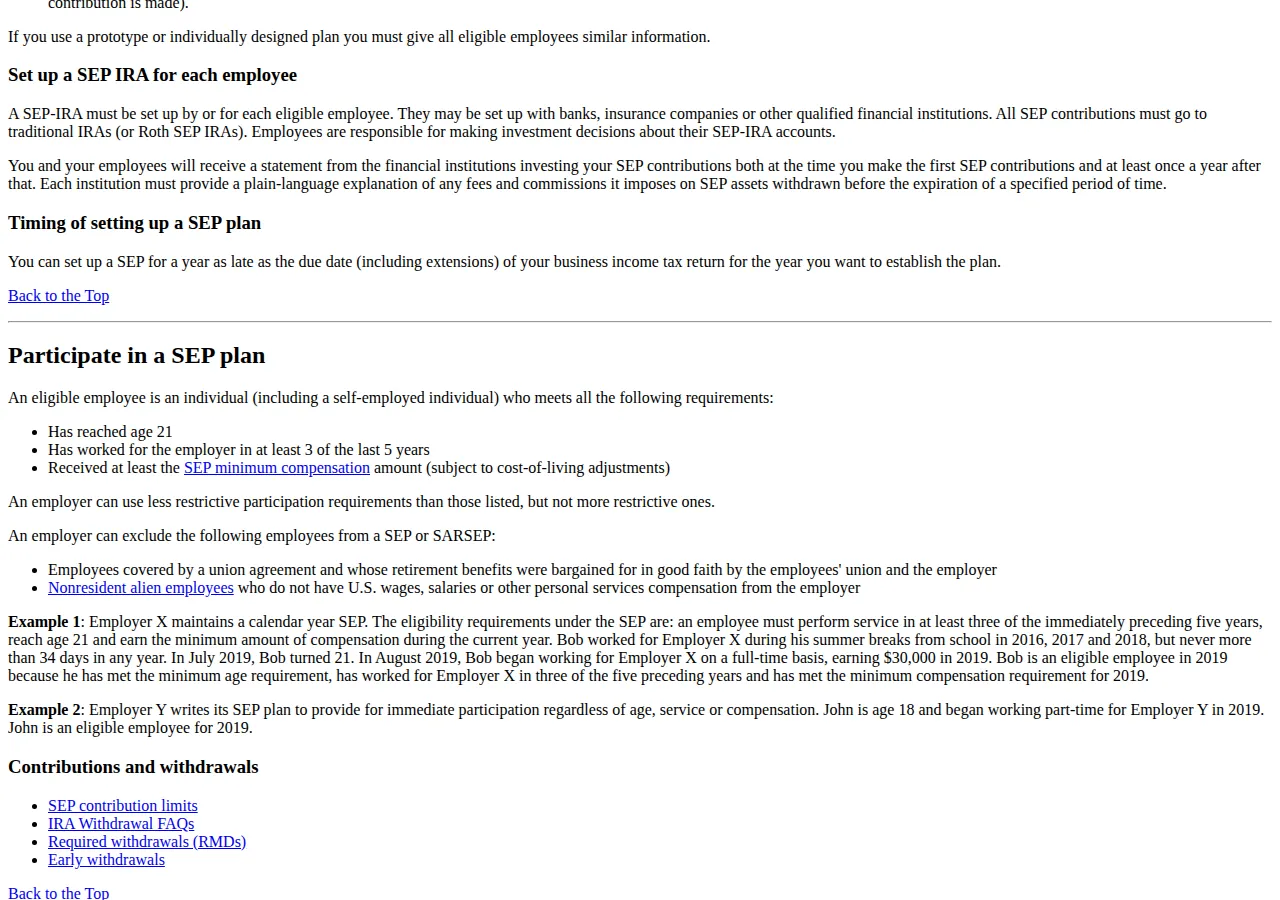
The SEP IRA handles the same hire differently. Under the IRS SEP eligibility rules, an eligible employee is one who has reached age 21, has worked for the employer in at least 3 of the last 5 years, and has received at least the SEP minimum compensation amount. An employer may use less restrictive requirements, but not more restrictive ones. If the founder contributes 20% of net adjusted income for herself, she must contribute the same percentage of compensation for every eligible employee. A single eligible employee earning $60,000 costs the founder $12,000 of employer contributions at a 20% rate, on top of her own. That is the honest price of the SEP IRA's simplicity: it treats everyone alike, and alike includes the payroll.
Entity note for the owner choosing a structure first: a single-member LLC files as a sole proprietorship unless it elects otherwise, an S-Corp pays its owner-employee through W-2 wages subject to FICA, and a C-Corp follows the same qualified-plan rules with its own payroll. Every employer plan needs an EIN on its adoption agreement, the self-employment tax itself is the SECA tax rather than FICA withholding, and a CPA should confirm which wage base applies before funding, because the S-Corp wage figure and the sole-proprietor net-income figure produce different employer contributions from the same business profit.
Operator boundaries: when each plan fights you
The Solo 401(k) fights you on administration. It needs a plan document, it needs the December 31 establishment deadline respected even when cash is tight at year-end, and it needs a Form 5500-EZ once plan assets exceed $250,000 at the end of a plan year. Ignoring the filing because the plan is "just theirs" creates a late-filing penalty problem unrelated to how much was saved.
The SEP IRA fights you on control. There is no deferral bucket to fill in a low year, no loan feature to borrow against in a cash crunch, and no way to contribute for yourself without contributing for eligible employees at the same rate. Its deadline generosity is real: a founder who discovers in March that last year was a strong year can still establish and fund a SEP IRA for that year by the return due date including extensions. A founder who discovers the same thing in March and has no Solo 401(k) established by the prior December 31 cannot retroactively create one for that year. The SEP IRA is the plan for founders who decide late; the Solo 401(k) is the plan for founders who decide on time.
> [!WARNING]
> Do not fund either plan on a gross-profit percentage. Applying 25% to net profit instead of the 20% effective rate on net adjusted income overstates the employer contribution, and an excess contribution to a SEP IRA or a qualified plan triggers correction procedures, excise tax exposure, and amended reporting. Run the worksheet in Publication 560, or have your CPA run it, before the money moves. The same warning applies in reverse: do not let a provider's marketing figure replace the worksheet, because the provider does not sign your return.
Execution checklist
For the payroll mechanics that sit underneath the self-employment tax figures in this guide, see our quarterly payroll tax filing guide, and for the deduction that shrinks when a retirement contribution grows, see our qualified business income deduction guide. Before funding, run the final totals through the self-employed tax estimator with the retirement deduction included, not added as an afterthought.
> [!TIP]
> If you are torn between the two plans, open the Solo 401(k) by December 31 and decide the funding split later. Establishing the plan preserves the deferral bucket, and the employer contribution can still be funded by the return due date including extensions. The reverse is not true: a SEP IRA opened in March cannot manufacture a prior-year deferral bucket that never existed.
> [!FOUNDER]
> "Founders treat retirement plans as a December problem, and December is when the better plan is already closed to them. The Solo 401(k) rewards the founder who decides in January and punishes the one who decides in March. If you will not decide in January, take the SEP IRA honestly and stop pretending the deferral bucket was ever yours."
> — Enow A. Jovial, Founder & Chief Executive Officer