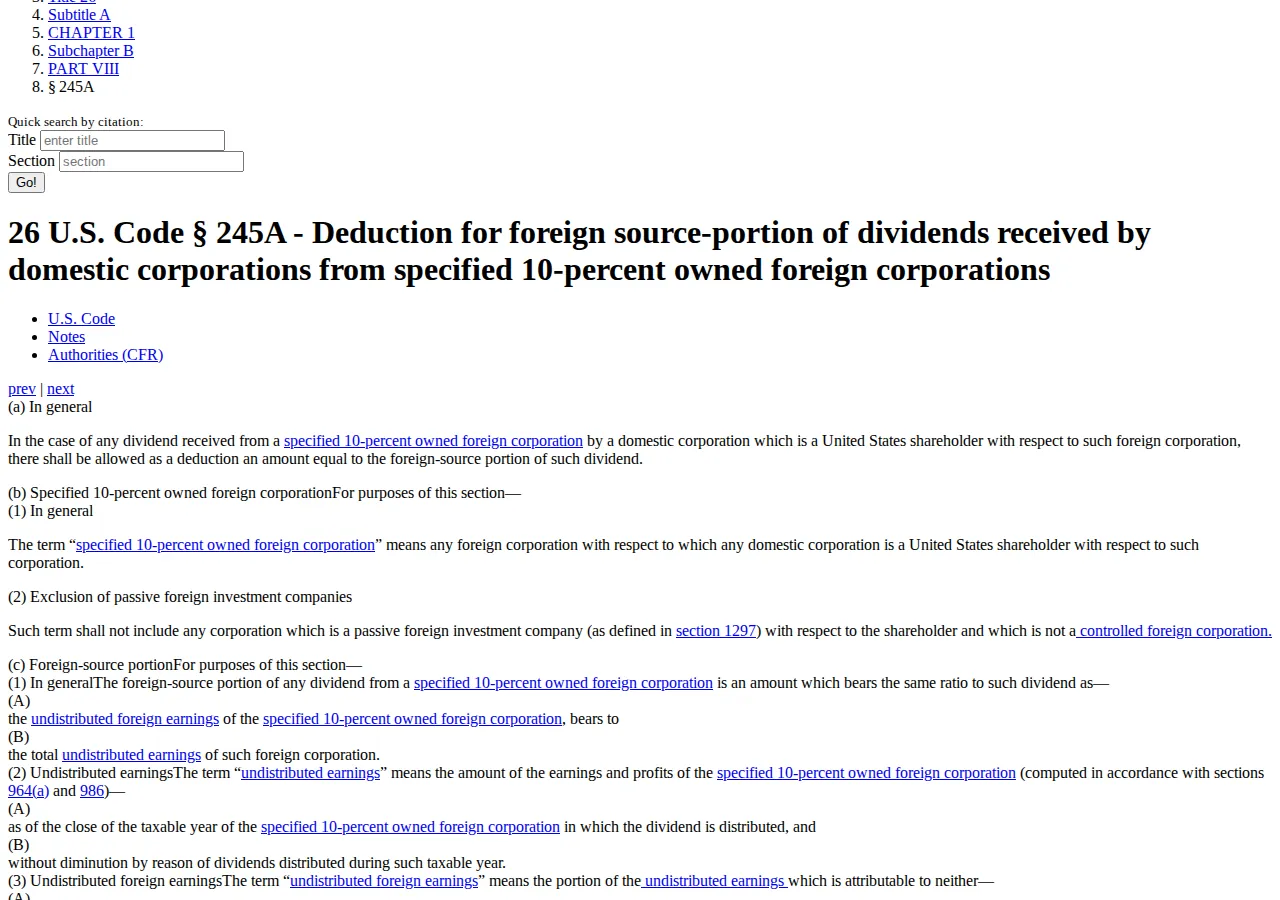
A United States corporation that owns at least 10 percent of a foreign corporation can bring the foreign corporation's dividend home and deduct the foreign-source portion of it entirely. That is the whole of IRC § 245A: a 100 percent dividends-received deduction for the foreign-source part of a dividend from a specified 10-percent owned foreign corporation, enacted by the Tax Cuts and Jobs Act for distributions made after December 31, 2017. On a $1,000,000 dividend where 80 percent of the foreign corporation's undistributed earnings are foreign-source, the deduction is $800,000, the taxable remainder is $200,000, and the federal tax at the 21 percent corporate rate is $42,000 instead of $210,000. The $168,000 difference is the reason every multinational group with a CFC repatriation plan starts its analysis at § 245A — and the reason the section's five traps (the holding period, the foreign-source ratio, the foreign tax credit denial, hybrid dividends, and the extraordinary-dividend rule) decide whether the plan works or fails in audit.
Who qualifies, and the three definitions that decide it
The deduction has three gates, and all three must be open at the same time. First, the recipient must be a domestic C-Corp — an individual, a partnership, an LLC, and an S-Corp cannot claim § 245A directly. Second, the domestic corporation must be a United States shareholder under IRC § 951(b): a United States person owning 10 percent or more of the foreign corporation's voting power or value. Third, the payer must be a specified 10-percent owned foreign corporation under § 245A(b)(1): any foreign corporation with respect to which a domestic corporation is a United States shareholder. A passive foreign investment company is excluded under § 245A(b)(2) unless it is also a controlled foreign corporation.
Founder & CEO Insight — Enow A. Jovial
The foreign-source portion: a ratio, not a guess
Section 245A(a) allows a deduction equal to the foreign-source portion of the dividend, and § 245A(c)(1) defines that portion as a ratio:
Undistributed earnings, under § 245A(c)(2), are the foreign corporation's earnings and profits computed under §§ 964(a) and 986, measured as of the close of the taxable year of distribution, without diminution for dividends distributed during that year. Undistributed foreign earnings, under § 245A(c)(3), are the portion attributable to neither the income described in § 245(a)(5)(A) nor the dividends described in § 245(a)(5)(B) — in practice, the earnings that are not United States-source income and not themselves dividends from a domestic corporation.
The ratio is where most repatriation math goes wrong, because the denominator is total undistributed earnings, not total earnings ever earned. A foreign corporation with $10,000,000 of undistributed earnings, of which $8,000,000 are foreign-source, produces a foreign-source portion of 80 percent on every dividend it pays that year, whatever the dividend's size. Worked through:
Without § 245A the same dividend is $1,000,000 of gross income and $210,000 of tax. The $168,000 saving is real money, and it is also the number the IRS tests first: the ratio must come from the foreign corporation's actual earnings and profits computation under § 964(a), under GAAP and FASB ASC 830, not from a planning memo. A group whose CPA has never maintained an E&P study for its CFC cannot prove the 80 percent, and an unproven ratio is a disallowed deduction.
The 365-day holding period, and the status that must never lapse
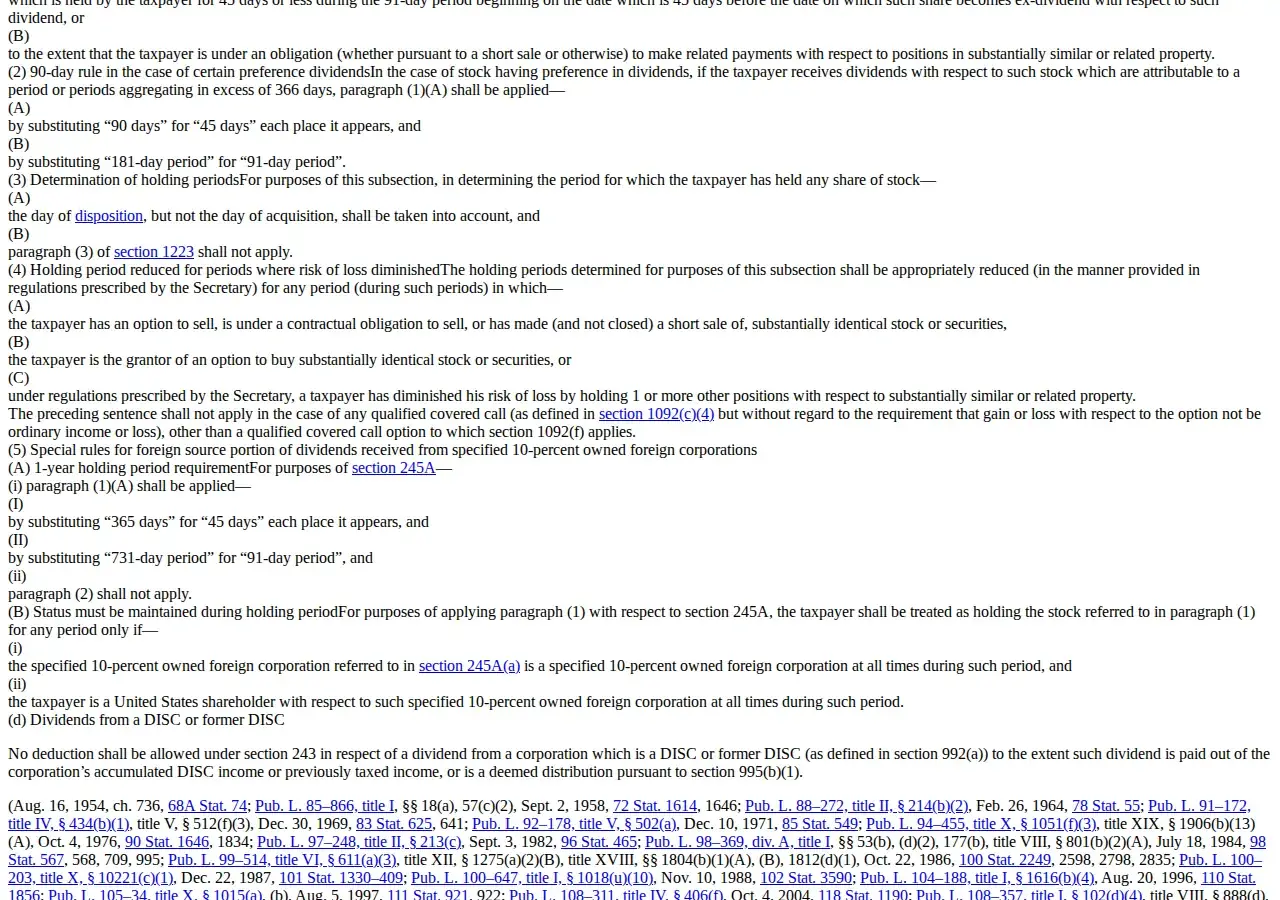
The deduction is lost if the stock was not held long enough. Section 246(c)(1) denies any deduction under § 243, § 245, or § 245A for a dividend on stock held for 45 days or less during the 91-day period beginning 45 days before the ex-dividend date. Section 246(c)(5) rewrites that rule for § 245A: 365 days replaces 45 days, and the 731-day period replaces the 91-day period. The domestic corporation must have held the stock for more than 365 days during the 731-day period beginning 365 days before the ex-dividend date.
Section 246(c)(5)(B) adds a second condition: the taxpayer counts as holding the stock only while the foreign corporation was a specified 10-percent owned foreign corporation, and only while the taxpayer was a United States shareholder. A quarter in which ownership dipped below 10 percent, or a restructuring that briefly moved the stock to a partnership, breaks the holding period for that stretch. And § 246(c)(4) reduces the holding period for any period in which the taxpayer's risk of loss was diminished — an option to sell, a short sale of substantially identical stock, or a hedge that takes the downside away.
The foreign tax credit trap: the deducted dividend carries no credit
Section 245A(d)(1) provides that no credit is allowed under § 901 for any taxes paid or accrued with respect to a dividend for which a deduction is allowed under § 245A, and § 245A(d)(2) denies any deduction for those taxes as well. The foreign withholding tax on the dividend is therefore a dead cost: it is neither creditable nor deductible. Section 904(b)(4) goes further — the foreign-source portion of a § 245A dividend is disregarded in computing the taxpayer's foreign-source taxable income for the foreign tax credit limitation, so the deducted dividend cannot be used to absorb excess credits from other baskets either.
The trap bites hardest in a high-tax jurisdiction. On the same $1,000,000 dividend, a 15 percent foreign withholding tax is $150,000 — gone, with no credit and no deduction — so the $168,000 saving falls to $18,000. At 25 percent withholding the dividend costs the group $82,000 more than leaving the cash abroad. The correct comparison is never "deduction versus no deduction"; it is "United States tax saved minus foreign tax stranded."
Hybrid dividends: the deduction that becomes subpart F income
Section 245A(e) denies the deduction for a hybrid dividend — an amount from a CFC for which a deduction would be allowed under § 245A(a), but for which the CFC received a deduction or other tax benefit for foreign income, war profits, or excess profits taxes. The classic case is a hybrid instrument: deductible interest abroad, dividend at home. The statute refuses to let the same dollar be deducted abroad and excluded at home.
The tiered rule in § 245A(e)(2) is worse than a denial. If a CFC receives a hybrid dividend from another CFC, it is treated as subpart F income of the receiving CFC under § 951(a)(1)(A), and the United States shareholder includes its pro rata share, determined as under § 951(a)(2), in gross income. The payment is not merely non-deductible; it is affirmatively includible, with no § 245A deduction and no § 250 deduction against it. Hybrid arrangements are exactly what the § 245A(e) regulations and the § 267A anti-hybrid rules were written to catch.
Section 245A against its neighbours
| Provision | What it does | Who it is for | Authority |
|---|---|---|---|
| § 245A | 100% deduction for the foreign-source portion of a dividend | Domestic corporation that is a US shareholder of a specified 10%-owned foreign corporation | 26 U.S.C. § 245A |
| § 243 | 50–100% dividends-received deduction for domestic dividends | Domestic corporation receiving a dividend from a domestic corporation | 26 U.S.C. § 243 |
| § 250 (FDII/GILTI) | Deduction for foreign-derived deduction eligible income and for the GILTI inclusion (renamed NCTI and FDDEI for tax years beginning after December 31, 2025) | Domestic corporation with foreign-derived income or a GILTI inclusion | 26 U.S.C. § 250 |
| § 951A (GILTI/NCTI) | Current inclusion of a US shareholder's share of a CFC's net tested income | US shareholder of a CFC, whether or not a dividend is paid | 26 U.S.C. § 951A |
| § 954 (Subpart F) | Current inclusion of specific categories of CFC income | US shareholder of a CFC | 26 U.S.C. § 954 |
| § 245A(e) hybrid | Denial, and tiered subpart F inclusion | Any group using hybrid instruments between CFCs | 26 U.S.C. § 245A(e) |
The boundary that matters most is § 245A against § 951A. Subpart F and GILTI inclusions are taxed as the CFC earns the income, whether or not a dividend is ever paid; § 245A applies only to an actual dividend, and only to the foreign-source portion not already taxed as a subpart F or GILTI inclusion. Previously taxed earnings and profits — the § 959 PTEP balance — are excluded from the dividend, so the same dollar is never taxed twice and never deducted twice. The section 250 FDII and GILTI deduction playbook carries the deduction-side math for the inclusions, the IRS Form 8992 GILTI inclusion playbook carries the inclusion mechanics, and the IRS Form 5471 foreign corporation reporting playbook carries the reporting that proves the E&P behind the ratio. For the transfer-pricing side of the same group, the section 482 transfer pricing arm's length methods and penalties playbook sets the prices that create the foreign earnings § 245A later moves.
The extraordinary-dividend tripwire
Section 1059 treats a dividend as extraordinary when it meets the threshold percentage of the taxpayer's adjusted basis in the stock, and the taxable portion — gross income minus the § 243, § 245, or § 245A deduction — reduces basis in the stock. A § 245A dividend that is large relative to basis therefore escapes current tax through the deduction and increases the gain on a later sale of the CFC stock. Groups planning a sale within a few years of a large § 245A dividend should model the basis reduction into the exit price, or the repatriation saving reappears as capital gain at closing.
Who should not use § 245A
Do not plan around § 245A if the recipient is not a domestic C-Corp: an individual, an S-Corp, an LLC, and a partnership receive no deduction, and the dividend is ordinary income to them. Do not use it for a dividend from a PFIC that is not a CFC — § 245A(b)(2) excludes it, and the excess-distribution regime of § 1291 applies instead. Do not use it for the United States-source portion: the deduction covers only the foreign-source portion, and a CFC with substantial United States-source earnings leaves a taxable remainder. Do not use it where the foreign withholding tax exceeds the United States tax saved — the § 245A(d) denial turns the repatriation into a net loss. And do not use it to repatriate a dividend that is really a hybrid payment: § 245A(e) will deny the deduction and, in a tiered structure, convert the payment into subpart F income.
Repatriation checklist
- [x] Step 1: Confirm the three gates — Domestic C corporation recipient, United States shareholder status at 10 percent or more, specified 10-percent owned foreign corporation payer; confirm the payer is not a non-CFC PFIC.
- [x] Step 2: Build the E&P study — Compute the CFC's earnings and profits under § 964(a) and § 986, split into foreign and total undistributed earnings, and document the ratio before the dividend is declared.
- [x] Step 3: Calendar the 365-day holding period — Count 365 days of holding inside the 731-day window beginning 365 days before the ex-dividend date, with no lapse in specified-corporation or United States shareholder status and no risk-of-loss-reducing hedge over the stock.
- [x] Step 4: Price the withholding tax — Compare the United States tax saved against the foreign withholding tax stranded by § 245A(d) on the wire transfer; if the withholding exceeds the saving, restructure the payment or leave the cash abroad.
- [x] Step 5: Screen for hybrid treatment — Confirm no deduction or tax benefit was taken abroad; if the instrument is hybrid, assume § 245A(e) denies the deduction and models the tiered subpart F inclusion.
- [x] Step 6: Model the § 1059 basis effect — If the dividend meets the extraordinary-dividend threshold, reduce basis by the taxable portion and carry it into the exit model.
- [x] Step 7: File and report — Report the dividend and the deduction on the corporate return, keep the EIN current on Form 5471 so the E&P behind the ratio is on the record, and retain the § 245A workpapers for the year the deduction is claimed. Run the after-tax total through the Business Profit Margin Calculator to see the repatriation in the group's real margin, not just in the tax line.