IRS Form 8992 GILTI Inclusion Playbook: From CFC Tested Income to the Tax You Actually Owe
Form 8992 is the worksheet where a U.S. shareholder's foreign-company profit becomes U.S. taxable income. Own 10 percent or more of a controlled foreign corporation (CFC) and the profit that company earns is taxed in the United States every year, whether or not it is ever distributed to you.
For tax years beginning after December 31, 2025, Pub. L. 119–21 (July 4, 2025) renamed Global Intangible Low-Taxed Income (GILTI) to Net CFC Tested Income (NCTI), repealed the 10 percent return on tangible assets, cut the section 250 deduction from 50 percent to 40 percent, and raised the deemed-paid foreign tax credit from 80 percent to 90 percent. The form posted at irs.gov/Form8992 is still Rev. December 2022, its instructions Rev. December 2024 — both still carry the GILTI name.
Who This Playbook Is For — and Who Should Not Use It
This playbook is for a U.S. person that is a U.S. shareholder of one or more CFCs and must compute a section 951A inclusion. The worked example follows a U.S. C corporation owning two foreign subsidiaries, because that fact pattern shows every moving part.
Do not use it if you own less than 10 percent of the foreign corporation, if no U.S. shareholder group owns more than 50 percent of it, or if the entity is a foreign partnership, a disregarded entity, or a foreign branch — none of those is a CFC, and section 951A does not apply. The section 250 computation itself is claimed on Form 8993 — see our Section 250 deduction playbook.
Step 1 — Confirm CFC Status and U.S. Shareholder Status
A CFC is generally a foreign corporation if more than 50 percent of the total combined voting power, or more than 50 percent of the total value of shares, is owned by U.S. shareholders. A U.S. shareholder is a U.S. person who owns, directly, indirectly, or constructively within the meaning of section 958, 10 percent or more of the voting power or value of all classes of stock.
Section 951A(c)(2) adds a timing rule: a person is a U.S. shareholder for a taxable year if the person owns stock in the foreign corporation on any day in that year, and section 951A(c)(3) mirrors it for CFC status — a December sale does not erase a January inclusion.
Step 2 — Compute Tested Income or Tested Loss for Each CFC
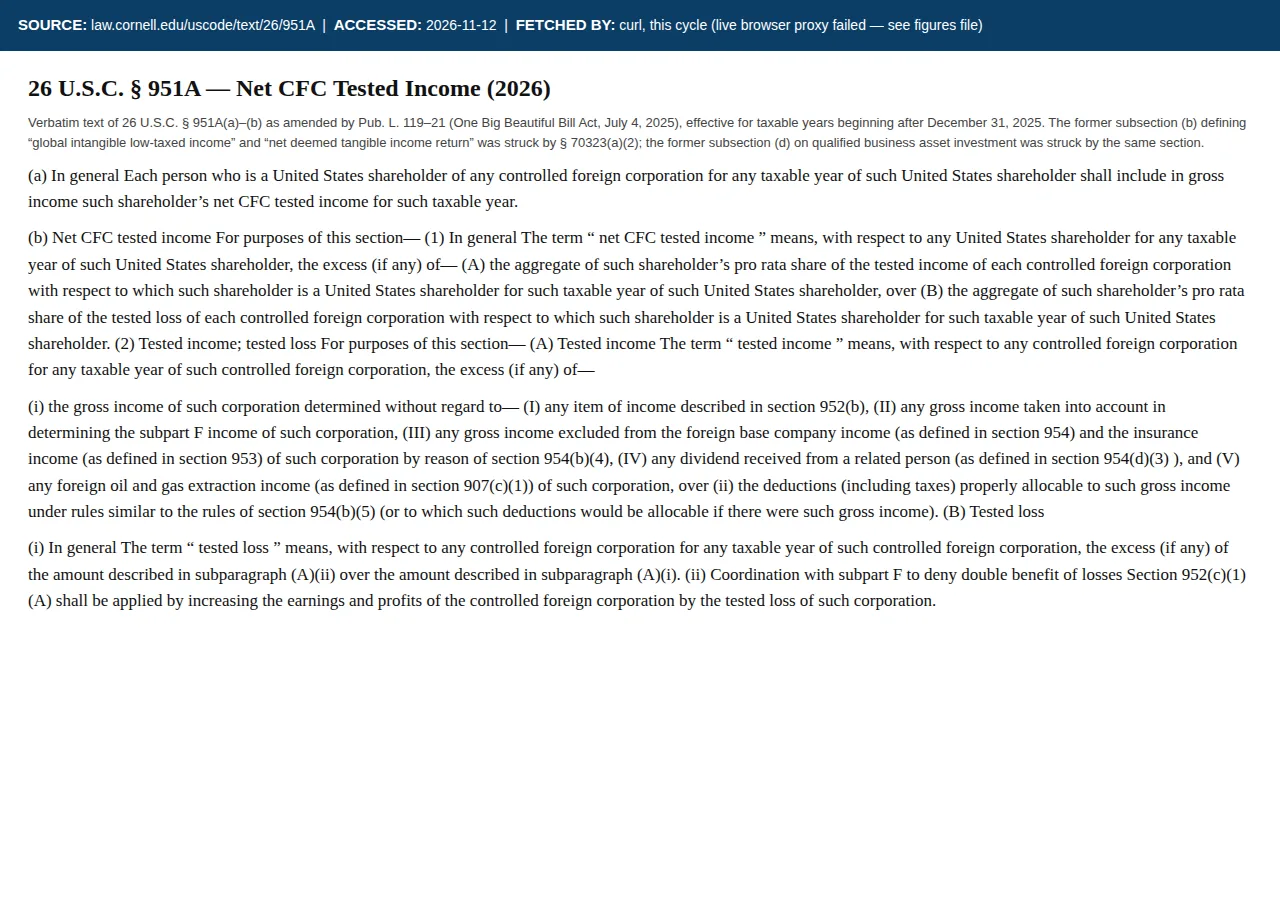
Under section 951A(b)(2)(A), start with the CFC's gross income, then remove five categories: any item described in section 952(b); any gross income taken into account in determining the CFC's subpart F income; any gross income excluded from foreign base company income and insurance income by reason of section 954(b)(4), the high-tax exception; any dividend received from a related person; and any foreign oil and gas extraction income. Then subtract the deductions, including taxes, properly allocable to the remaining gross income under rules similar to section 954(b)(5). What is left, if positive, is tested income. If the deductions exceed the gross income, the excess is a tested loss under section 951A(b)(2)(B), and section 952(c)(1)(A) increases the CFC's E&P by the tested loss, so the same loss cannot also shelter subpart F income.
Subpart F income is computed first and stripped out of tested income — an error there inherits into tested income; see our Subpart F guide for foreign SaaS founders.
The high-tax exception is the one exclusion a founder can plan around. Section 954(b)(4) excludes an item of income if the taxpayer establishes that it was subject to an effective rate of foreign income tax greater than 90 percent of the maximum rate in section 11 — 21 percent, so the threshold is 18.9 percent. Income taxed abroad above 18.9 percent can be excluded from the tested-income base entirely, through section 951A(b)(2)(A)(i)(III) — but the rate must be documented to the satisfaction of the Secretary, not asserted.
The per-CFC figures come from Schedule I-1 (Form 5471): tested income or loss from line 6, QBAI from line 8, tested loss QBAI amount from line 9c, tested interest expense from line 9d, tested interest income from line 10c. Our Form 5471 playbook works the filing and the $10,000-per-year section 6038 penalty ladder in full.
Step 3 — Aggregate on Schedule A and Form 8992 Part I
Schedule A turns CFC-level figures into a shareholder-level number. For each CFC you report the name, EIN or reference ID number, tested income, tested loss, your pro rata share of each, your pro rata share of QBAI, the tested loss QBAI amount, tested interest income, tested interest expense, and the GILTI allocation ratio — columns (a) through (l). A member of a U.S. consolidated group uses Schedule B instead.
Form 8992 Part I is three lines. Line 1 is the sum of your pro rata share of net tested income, from Schedule A line 1, column (e). Line 2 is the sum of your pro rata share of net tested loss, from column (f). Line 3 combines them: net CFC tested income, equal to line 1 minus line 2. The form's instruction is blunt — "If zero or less, stop here." Tested losses equal to or above tested income mean no inclusion and no Part II — the loss CFC in the worked example cuts the inclusion from $800,000 to $650,000.
Step 4 — The Deemed Tangible Income Return: 2025 Only
Part II turns net CFC tested income into the inclusion. On the form as printed, line 1 carries Part I line 3 forward, line 2 is the deemed tangible income return (DTIR) — Schedule A line 1 column (g) QBAI multiplied by 10 percent — lines 3a through 3c compute specified interest expense as tested interest expense less tested interest income, floored at zero, line 4 is net DTIR, and line 5 is the inclusion: line 1 less line 4, floored at zero.
For a 2025 return, that sequence is live law. QBAI is defined in Treasury Regulation section 1.951A-3(b) as the average of a tested income CFC's aggregate adjusted bases in specified tangible property. A CFC with $2,000,000 of average basis earned a $200,000 deemed return.
For a 2026 return, the sequence is dead: Pub. L. 119–21 struck the QBAI provisions from section 951A entirely, so there is no deemed tangible income return to subtract and no function for Schedule A columns (g) and (h). The form still prints those lines because the IRS has not issued a revised Form 8992. A preparer who completes Part II line 2 for a 2026 return understates the inclusion by 10 percent of QBAI; carry Part I line 3 directly to the inclusion, with DTIR equal to zero.
Step 5 — Deduct 40 Percent, Gross Up, and Credit 90 Percent
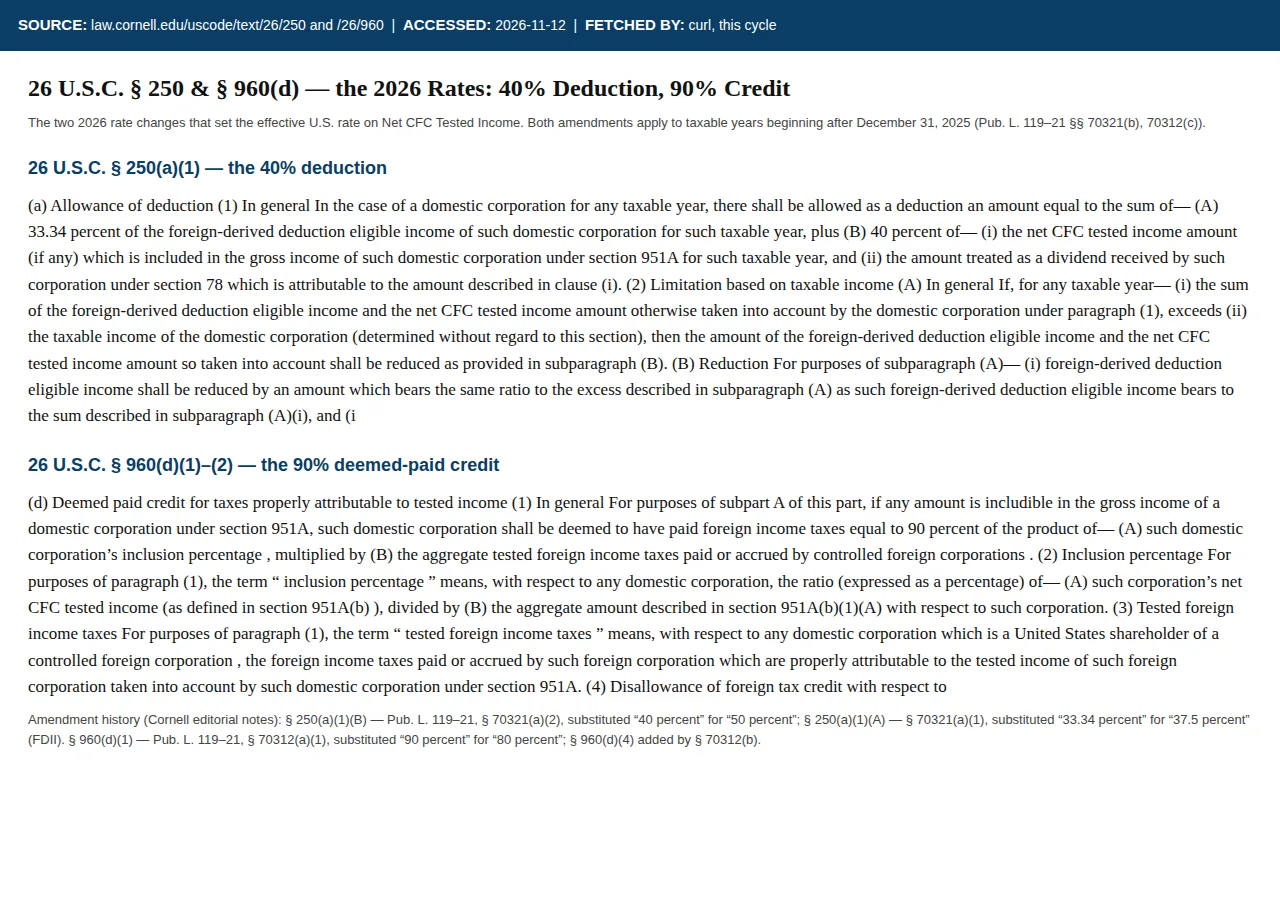
The inclusion is not the tax. For a domestic C-Corp, section 250(a)(1)(B) allows a deduction equal to 40 percent of the NCTI amount included under section 951A plus the section 78 gross-up attributable to it, capped by section 250(a)(2) at taxable income determined without section 250. Section 960(d)(1) provides the credit: the corporation is deemed to have paid foreign income taxes equal to 90 percent of its inclusion percentage — NCTI divided by aggregate tested income under section 960(d)(2) — multiplied by the aggregate tested foreign income taxes paid or accrued by its CFCs. The credit is claimed on Form 1118, subject to the section 904 limitation.
Computation A — the 2026 chain. Assume a U.S. C-Corp owns 100 percent of CFC-A (Ireland) and CFC-B (UK). CFC-A: gross income $1,200,000, deductions $400,000, tested income $800,000, Irish tax paid $100,000. CFC-B: gross income $300,000, deductions $450,000, tested loss $150,000, no foreign tax. Tested interest is zero; figures are illustrative.
The effective U.S. rate on the $650,000 inclusion is 2.77 percent — a 12.5 percent foreign rate plus a 90 percent credit does most of the work. Before credits, the rate is 12.6 percent: 21 percent applied to the 60 percent left after the 40 percent deduction. The break-even foreign rate is 12.6 percent divided by 90 percent, or 14.0 percent.
Computation B — the same company under 2025 law. DTIR is 10 percent of CFC-A's $2,000,000 average QBAI, or $200,000, so GILTI is $450,000. The inclusion percentage falls to 56.25 percent, deemed-paid taxes to $45,000, the section 250 deduction to $247,500, and tax to 21 percent of $247,500, or $51,975, less the $45,000 credit — net $6,975. The 2026 rules cost this company $11,013.75 more: the QBAI shelter is gone and the deduction is ten points thinner, partly offset by the stronger credit.
Step 6 — File It, Route It, and Track Previously Taxed Income
Attach Form 8992 and Schedule A to the return. For a C-Corp, the Part II line 5 result goes on line 17 of Form 1120, Schedule C; for an individual, on line 8o of Schedule 1 (Form 1040); for an S-Corp that elected entity treatment under proposed Regulation section 1.958-1(e), on Form 1120-S, Schedule K, line 10, using code E. File Form 5471 for each CFC, Form 8993, and Form 1118. Project the cash effect with our Self-Employed Tax & Quarterly Estimator.
Then track what you already paid tax on. Amounts included under section 951A become previously taxed earnings and profits (PTEP) under section 959, so a later distribution is excluded from gross income — but the C-Corp shareholder's basis in the CFC stock is increased under section 961 by the amount included and decreased by the distribution. Section 960(d)(4) also denies any credit for 10 percent of the foreign taxes attributable to amounts excluded under section 959(a) by reason of a section 951A inclusion.
Computation C — the individual founder. The same $650,000 NCTI in the hands of an individual with no election is taxed at ordinary rates with no section 250 deduction and no foreign tax credit: $240,500 at an assumed 37 percent rate, against $17,988.75 for the corporation. Section 962 lets an individual elect corporate-rate treatment, opening the deduction and the credit — but under section 962(d), a later distribution is taxed to the extent the distributed E&P exceeds the tax already paid.
Decision Table: Which Route Fits Your Facts
| Situation | Route | Authority |
|---|---|---|
| Domestic C corporation with CFCs | Form 8992; 40% §250 deduction on Form 8993; 90% deemed-paid credit on Form 1118 | §951A; §250(a)(1)(B); §960(d)(1) |
| Individual founder, no election | Inclusion taxed at ordinary rates; no §250 deduction; no FTC | §951A(a); Instructions for Form 8992, Part II |
| Individual founder, §962 election | Taxed at corporate rates; §250 deduction and 90% credit; §962(d) tax on later distributions | §962(a), (d); §250; §960(d) |
| CFC income taxed abroad above 18.9% | Exclude the item from tested income via the high-tax exception | §954(b)(4); §951A(b)(2)(A)(i)(III) |
Risk Layer: Penalties Price the Paperwork, Not Just the Tax
Failure modes cluster in four places: completing the repealed QBAI lines for a 2026 return; netting tested losses at the CFC level instead of aggregating them at the shareholder level; claiming the section 250 deduction without the section 78 gross-up; and filing Form 8992 without Form 5471, so the Schedule I-1 source figures do not exist. Each is cheaper for a CPA to prevent than to defend.
Founder & CEO Insight — Enow A. Jovial
Execution Checklist
- [x] Build the ownership map
- [x] Complete subpart F first
- [x] Pull figures from Schedule I-1 (Form 5471)
- [x] Aggregate on Schedule A; stop at Part I, line 3 if zero
- [x] For 2026, leave Part II line 2 at zero
- [x] Claim the §250 deduction on Form 8993
- [x] Compute the §960(d) credit on Form 1118
- [x] Route Part II, line 5 to the right return line
- [x] Update the PTEP ledger and §961 basis
Form 8992 rewards the founder who treats the foreign subsidiary as a reporting entity from the day it is formed — the statute gives you the deduction and the credit; the form asks you to prove you earned them.