Section 250 FDII & GILTI Deduction: The Complete Playbook
Section 250 decides what rate a domestic corporation pays on two kinds of cross-border income: profit from selling goods and services to foreign customers, and profit earned through a controlled foreign corporation. For tax years beginning after December 31, 2025, the statute lets a domestic corporation deduct 33.34 percent of its foreign-derived deduction eligible income and 40 percent of its net CFC tested income inclusion, plus the section 78 gross-up tied to that inclusion. Public Law 119-21, the One Big Beautiful Bill Act, enacted July 4, 2025, renamed both measures, cut both rates, and repealed the qualified business asset investment haircut.
1. What section 250 does
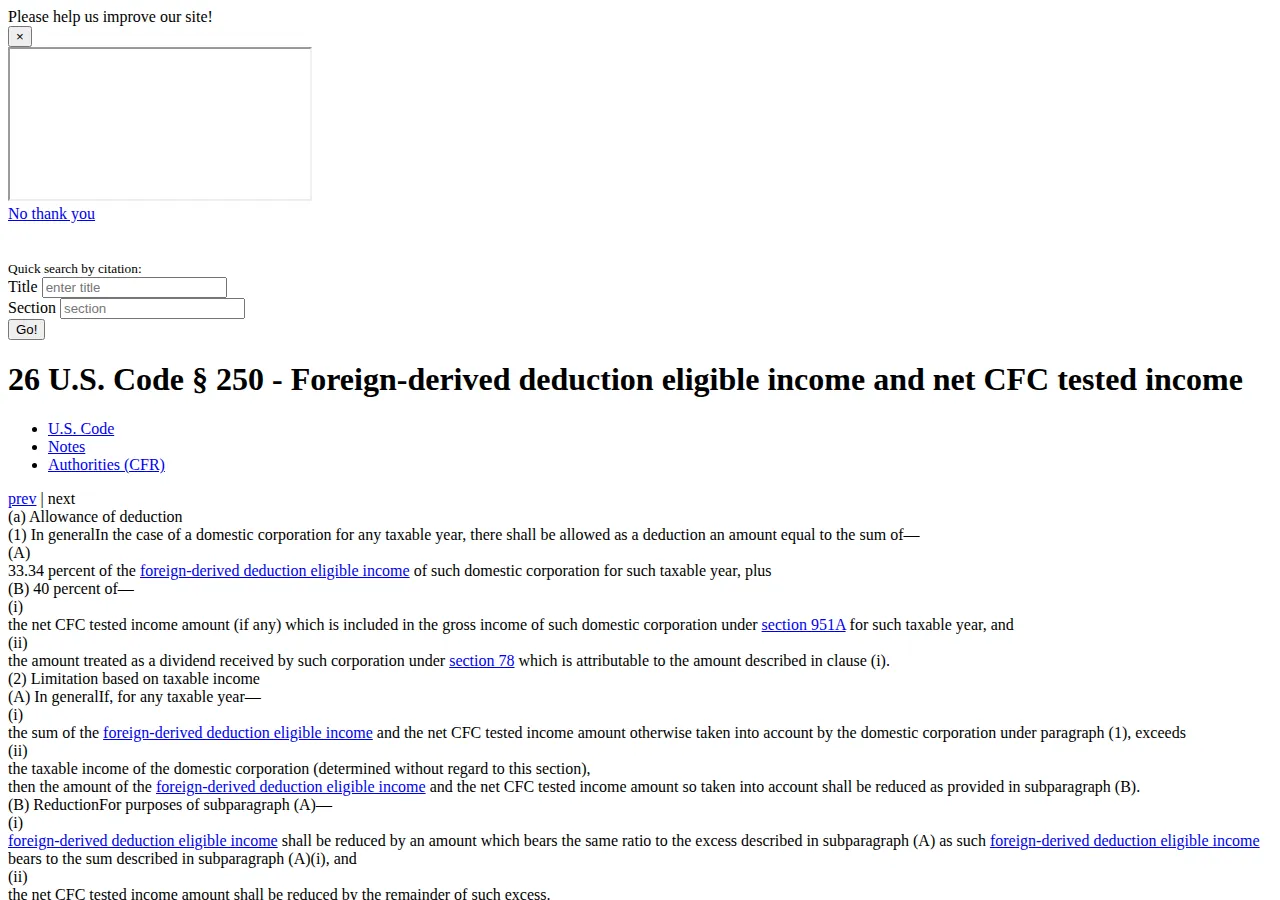
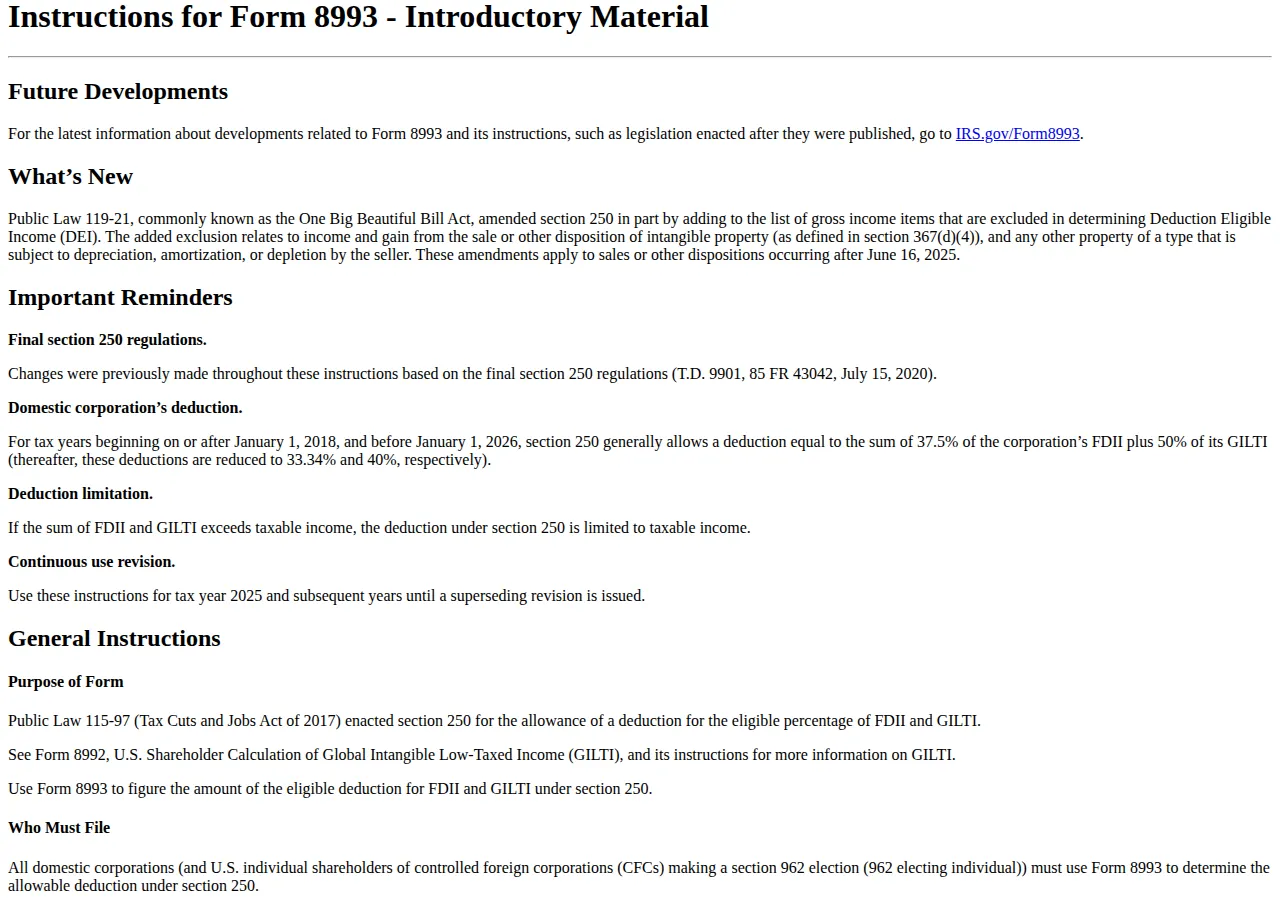
Section 250(a)(1) allows a domestic corporation a deduction of 33.34 percent of its foreign-derived deduction eligible income, called FDDEI, plus 40 percent of its net CFC tested income inclusion under section 951A and the section 78 dividend amount attributable to it, claimed by attaching Form 8993. Before 2026 the percentages were 37.5 percent and 50 percent, as the Instructions for Form 8993 (12/2025) confirm.
2. The OBBBA rewrite: new names, new rates, no QBAI
Public Law 119-21 rewrote section 250 in three moves effective for tax years beginning after December 31, 2025: section 70321 substituted 33.34 percent for 37.5 percent and 40 percent for 50 percent; section 70323 substituted the new names; and section 70323(b)(2)(B) struck the FDII and deemed tangible income return definitions.
| Item | Before 2026 | After Dec 31, 2025 | Authority |
|---|---|---|---|
| Export-side income | FDII | FDDEI | § 250(b)(1) |
| Export-side rate | 37.5% | 33.34% | § 250(a)(1)(A) |
| CFC-side inclusion | GILTI | NCTI | § 951A |
| CFC-side rate | 50% | 40% | § 250(a)(1)(B) |
| QBAI haircut | 10% of QBAI as DTIR | Repealed | § 250(b) |
The QBAI repeal is the largest move for asset-heavy exporters: under the old law, FDII equaled DEI minus 10 percent of QBAI, times the foreign-derived ratio; now the full FDDEI enters the 33.34 percent computation. The old step-down is also gone: the prior section 250(a)(3) would have cut the rates to 21.875 percent and 37.5 percent, and Public Law 119-21 struck that paragraph.
3. FDDEI: deduction eligible income that is foreign-derived
FDDEI starts with deduction eligible income, or DEI: gross income minus section 250(b)(3) exclusions and properly allocable deductions. The exclusions remove income other provisions already handle: subpart F amounts, NCTI, financial services income, CFC dividends, domestic oil and gas income, and foreign branch income. Public Law 119-21 added two more for sales after June 16, 2025: gains from selling intangible property under section 367(d)(4), and gains from selling depreciable, amortizable, or depletable property. A lease or license does not count as a sale for these two exclusions. Interest expense and research or experimental expenditures are not subtracted in computing DEI.
Once DEI is fixed, FDDEI is the slice derived from property sold to a non-United States person for a foreign use, or services provided to a person or property outside the United States. Foreign use means any use, consumption, or disposition outside the United States; "sale" includes a lease, license, exchange, or other disposition.
Two traps sit inside the foreign-use test. Under section 250(b)(2)(B), property sold to another person in the United States for further manufacture or modification here is not sold for a foreign use, even if that person later exports it; services provided to a person in the United States are not foreign-derived. Under section 250(b)(2)(C), a sale to a related foreign party counts only if the property is ultimately sold by, or used by, that related party in connection with property sold or services provided to an unrelated non-United States person, and the taxpayer proves foreign use. The final section 250 regulations (T.D. 9901) impose substantiation requirements in Regulations sections 1.250(b)-3(f), 1.250(b)-4(d)(3), and 1.250(b)-5(e)(4).
4. NCTI: the CFC-side inclusion after the QBAI repeal
Section 951A(a) requires each United States shareholder of a CFC to include its net CFC tested income. Section 951A(b)(1) defines NCTI as aggregate pro rata tested income minus aggregate pro rata tested loss across each CFC. Tested income is a CFC's gross income, excluding subpart F items, high-tax exception income, related-person dividends, and foreign oil and gas extraction income, minus allocable deductions. Tested loss is the mirror image.
The old GILTI definition subtracted a net deemed tangible income return of 10 percent of QBAI; Public Law 119-21 struck the QBAI definition from section 951A, so NCTI is aggregate tested income minus aggregate tested loss. Asset-heavy groups lose the tangible-return shelter; the higher 90 percent deemed-paid credit partly offsets that.
Form 8992 computes the inclusion. The Instructions for Form 8992 (12/2024) require a United States shareholder who owned CFC stock under section 958(a) on the last day of the CFC's tax year in which it was a CFC to file with Schedule A reporting each CFC's tested income, tested loss, and pro rata shares. Members of a United States consolidated group file a single consolidated Form 8992 with Schedule B. Domestic partnerships report on Schedule K-2 and Schedule K-3, Part VI, of Form 1065 instead. For the CFC's own reporting, see our IRS Form 5471 foreign corporation reporting playbook.
5. The deduction math: effective rates
The deduction is a fixed percentage of a defined base, applied against the 21 percent rate.
The NCTI side then gets the section 960(d) credit: for tax years beginning after December 31, 2025, the credit equals 90 percent of the inclusion percentage multiplied by the aggregate tested foreign income taxes paid or accrued by its CFCs. The credit was 80 percent before 2026; the section 78 gross-up, which equals the taxes deemed paid, grows with it, raising the section 250 deduction base as well as the credit.
Atlas Devices Inc. owns a single CFC with tested income of 2,000,000 dollars, no tested loss, and tested foreign taxes of 250,000 dollars.
Net United States tax of 55,350 dollars on a 2,000,000-dollar inclusion is an effective rate of 2.77 percent. The same CFC with zero foreign taxes would pay 12.60 percent. The deduction is fixed; the credit depends on foreign taxes actually paid or accrued.
6. The taxable-income limitation
Section 250(a)(2) caps the deduction when taxable income is too small: if FDDEI plus the NCTI amount exceeds taxable income determined without regard to section 250, FDDEI is reduced first by a pro rata share of the excess, and the NCTI amount by the remainder. The deduction cannot create or increase a loss.
Atlas has FDDEI of 6,000,000 dollars, an NCTI inclusion of 2,000,000 dollars, and taxable income before section 250 of 5,000,000 dollars: a 3,000,000-dollar excess over an 8,000,000-dollar sum.
7. Form 8993: where the deduction is claimed
Form 8993 is the return-level form for the section 250 deduction, required of every domestic corporation claiming it and every United States individual CFC shareholder making a section 962 election. Only domestic corporations (excluding REITs, RICs, and S corporations) and section 962 electing individuals may claim it. A corporate partner takes its distributive share of the partnership's gross DEI, gross FDDEI, and deductions from Schedule K-3 of Form 1065 (Reg. sections 1.250(b)-1(e) and 1.250(b)-3(e)).
One honest complication: the 12/2025 instructions still print the pre-OBBBA form lines, including line 7 for the deemed tangible income return, because the form had not been redesigned when the instructions were published. The statute controls: for tax years beginning after December 31, 2025, there is no deemed tangible income return to compute.
The form's own identifiers matter at filing time. Form 8993 and Form 8992 both carry the filer's employer identification number for a corporation, and a section 962 electing individual files under a Social Security number or an individual taxpayer identification number. The CPA ties the EIN on Form 8993 to Form 1120, each CFC's EIN or reference ID number on Schedule A to its Form 5471, and the section 78 gross-up to the deemed-paid taxes on Form 1118. A C corporation, an S corporation, and a limited liability company taxed as a corporation are three different filers: the S corporation and the LLC that never elected corporate treatment cannot claim the deduction, and a Schedule K-1 interest flows through only to a corporate partner. The preparer also checks the figures against the books kept under generally accepted accounting principles, while payroll taxes under the Federal Insurance Contributions Act and self-employment tax under the Self-Employment Contributions Act never enter this computation.
8. Worked example: Atlas Devices across the full return
Atlas Devices Inc., a domestic C corporation, reports for 2026 FDDEI of 5,000,000 dollars, an NCTI inclusion of 1,500,000 dollars, tested foreign taxes of 150,000 dollars, and taxable income before section 250 of 9,000,000 dollars. The sum of FDDEI and NCTI is 6,500,000 dollars, below taxable income, so the limitation does not apply.
Without section 250, the tax would be 21 percent of 9,000,000 dollars less the 135,000-dollar credit, or 1,755,000 dollars. The deduction saves 487,410 dollars, exactly 21 percent of the 2,321,000-dollar deduction. Under the pre-2026 rates the deduction would have been 2,692,500 dollars, so the OBBBA change costs Atlas 371,500 dollars of deduction, or 78,015 dollars of tax. To test the numbers on your own facts, run them through our tax estimator.
9. Section 250 versus section 199A: the boundary
Section 250 and section 199A both reduce the tax on business income, and they are routinely confused because both use the word deduction. Section 199A allows up to 20 percent of qualified business income for individuals and pass-through owners, with an SSTB phaseout. Section 250 allows 33.34 percent of FDDEI and 40 percent of NCTI for domestic C corporations and section 962 electing individuals. Section 199A is claimed on the individual return; section 250 on Form 8993 attached to the corporate return. A C corporation cannot claim section 199A on export profit, and an S corporation cannot claim section 250, which excludes S corporations outright. For the pass-through side, see our Section 199A QBI deduction SSTB phaseout playbook. For the pricing rules on whether the foreign sale is at arm's length, see our transfer pricing intercompany services playbook.
Founder & CEO Insight — Enow A. Jovial
>
10. Who this playbook is for, and the execution checklist
This playbook is for domestic C corporations with foreign customers, United States shareholders of CFCs, and section 962 electing individuals. It is not for S corporations, real estate investment trusts, or regulated investment companies, which the statute excludes; not for individuals who have not made a section 962 election; and not for anyone whose export sales go only to domestic intermediaries, because section 250(b)(2)(B) keeps those sales out of FDDEI.
- Confirm the filer qualifies: domestic C corporation, or a section 962 electing individual; S corporations, REITs, and RICs stop here.
- Compute DEI: gross income minus the section 250(b)(3) exclusions and allocable deductions, other than interest and research or experimental expenditures.
- Prove foreign use: collect contracts, shipping records, and customer locations.
- Apply the related-party and intermediary rules: trace every sale to an unrelated foreign end user.
- Compute the NCTI inclusion on Form 8992: aggregate tested income minus aggregate tested loss, Schedule A attached.
- Compute the section 78 gross-up and the section 960(d) credit: 90 percent of tested foreign taxes.
- Test the section 250(a)(2) limitation: if FDDEI plus NCTI exceeds taxable income, cut FDDEI pro rata first and NCTI by the remainder.
- Claim the deduction on Form 8993: attach it to the return by the due date including extensions.