The form that turns a foreign company into a U.S. reporting obligation
Form 5471 is an information return, not a tax return. It computes no tax bill by itself. It tells the IRS that a U.S. person owns, controls, or directs a foreign corporation, and hands the IRS the balance sheet, the earnings and profits ledger, and the ownership map it needs to tax that corporation's income in the United States. A founder with an Irish subsidiary, a fund holding 12 percent of a Cayman company, and a U.S. citizen on the board of a German GmbH can all be Form 5471 filers — three different reasons, three different categories. The form attaches to the filer's income tax return, due when that return is due, including extensions. The stakes: $10,000 for each annual accounting period of each foreign corporation under section 6038, plus a second penalty cutting the foreign tax credit.
> [!KEY TAKEAWAY]
> Form 5471 is triggered by ownership, control, or a board seat — not by receiving a dividend. Own 10 percent or more of a foreign corporation, control it, or serve as its officer or director while a U.S. person acquires 10 percent, and the filing duty exists whether or not any money crossed a border.
Why it matters: the penalty clock starts before the return is late
Section 6038(b) sets the base penalty at $10,000 for each annual accounting period with respect to which the failure exists. If the failure continues more than 90 days after the IRS mails notice, an additional $10,000 applies for each 30-day period, or fraction of one, after the 90-day period expires, capped at $50,000 additional per failure. Section 6038(c) adds a 10 percent reduction of the foreign taxes available for credit under sections 901 and 960, plus 5 percent for each 3-month period after the 90-day window.
!Section 6038 penalty text from 26 U.S.C. section 6038
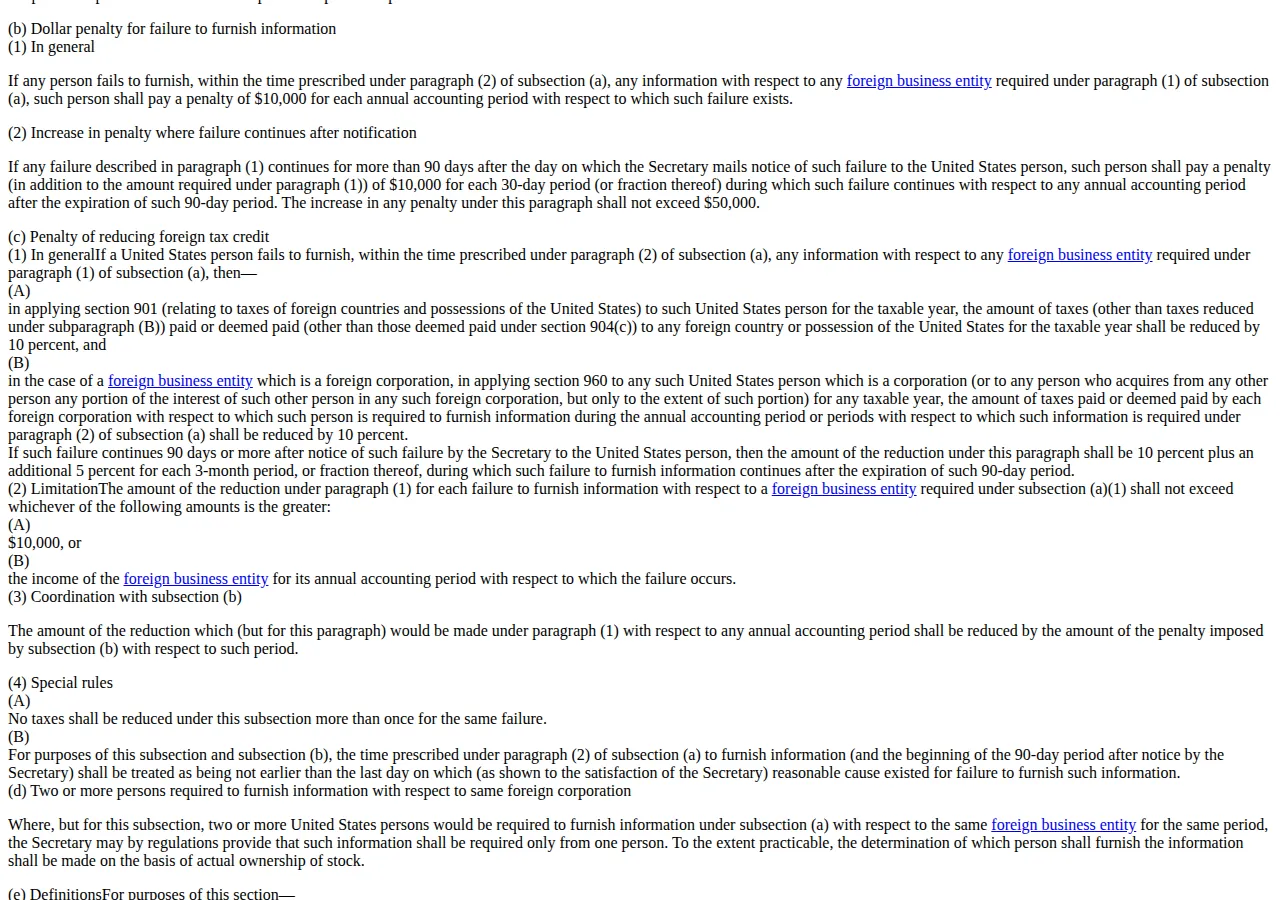
26 U.S.C. section 6038(b) and (c): the $10,000 base penalty, the $10,000 per 30-day continuation penalty, and the 10 percent credit reduction.
The five filer categories
The instructions divide every filer into Categories 1 through 5. One person can be two categories for the same corporation in the same year — a Category 4 controller who is also a Category 5 U.S. shareholder of a CFC, for example — and must satisfy each category's schedule requirements.
| Category | Who files | Trigger | Authority |
| :--- | :--- | :--- | :--- |
| Category 1 | U.S. shareholder of a section 965 SFC | 10 percent or more of a section 965 SFC on its last day as an SFC | § 965; Form 5471 instructions |
| Category 2 | U.S. citizen or resident officer or director | A U.S. person acquired 10 percent, or an additional 10 percent | § 6046; Treas. Reg. § 1.6046-1 |
| Category 3 | Acquiring or disposing U.S. person | Acquired 10 percent, became a U.S. person while meeting it, or fell below 10 percent | § 6046; Treas. Reg. § 1.6046-1 |
| Category 4 | U.S. person with control | Above 50 percent of voting power or value at any time | § 6038(e)(2) |
| Category 5 | U.S. shareholder of a CFC | 10 percent or more of a CFC on its last day as a CFC | §§ 951(b), 957 |
Category 1: the section 965 shareholder
A Category 1 filer was a U.S. shareholder of a section 965 specified foreign corporation at any time during the corporation's tax year ending with or within the filer's tax year, and owned that stock on the last day in that year in which the corporation was a section 965 SFC. A U.S. shareholder owns, directly, indirectly, or constructively under section 958, 10 percent or more of total combined voting power or value. Category 1 splits into 1a, 1b, and 1c for unrelated and related constructive shareholders of foreign-controlled SFCs. Reporting continues while the SFC has section 965 earnings on Schedule J or previously taxed section 965 earnings on Schedule P.
Category 2: the officer or director
Category 2 is the only category where the filer may own nothing: a U.S. citizen or resident who is an officer or director of a foreign corporation in which a U.S. person has acquired stock meeting the 10 percent test, or an additional 10 percent. Section 6046 requires the return within 90 days after the day the filer becomes liable to file it. The test is met at 10 percent of total stock value or total combined voting power.
Category 3: the acquirer and the disposer
Category 3 covers the U.S. person on the other side of the Category 2 event: one whose acquisition, added to stock already owned, meets the 10 percent test; one whose acquisition meets the test on its own; a person treated as a U.S. shareholder under section 953(c); a person who becomes a U.S. person while meeting the test; or one who disposes of enough stock to fall below 10 percent. The same 90-day section 6046 clock applies; Category 3 filers also attach a statement of the corporation's indebtedness to related persons and each subscriber's details.
Category 4: control above 50 percent
A Category 4 filer is a U.S. person who had control of a foreign corporation during the corporation's annual accounting period. Control means owning, at any time during the year, stock possessing more than 50 percent of total combined voting power of all classes of voting stock, or more than 50 percent of total value of all classes of stock. Control chains: a person in control of a corporation that owns more than 50 percent of another is treated as in control of the second too. Category 4 is the broadest in practice: a C-Corp parent holding a majority of a foreign subsidiary is a Category 4 filer every year it holds control, whether or not the subsidiary earns income.
Category 5: the CFC shareholder
A Category 5 filer was a U.S. shareholder that owned stock in a foreign corporation that was a CFC at any time during the corporation's tax year ending with or within the filer's tax year, and owned that stock on the last day in that year in which the corporation was a CFC. A CFC is a foreign corporation whose U.S. shareholders own, directly, indirectly, or constructively, more than 50 percent of total combined voting power or total value on any day of the year. A U.S. shareholder owns 10 percent or more of voting power or value.
Which schedules each category owes
Form 5471 is a cover page plus schedules A through R, and the schedule set depends on the category. Categories 2 and 3 file the cover page plus Schedule O and the statement above — not the full financial schedules, unless they are also Cat. 1, 4, or 5 filers for the same corporation. That distinction is the most common first-time error: an officer who files a full Category 5 package when only a Schedule O was due wastes a week, and a controller who files only a Schedule O when the full package was due has filed an incomplete return.
| Schedule | Contents | Owed by |
| :--- | :--- | :--- |
| Schedule A | Stock of the foreign corporation | All filers |
| Schedule C | Income statement | Cat. 1, 4, 5 |
| Schedule I / I-1 | Shareholder income; pro rata share | Cat. 1, 4, 5 |
| Schedule J | Accumulated earnings | Cat. 1, 4, 5 |
| Schedule M | Related-person transactions | Cat. 1, 4, 5 |
| Schedule O | Organization | Cat. 2, 3 |
| Schedule P | Previously taxed earnings | Cat. 1, 4, 5 |
| Schedule Q | CFC income by category | Cat. 1, 4, 5 |
Worked example: the penalty ladder on three corporations
A U.S. founder owns 100 percent of three foreign subsidiaries — Ireland, Singapore, Cayman Islands — and files no Form 5471 for either of the last two tax years. The IRS mails a notice of failure; the failure continues for 150 days after the notice was mailed. The dollar penalty for one corporation for one year is:
$
\text{Penalty}_{\text{per failure}} = \$10{,}000 + \left\lceil\frac{150 - 90}{30}\right\rceil \times \$10{,}000 = \$10{,}000 + 2 \times \$10{,}000 = \$30{,}000
$
The 150 days run 60 days past the 90-day grace window — two 30-day periods. The total across the group is:
$
\text{Total penalty} = 3\ \text{corporations} \times 2\ \text{years} \times \$30{,}000 = \$180{,}000
$
The $50,000 cap is per failure, not per filer, so it does not bind here. Section 6038(c) also cuts the foreign tax credit by 10 percent — $40,000 on $400,000 of available credit, plus 5 percent per 3-month period after the 90-day window.
!IRS Instructions for Form 5471 penalty section
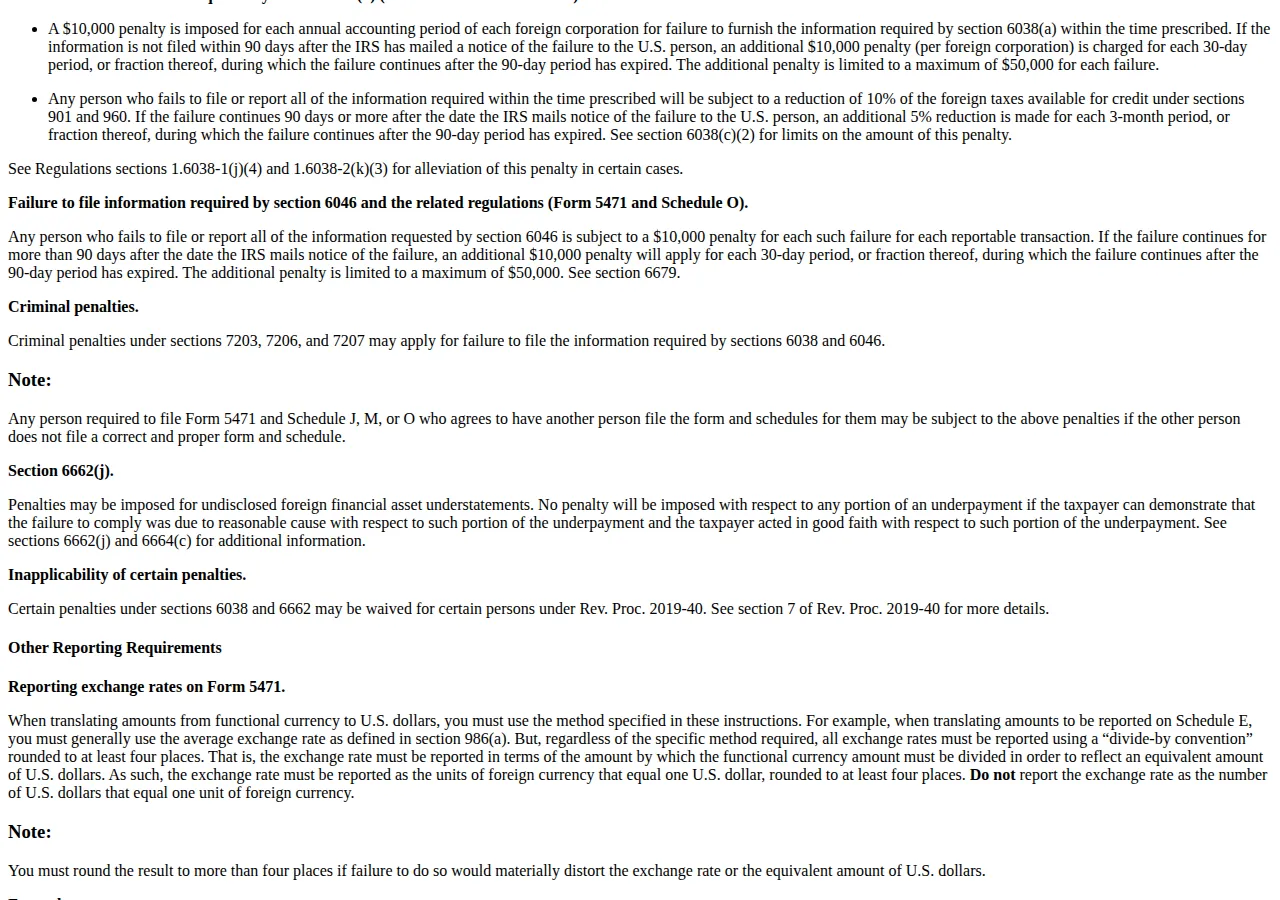
The IRS Instructions for Form 5471: $10,000 per annual accounting period per foreign corporation, plus $10,000 per 30-day period after the 90-day notice window, capped at $50,000 additional.
The GILTI connection: why Category 5 filers owe tax, not just paper
Form 5471 exists because section 951A taxes a U.S. shareholder on the net CFC tested income — formerly called GILTI — of a controlled foreign corporation: the pro rata share of tested income, less a deemed 10 percent return on qualified business asset investment (QBAI). For a domestic corporation, section 250 allows a deduction of 40 percent of the net CFC tested income — the OBBBA cut it from 50 percent, raising the effective corporate rate from 10.5 percent to 12.6 percent.
$
\text{Net CFC tested income} = \text{Tested income} - 10\% \times \text{QBAI}
$
$
\text{Effective rate} = 21\% \times (1 - 40\%) = 12.6\%
$
A CFC earns $500,000 of tested income and holds $1,000,000 of tangible depreciable property as QBAI. The deemed return is 10 percent of $1,000,000, or $100,000, so net CFC tested income is $400,000. The section 250 deduction is 40 percent of $400,000, or $160,000, leaving $240,000 taxable at 21 percent — $50,400 of U.S. tax, an effective rate of 12.6 percent. Schedule Q reports that tested income; Schedule P tracks previously taxed earnings.
Form 5471 versus Form 5472: the boundary that decides which form you file
The two forms are mirror images. Form 5471 reports a U.S. person's interest in a foreign corporation; Form 5472 reports a foreign person's interest in a U.S. corporation or a foreign-owned U.S. disregarded entity. A U.S. founder with an Irish subsidiary files Form 5471; a German founder with a Delaware LLC files Form 5472. Form 5472's penalty is $25,000 per year under section 6038A, against Form 5471's $10,000 per corporation per year under section 6038. Our Form 5472 guide covers the foreign-owned U.S. entity side and the 25 percent test. Parent-subsidiary pricing is in our transfer pricing guide, the S-Corp election is in our Form 2553 guide, and the tax cost runs through the tax estimator with the GILTI figure from Schedule Q as an input.
| Attribute | Form 5471 | Form 5472 | Authority |
| :--- | :--- | :--- | :--- |
| Direction | U.S. person owns foreign corporation | Foreign person owns U.S. corporation or entity | §§ 6038, 6038A |
| Ownership test | 10 percent (Cat. 1, 5); control above 50 percent (Cat. 4) | 25 percent foreign shareholder | §§ 6038, 6038A |
| Base penalty | $10,000 per corporation per year | $25,000 per year | §§ 6038(b), 6038A(d) |
| Continuing penalty | $10,000 per 30 days after 90-day notice, capped at $50,000 | $25,000 per 30-day period after 90-day notice | §§ 6038(b)(2), 6038A(d)(2) |
Who should NOT file Form 5471
Not every U.S. person with a foreign connection is a filer. A Category 1, 4, or 5 filer does not have to file when it owns no direct interest, is required to file solely because of constructive ownership from another U.S. person, and that person files Form 5471 reporting all the information the first filer would have reported. The same result follows when the constructive ownership runs from a nonresident alien and the filer owns no direct or indirect interest. A Category 1 filer is also excused when no U.S. shareholder owns section 958(a) stock in a foreign-controlled section 965 SFC on its last day as an SFC.
> [!WARNING]
> Never assume another person's Form 5471 covers you. The instructions state that a U.S. shareholder who agrees to have another person file Form 5471 and Schedules J, M, or O for them may face the same penalties if the other person does not file a correct and proper form and schedules. Get the filed copy and keep it with your return file.
Execution checklist
> [!TIP]
> File the Category 2 and 3 returns on the 90-day section 6046 clock even when the underlying return is on extension. The 90-day period runs from the acquisition or the event that created the duty, not from the tax return due date.
> [!FOUNDER]
> "Form 5471 is the form founders discover a year late, after the subsidiary is already running. The $10,000 penalty is not the lesson — the lesson is that the filing duty attached the day the shares were issued, not the day the accountant asked about them. Map the ownership on the day the entity is formed, not on the day the return is due."
> — Enow A. Jovial, Founder & Chief Executive Officer