The deduction that rewards pass-through profit, and the three limits that take it back
Section 199A of the Internal Revenue Code lets owners of pass-through businesses deduct up to 20 percent of their qualified business income. For a sole proprietor, a partner, or an S corporation shareholder, that deduction can exceed any single business write-off on the return. The return that reports that income is the IRS Form 1065 partnership tax return playbook, which works the March 16, 2026 deadline, the K-1 allocation, and the $255-per-partner-per-month penalty from the statute. It is also the most misunderstood deduction in the pass-through world, because the 20 percent headline survives only until three limits bite: the taxable-income cap, the wage-and-capital limit, and the specified service trade or business phaseout.
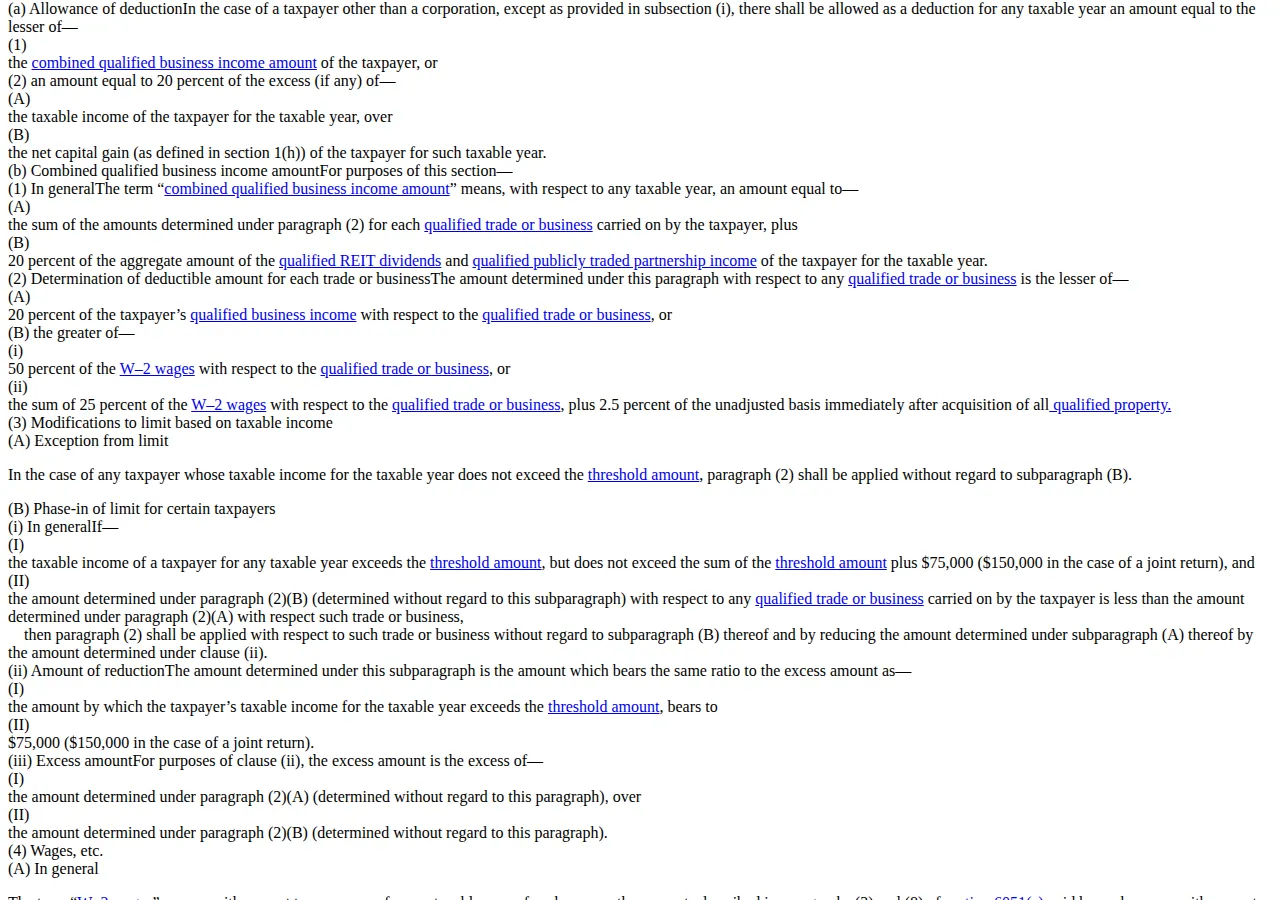
Under 26 U.S.C. § 199A(a), the deduction equals the lesser of the taxpayer's combined qualified business income amount or 20 percent of the excess of taxable income over net capital gain. Everything else in the section is machinery for deciding how much of that headline number survives.
> [!KEY TAKEAWAY]
> The 20 percent rate is a ceiling, not a promise. A pass-through owner deducts the smallest of three numbers: 20 percent of qualified business income, the wage-and-capital limit for each business, and 20 percent of taxable income minus net capital gain. Above the threshold, a specified service business also loses a slice of its qualifying income, and a business with no W-2 wages and no qualified property can see the wage limit reduce its deduction to zero.
Who this guide is for, and who should stop here
This guide is for owners of domestic pass-through businesses: sole proprietorships, partnerships, S corporations, and certain trusts and estates with qualified business income, plus the CPAs who prepare their returns. It follows the statute as amended by the One Big Beautiful Bill Act (Public Law 119-21, section 70105) and the IRS inflation adjustments for 2025 and 2026, not pre-2026 summaries that still print the old sunset date and phase-in range.
Stop here if the income comes from a C corporation or from services performed as an employee. The IRS qualified business income page states both exclusions plainly: income earned through a C corporation and income from providing services as an employee are not eligible. A C corporation shareholder cannot re-label dividends as qualified business income, and an employee cannot re-label salary as business profit. The deduction is available whether the taxpayer itemizes or takes the standard deduction.
The statute, in order: what counts, what caps it, what phases it out
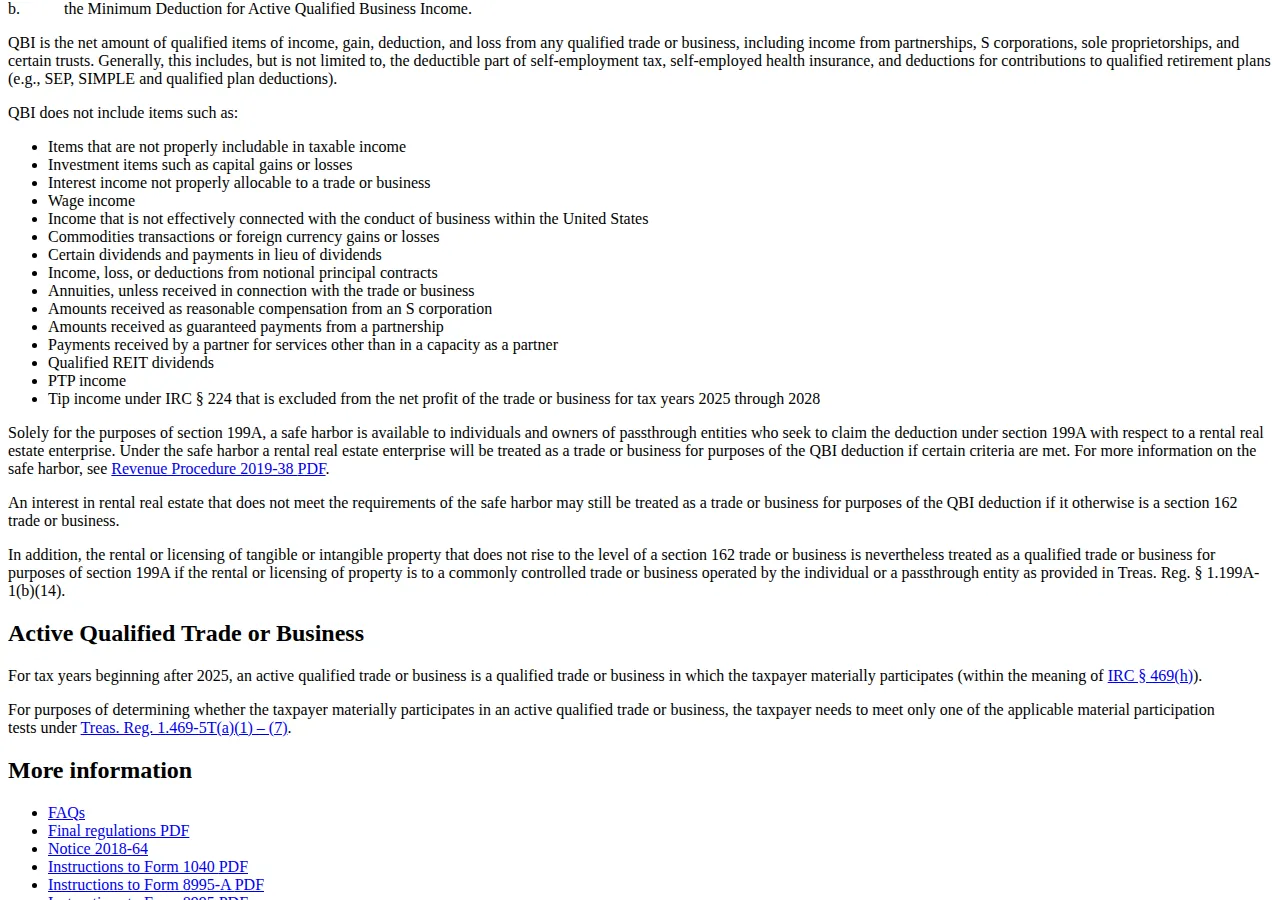
Qualified business income is the net amount of qualified items of income, gain, deduction, and loss from a qualified trade or business. The IRS page lists what it does not include, and the list decides more returns than the definition does: items not properly includable in taxable income, capital gains and losses, interest income not properly allocable to a trade or business, wage income, reasonable compensation from an S corporation, guaranteed payments, and non-partner-capacity partner payments. An S corporation owner who pays a salary therefore shrinks qualified business income twice: the salary is excluded from it, and it still costs payroll tax.
For each qualified trade or business, section 199A(b)(2) sets the deductible amount as the lesser of 20 percent of the business's qualified business income, or the greater of 50 percent of the W-2 wages paid by that business, or 25 percent of those W-2 wages plus 2.5 percent of the unadjusted basis immediately after acquisition of all qualified property. Qualified property is depreciable tangible property held at year-end; its unadjusted basis is cost basis before depreciation.
The three formulas:
$
\text{Deduction} = \min(\text{Combined QBI Amount},\ 0.20 \times (\text{Taxable Income} - \text{Net Capital Gain}))
$
$
\text{Per-Business Amount} = \min(0.20 \times \text{QBI},\ \max(0.50 \times \text{W-2 Wages},\ 0.25 \times \text{W-2 Wages} + 0.025 \times \text{UBIA}))
$
$
\text{SSTB Applicable Percentage} = 1 - \frac{\text{Taxable Income} - \text{Threshold Amount}}{\text{Phase-In Range}}
$
Below the threshold amount, section 199A(b)(3)(A) switches the wage-and-capital limit off entirely. That exception is why most small pass-through returns never touch the wage math. The threshold amount starts at $157,500 under section 199A(e)(2)(A), doubled for a joint return, and is inflation-adjusted yearly. Taxable income for this test is computed without regard to section 68 and without regard to any section 199A deduction, so the deduction never pulls its own threshold down.
The thresholds that actually apply: 2025 versus 2026
The IRS publishes the threshold and phase-in figures annually in its inflation-adjustment revenue procedure: Revenue Procedure 2024-40 for 2025, and Revenue Procedure 2025-32 for 2026. The 2026 procedure also records the One Big Beautiful Bill Act change: the phase-in range widened from $100,000 to $150,000 for joint returns, and from $50,000 to $75,000 for all other returns.
| Filing status | 2025 threshold | 2025 phase-in top | 2026 threshold | 2026 phase-in top | Authority |
| :--- | :--- | :--- | :--- | :--- | :--- |
| Married filing jointly | $394,600 | $494,600 | $403,500 | $553,500 | Rev. Proc. 2024-40; Rev. Proc. 2025-32 |
| Married filing separately | $197,300 | $247,300 | $201,775 | $276,775 | Rev. Proc. 2024-40; Rev. Proc. 2025-32 |
| All other returns | $197,300 | $247,300 | $201,750 | $276,750 | Rev. Proc. 2024-40; Rev. Proc. 2025-32 |
Read the table as a corridor, not a cliff. Below the threshold, the wage limit does not apply and a specified service business is fully qualified. Inside the corridor, both limits phase in proportionally. Above the corridor top, the wage limit applies in full and a specified service business is fully disqualified. A joint return with $500,000 of taxable income in 2026 sits inside the corridor, not past it, because the top moved to $553,500; the same income in 2025 would have sat past the $494,600 top. That one-year shift is worth real money to a service business near the boundary.
Specified service businesses: the phaseout, worked
A specified service trade or business, under section 199A(d)(2), is a trade or business described in section 1202(e)(3)(A) — health, law, accounting, actuarial science, performing arts, consulting, athletics, financial services, and brokerage services — applied without the words "engineering, architecture," so engineering and architecture firms are not specified service businesses — or a business involving investing and investment management, trading, or dealing in securities.
Scenario: a married couple filing jointly in 2026 owns a consulting practice with $300,000 of qualified business income, and their taxable income is $480,000. The threshold is $403,500 and the phase-in range is $150,000, so the applicable percentage is 1 minus ($480,000 minus $403,500) divided by $150,000, which is 1 minus 0.51, or 49 percent. Only 49 percent of the practice's qualified items count: applicable qualified business income is $147,000, and the tentative deduction before the wage limit and the taxable-income cap is 20 percent of $147,000, or $29,400. At $553,500 of taxable income, the applicable percentage reaches zero and the practice's deduction from that business reaches zero, no matter how profitable the practice is.
Contrast that with an architecture firm at the same income. Because engineering and architecture are carved out of the specified service definition, the firm is not a specified service business at all, so only the wage-and-capital limit and the taxable-income cap bind it. Two firms, identical profits, identical payroll, different deduction — and the difference is one parenthetical in section 199A(d)(2).
The wage-and-capital limit, worked
Scenario: a manufacturing LLC taxed as a partnership reports $500,000 of qualified business income, pays $100,000 of W-2 wages, and holds qualified property with an unadjusted basis of $400,000. Twenty percent of qualified business income is $100,000. The wage prongs give 50 percent of wages, or $50,000, and 25 percent of wages plus 2.5 percent of unadjusted basis, or $25,000 plus $10,000, which is $35,000. The greater prong is $50,000, so the per-business amount is the lesser of $100,000 and $50,000: $50,000, before the taxable-income cap.
The planning consequence runs both ways. Raising W-2 wages lifts the first prong at 50 cents per wage dollar but also costs payroll tax and, for an S corporation, shrinks qualified business income through the reasonable-compensation exclusion. Buying qualified property lifts the second prong at only 2.5 cents per basis dollar, so property alone rarely rescues a wage-starved business: $400,000 of equipment bought $10,000 of headroom above. The election that creates the S corporation in the first place is priced in the IRS Form 2553 S-corp election deadline playbook, which works the 2-month-15-day deadline, the late-relief window, and the revocation rules from the statute.
The taxable-income cap, worked
Scenario: a sole proprietor reports $200,000 of qualified business income, has no capital gain, and reports $180,000 of taxable income after other deductions. Twenty percent of qualified business income is $40,000; 20 percent of taxable income is $36,000. The deduction is $36,000, because section 199A(a) takes the lesser of the two. At a 22 percent marginal rate, that saves $7,920 against a return with no deduction at all. The cap binds most often on owners with large retirement-plan contributions or a large health-insurance deduction, because every above-the-line deduction that lowers taxable income also lowers the cap. A founder who maximizes a solo 401(k) contribution in the same year should expect the deduction to shrink in step, and should run both numbers together.
What changed for 2026: permanence, the $400 floor, and the active-business rule
Before the One Big Beautiful Bill Act, section 199A carried a sunset: the prior text provided that the section would not apply to taxable years beginning after December 31, 2025. Public Law 119-21, section 70105, removed that sunset, so the deduction no longer expires on its own terms. The same section added section 199A(i), the minimum deduction for active qualified business income: for tax years beginning after December 31, 2025, an applicable taxpayer's deduction is the greater of the computed amount or $400, provided the taxpayer has at least $1,000 of qualified business income, with both figures inflation-adjusted for tax years beginning after 2026. A side business with $1,500 of qualified business income computes 20 percent as $300, and the floor lifts it to $400.
For tax years beginning after 2025, the IRS page adds a second new gate: an active qualified trade or business is one in which the taxpayer materially participates within the meaning of section 469(h). A passive investor should not assume the minimum or the full deduction follows automatically; the records that prove participation — hours, logs, decision records — belong in the file before the return is filed, not reconstructed during an examination.
Decision table: six owner shapes, six answers
| Owner shape | Tentative 20 percent | Binding limit | Result | Authority |
| :--- | :--- | :--- | :--- | :--- |
| Sole proprietor below the threshold | Full 20 percent of QBI | Taxable-income cap only | Simplest return; Form 8995 | § 199A(a), (b)(3)(A) |
| S corporation with a real payroll | 20 percent of QBI after salary exclusion | Wage prong usually binds first | Salary excluded from QBI; wages create headroom | § 199A(b)(2), (c); IRS QBI page |
| Partnership with guaranteed payments | 20 percent of QBI after payment exclusion | Guaranteed payments never enter QBI | Reprice partner pay as profit share where allowed | § 199A(c); IRS QBI page |
| Specified service business below the threshold | Full 20 percent of QBI | Taxable-income cap only | SSTB status is irrelevant below the threshold | § 199A(b)(3)(A), (d)(3) |
| Specified service business inside the corridor | 20 percent of applicable QBI only | Applicable percentage, then wage limit | Partial deduction; corridor position decides the slice | § 199A(d)(3); Rev. Proc. 2025-32 |
| C corporation shareholder | None | Entity ineligibility | No deduction at any income level | IRS QBI page |
> [!WARNING]
> The expensive mistake is not missing the deduction; it is claiming the pre-2026 version of it. Returns prepared from old summaries overstate the deduction three ways at once: they use the $100,000 joint phase-in range instead of $150,000, they ignore the $400 minimum and the $1,000 qualified business income floor, and they assume the deduction expired after 2025. Verify the filing year's revenue procedure before the return is signed, and keep that year's threshold table in the workpapers.
Execution checklist
For the payroll side of the same business, the quarterly filing mechanics live in our IRS Form 941 quarterly payroll tax playbook, and the capitalization rules for software spend are in our Section 174 software capitalization guide. Before promising any figure to a partner or a lender, run it through the tax estimator with the corridor position and wage limit entered.
> [!TIP]
> Run the corridor test on projected taxable income in November, not on actuals in April. A specified service owner inside the corridor can still move the applicable percentage by timing retirement contributions and income recognition across the year-end boundary — but only while the year is still open.
> [!FOUNDER]
> "Founders treat the 20 percent like a discount and forget it is a formula with three locks on it. The owners who collect it know which lock binds their return — the wage limit for the manufacturer, the corridor for the consultant, the taxable-income cap for the saver. Find your binding lock first, and the planning writes itself."
> — Enow A. Jovial, Founder & Chief Executive Officer