> [!FOUNDER]
> "Section 174 was the quietest cash-flow crisis in software. Companies with real revenue and real payroll were paying tax on profit they never saw in cash, because the Code made them spread a salary over five years while the salary left the bank in one. The One Big Beautiful Bill fixed the domestic half of that problem and left the foreign half exactly where it was. Founders who still budget on the old five-year rule are now wrong in both directions." — Enow A. Jovial, Founder & Chief Executive Officer
The two eras, in one paragraph
From 2022 through 2024, the Tax Cuts and Jobs Act version of § 174 required specified research or experimental expenditures to be charged to capital account and amortized ratably: over 5 years for domestic research, over 15 years for foreign research, in each case beginning with the midpoint of the taxable year in which the expenditure was paid or incurred. Software development costs were expressly in scope. The result was phantom profit: a company could spend every dollar it collected on engineers and still owe tax, because only a fraction of the spend was deductible in the year it was paid.
The One Big Beautiful Bill Act (P.L. 119-21), enacted July 4, 2025, split the statute in two. Section 70302 amended § 174 so that it now applies only to foreign research or experimental expenditures, still amortized over 15 years from the midpoint. And it added § 174A, which restores immediate deductibility for domestic research or experimental expenditures for taxable years beginning after December 31, 2024. The amendments generally apply to amounts paid or incurred in taxable years beginning after December 31, 2024, with two transition elections for the stranded 2022–2024 balances and a retroactive election for eligible small businesses. Rev. Proc. 2025-28, issued August 28, 2025, supplies the procedures.
> [!KEY TAKEAWAY]
> Domestic software spend from 2025 onward is deductible when paid or incurred under § 174A(a), unless the taxpayer elects the § 174A(c) amortization route. Foreign research spend stays on § 174 at 15 years from the midpoint. Every planning question now starts with one classification: where was the research actually performed?
The statute, in its own words
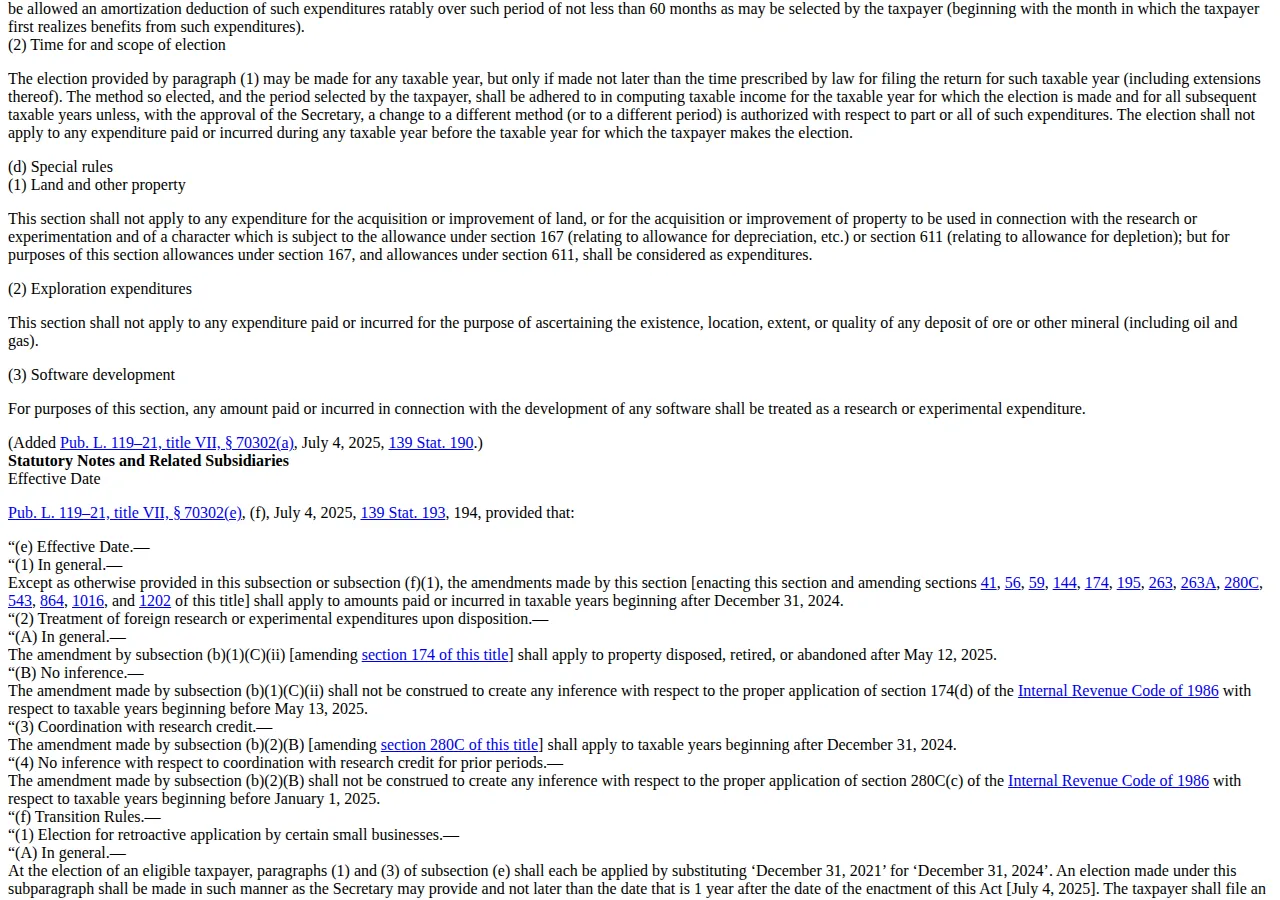
Section 174A(a) provides that, notwithstanding § 263, a deduction is allowed for any domestic research or experimental expenditures paid or incurred by the taxpayer during the taxable year. Section 174A(b) defines domestic research or experimental expenditures as research or experimental expenditures paid or incurred in connection with the taxpayer's trade or business other than expenditures attributable to foreign research within the meaning of § 41(d)(4)(F). Section 174A(d)(3) then removes the main software argument in a single sentence: for purposes of § 174A, any amount paid or incurred in connection with the development of any software is treated as a research or experimental expenditure.
Section 174A(c) is the alternative for taxpayers who do not want immediate expensing. A taxpayer may elect to charge domestic expenditures to capital account and amortize them ratably over a period of not less than 60 months, beginning with the month in which the taxpayer first realizes benefits from the expenditures. The election must be made by the return due date, including extensions, for the year, and the method and period elected must then be followed for that year and all subsequent years unless the Secretary consents to a change. Rev. Proc. 2025-28, section 6.02, requires the election statement to be marked at the top "FILED PURSUANT TO SECTION 6.02 OF REV. PROC. 2025-28", attached to the original return for the first year the election applies, stating the taxpayer and its taxpayer identification number (EIN for a corporation), the year, the declaration, and the number of months selected (not less than 60).
Section 174A(d) also states what the section does not cover: expenditures for the acquisition or improvement of land, or for property of a depreciable or depletable character, and expenditures to ascertain the existence, location, extent, or quality of a mineral deposit. A server farm is not research because it sits next to researchers, and a mining survey is not research because a geologist ran it.
The exposed math: the phantom-profit years
Take a software company with $1,000,000 of revenue in 2024 and $1,000,000 of domestic engineer payroll, and no other income or expense. Cash profit is zero. Under TCJA § 174, only the midpoint first-year slice of the 2024 spend was deductible:
$
ext{Year 1 Deduction} = ext{Domestic Spend} imes rac{0.5}{5} = $1{,}000{,}000 imes 10% = $100{,}000
$
$
ext{Taxable Income} = $1{,}000{,}000 - $100{,}000 = $900{,}000
$
$
ext{Federal Tax at 21%} = $900{,}000 imes 21% = $189{,}000
$
That is $189,000 of federal tax on a company whose bank account did not grow at all, before state tax and before payroll taxes. The full five-year pattern for that single year's spend is $100,000 in year 1, $200,000 in each of years 2 through 5, and $100,000 in year 6 — six calendar years to deduct one year's payroll. Under § 174A, the same $1,000,000 spent in 2025 is deductible in 2025, and taxable income on the same facts is zero. The section 163(j) business interest limitation playbook prices the other side of that taxable income: the 30 percent cap on deductible business interest and the restored EBITDA calculation of adjusted taxable income. The swing is the entire $189,000, which is why this statute, not pricing, decided whether some seed-stage companies survived 2023 and 2024.
The exposed math: foreign research still runs 15 years
Foreign research did not change. A $300,000 foreign contractor spend in 2025 amortizes from the midpoint over 15 years:
$
ext{Year 1 Deduction} = $300{,}000 imes rac{0.5}{15} = $10{,}000
$
$
ext{Annual Deduction, Years 2–15} = $300{,}000 imes rac{1}{15} = $20{,}000
$
$
ext{Year 16 Deduction} = $10{,}000
$
The company deducts $10,000 in the year it pays $300,000. Over a 15-year horizon the total is still $300,000, but the present value at any positive discount rate is far lower, and the cash tax in year 1 is computed on $290,000 of undeducted spend. This is the number to put in front of a founder who proposes moving a team abroad to save salary cost: the salary saving must first repay the lost deduction timing, at the company's marginal rate, over a decade and a half.
The stranded balances: the 2022–2024 recovery election
Consider a company that spent $600,000 domestically in 2022, $900,000 in 2023, and $1,200,000 in 2024, all capitalized under TCJA § 174. The unamortized balances at the start of 2025 are:
| Spend year | Amount spent | Deducted by end of 2024 | Remaining unamortized |
| :--- | :--- | :--- | :--- |
| 2022 | $600,000 | $300,000 (10% + 20% + 20%) | $300,000 |
| 2023 | $900,000 | $270,000 (10% + 20%) | $630,000 |
| 2024 | $1,200,000 | $120,000 (10%) | $1,080,000 |
| Total | $2,700,000 | $690,000 | $2,010,000 |
| Authority | TCJA § 174 midpoint convention | Rev. Proc. 2025-28 § 2.02 | OBBBA § 70302(f)(2) |
Under OBBBA § 70302(f)(2), the company may elect to deduct the full $2,010,000 in its first taxable year beginning after December 31, 2024, or ratably over that year and the next ($1,005,000 per year). At a 21% rate, the one-year election is worth $422,100 of tax shield in 2025, against $211,050 per year on the two-year path:
$
ext{One-Year Shield} = $2{,}010{,}000 imes 21% = $422{,}100
$
$
ext{Two-Year Shield per Year} = $1{,}005{,}000 imes 21% = $211{,}050
$
The choice is a timing and capacity question, not a free lunch. The one-year deduction is worthless in a year with no taxable income to absorb it, except to the extent it creates or increases a net operating loss (NOL), and a company expecting a large 2026 income year may rationally prefer the two-year spread. Model both paths against forecast taxable income before electing, because the election is implemented as a method change on a cut-off basis with no § 481(a) adjustment to revisit later.
The decision table: four treatments, one classification question
| Treatment | Applies to | Timing | Binding? | Authority |
| :--- | :--- | :--- | :--- | :--- |
| Immediate deduction | Domestic research, tax years beginning after Dec 31, 2024 | Full amount in year paid or incurred | Default method under § 174A(a) | IRC § 174A(a), (b) |
| 60-month-plus amortization | Domestic research, if elected | Ratably over ≥ 60 months from month benefits first realized | Yes, until Secretary consents to change | IRC § 174A(c); Rev. Proc. 2025-28 § 6 |
| 15-year amortization | Foreign research, all years | Ratably over 15 years from midpoint of spend year | Statutory, no election out | IRC § 174(a), (b) as amended |
| Retroactive expensing | Eligible small businesses only, 2022–2024 domestic spend | Amended returns for affected years | Election by Mon, July 6, 2026 | OBBBA § 70302(f)(1); Rev. Proc. 2025-28 § 3 |
| Regulatory / Operational Authority | Classification turns on § 41(d)(4)(F) foreign research | Midpoint vs benefit-month start | Cut-off basis, no § 481(a) adjustment for the transition | Rev. Proc. 2025-28 §§ 2, 7 |
Two further interactions belong in the same decision. First, § 280C(c) as amended reduces domestic research expenditures taken into account by the amount of the § 41 research credit allowed, unless the taxpayer elects the reduced-credit route under § 280C(c)(2) — so the § 174A deduction and the § 41 credit must be modelled together, not claimed independently. Qualified small businesses may also elect under § 41(h) to apply the credit against FICA payroll taxes, which changes the cash value of the credit for a pre-profit SaaS company. Second, a taxpayer may separately consider the § 59(e) election to amortize research expenditures over 10 years; it is a different election with a different horizon, and it should not be confused with the § 174A(c) 60-month election.
> [!WARNING]
> The foreign-research line follows where the research is performed, not where the contractor is incorporated or where the invoice is addressed. A US company paying a foreign subsidiary's engineers, a contractor team working abroad, or a "US vendor" that subcontracts the work overseas is buying foreign research for § 174 purposes. Re-labelling that spend as domestic consulting does not change its character, and the 15-year schedule, not the deduction, will apply when the return is examined.
Who this helps, and who should not rush
This law helps a profitable domestic software company most: the deduction lands in the same year as the payroll, taxable income falls to its economic level, and estimated-tax payments can be reset. It helps a loss-making company less in the short term, because a deduction without income is a net operating loss carryforward, not cash — though the carryforward itself has value if the company expects profit.
It does not help, and can hurt, in three cases. A company with no US taxable income and no near-term path to it gains timing, not money. A company whose research is genuinely performed abroad gains nothing from § 174A and should budget on the 15-year schedule from day one. And a company that elects § 174A(c) amortization for a smoothing reason, then needs to change method or period, needs the Secretary's consent — the election is sticky by design, so the smoothing case must be worth the lock-in.
> [!TIP]
> Before the 2025 return is filed, run three numbers side by side: the § 174A immediate deduction, the § 174A(c) 60-month path, and the § 70302(f)(2) recovery election on the 2022–2024 balance, each against forecast 2025 and 2026 taxable income. The right answer is the one that absorbs the most deduction at the highest marginal rate in the earliest year — and for most profitable domestic software companies, that is immediate deduction plus the one-year recovery election.
Execution checklist
Related reading on this site: the foreign developer payroll § 174 guide, which covers the 15-year foreign schedule and Form 3115 mechanics that still govern the foreign half; the Section 83(b) election playbook, because equity timing and research timing hit the same return; and the cash vs accrual accounting guide. The same research spend can also generate a credit, not just a deduction: see the IRC Section 41 research credit guide, because the § 174A treatment and the § 41 credit must be coordinated, never double-counted. To price the deduction in cash terms, run the forecast through the tax estimator and the hiring plan through the break-even calculator.