The one form that decides whether your corporation is taxed once or twice
Form 2553 is a single page with a hard edge. File it on time and the corporation is an S corporation from the first day of the tax year you name, with pass-through taxation. File it late and the corporation spends a full tax year as a C corporation, taxed at the entity level and again when profit reaches shareholders as dividends. There is no partial credit, no pro-rated S status, and no way to backdate the election without the relief procedure below.
Section 1362(a) creates the election; section 1362(b) sets the deadline at 2 months and 15 days after the first day of the tax year. The rest of this guide is the machinery around those two sentences.
> [!KEY TAKEAWAY]
> The S election deadline is 2 months and 15 days after the tax year begins. For a calendar-year corporation converting from C status, that is March 15. Miss it and the corporation is a C corporation for the whole year, unless Rev. Proc. 2013-30 relief applies.
Who can elect: the four eligibility walls
An S corporation is a small business corporation under section 1361(b), defined by four walls; hit any one and the election is invalid from the start.
| Eligibility wall | The rule | Authority |
| :--- | :--- | :--- |
| Shareholder count | No more than 100 shareholders; a husband and wife (and their estates) count as one, and all members of a family under section 1361(c)(1) count as one | § 1361(b)(1)(A) |
| Eligible shareholders | Only individuals, estates, certain exempt organizations, and certain trusts | § 1361(b)(1)(B) |
| No nonresident aliens | No nonresident alien shareholders (other than as potential current beneficiaries of an ESBT) | § 1361(b)(1)(C) |
| One class of stock | One class of stock; all shares must confer identical rights to distribution and liquidation proceeds | § 1361(b)(1)(D); Reg. § 1.1361-1(l) |
Two traps hide in that table. First, the 100-shareholder count is a headcount with family aggregation: 101 unrelated individuals fail even if 100 hold a single share each. Second, the one-class-of-stock rule is about economic rights, not voting: voting and nonvoting common stock is permitted, but a side agreement giving one shareholder a preferential distribution — a liquidation preference, a guaranteed return, a disproportionate distribution right — creates a second class of stock and kills the election. Most failed elections are found in Regulation section 1.1361-1(l).
An LLC or other entity eligible to elect corporate treatment uses Form 2553 itself and does not need to file Form 8832 first; it is treated as a corporation as of the effective date of the S election.
The deadline, worked two ways
The rule is 2 months and 15 days after the beginning of the tax year the election is to take effect, or at any time during the tax year preceding it. The 2-month period begins on the day of the month the tax year begins and ends with the close of the day before the numerically corresponding day of the second calendar month following that month. The instructions give two examples.
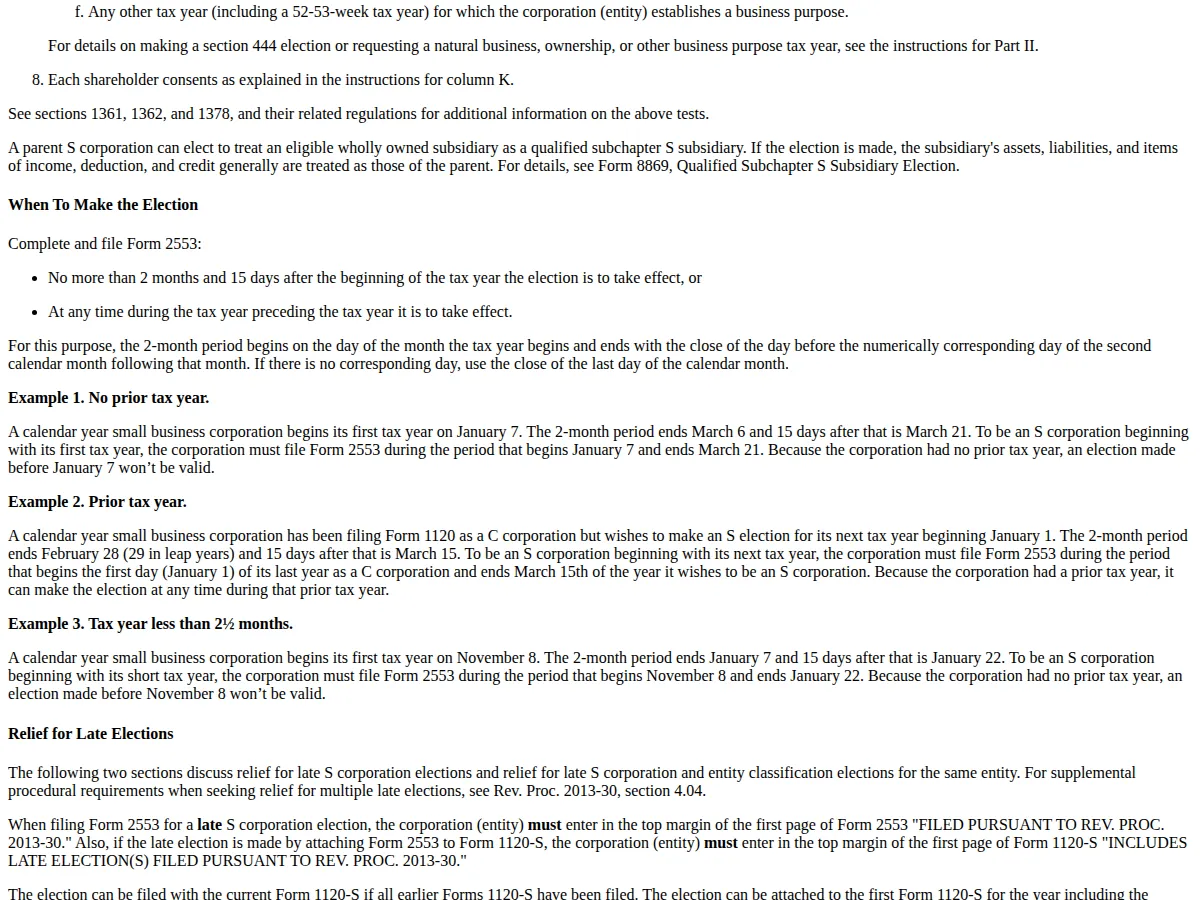
Example 1 — a new corporation, no prior tax year. First tax year begins January 7; the 2-month period ends March 6, and 15 days after that is March 21. Window: January 7 to March 21.
Example 2 — a C corporation converting for next year. Next tax year begins January 1; the 2-month period ends February 28 (February 29 in leap years) and 15 days after that is March 15. Filing is open all of the prior tax year; the window closes March 15.
$
\text{Deadline} = \text{Tax Year Start} + \text{2 calendar months} + \text{15 days};\ \text{Jan 1 start} \Rightarrow \text{Mar 15};\ \text{Jan 7 first year} \Rightarrow \text{Mar 21}
$
The trap is the first-year rule. A first tax year starting December 15 ends March 1 in a non-leap year: the 2-month period closes February 14, and 15 days after that is March 1.
Where to file, and what the form actually asks for
Form 2553 is filed by mail or fax, not electronically, to the Department of the Treasury, Internal Revenue Service Center for the state where the corporation's principal business, office, or agency is located:
| Principal location | Mail to | Fax |
| :--- | :--- | :--- |
| Connecticut, Delaware, District of Columbia, Georgia, Illinois, Indiana, Kentucky, Maine, Maryland, Massachusetts, Michigan, New Hampshire, New Jersey, New York, North Carolina, Ohio, Pennsylvania, Rhode Island, South Carolina, Tennessee, Vermont, Virginia, West Virginia, Wisconsin | Kansas City, MO 64999 | 855-887-7734 |
| Alabama, Alaska, Arizona, Arkansas, California, Colorado, Florida, Hawaii, Idaho, Iowa, Kansas, Louisiana, Minnesota, Mississippi, Missouri, Montana, Nebraska, Nevada, New Mexico, North Dakota, Oklahoma, Oregon, South Dakota, Texas, Utah, Washington, Wyoming | Ogden, UT 84201 | 855-214-7520 |
The form has three parts. Part I carries the election — name, address, EIN, date and state of incorporation, the selected tax year, Item E (the effective date), and Column K, where each shareholder signs and states shares owned and date acquired. Every shareholder must consent: a missing signature after the deadline is a defective election. Part II is the section 444 election for a fiscal tax year; Part III carries the QSST election under section 1361(d)(2), and an ESBT election follows Regulation section 1.1361-1(m).
What a missed deadline costs
The cost of a missed election is one year of C corporation taxation, on $100,000 of profit:
$
\text{C tax on \$100,000 profit} = \$100,000 \times 21\% = \$21,000;\ \text{dividend tax on remaining \$79,000 at assumed 15\%} = \$11,850
$
$
\text{Combined C burden} = \$21,000 + \$11,850 = \$32,850;\ \text{S pass-through at assumed 22\%} = \$100,000 \times 22\% = \$22,000
$
$
\text{One-year cost of the missed election} = \$32,850 - \$22,000 = \$10,850
$
That $10,850 is the cost on $100,000 of profit in one year, using the 21% corporate rate under section 11(b) and assumed 15% and 22% shareholder rates. The real cost scales with profit and with the shareholder's actual marginal rate, and the corporation also loses the year of QBI deduction planning, because the section 199A deduction turns on the entity's structure. The S corporation savings threshold guide prices when the election pays for itself; this one prices when it is available at all.
Late relief: Rev. Proc. 2013-30
Section 1362(b)(5) lets the Secretary treat a late election as timely on a finding of reasonable cause; Rev. Proc. 2013-30 is the procedure that implements it.
To request relief on Form 2553 itself, the corporation must show four things: it intended S status as of the effective date on line E; the failure to qualify on that date was solely because Form 2553 was not filed by the due date; it has reasonable cause and took diligent action to correct the mistake upon discovery, explained on line I or an attached statement; and all shareholders between the effective date and the filing date reported their income on all affected returns consistent with the S election for the year the election should have been made and all subsequent years.
The filing mechanics are exact. Enter "FILED PURSUANT TO REV. PROC. 2013-30" in the top margin of the first page of Form 2553, and if the late election is attached to Form 1120-S, "INCLUDES LATE ELECTION(S) FILED PURSUANT TO REV. PROC. 2013-30" in the top margin of the first page of Form 1120-S. File it with the current Form 1120-S if all earlier Forms 1120-S have been filed, or attach it to the first Form 1120-S for the year including the effective date. Form 2553 can also be filed separately.
The outer limit is 3 years and 75 days from the effective date on line E (Rev. Proc. 2013-30, § 4.03):
$
\text{Relief deadline} = \text{Effective date} + \text{3 years} + \text{75 days};\ \text{Jan 1, 2024} \Rightarrow \text{Mar 17, 2027};\ \text{Jan 1, 2026} \Rightarrow \text{Mar 17, 2029}
$
If the form-based requirements are not met — inconsistent reporting, or an IRS notice of a problem within 6 months of the first Form 1120-S filing — the corporation must request a private letter ruling and pay a user fee under Rev. Proc. 2021-1 or its successor. A private letter ruling is slower, more expensive, and discretionary. File the late election as soon as the mistake is discovered, with the shareholder statements attached.
> [!WARNING]
> A late election filed after the 3-year-and-75-day window is not eligible for form-based relief under Rev. Proc. 2013-30 at all. The only remaining route is a private letter ruling with a user fee, and the IRS may still say no. Calendar the relief deadline the day you discover the missed election — it is a second deadline, and it is just as hard as the first.
Revocation and termination: how an S election ends
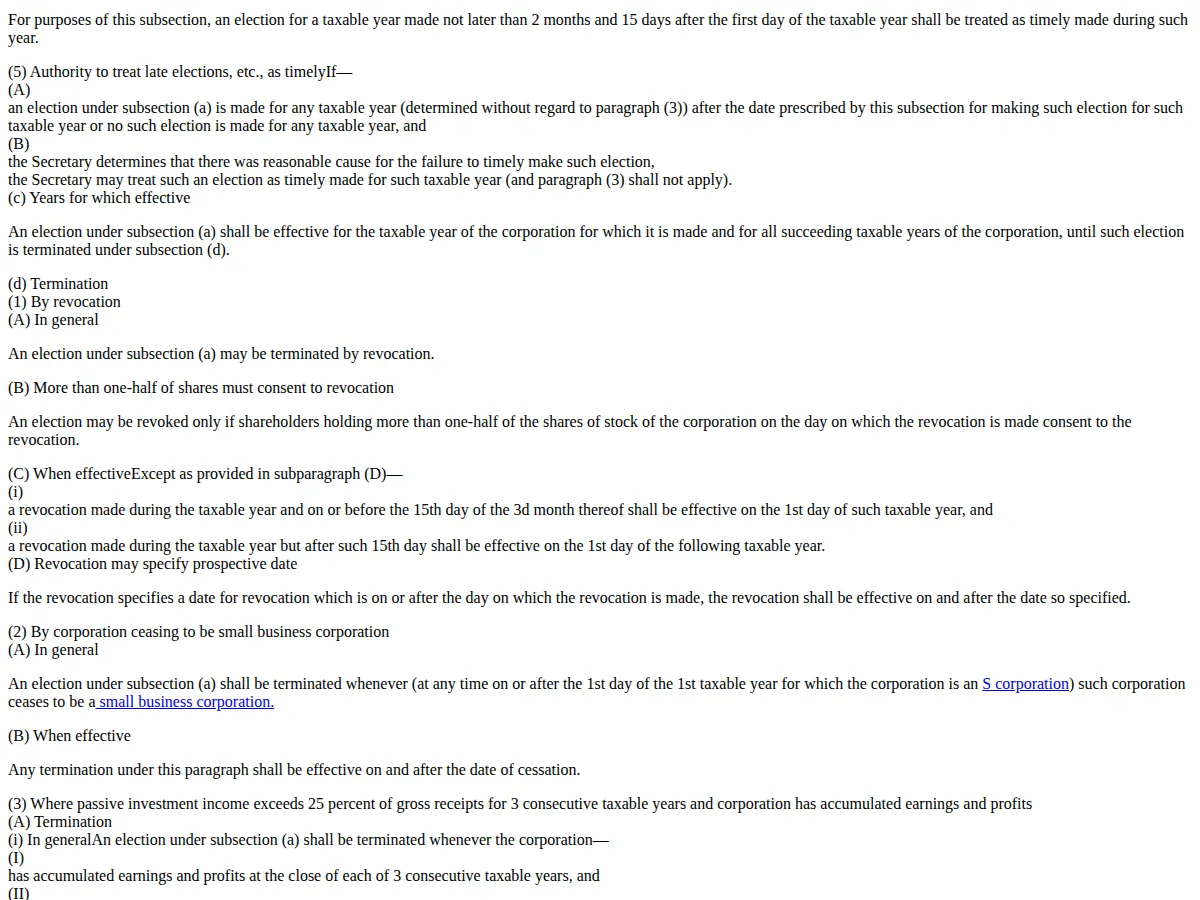
Revocation. An election may be revoked only if shareholders holding more than one-half of the shares on the day of revocation consent to it. A revocation made during the tax year and on or before the 15th day of the 3rd month is effective on the 1st day of that tax year; one made after that day is effective on the 1st day of the following tax year. For a calendar-year corporation, revoke by March 15 to end S status for the current year — revoke on March 16 and the corporation stays an S corporation for the whole current year.
Cessation. An election terminates whenever the corporation ceases to be a small business corporation — a 101st shareholder, a nonresident alien, or a second class of stock — effective on and after the date of cessation. There is no cure period; the only protection is inadvertent-termination relief under section 1362(f).
Passive investment income. An election terminates whenever the corporation has accumulated earnings and profits at the close of each of 3 consecutive taxable years and gross receipts for each of those years more than 25 percent of which are passive investment income — both conditions, all three years. The formula:
$
\text{3 consecutive years: } \frac{\text{Passive investment income}}{\text{Gross receipts}} > 25\% \text{ AND accumulated E\&P} > \$0
$
A C corporation that converts to S status with retained earnings carries its accumulated earnings and profits into the S years, and that E&P is what makes the test live. With no accumulated E&P, a corporation can earn passive income indefinitely without triggering termination. The companion tax is section 1375, on excess net passive income.
Decision table: elect now, elect later, or stay a C corporation
| Option | When it fits | Cost | Authority |
| :--- | :--- | :--- | :--- |
| Elect for the current tax year | Profits are being distributed, the savings threshold is met, all shareholders consent | One Form 2553, by the 2-month-15-day deadline | § 1362(b) |
| Elect for next year | The current year is nearly over, or the salary structure is not ready | Same form, any time during the current tax year | Instructions for Form 2553, Ex. 2 |
| Stay a C corporation | Profits are retained for growth, venture investors require preferred stock, or a shareholder is a nonresident alien | 21% entity tax plus dividend tax on distributions | § 11(b); § 1361(b) |
| File late with relief | Missed within the last 3 years and 75 days, returns filed consistently with S status | Form 2553 with the Rev. Proc. 2013-30 legend and shareholder statements | Rev. Proc. 2013-30, § 4.03 |
| Revoke | The S structure no longer fits — new investor class, foreign shareholder, or a sale | Consent of more than one-half of shares; effective-date rules apply | 26 U.S.C. § 1362(d)(1) |
Operator boundaries: who should not file this form
Do not file if any shareholder is a nonresident alien, if the corporation has more than 100 shareholders, or if any side agreement creates a second class of stock. Do not file if a venture investor holds preferred stock — that is a second class of stock. Do not file in a year when the corporation plans to retain substantially all of its profit for growth, because the pass-through tax falls on shareholders whether or not cash is distributed. Do not file without checking the accumulated earnings and profits balance, which arms the passive-income termination test and the section 1375 tax. And do not file the week the deadline expires without confirming every consent signature in Column K.
> [!FOUNDER]
> "The S election is the cheapest tax decision a founder ever makes — one page, no fee — and the most expensive one to miss. I have seen a founder lose a full year of pass-through treatment over a form that sat in a drawer for three days past March 15. File it the week you decide, not the week it is due."
> — Enow A. Jovial, Founder & Chief Executive Officer
Execution checklist
> [!TIP]
> File in the prior tax year whenever the decision is made before year-end: a December filing can never be late for a January 1 effective date.
Once the election is in force, the quarterly estimated tax guide covers estimated tax on pass-through income, and the 1099-NEC contractor guide covers the reporting that sits alongside it. The return that reports that income is the IRS Form 1120-S versus Form 1120 corporate tax return playbook, which works the March 16 and April 15 deadlines, the $255-per-shareholder-per-month penalty, and the double-tax math from the statute. Run your own numbers through the tax estimator before you decide.