A company borrows $4,000,000 to buy equipment, pays $900,000 of interest in the year, and assumes the whole $900,000 is deductible. Then the return comes back with $30,000 of interest disallowed, a carryforward the CFO must track indefinitely, and a tax bill $6,300 higher than the model predicted. IRC section 163(j) is the reason: since 2018, business interest is deductible only up to business interest income plus 30 percent of adjusted taxable income, plus floor plan financing interest. The excess is not lost, but it is not deductible this year — and for tax years beginning after December 31, 2024, the One Big Beautiful Bill Act restored the EBITDA-based calculation of adjusted taxable income.
What section 163(j) is, in one paragraph
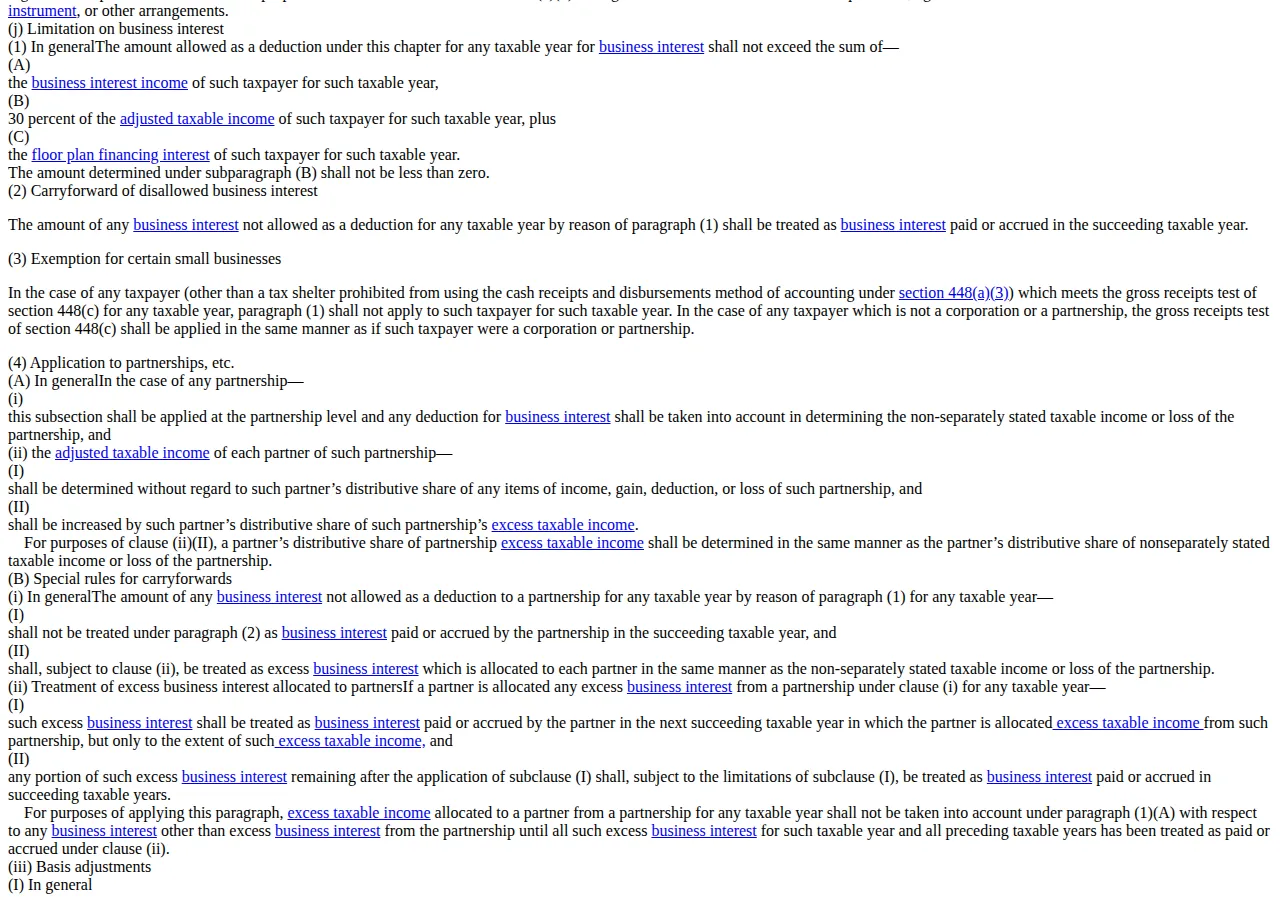
Section 163(j)(1) caps the business interest deduction for a taxable year at the sum of three items: the taxpayer's business interest income for the year, 30 percent of adjusted taxable income (ATI), and floor plan financing interest. Business interest is interest paid or accrued on indebtedness properly allocable to a trade or business; investment interest, personal interest, and interest allocable to an excepted trade or business are outside the section. The amount disallowed is not forfeited: section 163(j)(2) treats it as business interest paid or accrued in the succeeding taxable year, so a corporation carries it forward indefinitely until a year with spare capacity absorbs it. The rule has applied to tax years beginning after December 31, 2017, to every taxpayer with business interest, unless an exemption or an election takes the business out.
> [!KEY TAKEAWAY]
> The cap is business interest income plus 30 percent of ATI plus floor plan financing interest, and the disallowed slice carries forward indefinitely. The only question that matters is the size of ATI — and since 2025, ATI is an EBITDA number again, which makes the cap materially larger for any business with real depreciation.
Why it matters
Interest is the largest single deduction for a leveraged operator, and the cap turns a financing decision into a tax decision. A manufacturer that finances a $4,000,000 equipment purchase at 9 percent pays $360,000 a year in interest; if its ATI supports only $300,000 of deduction, $60,000 a year is deferred, and at the 21 percent corporate rate that is $12,600 of cash tax a year arriving late. The 2022 switch from EBITDA to EBIT made this bite real for capital-intensive businesses, because removing the depreciation addback shrank ATI by the full depreciation charge. The OBBBA restoration reverses that: for tax years beginning after December 31, 2024, depreciation, amortization, and depletion are added back again, permanently. Any model built on 2022–2024 EBIT math now overstates the tax cost of debt.
> [!FOUNDER]
> "I have watched a founder sign a loan for the tax shield and then discover the shield has a ceiling. Debt is still cheap money — but only the deductible part is cheap. Price the loan on the deductible interest, not the headline rate, or the model lies to the board." — Enow A. Jovial, Founder & Chief Executive Officer
The formula, exposed
The limitation is arithmetic. Section 163(j)(1) allows a deduction for business interest up to:
$
\text{Allowable Interest} = \text{Business Interest Income} + 30\% \times \text{ATI} + \text{Floor Plan Financing Interest}
$
ATI is defined in section 163(j)(8): taxable income computed without regard to items not allocable to a trade or business, business interest or business interest income, any net operating loss deduction under section 172, any deduction under section 199A, any deduction for depreciation, amortization, or depletion, and — for tax years beginning after December 31, 2025 — the foreign-income inclusions under sections 951(a), 951A(a), and 78 and the related deductions under sections 245A(a) and 250(a)(1)(B). The depreciation addback is the EBITDA restoration: it was in the statute for 2018–2021, struck for 2022–2024, and restored by OBBBA section 70303 for tax years beginning after December 31, 2024. The disallowed amount follows from the same formula:
$
\text{Disallowed Interest} = \max(0, \text{Business Interest Expense} - \text{Allowable Interest})
$
The cash cost of the deferral, at the 21 percent corporate rate, is:
$
\text{Deferred Tax} = \text{Disallowed Interest} \times 21\%
$
Worked example one: the $360,000 EBITDA swing
A C corporation reports taxable income of $2,000,000 for the year, after deducting $900,000 of business interest and $1,200,000 of depreciation, with no business interest income and no floor plan interest. Under the restored EBITDA rule, ATI is taxable income with the interest and the depreciation added back: $2,000,000 + $900,000 + $1,200,000 = $4,100,000. Thirty percent of ATI is $1,230,000, which exceeds the $900,000 of interest expense, so the full $900,000 is deductible. Under the 2022–2024 EBIT rule, ATI is $2,000,000 + $900,000 = $2,900,000, thirty percent is $870,000, and $30,000 of interest is disallowed and carried forward. The swing is exactly the depreciation charge times 30 percent:
$
\text{EBITDA Cap} - \text{EBIT Cap} = \$1,200,000 \times 30\% = \$360,000
$
At the 21 percent corporate rate, the $30,000 disallowance is $6,300 of deferred tax. On a $12,000,000 depreciation charge the same arithmetic is a $3,600,000 cap swing and a $756,000 timing difference. ATI is also computed without regard to the section 199A deduction, so a pass-through owner cannot inflate ATI with it — for the full QBI mechanics, see the section 199A QBI deduction playbook.
Worked example two: floor plan interest is fully deductible
A vehicle dealer has ATI of $3,000,000, business interest income of $50,000, floor plan financing interest of $400,000, and other business interest expense of $1,100,000. The cap on the non-floor-plan interest is 30 percent of ATI plus business interest income: $900,000 + $50,000 = $950,000. Of the $1,100,000, $950,000 is deductible and $150,000 is disallowed and carried forward. The $400,000 of floor plan interest is deductible in full, on top of the cap, because section 163(j)(1)(C) adds it separately — a total deduction of $1,350,000 against $1,500,000 of interest paid. The OBBBA expanded floor plan financing for tax years beginning after December 31, 2025, to include trailers and campers built as temporary living quarters and designed to be towed. In the following year, if the cap is $800,000 and current interest is $600,000, the $150,000 carried forward is deductible too, because $600,000 + $150,000 = $750,000 is within the cap.
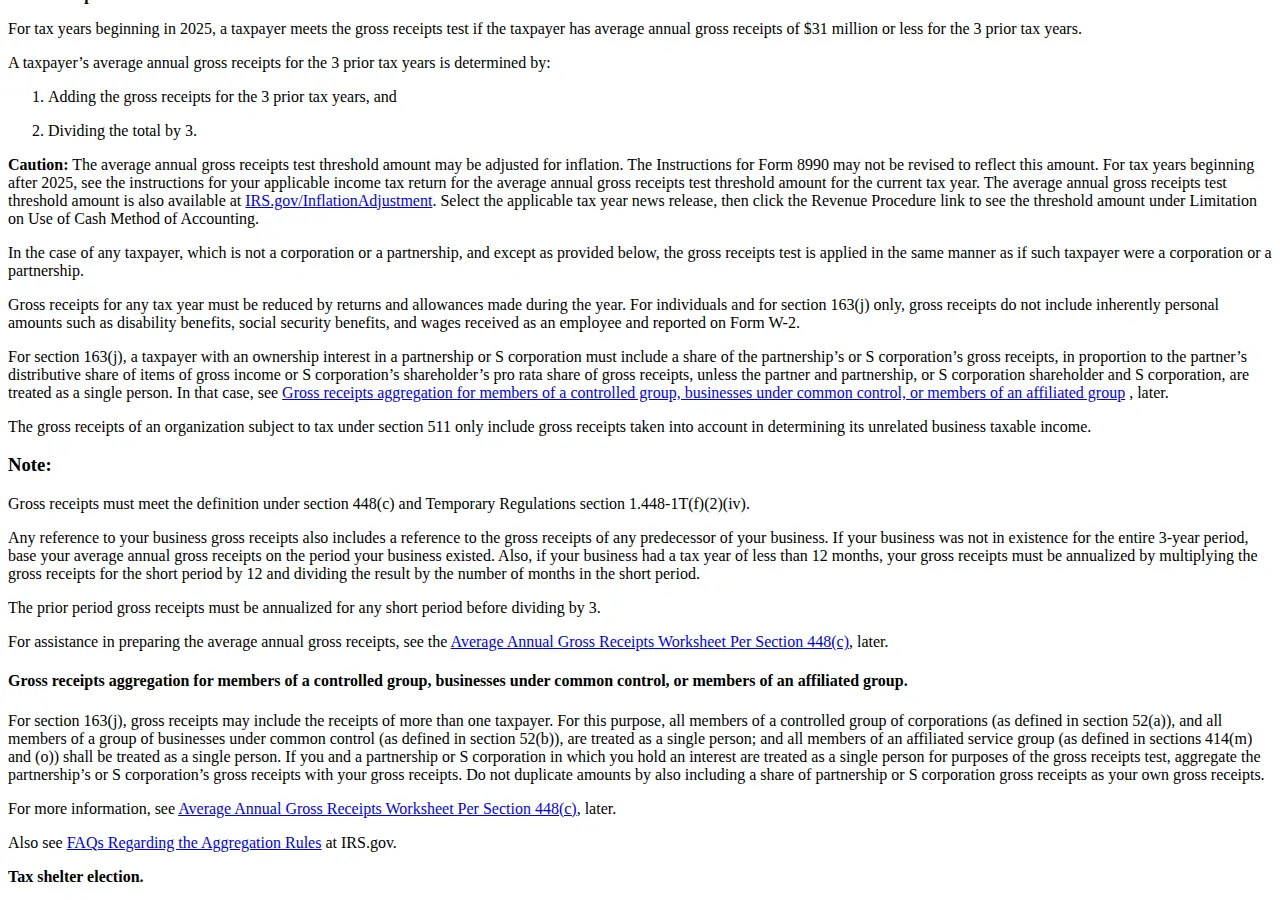
The small-business exemption: the $31 million test
Section 163(j)(3) exempts any taxpayer that meets the gross receipts test of section 448(c) — and a tax shelter prohibited from using the cash method under section 448(a)(3) can never qualify. The Instructions for Form 8990 state the test plainly: for tax years beginning in 2025, a taxpayer meets it with average annual gross receipts of $31 million or less for the three prior tax years. The inflation-adjusted figure for tax years beginning in 2026 is $32 million. The average is the sum of the three prior years divided by three, with returns and allowances subtracted, and a partner's share of partnership or S corporation gross receipts counts in proportion to the distributive share. Receipts of $26,000,000, $29,000,000, and $29,000,000 average $28,000,000 — exempt, with generally no Form 8990. An average of $45,000,000 is fully subject. The trap is aggregation: members of a controlled group, businesses under common control, and affiliated service groups are treated as a single person, so splitting a $40,000,000 business in two does not create two exemptions.
Partnerships: the limitation applies at the entity level
Section 163(j)(4) applies the limitation at the partnership level. Disallowed interest is not carried forward by the partnership; it is allocated to the partners as excess business interest, and a partner may deduct it only in a later year in which that same partnership allocates the partner excess taxable income — and only to the extent of that excess. A partner who leaves the partnership, or a partnership that never generates excess taxable income, strands the deduction. Each partner's ATI is computed without regard to the distributive share of partnership items, then increased by the partner's share of the partnership's excess taxable income. The same architecture applies to S corporations through Form 8990 Part III. A leveraged partnership is a worse place to hold disallowed interest than a leveraged corporation: the corporation's carryforward is usable against any future capacity, the partner's only against that partnership's future excess. For the partnership return mechanics, see the Form 1065 partnership playbook.
The OBBBA changes, by effective date
The One Big Beautiful Bill Act (P.L. 119-21, signed July 4, 2025) changed section 163(j) in four pieces with two different effective dates. The table states each change once, with its authority.
| OBBBA change | Effective for tax years beginning | Authority |
| :--- | :--- | :--- |
| ATI restored to EBITDA: depreciation, amortization, depletion added back | After Dec 31, 2024 (permanent) | P.L. 119-21 § 70303; IRS Form 8990 instructions, line 11 |
| Floor plan financing expanded to trailers and campers | After Dec 31, 2025 | Crowe OBBBA guidance (P.L. 119-21) |
| Limitation applies to capitalized interest, except § 263(g) straddles and § 263A(f) UNICAP | After Dec 31, 2025 | P.L. 119-21 § 70341; Crowe OBBBA guidance |
| ATI excludes Subpart F, GILTI, § 78, § 245A, § 250 inclusions | After Dec 31, 2025 | P.L. 119-21 § 70108(b); Cornell amendment notes |
The capitalized-interest change ends the elective capitalization strategy: from 2026 the limitation reaches capitalized interest too, except interest that must be capitalized under the straddle rules or UNICAP. The foreign-income exclusion can negate part of the EBITDA benefit for groups with controlled foreign corporations. New York City decoupled from the federal EBITDA restoration, so a New York City taxpayer must prepare a pro forma federal Form 8990 on an EBIT basis for city purposes.
> [!WARNING]
> The EBITDA restoration is permanent at the federal level but not universal. New York City retained the EBIT-based calculation, so a New York City business that models its interest deduction on the federal EBITDA cap will overstate its city deduction and underpay city tax.
Electing out: real property, farming, and utilities
Three categories escape the limitation by election or by statute, and each escape has a price. An electing real property trade or business under section 163(j)(7) and an electing farming business may elect out; the election is irrevocable and the price is the alternative depreciation system — longer lives, straight-line, no bonus depreciation. A regulated public utility is excepted by statute. The election math is a present-value comparison: the tax saved by deducting all interest against the tax lost by giving up accelerated depreciation. A real estate business with heavy interest and light depreciation wins by electing out; one with a large depreciable base and modest debt usually loses. For the capitalization regime that now governs research spending, see the section 174 software capitalization guide.
The decision table
| Operator shape | Section 163(j) posture | Correct move |
| :--- | :--- | :--- |
| 3-year average receipts ≤ $31M (2025) | Exempt under § 163(j)(3) | Document the test annually; re-test after any acquisition |
| C corporation, heavy depreciation | Capped at 30% of EBITDA-based ATI | Re-run the 2025 model on EBITDA |
| Leveraged partnership | Entity-level cap; excess interest stranded with partners | Model partner-level usability before borrowing at the partnership |
| Vehicle or RV dealer | Floor plan interest fully deductible | Segregate floor plan interest from operating debt |
| Real property trade or business | May elect out under § 163(j)(7) | Compare interest saved against ADS depreciation lost |
| Group with controlled foreign corporations | ATI excludes foreign inclusions from 2026 | Recompute the 2026 cap without Subpart F and GILTI |
Who should NOT rely on this playbook
This playbook is not for a business whose interest is investment interest under section 163(d), personal interest, or interest on debt that funds a passive activity — those are governed by other limitations. It is not for a tax shelter, which cannot use the small-business exemption at any size. It is not for a taxpayer that has already elected out as a real property or farming business and is living with ADS depreciation; the election is irrevocable. And it is not a substitute for the Form 8990 computation itself. For the quarterly payroll filing that shares the same deadline discipline, see the Form 941 quarterly payroll tax playbook, and to sanity-check the tax on any estimate, use the tax estimator.
The Form 8990 filing sequence in five steps
1. Test the exemption first: three-year average gross receipts, with aggregation and pass-through shares. At or below $31 million for 2025, stop.
2. Compute tentative taxable income: start from taxable income and add back business interest, business interest income, the section 172 NOL, the section 199A deduction, and depreciation, amortization, and depletion (line 11).
3. Apply the 30 percent cap: allowable interest equals business interest income plus 30 percent of ATI plus floor plan financing interest; line 30 is the deduction and line 31 the disallowed amount.
4. Carry the disallowance correctly: a corporation carries it to the next year under section 163(j)(2); a partnership allocates it to partners as excess business interest (Part II), an S corporation on Part III.
5. Re-test every year: the exemption, the ATI, and the cap all move with receipts, depreciation, and debt. A business exempt at $28 million average that grows to $33 million becomes subject mid-plan.
Execution checklist
> [!TIP]
> The cheapest section 163(j) work is done before the debt is signed. Run the cap on the proposed loan's interest, depreciation, and ATI for three years out, and put any disallowance into the loan's effective rate before the term sheet is signed.