An S corporation pays no federal income tax. That sentence is true until the day it is not. A corporation that converted from a C-Corp carries a balance the S election does not erase: accumulated earnings and profits. If that balance is still on the books at year-end, and more than 25 percent of the corporation's gross receipts are passive investment income, section 1375 imposes a corporate-level tax on the S corporation itself — and starts a three-year clock that ends with the election terminated. The rate is a flat 21 percent, and the only defences are arithmetic: remove the earnings and profits, or keep the passive share at or below 25 percent.
What § 1375 actually taxes
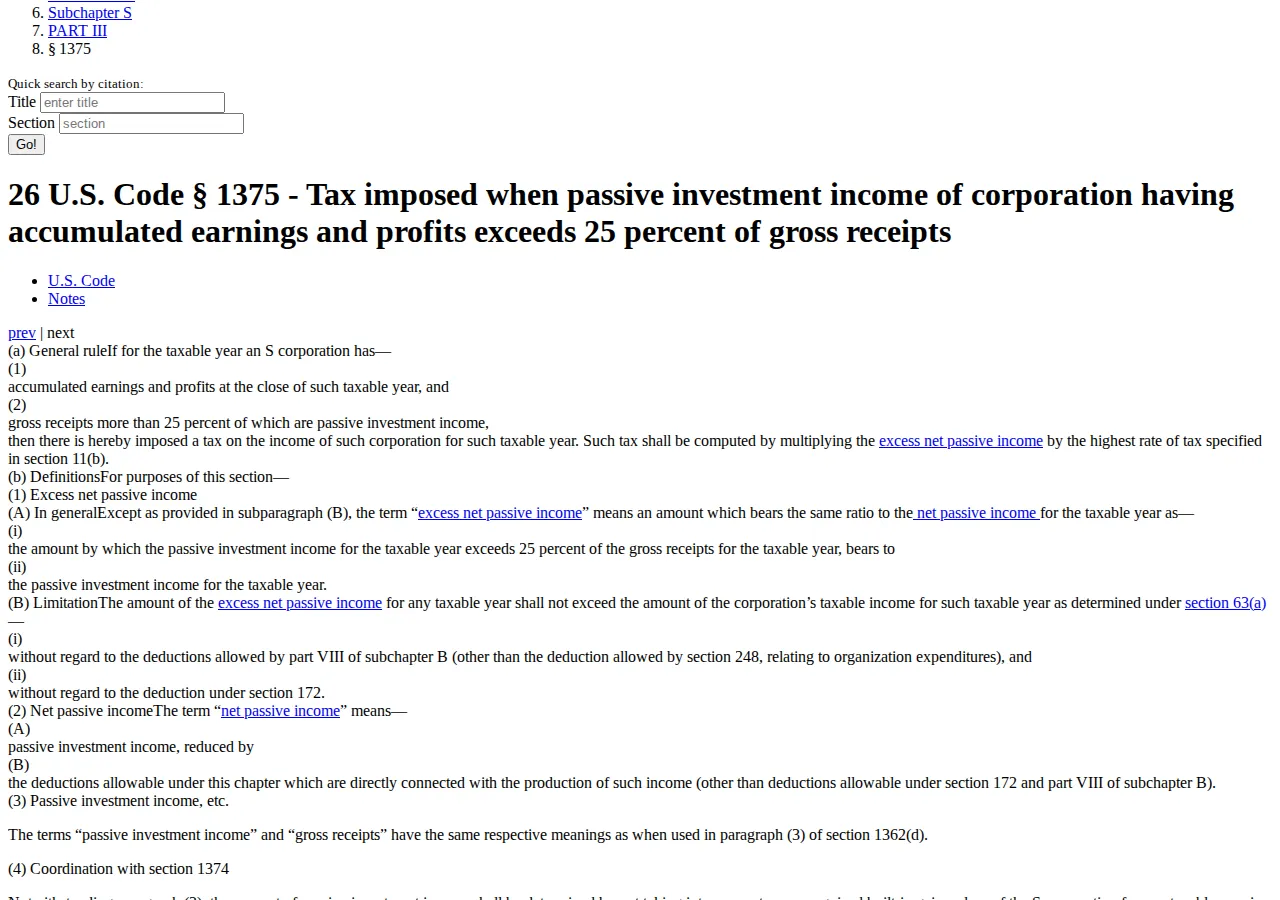
Section 1375(a) fires only when two conditions are both true for the taxable year. First, the S corporation has accumulated earnings and profits at the close of the year. Second, gross receipts more than 25 percent of which are passive investment income. If either condition fails, there is no section 1375 tax at all. A corporation that was always an S corporation has no accumulated earnings and profits, so it can collect rent, interest, and dividends all year and never owe this tax. A corporation that converted from a C-Corp and never distributed its old earnings is the target, because the earnings survive the conversion and the election does not clean them.
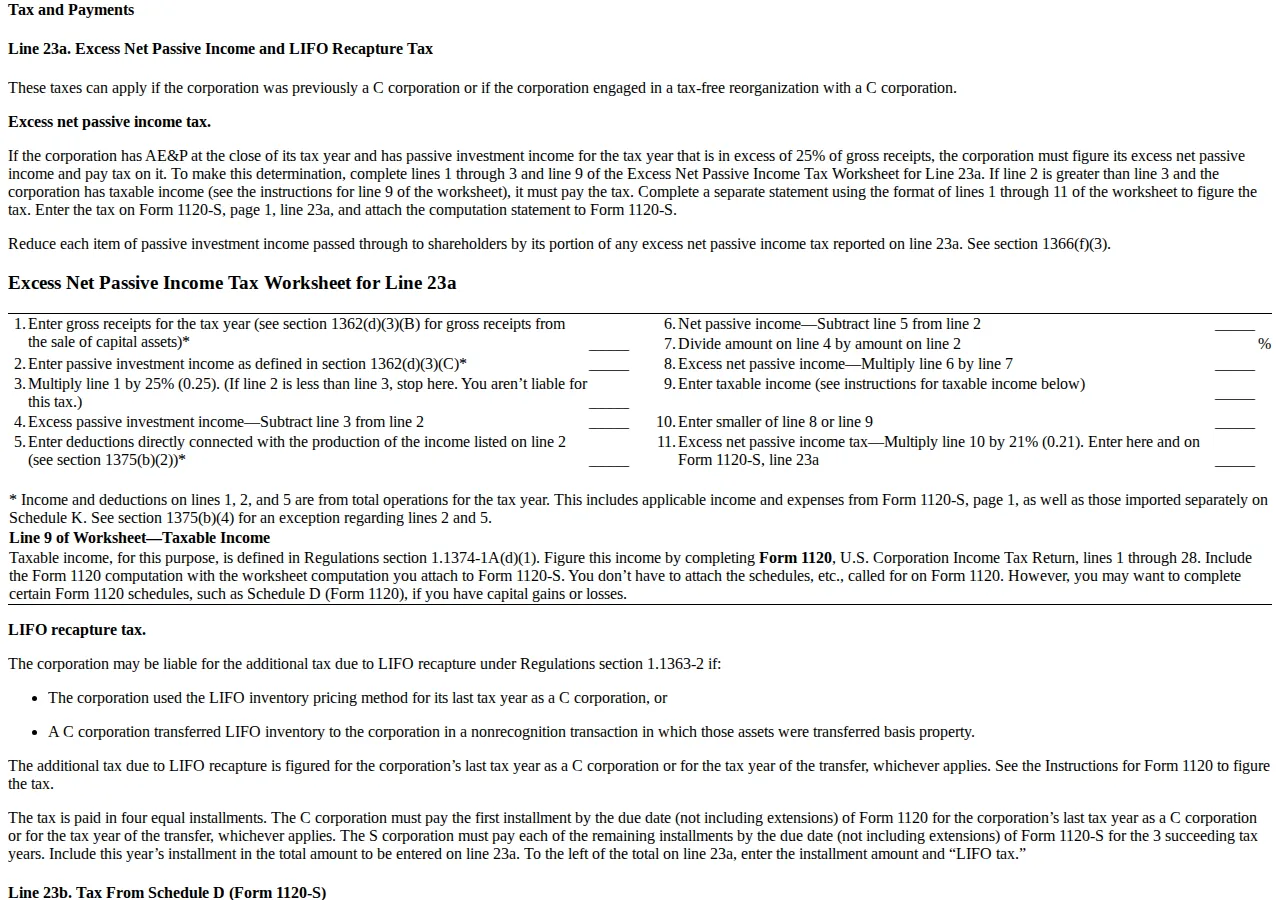
The tax is imposed on the corporation, not on the shareholders. It is computed by multiplying excess net passive income by the highest rate of tax specified in section 11(b) — the flat 21 percent corporate rate. It is reported on Form 1120-S, line 23a, on the worksheet attached to the return. No credits are allowed against it except the section 34 credit, under section 1375(c), so the usual credits that soften a corporate return do not soften this one.
The excess net passive income formula
The tax base is not the passive income itself. It is excess net passive income, defined in section 1375(b)(1), built in three steps. First, net passive income: passive investment income reduced by the deductions directly connected with producing it, excluding section 172 (NOL) deductions and part VIII of subchapter B deductions. Second, the excess ratio: the amount by which passive investment income exceeds 25 percent of gross receipts, divided by total passive investment income. Third, excess net passive income is net passive income multiplied by that ratio. The statute caps it: excess net passive income cannot exceed the corporation's taxable income for the year, computed under section 63(a) without part VIII deductions other than section 248 and without the section 172 deduction.
Worked example. A converted S corporation has gross receipts of $2,400,000, of which $840,000 is passive investment income — 35 percent, above the 25 percent line. Deductions directly connected with producing that passive income are $120,000. Net passive income is $840,000 minus $120,000, or $720,000. The excess is $840,000 minus 25 percent of $2,400,000, which is $240,000. The ratio is $240,000 divided by $840,000, or about 28.57 percent. Excess net passive income is $720,000 times that ratio, or $205,714.29. The tax is $205,714.29 times 21 percent, or $43,200. The cap does not bind here: the corporation's taxable income computed under the section 63(a) method is $400,000, above the $205,714.29 base.
Now the same corporation in a thin year. Gross receipts and passive income are unchanged, so excess net passive income is still $205,714.29 — but taxable income under the section 63(a) method is only $150,000. Section 1375(b)(1)(B) caps the base at $150,000, and the tax falls to $150,000 times 21 percent, or $31,500. The cap is a real defence in a loss-heavy year, because it ties the tax to income the corporation actually has, but it does not erase the trigger: the year still counts toward the three-year termination clock, which is measured by the 25 percent test, not by the tax paid.
What counts as passive investment income
Section 1375(b)(3) borrows the definitions from section 1362(d)(3), and the list is narrow and mechanical. Passive investment income means gross receipts derived from royalties, rents, dividends, interest, and annuities. Nothing else. Active business receipts are not passive, however large they are, which is why the ratio is computed against gross receipts: a corporation with $4,000,000 of operating receipts and $400,000 of rent is at 9 percent passive and owes nothing, while a corporation with $600,000 of operating receipts and the same $400,000 of rent is at 40 percent and owes the tax.
Three exceptions in section 1362(d)(3)(C) keep ordinary business income out of the passive bucket. Interest on an obligation acquired in the ordinary course of the trade or business from the sale of inventory described in section 1221(a)(1) is not passive. Gross receipts from the active and regular conduct of a lending or finance business, for a corporation meeting the section 542(c)(6) requirements, are not passive. Dividends from a C corporation meeting the section 1504(a)(2) test are not passive to the extent attributable to that corporation's active-business earnings and profits. Banks and depository institution holding companies exclude their interest income and dividends on assets they are required to hold.
The gross-receipts denominator has its own counting rule, in section 1362(d)(3)(B), and it favours the taxpayer. Gross receipts from dispositions of capital assets other than stock and securities count only to the extent of the capital gain net income from them, and gross receipts from sales or exchanges of stock or securities count only to the extent of the gains. A corporation that sells a building for $2,000,000 with a $200,000 gain counts $200,000 of gross receipts, not $2,000,000. A corporation that sells stock for $500,000 with a $60,000 gain counts $60,000.
| Provision | Trigger | Rate and base | Who it hits | Authority |
|---|---|---|---|---|
| § 1375 passive-income tax | E&P at year-end + PII above 25% of gross receipts | 21% × excess net passive income | Converted S corporations with undistributed C earnings | 26 U.S.C. § 1375 |
| § 1374 built-in gains tax | Recognized built-in gain inside the 5-year recognition period | 21% × net recognized built-in gain | Converted S corporations selling appreciated C-era assets | 26 U.S.C. § 1374 |
| § 1362(d)(3) termination | E&P + PII above 25% for 3 consecutive years | Election terminated, effective first day of the year after the third | Any S corporation that trips the test three years running | 26 U.S.C. § 1362(d)(3) |
The coordination rule in section 1375(b)(4) keeps the two taxes from stacking on the same dollars. Passive investment income is determined without taking into account any recognized built-in gain or loss of the S corporation for any taxable year in the recognition period. A built-in gain recognized during the recognition period is section 1374 territory, not section 1375 territory. The section 1374 built-in gains tax playbook works the recognition-period mechanics and the 21 percent rate on the gain side, and the two articles together cover the full conversion-tax pair.
The three-year clock: termination under § 1362(d)(3)
The tax is the warning. Termination is the consequence. Section 1362(d)(3)(A) provides that the S election is terminated whenever the corporation has accumulated earnings and profits at the close of each of three consecutive taxable years and has gross receipts for each of those years more than 25 percent of which are passive investment income. The termination is effective on and after the first day of the first taxable year beginning after the third consecutive year. A prior year counts only if the corporation was an S corporation for that year.
Take a calendar-year C-Corp that trips the test in 2024, 2025, and 2026. The election terminates effective January 1, 2027, so 2027 is taxed entirely as a C corporation year. There is no short-year split when the termination is effective on the first day of a taxable year; the section 1362(e) S-termination-year split applies when a termination takes effect mid-year, for example on a revocation date. The corporation then faces the section 1362(g) bar: it cannot make a new S election for any taxable year before its fifth taxable year beginning after the first taxable year for which the termination is effective — for a 2027 termination, the earliest re-election year is 2032, unless the Secretary consents.
The defences, in order of strength
The strongest defence is to remove the earnings and profits. A distribution of accumulated earnings and profits eliminates the section 1375(a)(1) condition entirely, and it also breaks the termination chain, because the chain requires earnings and profits at the close of each of the three years. The cost is real: distributions come out of the accumulated adjustments account first, tax-free to the shareholder to the extent of stock basis, and only after that account is exhausted do they come out of earnings and profits as dividends. The S corporation shareholder basis playbook works the basis mechanics that decide how much of the distribution is tax-free for an LLC that elected S status, and the S corporation election deadline playbook sets out the election the corporation is protecting. Price the dividend cost against the tax and the termination risk before distributing.
The second defence is to keep passive income at or below 25 percent of gross receipts. Because the test is a ratio, growing the denominator works as well as shrinking the numerator: active business receipts dilute the passive share. Reclassifying receipts correctly matters more than either — interest on inventory-sale obligations and active lending receipts are not passive at all, and a corporation that books them as passive income is manufacturing its own trip.
The third defence is the section 1375(d) waiver. If the S corporation establishes to the satisfaction of the Secretary that it determined in good faith that it had no accumulated earnings and profits at the close of a taxable year, and that during a reasonable period of time after it was determined that it did have accumulated earnings and profits those earnings and profits were distributed, the Secretary may waive the tax for that year. Good faith plus prompt distribution is the whole test. It waives the tax, not the termination clock, so it is a one-year repair, not a strategy.
The fourth defence is timing inside the recognition period. Built-in gains recognized during the recognition period are excluded from passive investment income under section 1375(b)(4), so a conversion-year asset sale does not itself push the passive percentage up. After the recognition period ends, that shelter is gone.
Execution checklist
- [x] Step 1 — Confirm the earnings balance: Pull the accumulated earnings and profits balance at year-end from the corporate records and have a CPA confirm it. If it is zero, section 1375 cannot apply — document the zero and move on.
- [x] Step 2 — Classify every receipt: Sort gross receipts into passive investment income and active receipts using section 1362(d)(3)(C), and apply the asset-sale counting rule so only gains enter gross receipts.
- [x] Step 3 — Run the 25 percent test: Divide passive investment income by gross receipts. At or below 25 percent, there is no tax and no clock year; above it, both start.
- [x] Step 4 — Compute the worksheet: Work the Form 1120-S instructions worksheet — net passive income, the excess ratio, the section 63(a) taxable-income cap — and multiply the result by 21 percent. Enter it on Form 1120-S, line 23a.
- [x] Step 5 — Count the clock: Mark which consecutive year this is. Year one is a warning, year two is the last planning year, year three closes the election.
- [x] Step 6 — Price the distribution: Compare the dividend cost of distributing the earnings and profits against the section 1375 tax plus the five-year re-election bar, and decide before the third year closes.
- [x] Step 7 — File the waiver if the facts fit: If the corporation believed in good faith it had no earnings and profits and distributed them promptly on discovery, prepare the section 1375(d) waiver request with the distribution records attached.
Founder & CEO Insight — Enow A. Jovial
The section 1361 S corporation eligibility playbook covers the small-business-corporation requirements the election rests on, and the tax estimator runs the shareholder-level numbers on any distribution the defence requires. Section 1375 is a small tax with a large shadow: the dollars are modest, the termination is not.