Section 1374 Built-In Gains Tax: The 5-Year Clock, the NUBIG Cap, and Schedule D Part III
Meridian Fabrication Inc. was a C corporation for twelve years. On January 1, 2026, it elects S status; in March it sells a warehouse held since its C years for $950,000. The $450,000 gain produces $52,500 of corporate-level tax, even though Meridian is now an S corporation. That is section 1374.
Who pays it — section 1374(a) and (c)
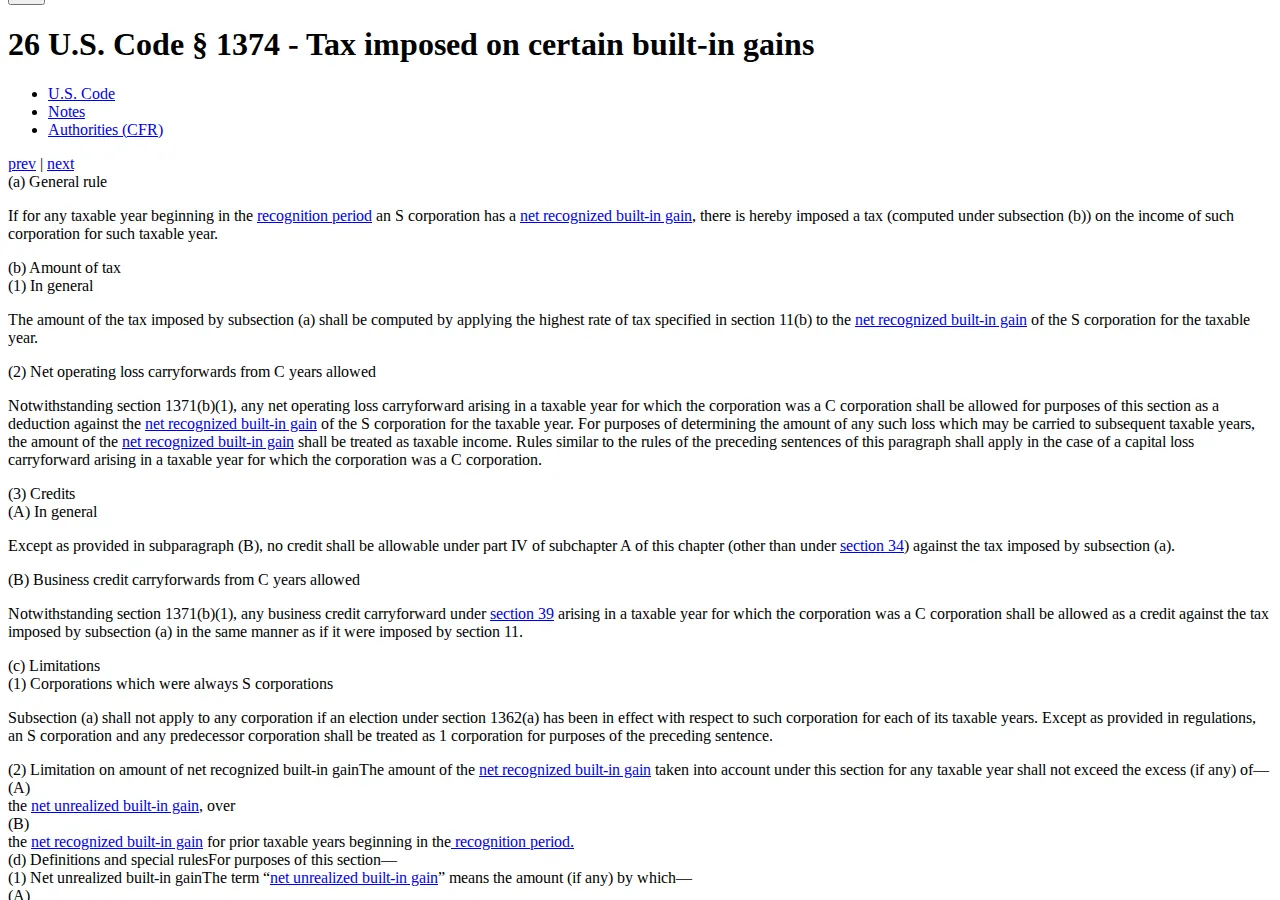
Section 1374(a) imposes the tax when an S corporation "has a net recognized built-in gain" in "any taxable year beginning in the recognition period." Two kinds of corporations are exposed: one that was a C corporation before electing S status, and, under section 1374(d)(8), one that acquires an asset on a transferred basis from a C corporation, with a fresh recognition period.
One class never pays it. Section 1374(c)(1) provides that subsection (a) "shall not apply to any corporation if an election under section 1362(a) has been in effect with respect to such corporation for each of its taxable years." A company formed as an S corporation from day one has no section 1374 exposure.
The recognition period — section 1374(d)(7)
The recognition period is "the 5-year period beginning with the 1st day of the 1st taxable year for which the corporation was an S corporation." For Meridian, effective January 1, 2026, the period runs January 1, 2026 through December 31, 2030. A disposition on January 2, 2031 escapes section 1374 entirely.
The consequence is a timing trade-off: holding an appreciated C-year asset one more year can be worth 21 percent of its built-in gain. Installment sales do not stretch the clock: under section 1374(d)(7)(B), payments are governed by the rules for the year of sale.
Net unrealized built-in gain — section 1374(d)(1)
The ceiling on everything is net unrealized built-in gain. Section 1374(d)(1) defines it as the amount by which "the fair market value of the assets of the S corporation as of the beginning of its 1st taxable year for which an election under section 1362(a) is in effect, exceeds the aggregate adjusted bases of such assets at such time." Meridian's assets were worth $2,400,000 at conversion against $1,500,000 of basis:
That $900,000 is the lifetime cap: section 1374(c)(2) limits the net recognized built-in gain in any year to NUBIG less prior years' net recognized built-in gain.
The cap is measured asset by asset. Under section 1374(d)(3), a recognized built-in gain is a gain on a disposition during the recognition period, except to the extent the corporation establishes that the asset was not held at the start of the first S year, or that the gain exceeds the asset's conversion-date fair market value over its basis. Meridian's warehouse was worth $800,000 at conversion against a $500,000 basis and sold for $950,000: the $450,000 gain contains only $300,000 of built-in gain, because the $150,000 above conversion value is post-conversion appreciation. Section 1374(d)(5) adds built-in items that are not dispositions: income or deductions from pre-S periods but taken into account during the recognition period count as recognized built-in gains and losses.
The computation — Schedule D, Part III
Section 1374(b)(1) sets the rate: the tax is computed "by applying the highest rate of tax specified in section 11(b)" — flat 21 percent — to net recognized built-in gain. The mechanics are Schedule D (Form 1120-S), Part III, lines 16–23.
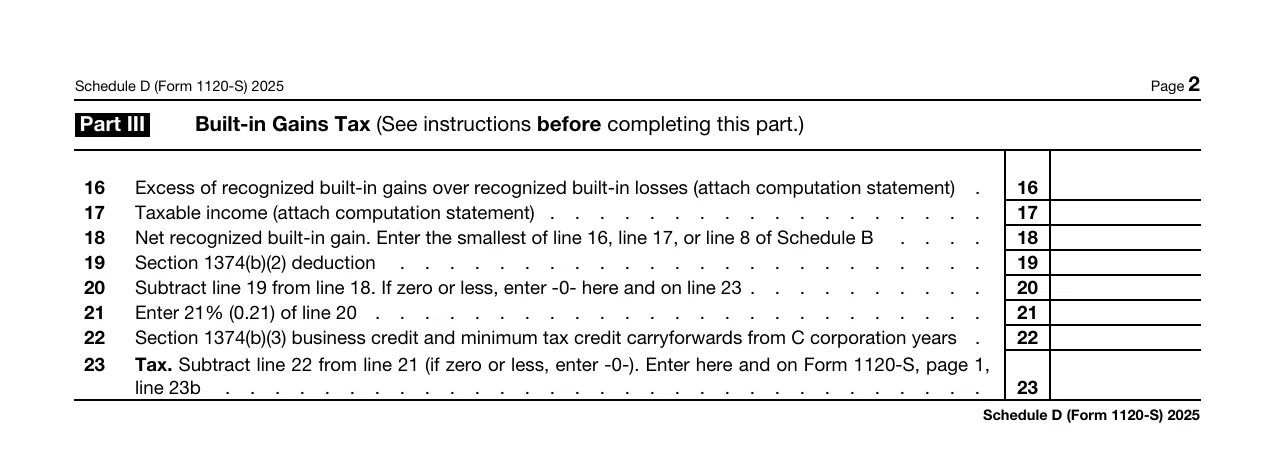
| Line | What it carries | Authority |
|---|---|---|
| 16 | Excess of RBG over RBL | § 1374(d)(2)(A)(i) |
| 17 | Form 1120-method taxable income | § 1374(d)(2)(A)(ii) |
| 18 | NRBG — smallest of lines 16, 17, Schedule B line 8 | § 1374(d)(2), (c)(2) |
| 19 | § 1374(b)(2) deduction — C-year NOL/capital loss carryforwards | § 1374(b)(2) |
| 20 | Line 18 minus line 19 | Schedule D |
| 21 | 21 percent of line 20 | § 1374(b)(1); § 11(b) |
| 22 | § 1374(b)(3) credit — C-year business credits | § 1374(b)(3)(B) |
| 23 | Tax — line 21 minus line 22, to line 23b | Schedule D |
Worked example — Meridian's year 1 (2026): the warehouse produces a $300,000 recognized built-in gain, the equipment a $20,000 gain, the land a $20,000 recognized built-in loss. Line 16 is the excess of gains over losses:
Taxable income on the Form 1120 method is $360,000, and Schedule B line 8 — NUBIG less prior years' gain — is $900,000, there being no prior years. Line 18 is the smallest of the three:
Meridian carries a $50,000 net operating loss from a C corporation year. Section 1374(b)(2) allows it against net recognized built-in gain, so line 19 is $50,000 and line 20 is $250,000:
Line 22 is $0, so line 23 — the built-in gains tax — is $52,500, on Form 1120-S, page 1, line 23b. The tax estimator runs the 21 percent rate on your own numbers before you commit to a sale price.
In year 2 (2027), Meridian sells its remaining appreciated C-year assets: line 16 is $700,000, taxable income $800,000, Schedule B line 8 now $600,000 — the $900,000 NUBIG minus year 1's $300,000. Line 18 is $600,000; the tax is $126,000. The $100,000 above the cap is never taxed — the section 1374(c)(2) cap has no carryover, unlike section 1374(d)(2)(B), which applies only when taxable income binds.
What the tax does to the shareholders
The built-in gains tax is not a dead cost on top of shareholder tax — it is treated as a loss sustained by the corporation in the same tax year. The Instructions for Schedule D allocate the deemed loss proportionately: the short-term portion as a short-term capital loss (Schedule D, line 6), the long-term portion as a long-term capital loss (line 14), and the ordinary portion as a deduction for taxes (Form 1120-S, line 12).
Two reliefs sit inside the computation. Section 1374(b)(2) lets C-year net operating loss and capital loss carryforwards absorb net recognized built-in gain — Meridian's $50,000 NOL saved $10,500 at 21 percent. Section 1374(b)(3)(B) lets C-year section 39 business credit carryforwards offset the tax. What is not allowed is any other credit: section 1374(b)(3)(A) bars every part IV credit except section 34.
Section 1375 — the passive-income tax on the same corporations
Section 1374 is not the only corporate-level tax that follows a C corporation into S status. Section 1375 imposes a second one when the corporation still holds C-year accumulated earnings and profits and passive investment income exceeds 25 percent of gross receipts.
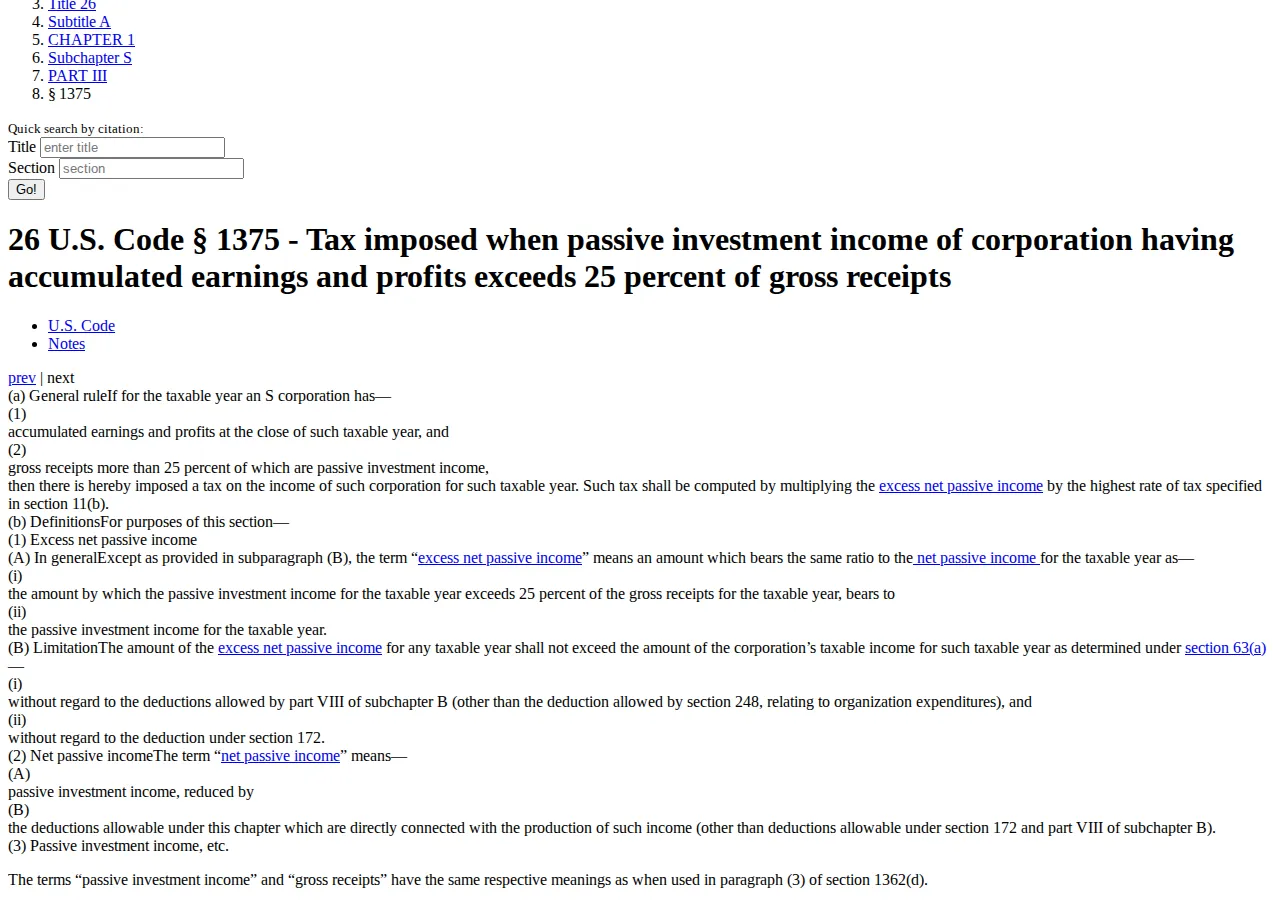
Section 1375(a) applies when the S corporation has "(1) accumulated earnings and profits at the close of such taxable year, and (2) gross receipts more than 25 percent of which are passive investment income." The tax is excess net passive income times the highest section 11(b) rate — 21 percent. Passive investment income is defined in section 1362(d)(3) as "gross receipts derived from royalties, rents, dividends, interest, and annuities."
Meridian's 2026 passive income: receipts $1,000,000, passive investment income $400,000, connected deductions $50,000, net passive income $350,000:
The tax is 21 percent of that, $27,562.50, on Form 1120-S, page 1, line 23a. Combined with the $52,500 built-in gains tax, Meridian's 2026 entity-level tax is $80,062.50 — and under section 1366(f)(3) the section 1375 tax reduces each item of passive investment income passed through to shareholders.
The coordination rule is the point most preparers miss. Section 1375(b)(4) provides that passive investment income "shall be determined by not taking into account any recognized built-in gain or loss of the S corporation for any taxable year in the recognition period." Meridian's $300,000 warehouse gain is therefore excluded — the two taxes never double-count the same dollar.
Section 1375 carries the sharper long-term threat. Under section 1362(d)(3), an S election terminates after 3 consecutive years with accumulated earnings and profits at each year-end and gross receipts over 25 percent passive in each year. Three years of heavy passive income does not just cost 21 percent a year — it ends S status. Section 1375(d) offers one escape hatch: a waiver for a good-faith belief of no AE&P plus prompt distribution.
When and where to file
File Schedule D with Form 1120-S: the built-in gains tax from Part III, line 23 goes on Form 1120-S, page 1, line 23b; the excess net passive income tax goes on line 23a. Form 1120-S is due by the 15th day of the 3rd month after year-end — March 15 for a calendar-year corporation, falling on March 16, 2026 because March 15 is a Sunday. The return must also answer Schedule B, item 8 with NUBIG less prior years' NRBG — the number that caps line 18.
The filing is made under the corporation's EIN; the Form 1120 computation feeding line 17 is attached to Schedule D, usually built by a CPA. S-Corp and C-Corp treatment diverge: the same income is measured once as a C corporation for the cap, and again as an S corporation for the pass-through. An LLC taxed as an S corporation follows the same rules, and shareholders report pass-through shares under their SSN or ITIN. FICA and SECA never apply: this is an entity-level income tax, not payroll tax. Our S corporation election playbook covers the election; the entity classification playbook covers the classification.
Founder & CEO Insight — Enow A. Jovial
Execution checklist
- Step 1: Confirm exposure — a C corporation past or a transferred-basis acquisition; always-S corporations skip it.
- Step 2: Value every asset at the start of the first S year and compute NUBIG.
- Step 3: Record each C-year asset's conversion-date FMV and basis, so the per-asset cap is provable.
- Step 4: Calendar the five-year recognition period and flag any planned sale inside it.
- Step 5: Track built-in items under section 1374(d)(5) — pre-conversion receivables and expenses.
- Step 6: Complete Schedule D, Part III, lines 16–23, applying C-year NOL and capital loss carryforwards.
- Step 7: Enter the line 23 tax on Form 1120-S, line 23b, and answer Schedule B, item 8 with NUBIG less prior NRBG.
- Step 8: Test section 1375 separately — AE&P at year-end and passive income over 25 percent of receipts — and run the break-even calculator on holding or selling.
- Step 9: Pay estimated tax if the three entity-level taxes together reach $500, and distribute old C earnings before three passive years end the election.