IRC §1361: the S-Corp Eligibility Playbook — the 100-Shareholder Limit, One Class of Stock, and the Trusts That Can Hold Shares
An S corporation election is not a form. It is a status that survives only while four statutory conditions hold, every day, for every share. Fail one, and the election terminates — entity-level tax starts on the date of cessation.
The four tests of §1361(b)(1)
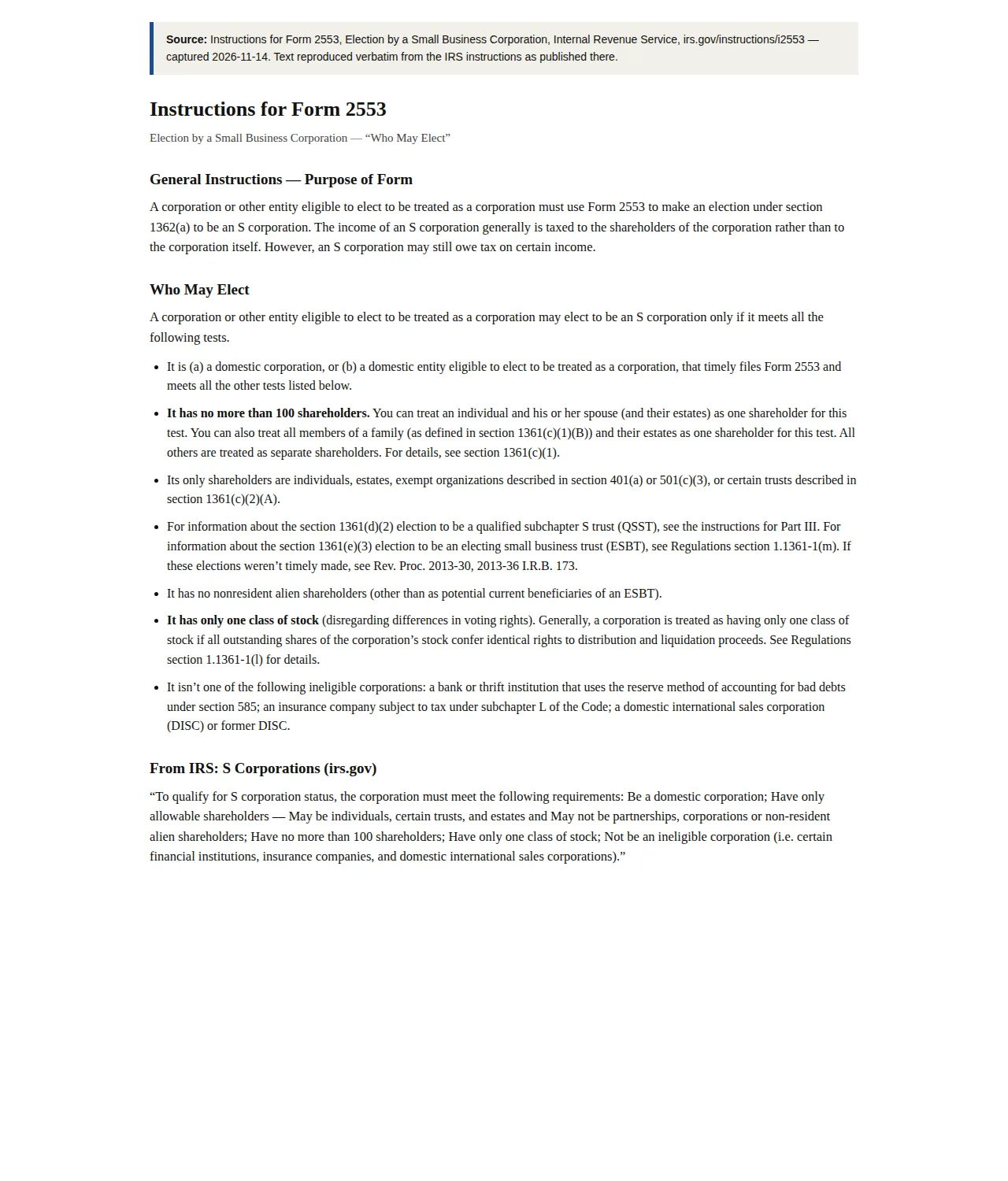
Section 1361(a)(1) defines an S corporation as a small business corporation for which an election under §1362(a) is in effect — an LLC electing corporate treatment included. Section 1361(b)(1) defines the small business corporation as a domestic corporation, not an ineligible corporation, that does not: have more than 100 shareholders; have as a shareholder a person other than an individual, an estate, a trust described in §1361(c)(2), or an organization described in §1361(c)(6); have a nonresident alien as a shareholder; or have more than one class of stock. Ineligible under §1361(b)(2): a §585 reserve-method financial institution, a subchapter L insurer, and a DISC or former DISC. The Instructions for Form 2553 restate the four tests under "Who May Elect." The Form 2553 deadline playbook works the filing deadline; this one works the qualification underneath it.
Worked math 1: the 100-shareholder count with family aggregation
Scenario: Harbor & Sons Inc., a fourth-generation family business, elects S status. The cap table: the estate of founder Eleanor Vance; her 4 children and their 4 spouses; 16 grandchildren and 10 of their spouses; 70 great-grandchildren; and 2 unrelated angel investors. Counting heads:
Section 1361(c)(1) changes the count: a husband and wife (and their estates) count as one shareholder, and all members of a family count as one. Members of a family means a common ancestor, any lineal descendant, and any spouse or former spouse, subject to the six-generation rule: no common ancestor more than 6 generations removed from the youngest generation. Eleanor's great-grandchildren are three generations below her, so the whole family line collapses into one:
Run the same count on your own cap table with our Tax & Quarterly Estimator.
Who may hold the shares
The permitted-holder list is closed: individuals; estates (§1361(c)(3) extends "estate" to a bankruptcy estate). A trust may hold shares only if it is one of six in §1361(c)(2)(A): a grantor trust owned by a US citizen or resident under subpart E; that trust for 2 years after the deemed owner's death; a testamentary trust for 2 years after transfer under a will; a voting trust; an electing small business trust; and, for a bank, an IRA trust. A §401(a) or §501(c)(3) organization exempt under §501(a) may hold shares (§1361(c)(6)). Who counts as shareholder depends on the trust: grantor trust, the deemed owner; post-death trust, the estate; testamentary trust, the testator's estate; voting trust, each beneficiary; ESBT, each potential current beneficiary — so an ESBT with twelve potential current beneficiaries consumes twelve slots while a QSST consumes one (§1361(c)(2)(B)).
One class of stock — and the debt that is not stock
Section 1361(b)(1)(D) allows one class of stock: under Treas. Reg. §1.1361-1(l)(1), all outstanding shares must confer identical rights to distribution and liquidation proceeds. (Voting differences are disregarded under §1361(c)(4).) The safe harbour is §1361(c)(5): straight debt — a written unconditional promise to pay a sum certain, non-contingent interest, no convertibility, an eligible creditor — is not a second class of stock. A shareholder loan paying interest only if the company is profitable fails the test. The S-Corp election tax savings threshold prices the payroll-tax saving the election defends — worthless if a side agreement creates a second class of stock.
The QSST: one beneficiary, all the income, currently
A qualified subchapter S trust under §1361(d) is the narrow, cheap route for holding S corporation stock. The trust qualifies only if its terms require four things under §1361(d)(3)(A): one income beneficiary for life; corpus only to that beneficiary; the income interest ending at death or trust termination; and all assets to that beneficiary on termination during life. And under §1361(d)(3)(B), all §643(b) income must be distributed currently to one US citizen or resident individual. The beneficiary elects under §1361(d)(2), separately for each corporation, within the 16-day-and-2-month period beginning on the day the stock is transferred to the trust (Treas. Reg. §1.1361-1(j)(6)(iii)(A)); §1361(d)(2)(D) backdates an election up to 15 days and 2 months. The beneficiary is then treated as owner under §678. If the trust stops meeting the (B) requirement, §1361(d)(4)(B) ends QSST treatment as of the first day of the first taxable year beginning after the failure year. Measure the distribution against §643(b) income — not GAAP net income, which FASB guidance does not control for tax — and pay by ACH or check before the year closes.
The ESBT: flexibility priced at the top rate
An electing small business trust under §1361(e) is the broad route. Any trust qualifies if its beneficiaries are only individuals, estates, §170(c)(2)–(5) organizations, or a §170(c)(1) organization holding a contingent interest that is not a potential current beneficiary; no interest was acquired by purchase; and an election applies. The trustee elects, and the price is in §641(c): the S corporation portion is taxed separately, and §641(c)(2) taxes it at the highest rate in §1(e) — 37% — with no distribution deduction. Every potential current beneficiary counts as a shareholder under §1361(c)(2)(B)(v).
Worked math 2: QSST against ESBT on the same $120,000
Scenario: the Vance family trust — one income beneficiary, Mara Vance — holds S corporation stock, and the S corporation allocates $120,000 to the trust's shares for the year. Under a QSST, Mara is treated as owner and taxed on her return at a stated 24% marginal rate (assumption):
Under an ESBT, the S portion is taxed to the trust at the highest §1(e) rate, 37%, with no distribution deduction:
The decision table
| Route | Who is taxed | Rate | Shareholders | Authority |
|---|---|---|---|---|
| Individual holder | The individual | Individual rates | 1 | §1361(b)(1)(B) |
| QSST | The beneficiary (§678) | Individual rates | 1 | §1361(d) |
| ESBT | The trust, S portion only | 37%, highest in §1(e) | Each potential current beneficiary | §1361(e), §641(c)(2) |
| Testamentary trust (2-year) | The testator's estate | Estate rates | 1 | §1361(c)(2) |
| Partnership holder | Not permitted | Election terminates | N/A | §1361(b)(1)(B) |
| Nonresident alien holder | Not permitted | Election terminates | N/A | §1361(b)(1)(C) |
Termination: the three ways an election dies
Section 1362(d) gives three routes. Revocation by shareholders holding more than one-half of the shares. Second, §1362(d)(2): the election terminates whenever the corporation ceases to be a small business corporation, effective on and after the date of cessation — the day the 101st shareholder, a partnership, or a second class of stock appears — with no grace period. Third, §1362(d)(3): if the corporation has accumulated earnings and profits at the close of each of 3 consecutive taxable years and gross receipts for each of those years more than 25 percent of which are passive investment income, the election terminates effective on the first day of the first taxable year beginning after the third consecutive year. The termination year splits by §1362(e) into an S short year and a C short year, items allocated pro rata by day unless all shareholders elect normal tax accounting; §1362(e)(6)(A) treats the two short years as one year for carryovers, so a net operating loss (NOL) carryover survives. Section 1362(g) bars re-election before the 5th taxable year after the termination year, unless the Secretary consents.
Worked math 3: what termination costs on $500,000 of income
Scenario: Harbor & Sons earns $500,000 in the year after its election terminates, and distributes it all. As an S corporation it would have been taxed once, at a stated 24% blended marginal rate (assumption):
As a C-Corp, the same $500,000 is taxed twice — 21% at the entity level (§11(b)), then 15% on the dividend (assumption):
Founder & CEO Insight — Enow A. Jovial
The ruling that proves the calendar: PLR 200252053
Scenario: IRS Private Letter Ruling 200252053, issued September 4, 2002 and released December 27, 2002. A company elected S status effective in Year 1; in Year 2, Trust A and Trust B became shareholders, both represented to satisfy the QSST requirements under §1361(d)(3) with timely filed QSST elections — but neither instrument required the trustee to distribute all income annually. Preparing Year 5 returns, new accountants found no distributions for the years ending Year 2 through Year 5 — the trustees had not known retention would terminate the election. They immediately made the Year 5 distributions, and its Years 2–5 returns were filed as an S corporation. The IRS concluded the election terminated on Date 3, Year 3, under the §1361(d)(4)(B) calendar, and that the termination was inadvertent under §1362(f), so the company would be treated as continuing to be an S corporation from Date 3, Year 3, if its election was otherwise valid. The ruling is directed only to the taxpayer requesting it and, under §6110(k)(3), may not be used or cited as precedent. The warning: a trustee's quiet decision to retain income had already terminated the election a year after the first retained distribution, and only a §1362(f) ruling saved the status.
Inadvertent-termination relief under §1362(f)
Section 1362(f) has four conditions: the election was ineffective for failure to meet §1361(b) or to obtain consents, or was terminated under §1362(d)(2) or (3); the Secretary determines the circumstances were inadvertent; within a reasonable period after discovery, steps were taken so the corporation is once more a small business corporation, or the consents were acquired; and the corporation and every shareholder during the period specified agrees to the Secretary's required adjustments. If all four are met, the corporation is treated as an S corporation during the period the Secretary specifies — the termination is erased, not merely forgiven. Relief requires a ruling request and prompt correction; Rev. Proc. 2013-30 offers a narrower route for late QSST and ESBT elections.
Who this playbook is for, and who should not use it
This playbook is for a founder or operator of a closely held domestic corporation with fewer than 100 shareholders who needs the election to survive transfers, succession, and trust planning — not for a company that needs a foreign, corporate, or partnership investor, or preferred stock.
Execution checklist
- [x] Count shareholders (§1361(c)(1)): families as one, outsiders separate, 100 or fewer.
- [x] Test every holder (§1361(b)(1)(B), (C)): individual, estate, permitted trust, or §401(a)/§501(c)(3) org only.
- [x] Test the stock (Reg. §1.1361-1(l)): identical distribution and liquidation rights for every share.
- [x] Test shareholder loans (§1361(c)(5)): written, unconditional, sum certain, non-contingent interest, no convertibility, eligible creditor.
- [x] File trust elections on time: QSST by the beneficiary within 16 days and 2 months of transfer; ESBT by the trustee; keep copies with Form 2553 and the EIN.
- [x] Verify QSST terms yearly with your CPA: one income beneficiary, corpus only to that beneficiary, all §643(b) income distributed currently to one US citizen or resident.
- [x] Re-run the four tests on every transfer: no share move, trust distribution, loan, or side letter without a fresh count.
- [x] If a defect is found, act fast: correct it, document discovery and correction, seek relief under §1362(f) before the next return.
Eligibility is the cheapest tax position a small business will ever hold and the easiest to lose without noticing. Run the test, keep the file.