Lease Accounting Under ASC 842: Operating vs Finance Leases, Right-of-Use Assets & Monthly Expense Math
Before 2019, a public company could sign a ten-year office lease worth millions and show none of it. Under ASC 840, operating leases lived in the footnotes; only capital leases hit the books. The Financial Accounting Standards Board ended that treatment with Accounting Standards Update 2016-02, issued on 25 February 2016, which created Topic 842. Public business entities adopted it for fiscal years beginning after 15 December 2018; private companies and most nonprofits followed for fiscal years beginning after 15 December 2021, after two deferrals (ASU 2019-10, ASU 2020-05). Calendar-year private companies first reported under it in 2022.
The core change: a lessee now recognises a right-of-use (ROU) asset and a lease liability for virtually every lease longer than 12 months, operating or finance. Classification still matters, because it decides how the expense hits the income statement — flat for operating, front-loaded for finance. This guide runs the classification tests, the measurement math, the discount-rate choice, and a worked monthly example you can reproduce in a spreadsheet.
1. Scope: who ASC 842 applies to
ASC 842 applies to every US GAAP reporter entering a contract conveying the right to control the use of an identified asset for a period of time in exchange for consideration. Office space, warehouses, vehicles, servers, and equipment all sit inside it.
| Contract or arrangement | Inside ASC 842? | Authority |
|---|---|---|
| Office, retail, warehouse, or equipment lease over 12 months | Yes — ROU asset and liability recognised | ASC 842-20-25-1 |
| Lease of 12 months or less, exemption elected | No — payments expensed straight-line | ASC 842-20-25-2 |
| Lease of an intangible asset, inventory, or an asset under construction | No — other guidance applies | ASC 842 scope exclusion |
| Month-to-month arrangement that is in substance 12 months or less | Exempt if the election is made by asset class | ASC 842-20-25-2 |
Two groups act differently. Entities not reporting under US GAAP follow IFRS 16, which has a single lessee model and no operating-versus-finance split. And a service contract with no identified asset or right to control its use is no lease at all; booking one overstates liabilities.
2. The five finance-lease tests (ASC 842-10-25-2)
Classification happens once, at commencement. A lessee classifies a lease as a finance lease if it meets any one of five criteria; if none is met, it is an operating lease. The criteria are:
- The lease transfers ownership of the underlying asset to the lessee by the end of the lease term.
- The lease grants the lessee an option to purchase the underlying asset that the lessee is reasonably certain to exercise.
- The lease term is for the major part of the remaining economic life of the underlying asset — unless commencement falls at or near the end of that economic life, in which case this criterion is not used.
- The present value of the sum of the lease payments and any residual value guaranteed by the lessee equals or exceeds substantially all of the fair value of the underlying asset.
- The underlying asset is of such a specialised nature that it is expected to have no alternative use to the lessor at the end of the lease term.
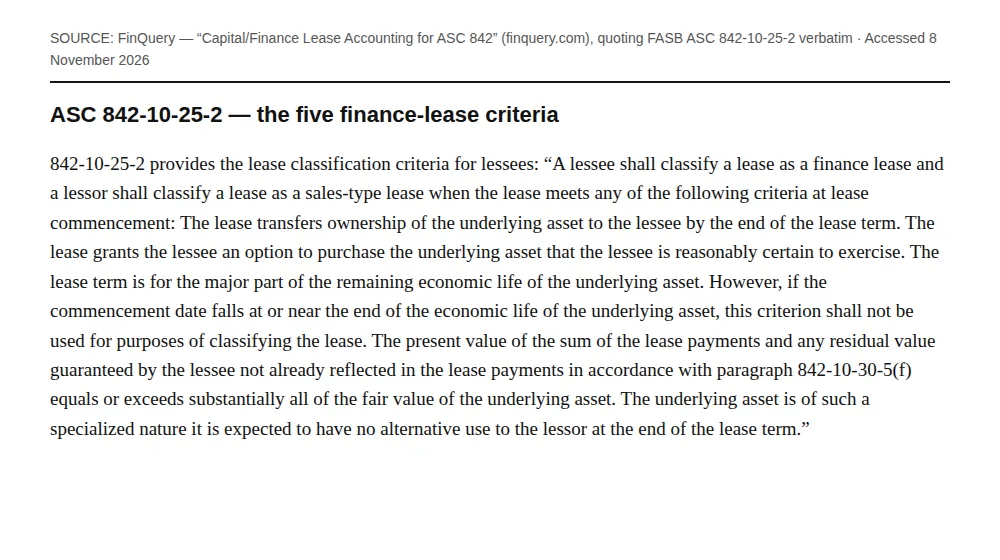
ASC 842 removed the bright lines its predecessor used: "major part" and "substantially all" are not defined as percentages. The guidance in ASC 842-10-55-2 says the old thresholds — 75% of remaining economic life and 90% of fair value — remain a reasonable basis for a policy conclusion, and most entities still use them as documented proxies.
In practice, criteria 3 and 4 catch ordinary leases: a five-year lease on equipment with a six-year life trips criterion 3, and payments discounting to 92% of fair value trip criterion 4. Criterion 5 is the specialist trap — a custom-built production line with no other buyer is a finance lease even on a short term, because the lessor has no alternative use for it.
Founder & CEO Insight — Enow A. Jovial
3. Initial measurement
Measurement is identical for both lease types at commencement. The lease liability is the present value of the payments not yet paid, discounted at the rate from Section 4. The ROU asset starts from that liability, adjusted for cash already moved:
Payments in the liability are fixed payments (including in-substance fixed payments), variable payments depending on an index or rate measured at commencement, expected residual value guarantees, the exercise price of a reasonably-certain purchase option, and termination penalties if the term reflects exercising one. Variable payments tied to usage or sales are left out and recognised as cost when incurred.
Initial direct costs are narrow: only costs incremental to obtaining the lease, such as a broker commission payable only on execution. Internal salaries, overhead, and negotiation time do not qualify and are expensed as incurred. Lease incentives — lessor cash, reimbursements, rent-free periods — reduce the ROU asset. The commencement entry is the same for both:
- Dr Right-of-use asset — the amount from the formula above
- Cr Lease liability — the present value of the unpaid payments
From there the two classifications diverge, and the divergence is the whole financial story of the standard.
4. The discount rate
The discount rate is the most sensitive input: a lower rate produces a larger liability and ROU asset. ASC 842 fixes the order in which rates are chosen.
| Priority | Rate | When it is used | Authority |
|---|---|---|---|
| 1 | Rate implicit in the lease | When readily determinable — the rate equating the present value of payments plus the unguaranteed residual to the asset's fair value plus the lessor's initial direct costs | ASC 842-20-30-2 |
| 2 | Incremental borrowing rate (IBR) | The default in practice: the rate the lessee would pay to borrow, on a collateralised basis, an amount equal to the lease payments over a similar term | ASC 842-20-30-3 |
| 3 | Risk-free rate (private companies only) | Policy election by asset class, using a term-matched Treasury yield; since ASU 2021-09 | ASC 842-20-30-3 |
The implicit rate sits first and is almost never available to the lessee — solving for it needs the lessor's fair value, unguaranteed residual, and initial direct costs, data the lessor rarely shares. The operational default is therefore the IBR, built and documented by the lessee: a term-matched risk-free rate plus a credit spread.
The risk-free election is the private-company relief valve. A non-public entity may discount with a term-matched US Treasury yield instead of building an IBR, and since ASU 2021-09 it may do so by asset class — risk-free for equipment, IBR for real estate. The trade is real: Treasury yields sit below a borrower's IBR, so the election inflates the liability and the ROU asset.
5. Worked example: $3,000 a month for five years
Take a 5-year office lease: $3,000 monthly in arrears, 60 payments, no prepayments, incentives, or initial direct costs, at a 6% incremental borrowing rate (0.5% a month). Total cash is $180,000.
The present-value factor for a 60-month ordinary annuity at 0.5% a month:
The opening ROU asset is also $155,176.68.
Operating lease: one flat number every month
For an operating lease, ASC 842 requires a single lease cost, straight-line over the term:
Each month the lessee records $3,000 of lease expense; behind it, interest accrues and the ROU asset amortises by the plug that keeps total expense at $3,000.
Finance lease: interest plus amortisation, front-loaded
For a finance lease the expense splits in two: interest on the liability and ROU amortisation (straight-line):
| Month | Interest | ROU amortisation | Finance cost | Operating cost | Difference |
|---|---|---|---|---|---|
| 1 | $775.88 | $2,586.28 | $3,362.16 | $3,000.00 | $362.16 |
| 60 | $14.93 | $2,586.28 | $2,601.21 | $3,000.00 | -$398.79 |
Month 1 shows it: the liability is at its largest, so interest is at its largest, and the finance cost of $3,362.16 runs $362.16 above the operating cost. By month 60 the position reverses — interest has fallen to $14.93 and the finance cost of $2,601.21 sits $398.79 below the operating cost. Over the full term both models expense exactly $180,000, of which the finance lease recognises $24,823.32 as interest.
6. The tax side: IRC § 162
Book and tax treatment are two different regimes, and confusing them is the most common error in lease planning. For tax, the governing text is IRC § 162(a)(3), which allows a deduction for "rentals or other payments required to be made as a condition to the continued use or possession" of property "to which the taxpayer has not taken or is not taking title or in which he has no equity."
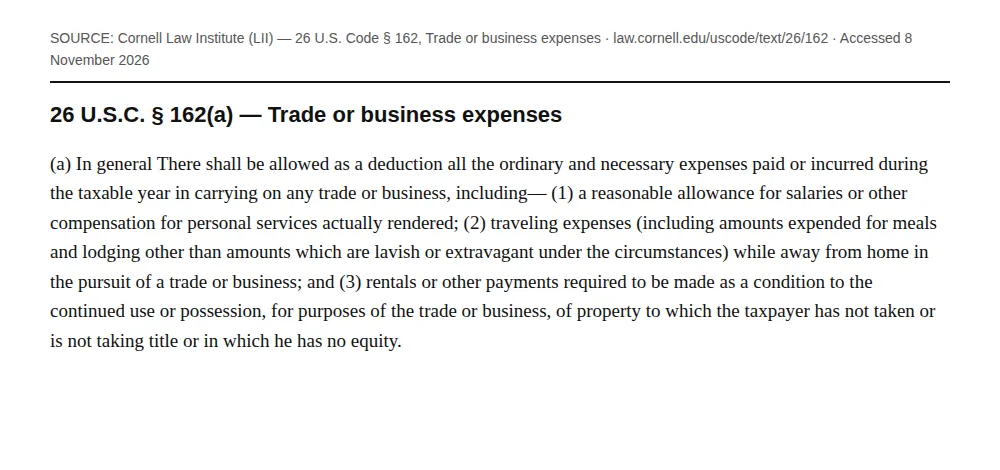
The statute's test turns on title and equity. Rent for property the taxpayer has no title to and no equity in is an ordinary and necessary expense. A lease that transfers ownership, or that in substance gives the lessee equity, moves toward capitalisation — the payment becomes part of the asset's basis, recovered through depreciation instead of a current rent deduction. That is why the Section 2 criteria matter twice: the facts that make a lease a finance lease on the books are the facts that put the tax deduction at risk.
Keep two schedules: the book schedule follows ASC 842; the tax schedule follows § 162. The two will disagree in amount and timing for most finance leases; the difference is a deferred tax item, not an error. For owned assets and the depreciation mechanics that apply once a lease is capitalised, see the IRS Form 4562 depreciation and amortization playbook and the capital expenditure vs repair expense playbook.
7. What changes on the financial statements
The headline is the balance sheet: $155,176.68 of asset and liability appear where a footnote used to sit.
First, the debt ratio moves. A company with $500,000 of debt and $400,000 of equity that signs the worked lease reports $655,176.68 of debt, and its debt-to-equity ratio moves from 1.25 to 1.64. Loan agreements written before ASC 842 sometimes define debt to exclude operating leases. Check the definition before signing.
Second, EBITDA changes shape. Operating lease cost sits above the EBITDA line; finance lease interest sits below it and amortisation is added back. The same contract therefore reports higher EBITDA as a finance lease, with no change in cash.
Third, the cash-flow statement re-sorts the same $3,000. Operating lease payments are operating outflows; finance lease payments split, interest operating and principal financing. Operating cash flow improves under a finance lease by the principal amount each month — $2,224.12 in month 1 — while financing cash flow falls by the same amount. Total cash flow is unchanged.
Lease schedules and remeasurement triggers belong in the close checklist: the month-end close checklist for a 5-day close — and the cash conversion cycle playbook covers receivables the same way. Compare the lease against borrowing with the business loan calculator.
8. Execution checklist
- [x] Step 1: Identify the lease. Confirm control of an identified asset; separate lease from non-lease components.
- [x] Step 2: Set the lease term. Non-cancellable period, plus reasonably-certain renewals, minus reasonably-certain terminations.
- [x] Step 3: Run the five classification tests. Apply ASC 842-10-25-2; document each test and any 75% / 90% proxies.
- [x] Step 4: Select and document the discount rate. Implicit rate if determinable, otherwise the IBR.
- [x] Step 5: Measure the liability and the ROU asset. Discount unpaid payments; add prepayments and direct costs; subtract incentives.
- [x] Step 6: Build the monthly schedule. Effective interest; straight-line ROU amortisation; operating-lease plug holds expense flat.
- [x] Step 7: Apply the short-term election deliberately. Decide by asset class; a 13-month lease never qualifies.
- [x] Step 8: Set the tax schedule separately. Track § 162 deductions apart from the book schedule; record the deferred tax difference.
- [x] Step 9: Check the covenants. Recompute debt-to-equity and coverage before signing; confirm the credit agreement's definition of debt.
- [x] Step 10: Calendar remeasurement triggers. Modifications, term changes, and purchase-option reassessments re-open measurement.
9. Who should not use this playbook
Written for US GAAP reporters who sign leases longer than 12 months. Three groups should not apply it as written: IFRS reporters must use IFRS 16, which has a single lessee model; entities leasing only short-term assets under the exemption will never book an ROU asset; and service agreements without an identified asset are no lease at all.
The honest limitation is the judgment at the centre of the standard. "Major part," "substantially all," "reasonably certain," and the IBR are estimates two competent accountants can answer differently. This guide gives you the paragraphs, the proxies, and the arithmetic; it does not replace the auditor's judgment.