IRS Form 4562 Depreciation and Amortization Playbook: MACRS, Section 179, Bonus Depreciation, and Section 197
Form 4562 is where a business converts what it bought into what it deducts, and the order of the claims changes the result. Every dollar figure below traces to the Internal Revenue Code or an IRS publication opened on 2026-11-06.
What Form 4562 Is and Who Must File It
Use Form 4562 to claim depreciation and amortization, elect under section 179, and report business use of automobiles and other listed property. Part I is section 179, Part II bonus, Part III MACRS, Part IV the summary, Part V listed property, Part VI amortization.
You must file for 2025 if you claim depreciation on property placed in service during 2025; a section 179 deduction, including a carryover; depreciation on any vehicle or other listed property, whenever placed in service; a vehicle deduction on a form other than Schedule C; depreciation on a corporate return other than Form 1120-S; or amortization beginning during 2025. File one form per business or activity, completing only one Part I in full.
Under 26 U.S.C. § 167(a), depreciation is a reasonable allowance for exhaustion, wear and tear of property used in a trade or business or held for the production of income — buildings, machinery, vehicles, furniture, equipment, patents, and software. Land cannot be depreciated. It starts at first business use and ends when the property leaves service or its cost is fully deducted. Schedule C filers report the same vehicle detail in IRS Form 1040 Schedule C: Self-Employed Profit and Loss Playbook.
> [!KEY TAKEAWAY]
> Form 4562 is filed per business, not per return: an LLC and a separate S-Corp each file one, and the section 179 limit applies per taxpayer, not per business.
The MACRS System: Classes, Methods, and Recovery Periods
Most tangible property placed in service after 1986 uses the Modified Accelerated Cost Recovery System in 26 U.S.C. § 168. The General Depreciation System (GDS) is the default; the Alternative Depreciation System (ADS) uses longer periods and straight line, and electing it covers all property in the class placed in service that year and generally cannot be revoked without IRS consent.
GDS classes run 3, 5, 7, 10, 15, 20, and 25 years, plus residential rental at 27.5 and nonresidential real property at 39. Five-year property includes automobiles, light trucks, computers, and office machinery. Seven-year property includes office furniture — and, as a catch-all, any property with no class life and no other designation.
Method follows class under section 168(b): 200% declining balance for 3-, 5-, 7-, and 10-year property; 150% for 15- and 20-year property; straight line for real property. Declining balance switches to straight line in the first year straight line yields more; the Publication 946 tables encode that switch.
> [!FOUNDER]
> "Depreciation is the one deduction where the calendar is worth more than the purchase price. I have watched founders negotiate a 10% equipment discount, then lose more than that by placing it in service in December without checking the mid-quarter test."
> — Enow A. Jovial, Founder & Chief Executive Officer
The Three Conventions, With Worked Numbers
Section 168(d) sets three conventions, each answering one question: on what date is property treated as placed in service? Half-year is the default — all property placed in service during the year counts as placed at the year's midpoint. Mid-month applies to real property. Mid-quarter is mandatory when triggered.
The trigger is a 40% test: use mid-quarter for all MACRS property that year if the bases placed in service in the last three months exceed 40% of the year's total bases. Real property, same-year disposals, and non-MACRS property are excluded. The test basis reflects section 179 reductions and personal use, but not bonus depreciation.
Worked example 1 — half-year, 7-year property. Office furniture costs $10,000, placed in service August 11, 2025, 100% business use, no section 179, no bonus. The Publication 946 Table A-1 Year-1 rate for 7-year property is 14.29%:
$
\text{Year 1} = \$10{,}000 \times 0.1429 = \$1{,}429.00
$
Year 2 uses 24.49%, or $2,449.00.
Worked example 2 — the mid-quarter trap. Three items in 2025: a machine for $4,000 in January, furniture for $1,000 in September, a computer for $5,000 in October. Total bases are $10,000; the $5,000 in the last three months is 50%, so mid-quarter applies to all three. Year 1 is $4,000 × 25.00% = $1,000.00, $1,000 × 10.71% = $107.10, and $5,000 × 5.00% = $250.00:
$
\text{Year-1 total} = \$1{,}000.00 + \$107.10 + \$250.00 = \$1{,}357.10
$
Half-year would have given $571.60 + $142.90 + $1,000.00 = $1,714.50 — the switch costs $357.40 in Year 1.
Worked example 3 — mid-month, real property. A nonresidential building, basis excluding land $390,000, placed in service July 15, 2025. At 39 years straight line, the annual deduction is $390,000 ÷ 39 = $10,000.00. Mid-month counts July as one-half month plus August through December — 5.5 months:
$
\text{Year 1} = \$10{,}000.00 \times \frac{5.5}{12} = \$4{,}583.33
$
A $275,000 residential rental property gives the same annual figure, $275,000 ÷ 27.5 = $10,000.00.
> [!TIP]
> Run the 40% mid-quarter test in October, not in April. Total the MACRS bases placed in service so far, add what you still plan to buy, and check the fourth-quarter slice against 40%.
Section 179 vs Bonus Depreciation: The Stacking Order
Section 179 and bonus depreciation both accelerate deductions into the placed-in-service year, and they stack in a fixed order: section 179 first, then bonus on the remaining basis, then MACRS on what is left.
Section 179 lets a business expense qualifying property placed in service during the year and used more than 50% in the trade or business. For 2025, the maximum is $2,500,000, reduced dollar-for-dollar by costs over $4,000,000; the SUV maximum is $31,300. For 2026: $2,560,000, a $4,090,000 threshold, and a $32,000 SUV limit. The deduction cannot exceed taxable income from the business; disallowed amounts carry forward.
Bonus depreciation under section 168(k) turns on the acquisition date. P.L. 119-21, the One Big Beautiful Bill Act, reinstated 100% bonus for qualified property acquired and placed in service after January 19, 2025. Property acquired after September 27, 2017 and before January 20, 2025, placed in service in 2025, is limited to 40% — 60% for long-production-period property and certain aircraft. You may elect, per class, not to claim it at all. It applies only in the first year the property is placed in service.
Worked example 4 — section 179 plus 100% bonus, 2025. An LLC buys 7-year equipment for $120,000, acquired after January 19, 2025, placed in service March 2025. It elects $50,000 of section 179, leaving a $70,000 basis; 100% bonus on that is $70,000, leaving zero for MACRS:
$
\text{Year-1 total} = \$50{,}000.00 + \$70{,}000.00 = \$120{,}000.00
$
Worked example 5 — the same asset, no section 179 election. Bonus is 100% × $120,000 = $120,000.00, and the Year-1 total is again $120,000.00. When 100% bonus is available, section 179 does not change the Year-1 total — but the business-income limit can still defer section 179 that bonus would have allowed in full.
Worked example 6 — the same asset acquired before January 20, 2025. No section 179. Bonus is 40% × $120,000 = $48,000.00, leaving a $72,000.00 MACRS basis. Year-1 MACRS at 14.29% is $72,000 × 0.1429 = $10,288.80:
$
\text{Year-1 total} = \$48{,}000.00 + \$10{,}288.80 = \$58{,}288.80
$
The acquisition date alone moves the Year-1 deduction from $120,000.00 to $58,288.80 on the same asset. For the startup comparison, see Section 179 vs Bonus Depreciation for Tech Startups.
> [!WARNING]
> Section 179 disallowed by the business-income limit carries forward. But section 179 claimed on property whose business use later falls to 50% or less is recaptured as ordinary income in that year. Bonus has no business-income limit, which is one reason a low-profit year favours bonus.
Listed Property and the Section 280F Passenger-Auto Limits
Listed property gets its own part — Part V — because it is easy to use personally: passenger automobiles, property used for entertainment, recreation, or amusement, and computers unless used exclusively at a regular business establishment. Claiming mileage, vehicle expenses, or depreciation on listed property means completing Part V, whenever it was placed in service.
The controlling test is qualified business use. At 50% or less, the property must be depreciated under ADS straight line, with no accelerated method, no section 179, and no bonus. Section 179 independently requires more than 50% business use in the placed-in-service year, and if use later falls to 50% or less, the amount is recaptured. Keep contemporaneous records: mileage logs and calendars.
Passenger automobiles carry a second limit. Under section 280F, the total of section 179, bonus, and MACRS for a passenger automobile — a four-wheeled vehicle for public roads, rated at 6,000 pounds or less unloaded gross vehicle weight — cannot exceed the annual caps. For automobiles acquired after September 27, 2017 and placed in service in 2025: Year 1 is $20,200 with bonus and $12,200 without, Year 2 $19,600, Year 3 $11,800, Year 4 and later $7,060.
!Pub 946 maximum depreciation table 2025
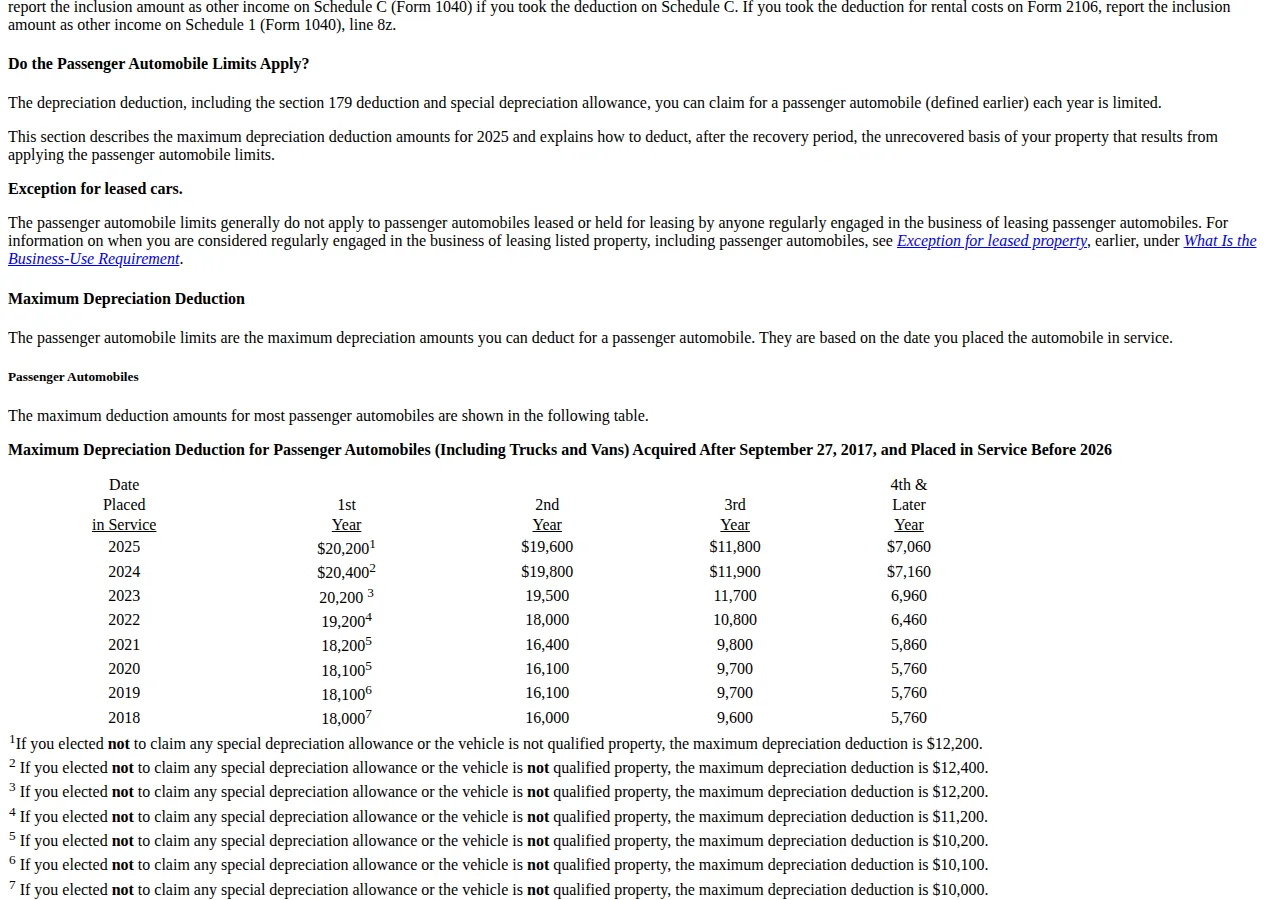
Worked example 7 — a $48,000 car, 2025, 100% business use. With bonus, the Year-1 deduction would be $48,000.00 before the cap; the cap limits it to $20,200.00, and the remaining $27,800.00 is recovered in later years. Without bonus, Year-1 MACRS is $48,000 × 20% = $9,600.00, below the $12,200.00 cap, so the full $9,600.00 is deductible. At 60% business use with no bonus, the IRS's own figure is $12,200 × 60% = $7,320.00. The 2026 caps were not published in the sources opened for this article; confirm them before filing a 2026 return.
Section 197 Amortization: Goodwill and Other Intangibles
Section 197 amortization recovers certain intangibles acquired in a trade-or-business acquisition. Section 197(a) amortizes an amortizable section 197 intangible ratably over the 15-year period beginning with the month acquired — 180 months, no election, no acceleration, and no other deduction for the same intangible. Goodwill and going-concern value qualify when acquired with a trade or business. Self-created intangibles are generally excluded.
Worked example 8 — goodwill from an asset purchase. Goodwill of $150,000 acquired in March with a trade or business. Annual amortization is $150,000 ÷ 15 = $10,000.00, or $833.33 per month. The first year runs March through December, 10 months: $10,000.00 × 10/12 = $8,333.33. The same 15-year treatment applies to the other amortizable intangibles in section 197(d), reported in Part VI, not Part III. Startup costs have their own amortization elections in Part VI — see Prepaid Expenses and Deferred Charges Amortization Playbook. Under GAAP, goodwill is tested for impairment rather than amortized, so book and tax diverge — the CPA reconciles that on the M-1.
The Filing Sequence: Which Part, When, With What Return
Complete the form in order. Part I computes the section 179 election and its limits. Part II claims bonus on the basis remaining after Part I. Part III computes MACRS on the basis remaining after Parts I and II. Part IV totals everything onto `line 22`, which flows to Schedule C, Form 1065, Form 1120-S, or Form 1120 for a C-Corp, each under its own EIN. Part VI reports amortization, including section 197. A tax estimator can model the Year-1 result first, but the form is the filing position.
Form 4562 deductions reduce taxable income, not FICA wages: payroll taxes on an S-Corp owner's salary are computed separately. Attach the form to the timely filed return, including extensions, and keep the permanent records: invoices, placed-in-service dates, business-use logs, and the convention determination. Elections on the return — no bonus for a class, ADS, section 179 itself — generally cannot be revoked without IRS consent.
Decision Table: Which Election for Which Asset
| Situation | Election | Authority |
|---|---|---|
| 7-year equipment, acquired after Jan 19, 2025 | Bonus 100% after targeted § 179 | § 168(k) |
| Same equipment, acquired before Jan 20, 2025 | Bonus 40%, then MACRS 14.29% Year 1 | § 168(k); Pub. 946 |
| Low-profit year | Prefer bonus; carry § 179 excess forward | § 179(b)(3); Pub. 946 |
| Heavy Q4 purchases over 40% | Mid-quarter for all MACRS property | § 168(d)(3); Pub. 946 |
| Nonresidential building, mid-year | 39-year straight line, mid-month | § 168(b)(3), (d)(2) |
| Passenger auto, 100% business, 2025 | Cap Year 1: $20,200 / $12,200 | § 280F(a) |
| Listed property, ≤50% business use | ADS straight line; no § 179, no bonus | § 280F(b) |
| Goodwill acquired with a business | § 197, 15 years from acquisition month | § 197(a) |
| Qualified production property after Jul 4, 2025 | 100% allowance under § 168(n) | § 168(n) |
Operator Boundaries: Who Should Not Use Each Election
Do not use section 179 where the business-income limit will defer most of it while bonus would have been allowed in full. Do not use it on property that may fall to 50% or less business use, or without contemporaneous business-use records.
Do not elect bonus where you want to preserve deductions for a later, higher-income year — the per-class election not to claim bonus exists for that reason. Do not claim it on non-qualified property, such as used property from a related party.
Do not use MACRS for land, inventory, or property used predominantly outside the United States in a way that requires ADS — and do not elect ADS casually — it lengthens every recovery period in the class. Do not claim section 197 for self-created goodwill; the statute excludes it. No election fixes a missing placed-in-service date.
Execution Checklist
1. List every asset placed in service this year with acquisition date, cost, placed-in-service date, and business-use percentage.
2. Assign each asset its GDS class and recovery period from Publication 946.
3. Run the mid-quarter 40% test before December 31.
4. Complete Part V first for every listed property, with business-use percentage and vehicle detail.
5. Compute the section 179 limit — $2,500,000 for 2025, $2,560,000 for 2026 — less costs over $4,000,000 or $4,090,000.
6. Apply section 179 in Part I, then bonus in Part II on the remaining basis — 100% after Jan 19, 2025, 40% before Jan 20, 2025.
7. Compute MACRS in Part III on the remaining basis.
8. Apply the section 280F caps to every passenger automobile — $20,200 with bonus, $12,200 without, for 2025 Year 1.
9. Compute section 197 amortization in Part VI at the 15-year rate.
10. Total in Part IV, carry `line 22` to the correct return for the entity's EIN, attach the form to the timely filed return, and file the records.