Capital Expenditure vs Repair Expense: The Capitalization Playbook
A $48,000 HVAC replacement and a $48,000 HVAC repair can sit on the same invoice, in the same building — and produce tax results that differ by $9,821.54 in year one. The difference is the capitalization decision: whether the amount is an ordinary and necessary expense under 26 U.S.C. § 162, deductible now, or a capital expenditure under 26 U.S.C. § 263(a), recovered slowly through depreciation.
This playbook runs the capitalization operation itself — not the depreciation filing in the IRS Form 4562 depreciation playbook, and not the research-cost rule in the Section 174 software capitalization guide.
Who this is for — and who should stop here
This guide is for an owner, bookkeeper, or CPA at a real operating business: a sole proprietor on Schedule C, a single-member LLC taxed as a sole proprietor filing under the owner's SSN or the LLC's EIN, a multi-member LLC or partnership, an S-Corp filing Form 1120-S, or a C-Corp filing Form 1120. An S-Corp owner takes a salary subject to FICA; a sole proprietor pays SECA tax on net earnings.
It is not for personal expenses, inventory, or property held for sale (§ 263A), or for financial-statement reporting: GAAP and tax capitalization are different systems. It is not a substitute for a CPA review on a six-figure project, a business under examination, or a method change.
> [!FOUNDER]
> "Every operator I know has paid a repair invoice and called it an expense. The question is never what the invoice says. It is what the work did to the property. If the work made the building stronger, bigger, or useful for something new, the tax law treats it as an investment — and investments are recovered over years, not written off in an afternoon."
> — Enow A. Jovial, Founder & Chief Executive Officer
The § 162 test: ordinary and necessary
The starting point is § 162(a): "There shall be allowed as a deduction all the ordinary and necessary expenses paid or incurred during the taxable year in carrying on any trade or business." "Ordinary" means common and accepted in the taxpayer's trade or business. "Necessary" means helpful and appropriate. A $900 burst-pipe repair is ordinary and necessary.
But § 162 is only half the statute: an amount must first qualify under § 162, then survive § 263(a). Fail § 162 and it is never deductible; pass § 162 but fall under § 263(a) and it is capitalized.
> [!KEY TAKEAWAY]
> Section 162 lets the deduction in; section 263(a) decides whether it stays in this year or is spread over the property's life. The safe harbors below are exceptions to the second gate.
The § 263(a) rule and the repair regulations
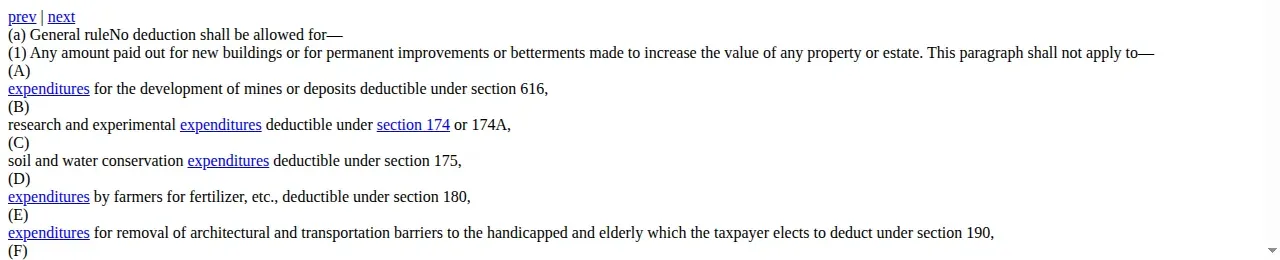
Section 263(a)(1): "No deduction shall be allowed for— (1) Any amount paid out for new buildings or for permanent improvements or betterments made to increase the value of any property or estate." Treas. Reg. § 1.263(a)-3 — the repair regulations — supplies the machinery: unit of property, improvement standard, safe harbors, and the IRS's worked examples.
The regulation first fixes the unit of property, because "improvement" is always measured against a unit. For a building, the unit is the building and its structural components as a single unit — but an amount is an improvement if it improves the structure or any one of nine designated building systems, including HVAC, plumbing, and electrical.
Under § 1.263(a)-3(d), an amount paid to improve a unit of property must be capitalized if it is a betterment, a restoration, or an adaptation — the BAR test, where one hit is enough.
The BAR test: betterment, adaptation, restoration
| Test | The regulation's question | What fails it (capitalize) | Authority |
| :--- | :--- | :--- | :--- |
| Betterment | Does the work fix a material condition or defect, or materially increase capacity, productivity, efficiency, strength, quality, or output? | Reinforcing columns so a floor carries 50% more weight | Treas. Reg. § 1.263(a)-3(j) |
| Restoration | Does the work replace a major component or substantial structural part, or return disrepaired property to working order? | Rebuilding a derelict barn; replacing a whole HVAC system | Treas. Reg. § 1.263(a)-3(k) |
| Adaptation | Does the work adapt the property to a new or different use? | Converting a warehouse into a restaurant | Treas. Reg. § 1.263(a)-3(l) |
Betterment turns on the property's condition before the work: reinforcing columns to carry 50 percent more weight is a betterment, because it materially increases the structure's strength. Restoration turns on the property's condition against its ordinarily efficient operating condition: comparable shingles on a working roof are a repair; shoring up an outbuilding left unmaintained until it is no longer sound is a restoration. Adaptation is the simplest test: a cost that changes what the property is used for is capitalized even if nothing got bigger or stronger.
> [!WARNING]
> The BAR test is applied to related amounts as a whole, not invoice by invoice. Under § 1.263(a)-3(g)(3), amounts paid to improve one unit of property are aggregated even when separately invoiced or spread over several taxable years.
The de minimis safe harbor: $2,500 per item
The first escape from capitalization is the de minimis safe harbor election under Treas. Reg. § 1.263(a)-1(f). A taxpayer without an applicable financial statement (AFS) — most small businesses — may elect not to capitalize amounts of $2,500 or less per invoice, or per item on the invoice. A taxpayer with an AFS may use a $5,000 ceiling instead. IRS Notice 2015-82 raised the regulatory $500 ceiling to $2,500 for taxpayers without an AFS, effective for taxable years beginning on or after January 1, 2016.
The taxpayer must have written accounting procedures at the beginning of the year treating sub-threshold amounts as an expense, and must actually treat the amount as an expense on the books. The election is made by attaching a statement titled "Section 1.263(a)-1(f) de minimis safe harbor election" to the timely filed original return; it applies to every qualifying amount paid that year — all-or-nothing, and it cannot be revoked. The ceiling is per item, not per invoice total: six laptops at $2,400 each on one $14,400 invoice still qualify — but a single item at $2,501 fails.
The small-taxpayer safe harbor: $10,000 or 2% of basis
The second escape is the safe harbor for small taxpayers under Treas. Reg. § 1.263(a)-3(h). A qualifying taxpayer — average annual gross receipts of $10,000,000 or less for the three preceding years — may elect out of capitalization for an eligible building: one with an unadjusted basis of $1,000,000 or less. The election is available when the total paid during the year for repairs, maintenance, and improvements on that building does not exceed the lesser of $10,000 or 2 percent of the building's unadjusted basis.
!Small-taxpayer safe harbor text
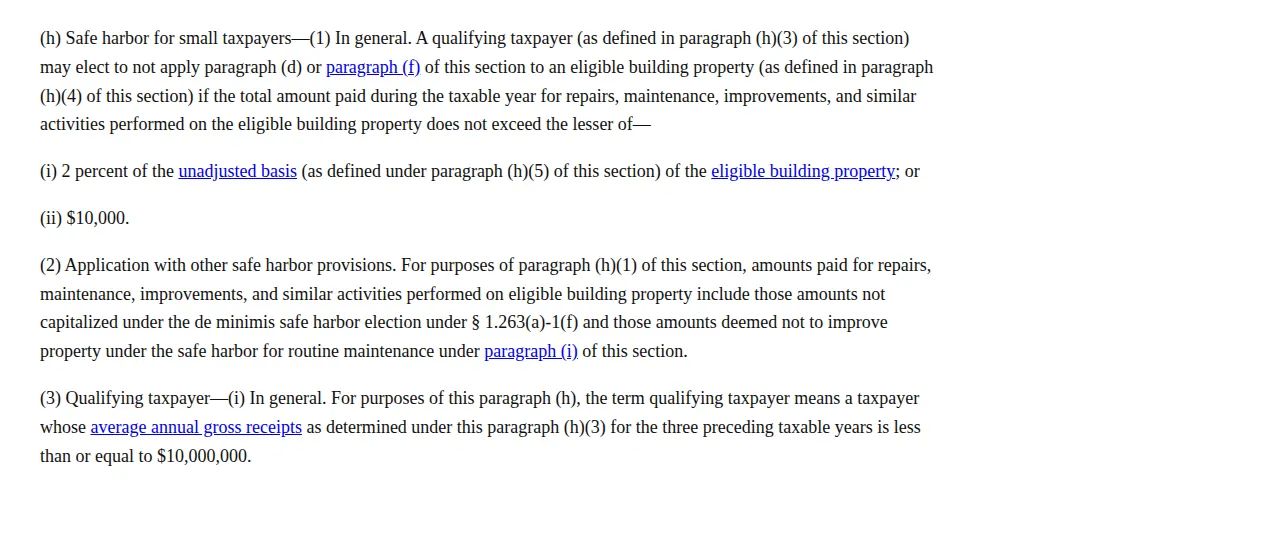
The regulation's own example: an office building with an unadjusted basis of $750,000, $5,500 paid in the year. Two percent of $750,000 is $15,000, so the cap is the lesser of $15,000 and $10,000 — $10,000 — and $5,500 is below it, so the full $5,500 is deductible in year one: $1,155 of tax at 21 percent, $2,035 at 37 percent. Two traps: the cap counts everything paid for the building in the year, including amounts already expensed under the other safe harbors — $9,000 of de minimis items plus a $2,000 repair is $11,000, and the election fails. And the basis is unadjusted basis — original cost, not book value. The formula is the whole safe harbor:
$
\text{Deductible Amount} = \min(\text{Total Spent}, \min(\$10{,}000, 0.02 \times \text{Unadjusted Basis}))
$
> [!TIP]
> Run the test in January: a December dollar can cost February's deduction.
The routine maintenance safe harbor
The third escape is the routine maintenance safe harbor under Treas. Reg. § 1.263(a)-3(i). Amounts paid for routine maintenance do not improve the unit of property. For a building, routine maintenance means recurring activities to keep the building structure or a building system in its ordinarily efficient operating condition — inspection, cleaning, testing, and replacing worn parts with comparable replacement parts — but only if the taxpayer reasonably expects to perform them more than once during the 10-year period beginning when the structure or system is placed in service.
Worked example A: the $48,000 HVAC decision
Take a C-Corp that pays $48,000 to replace a failed HVAC system in its office building with a current-model replacement of the same capacity. A full system replacement replaces a major component of the HVAC system, which under § 1.263(a)-3(k) is a restoration that must be capitalized. A compressor swap is not. Capitalized, it is recovered as 39-year nonresidential real property — $1,230.77 per year. The year-one tax math at 21 percent is the whole lesson:
$
\text{Tax Saved (expense)} = \$48{,}000 \times 0.21 = \$10{,}080
$
$
\text{Tax Saved (capitalize, year 1)} = \frac{\$48{,}000}{39} \times 0.21 = \$1{,}230.77 \times 0.21 = \$258.46
$
The gap is $10,080 minus $258.46, or $9,821.54 of tax saving deferred out of year one. That gap is the baseline without a § 179 election: if the replacement HVAC is qualified real property under § 179(e), the full $48,000 can be expensed in year one, saving $10,080 — subject to the limit and the business-income limit.
Worked example B: six laptops and the $2,500 cliff
Take an S-Corp owner at the 37 percent top individual rate who buys six laptops at $2,400 each — $14,400 total. The business has written accounting procedures expensing property under $2,500, books the laptops as an expense, and attaches the de minimis election statement to its timely filed return. Each laptop is $2,400, under the $2,500 ceiling, so the full $14,400 is deductible in year one: $14,400 times 37 percent, or $5,328.
Capitalized and recovered evenly over five years — a straight-line illustration — the deduction would be $2,880 a year, worth $1,065.60 of tax per year. The year-one gap is $4,262.40.
$
\text{Tax Saved (de minimis)} = \$14{,}400 \times 0.37 = \$5{,}328
$
$
\text{Tax Saved (capitalize, per year)} = \frac{\$14{,}400}{5} \times 0.37 = \$2{,}880 \times 0.37 = \$1{,}065.60
$
Section 179 and bonus depreciation: the third door
Capitalization is not always the end of the story: § 179 and bonus depreciation can pull the deduction back into year one — but only for the right property. For tax years beginning in 2025, the § 179 limit is $2,500,000, phased out above $4,000,000 of § 179 property placed in service, with a $31,300 cap for sport utility vehicles. Bonus depreciation is 100 percent again for qualified property acquired and placed in service after January 19, 2025, under the One Big Beautiful Bill Act — but not for 39-year nonresidential real property. Section 179 is different: at the taxpayer's election, § 179 property includes qualified real property under § 179(e) — qualified improvement property plus roofs, HVAC, fire protection and alarm systems, and security systems for nonresidential real property placed in service after the building was first placed in service. A replacement HVAC system in an existing building can qualify, subject to the $2,500,000 limit and the business-income limit.
A C-Corp buying $60,000 of equipment saves $12,600 in year one under § 179 or 100 percent bonus ($60,000 × 21%), against $1,800.00 per year over seven years — a year-one gap of $10,800. The Section 179 vs bonus depreciation guide runs the full comparison, including the business-income limit. The profit calculator turns the same arithmetic into a margin check: run the after-tax cost through it before signing.
The decision table: expense or capitalize?
| Situation | Treatment | Authority |
| :--- | :--- | :--- |
| Item costs $2,500 or less, election made, procedures in place | Expense, de minimis safe harbor | Treas. Reg. § 1.263(a)-1(f); Notice 2015-82 |
| Building work under the lesser of $10,000 or 2% of basis; receipts ≤$10M; basis ≤$1M | Expense, small-taxpayer safe harbor | Treas. Reg. § 1.263(a)-3(h) |
| Reinforce structure to carry 50% more weight | Capitalize — betterment | Treas. Reg. § 1.263(a)-3(j) |
| Replace an entire HVAC system; rebuild a derelict barn | Capitalize — restoration | Treas. Reg. § 1.263(a)-3(k) |
The execution checklist
1. Fix the unit of property first. Write down the unit — building, HVAC system, machine — before pricing the work.
2. Run the BAR test. For each project over $2,500: betterment, restoration, or adaptation? One yes means capitalize.
3. Check the safe harbors before paying. De minimis election, written procedures, per-item price at or under $2,500; small-taxpayer totals under the cap.
4. Put the election statements on the return. Attach the de minimis statement and, where used, the small-taxpayer election statement to the timely filed original return.
5. Keep the invoice honest. It must show the per-item price, scope of work, and property.
6. Separate improvement from repair on mixed jobs. Get costs broken out line by line.
7. Decide § 179 and bonus before year-end. Confirm the equipment qualifies, the § 179 business-income limit, and a placed-in-service date after January 19, 2025.
8. File the depreciation where it belongs. Capitalized amounts go on Form 4562. Keep the BAR-test memo, invoices, and election statements.
9. Revisit the method when the facts change. Fixing years of wrong treatment is a change in accounting method — Form 3115 and a § 481(a) adjustment, with Rev. Proc. 2015-20 relief for small businesses.
Who should not use this guide
A business with an applicable financial statement uses the $5,000 ceiling, not $2,500 — confirm the election with its CPA. A business under IRS examination should not change its capitalization method mid-examination without advice. A developer under § 263A, a farmer with § 175 soil and water conservation expenditures, and a business claiming research expenditures under § 174 each operate under a different regime — § 263(a)(1) carves those expenditures out, and the Section 174 software capitalization guide covers the research side. Our editorial analysis found the most expensive mistake is a missing election statement, missing procedures, or a missing BAR-test memo.
The capitalization decision is a $9,821.54 decision on a $48,000 invoice, a $4,262.40 decision on six laptops, and a $10,800 decision on a $60,000 machine. Run the BAR test, check the safe harbors, attach the statements. The deduction follows the paperwork.