> [!FOUNDER]
> "Founders watch revenue and wonder why the bank account disagrees. Revenue is a promise with a date on it. Cash is the promise kept. The gap between the two is not bad luck; it is three clocks running at different speeds — how long stock sits, how long customers take to pay, and how long you take to pay suppliers. Measure the three clocks and you stop guessing about runway." — Enow A. Jovial, Founder & Chief Executive Officer
The three clocks behind every cash balance
A B2B company can be profitable on paper and still run out of cash, because profit is recognised when earned and cash arrives when collected. The cash conversion cycle (CCC) closes that gap into a single number: the days between paying for inputs and collecting from customers. A shorter cycle means the same revenue needs less working capital; a longer cycle means growth itself consumes cash, because each new sale parks more money in stock and receivables before any of it returns.
The cycle has three legs, each measured in days:
$
ext{CCC} = ext{DIO} + ext{DSO} - ext{DPO}
$
Days inventory outstanding (DIO) counts how long stock sits before it sells. Days sales outstanding (DSO) counts how long customers take to pay after invoicing. Days payable outstanding (DPO) counts how long the company itself takes to pay suppliers. Inventory and receivables tie cash up, so they add days; payables hold cash longer, so they subtract days. Because of that subtraction, a company that collects faster than it pays can run a negative cycle — customers fund the business instead of the business funding customers.
> [!KEY TAKEAWAY]
> Growth consumes cash in direct proportion to the cycle. At $3,650,000 of annual credit revenue, every 10 days of DSO is $100,000 of cash sitting in receivables. Cut the cycle and growth funds itself; ignore it and every new customer makes the bank balance worse before it makes it better. The financing side is priced in the business line of credit versus term loan versus invoice factoring playbook, which runs all three instruments on the same 25,000 dollar invoice.
The formulas, with nothing hidden
Each leg is an average balance divided by the flow that moves through it, multiplied by 365 days. Use trailing-twelve-month flows and average balances (opening plus closing, divided by two) rather than a single month-end snapshot, because a single month-end balance flatters or punishes the result depending on when the snapshot lands.
$
ext{DSO} = rac{ ext{Average Accounts Receivable (AR)}}{ ext{Annual Credit Revenue}} imes 365
$
$
ext{DIO} = rac{ ext{Average Inventory}}{ ext{Annual Cost of Goods Sold (COGS)}} imes 365
$
$
ext{DPO} = rac{ ext{Average Accounts Payable (AP)}}{ ext{Annual COGS}} imes 365
$
Two measurement traps deserve naming. First, cash sales do not belong in the DSO numerator's flow: dividing receivables by total revenue including cash sales understates DSO and hides a collections problem. Second, a company on a cash basis for tax still tracks receivables for management purposes; the GAAP accrual picture in the cash vs accrual accounting guide is the one that explains why the bank balance lags revenue. The accounts themselves live in the master chart of accounts for SaaS and agencies, where AR, AP, and inventory each get their own control account and their own reconciliation.
Worked example: a $3.65 million B2B operator
Consider an illustrative B2B distributor and services firm — figures chosen to make the arithmetic checkable, not presented as any real company's results. Annual credit revenue is $3,650,000, annual COGS is $1,200,000, average AR is $480,000, average inventory is $150,000, and average AP is $220,000.
$
ext{DSO} = rac{480{,}000}{3{,}650{,}000} imes 365 = 48 ext{ days}
$
$
ext{DIO} = rac{150{,}000}{1{,}200{,}000} imes 365 = 46 ext{ days}
$
$
ext{DPO} = rac{220{,}000}{1{,}200{,}000} imes 365 = 67 ext{ days}
$
$
ext{CCC} = 46 + 48 - 67 = 27 ext{ days}
$
This company waits 27 days between funding its inputs and collecting its sales. Now apply the DSO lever alone: cutting DSO from 48 days to 32 days frees 16 days of receivables.
$
ext{Cash freed} = rac{16}{365} imes 3{,}650{,}000 = $160{,}000
$
That $160,000 is not a forecast or a benchmark. It is the same arithmetic with one input changed, and it is why DSO is usually the first lever a B2B operator pulls: receivables are the largest balance the company controls directly, and the cash released needs no lender, no equity, and no new sale. The same logic in reverse explains why DPO abuse backfires: stretching payables from 67 to 90 days would free a further $75,000 on paper, but only by breaking the terms suppliers priced into the relationship.
The decision table: five levers, priced honestly
| Lever | Effect on CCC | What it costs | Authority / boundary |
| :--- | :--- | :--- | :--- |
| Shorten contractual terms (net 60 to net 30) | DSO falls up to 30 days | Lost deals where the term was the reason the customer signed | Contract terms govern; UCC § 2-310 fills gaps only where parties are silent |
| Invoice on delivery, not month-end | DSO falls by the batching delay, often 5 to 15 days | One process change in billing discipline | UCC § 2-310(d): where goods ship on credit, the credit period runs from shipment |
| Early-payment discount (2/10 net 30) | DSO falls only if customers take it | About 36 percent annualised if every customer takes it | Price the discount as interest before offering it |
| Tighten inventory to demand | DIO falls | Stock-out risk on the fastest-moving lines | DIO only moves if purchasing changes, not if the warehouse merely counts faster |
| Stretch payables past agreed terms | DPO rises on paper | Supplier holds, cash-on-delivery terms, and damaged credit | Breach of the agreed term; the supplier's remedy, not a financing strategy |
When the government is the customer: the 30-day rule that actually exists
Commercial payment terms are a contract question. Federal payment terms are a statute question, and founders selling to agencies should know the difference. Under 31 U.S.C. § 3903(a)(1)(B), where a federal contract sets no specific payment date, the required payment date is 30 days after a proper invoice is received. The same section sets a 15-day accelerated payment goal for small business prime contractors, and requires an agency to return an improper invoice within 7 days with the reasons stated — so a rejected invoice that sits silently for a month is itself a violation of the timetable, not a normal delay.
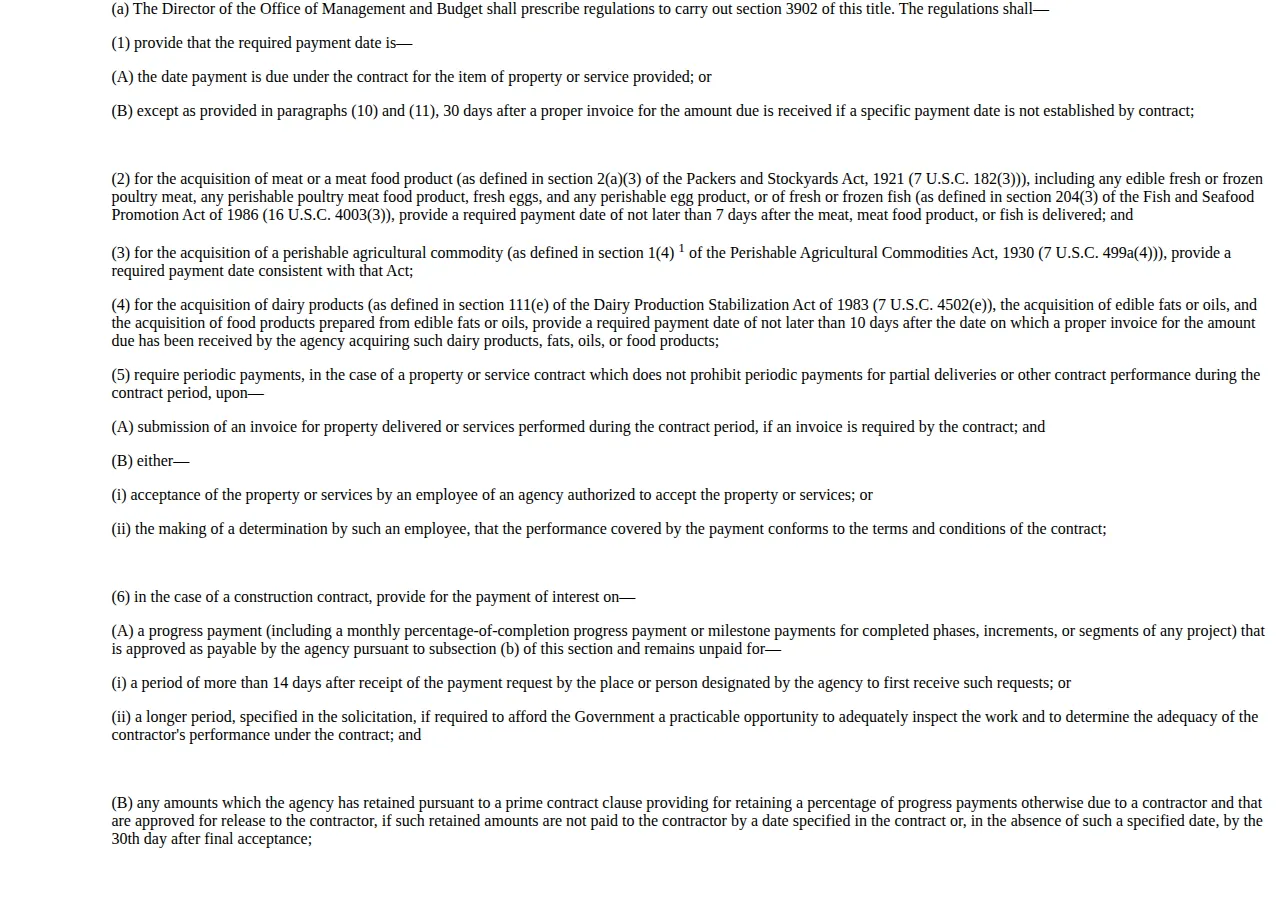
The practical consequence is narrow but real: a federal receivable past 30 days on a proper invoice carries a statutory interest penalty under 31 U.S.C. § 3902, and the contractor does not need to beg for it. The same reasoning does not transfer to commercial customers. If a commercial buyer pays late, the remedies are the contract's late fee, interest clause, suspension right, or collections process — which is why the contract terms in the table above matter more than any general complaint about slow payers.
> [!WARNING]
> Stretching DPO past agreed terms is not a working-capital strategy; it is a breach that suppliers price back into the relationship. The failure mode runs in a fixed sequence: a supplier moves the account to cash on delivery, the next order needs cash before shipment, and the DPO gain reverses in a single cycle while the company still owes the original balance. Treat any DPO target above the contracted term as a renegotiation, documented and signed, or do not set it at all.
Who should NOT chase DSO to zero
A DSO of zero sounds like discipline and behaves like a lost customer base in three cases. First, enterprise customers whose procurement runs on net 60 or net 90 will simply buy from a competitor who accepts their cycle; the sale lost costs more than the 30 days of receivables saved. Second, channel partners who resell into their own customers cannot pay faster than their own collections, so demanding net 15 from a distributor with net 60 receivables pushes the partner into insolvency or into a rival's channel. Third, a company whose product requires customer acceptance testing cannot invoice on shipment in any honest sense — the receivable starts at acceptance, and the DSO clock should too. The operator boundary is therefore a policy, not a slogan: standard terms by customer tier, written down, with exceptions approved by name rather than granted by habit.
The DSO reduction playbook, in order
1. Measure the real DSO first. Pull trailing-twelve-month credit revenue and average AR from the ledger, exclude cash sales, and compute the figure before changing anything. A playbook without a baseline measures enthusiasm, not progress.
2. Split DSO into its three delays. Contract term, invoice lag, and payment lag are three different problems. A company on net 30 with a 48-day DSO has an 18-day collections or invoicing problem, not a terms problem, and renegotiating terms will not fix it.
3. Kill invoice lag. Invoice on delivery or acceptance, every time, with the purchase order number and the delivery evidence attached. Month-end batching hands customers a free 15-day extension and a ready-made dispute about what was delivered.
4. Put the term in the contract, not the invoice footer. UCC Article 2 supplies a default — payment due when the buyer receives the goods — only where the parties are silent. Silence is a choice to let the default and the customer's accounts-payable queue decide. Net 30, net 45, or net 60 belongs in the signed agreement and in the order confirmation.
5. Automate the chase before hiring the chaser. A dunning sequence at 7 days before due, on due date, and at 7 and 14 days past due, with the invoice attached and a payment link in every message, recovers more cash than a monthly phone call round. Move the payment rail to ACH or card where the customer allows it, because a cheque in the post is another 7 days of DSO that no policy can remove.
6. Price discounts as interest. Before offering 2/10 net 30, compute the annualised cost and the take-up rate required to break even on the DSO saved. Offer the discount only to customers whose payment behaviour actually moves, and retire it when the measured DSO stops responding.
7. Escalate on a schedule, not on frustration. At 30 days past due, pause new shipments pending payment or a signed plan; at 60 days, involve a collections agency or counsel; at 90 days, reserve the balance and stop counting it as working capital. A receivable that will never arrive is not an asset, and carrying it as one overstates both liquidity and the cycle's health.
Execution checklist
> [!TIP]
> The cheapest DSO reduction in most B2B companies is not a new term or a new tool; it is invoicing on the day of delivery. Audit ten recent invoices against their delivery dates before buying anything. If the average lag is over 5 days, the invoicing process is the DSO problem, and fixing it costs nothing but discipline.
Related reading on this site: the cash vs accrual accounting guide, which explains why revenue and cash diverge; the master chart of accounts for SaaS and agencies, for the accounts each leg posts into; and the ASC 606 revenue recognition guide, because recognised revenue starts the receivable clock. To price a terms change before signing it, run the numbers through the pricing calculator and the invoice terms through the invoice generator.