The close that eats ten days of every month
A founder closes the books on the 10th of every month, which means the numbers that describe January arrive when February is already a third gone, and every decision in those ten days runs on stale data. The month-end close is the speed at which a business learns what it just did, and a ten-day close is a business learning about itself ten days late.
> [!KEY TAKEAWAY]
> A five-business-day close is a sequencing discipline, not a staffing decision. The same three-person team that closes in ten days can close in five by moving reconciliation work into the month, posting accruals on a fixed calendar, and reviewing variances before the trial balance is final.
Who this guide is for, and who should stop here
This guide is for a founder, controller, or finance lead who runs a monthly close in a United States business and wants it finished in five business days without hiring. It assumes an accrual-basis general ledger (GL), a bank feed, and at least one person who reviews the work of the person who prepared it.
It is not for a business that reports to the SEC on an accelerated timetable without a dedicated close team: public-company deadlines are the outer boundary here, not the target. It is also not for a one-person bookkeeping operation with no reviewer, because a five-day close with no segregation of duties trades speed for control. If one person prepares and approves everything, read our automated bank reconciliation playbook first and fix the control gap before you compress the calendar.
> [!FOUNDER]
> "The close is the one process where slowness compounds. A ten-day close does not cost ten days. It costs ten days of decisions made on last month numbers, twelve times a year. Speed in the close is not about working harder in week two. It is about refusing to let week one pass with nothing reconciled."
> — Enow A. Jovial, Founder & Chief Executive Officer
The calendar math: what five days actually buys
Start with the worked example. Take a three-person finance team working eight-hour days. A ten-business-day close consumes 240 staff-hours per month. A five-business-day close consumes 120. The difference is 120 staff-hours every month, or 1,440 staff-hours a year, freed for analysis, pricing, and collections instead of rework. Those staffing numbers are illustrative assumptions, not a benchmark; the work removed is waiting, rework, and late-arriving inputs, not the reconciliations themselves.
The second number matters more than the first. Five days earlier, twelve times a year, is 60 days of earlier information per year. Ventana Research found the same effect from the other direction: 75 percent of companies that close their quarterly books in one or two days say they receive timely information from their finance organization, compared with 27 percent of those that take seven to ten days and 10 percent of those that take eleven or more days. Speed is not vanity. It is the difference between information and history.
$
\text{Staff-hours per close} = \text{Team size} \times 8 \times \text{Close days}
$
$
\text{Information gained per year} = (10 - 5) \times 12 = 60 \text{ business days}
$
The outer boundary: SEC filing deadlines
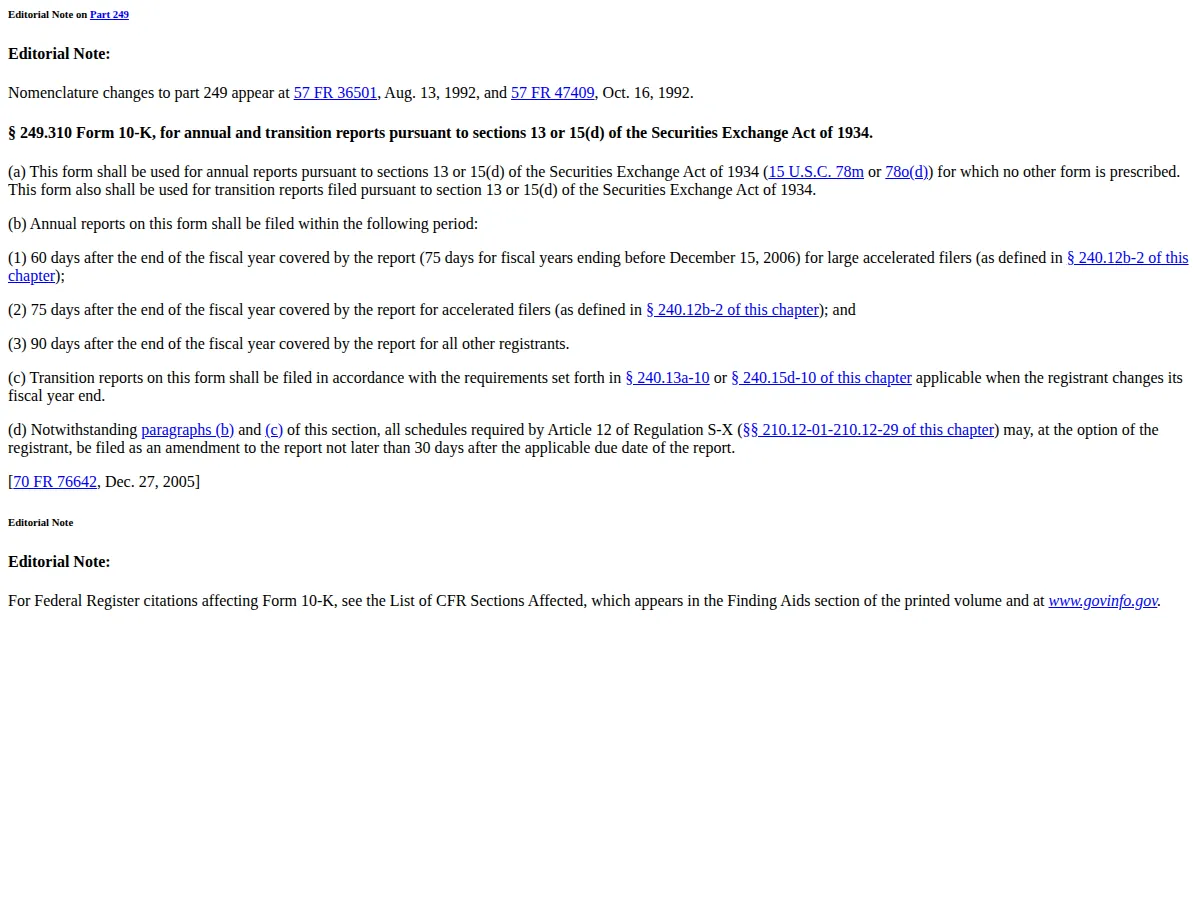
A private company sets its own close calendar, but the public-company deadlines show what the law considers possible. Form 10-K must be filed within 60 days of fiscal year-end for a large accelerated filer, 75 days for an accelerated filer, and 90 days for all other registrants, under 17 CFR 249.310(b). Form 10-Q must be filed within 40 days of quarter-end for large accelerated and accelerated filers and 45 days for all other registrants, under 17 CFR 249.308a. A public company files a fully audited annual report in 60 days. A private company that needs ten days for an unaudited monthly close has a sequencing problem, not a volume problem.
| Report | Large accelerated filer | Accelerated filer | All other registrants | Authority |
| :--- | :--- | :--- | :--- | :--- |
| Form 10-K annual report | 60 days | 75 days | 90 days | 17 CFR 249.310(b) |
| Form 10-Q quarterly report | 40 days | 40 days | 45 days | 17 CFR 249.308a |
SOX 302: the certification that makes the close a control
For public companies, the close is not only a calendar. It is a certification. Under 15 U.S.C. § 7241, the Sarbanes-Oxley Act section 302, the principal executive officer and the principal financial officer must certify in each annual and quarterly report that they are responsible for establishing and maintaining internal controls, that they designed those controls so material information reaches them, and that they evaluated the effectiveness of those controls as of a date within 90 days prior to the report. They must also disclose all significant deficiencies in the design or operation of internal controls.
A private company has no 302 certification to sign, but the discipline transfers directly. The close checklist is the internal control, and a checklist that lives in a spreadsheet on a shared drive, with no named preparer, no named reviewer, and no version control, is not a control. It is a hope. BlackLine puts it plainly: a centralized checklist with real-time visibility solves only part of the problem, because without integration between the checklist and the underlying accounting work, and without certification and approval workflow, segregation of duties, and version control, the close still carries control deficiencies. The five-day close in this guide assigns every task a preparer and a reviewer, and nothing is marked complete until the reviewer signs it.
> [!WARNING]
> A period left unlocked after the close is an open door. Any posting to a closed period rewrites the numbers the management package already reported. Lock the period in the GL on business day 5, and treat any post-lock entry as a prior-period adjustment with a written reason, not a quiet correction.
The five-day close, day by day
The cadence below assumes work begins on the first business day after period-end and that bank feeds, payroll, and supplier invoices arrive on time.
Step 1 — Day 1: cash position and cut-off
1. Confirm all bank and credit card feeds refreshed through period-end. Reconcile every bank account to its statement before anything else. Cash is the anchor.
2. Post final billing and cash receipts, then close accounts receivable (AR) for the period.
3. Post approved vendor invoices and payments, then close accounts payable (AP). Invoices dated after period-end wait for next month. That is what accruals are for.
4. Freeze the sub-ledgers so later work reconciles against a fixed target.
Step 2 — Day 2: accruals, prepayments, and payroll
1. Post accruals for expenses incurred but not yet invoiced. The formula is daily rate times days elapsed:
$
\text{Accrued expense} = \frac{\text{Total cost}}{\text{Days in period}} \times \text{Days elapsed}
$
A 9,000 dollar quarterly insurance premium spread over 90 days accrues 100 dollars per day, so 30 days elapsed in the month means a 3,000 dollar accrual. Reverse prior-month temporary accruals that have now been realized.
2. Roll forward prepaids and release deferred revenue. A 120,000 dollar annual contract releases 10,000 dollars per month.
3. Book payroll and payroll liabilities, tied to tax deposits the same day.
4. Close inventory: count adjustments, cost roll, receiving cut-off.
Step 3 — Day 3: reconciliations and the trial balance
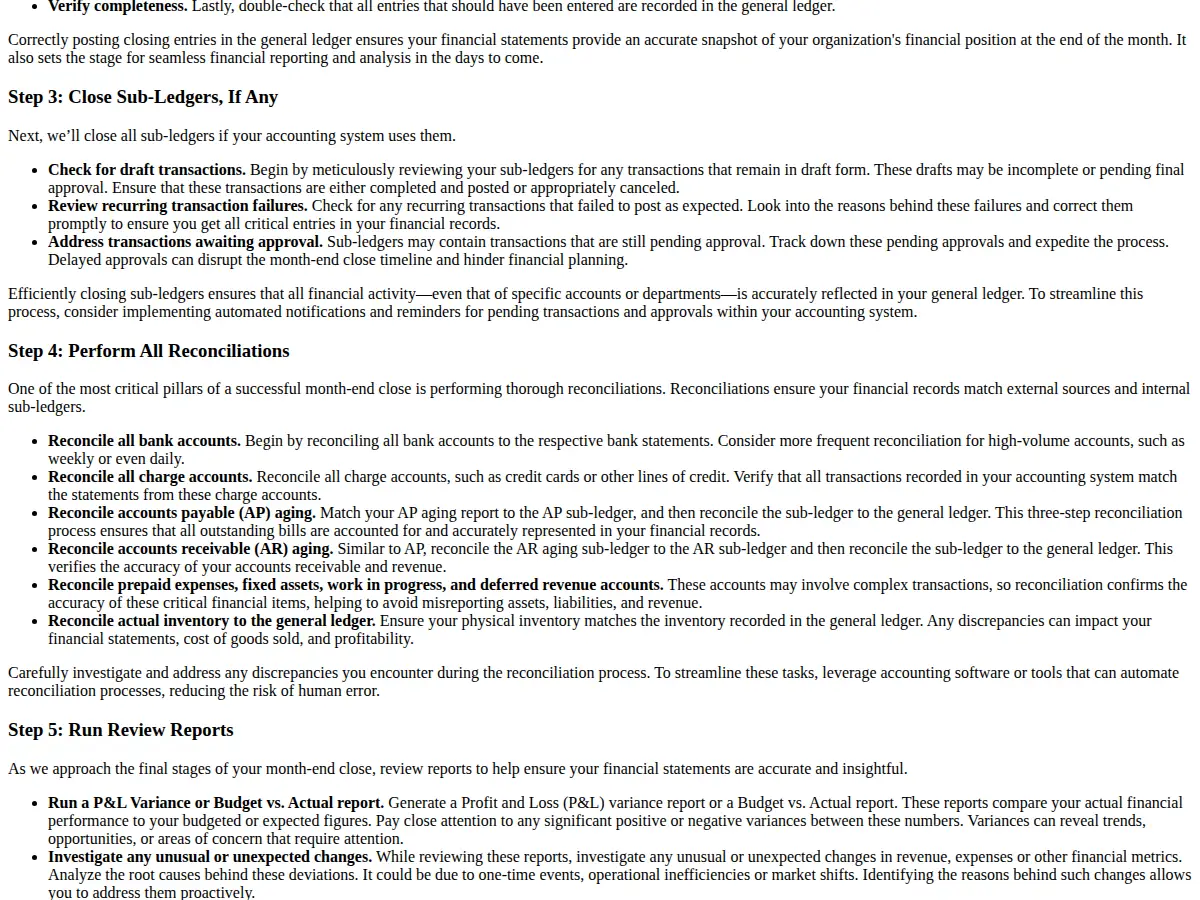
1. Reconcile every balance-sheet account by the decision table below. Work the exceptions, not the matches.
2. Clear the suspense account. Every item in suspense is a transaction nobody has classified, and a balance that grows month over month is a close hiding its errors.
3. Run the preliminary trial balance. Debits must equal credits before review begins. An error found on day 3 is cheap. Found on day 5, it is expensive.
| Account group | Reconciliation method | Frequency | Authority |
| :--- | :--- | :--- | :--- |
| Bank and cash | Statement to GL, all transactions matched | Daily high volume, monthly minimum | FloQast close checklist, Step 4 |
| Charge accounts | Card statement to GL | Monthly | FloQast close checklist, Step 4 |
| AP aging | Aging to sub-ledger to GL | Monthly | FloQast close checklist, Step 4 |
| AR aging | Aging to sub-ledger to GL | Monthly | FloQast close checklist, Step 4 |
| Prepaids, fixed assets, deferred revenue | Rollforward tied to the GL | Monthly | FloQast close checklist, Step 4 |
| Inventory | Count to GL | Monthly | FloQast close checklist, Step 4 |
The software underneath the close is SaaS now. BlackLine, FloQast, and Numeric sit on top of the ERP, pull bank data through an API, and match transactions in SQL before a human sees them. A CPA reviewing the package checks the same GAAP rules the ERP enforces, and the FASB codification is the authority behind the accrual and cut-off judgments in Step 2. Exports still move as CSV files when the API is down, and the IRS forms the close feeds, Form 941 and Form W-2, are filed from the same payroll data the close reconciled.
$
\text{Auto-match rate} = \frac{45}{48} = 93.75\%
$
Step 4 — Day 4: flux analysis and the management package
1. Run flux analysis on the income statement and balance sheet against the prior month and the budget. Flag every account that moves more than the materiality threshold, and write the explanation before anyone asks for it. The operator rule in this guide is the greater of 10,000 dollars or 5 percent of the account balance.
2. Work the example. Revenue of 480,000 dollars against a budget of 450,000 dollars is a 30,000 dollar variance, or 6.7 percent, which clears the 5 percent threshold and requires a written explanation. The threshold is what stops the team from investigating noise and missing signal.
3. Draft the financial statements and the management package: P and L, balance sheet, cash flow, variance commentary.
$
\text{Variance \%} = \frac{\text{Actual} - \text{Budget}}{\text{Budget}} = \frac{480,000 - 450,000}{450,000} = 6.7\%
$
Step 5 — Day 5: review, sign-off, and lock
1. Senior review of the full package. The reviewer is not the preparer, and segregation of duties cannot be waived for speed.
2. Post final adjustments and re-run the trial balance, each adjustment carrying a written reason.
3. Lock the period in the GL. A post-lock entry is a prior-period adjustment, documented and approved.
4. Hold the retrospective: fifteen minutes, one question, what arrived late and who owns fixing it before next month.
Why most closes run long, and what the data says
Ventana Research, in a study published through BlackLine, measured the gap. Only 53 percent of companies complete their monthly close within six business days. Among organizations that automated their reconciliations, 57 percent close their quarterly books within six working days, against 27 percent of those that have not automated. Companies with a single data repository close their quarter on average one day faster. The slow close is not caused by transaction volume. It is caused by manual reconciliation, scattered data, and review that starts too late. Automation of the matching step and a single repository are the two moves with measured effect.
The cash-versus-accrual choice underneath the close matters too. Our cash versus accrual guide works through that trade-off. If you are on the accrual basis, the accruals in Step 2 are not optional work.
When the five-day close fails
Three failure modes cover almost every blown close.
Late inputs. Bank feeds, payroll files, or supplier invoices that arrive on day 3 cannot be reconciled on day 1. The fix is upstream: move the feed refresh to daily and set a vendor invoice cut-off date in writing.
Unposted sub-ledgers. Draft transactions sitting in AR or AP at period-end mean the sub-ledger does not tie to the GL. FloQast lists the check explicitly: review sub-ledgers for draft transactions, check recurring transaction failures, and address transactions awaiting approval before the sub-ledger closes. A recurring entry that failed to post is a missing expense.
Review starting on day 5. If the reviewer first sees the package on the last day, every error found costs a full day. The reviewer should see the trial balance on day 3 and the flux analysis on day 4, so day 5 is sign-off, not discovery.
> [!TIP]
> Move three tasks out of the close entirely. Reconcile high-volume bank accounts weekly, post recurring accruals as auto-reversing entries scheduled before period-end, and run the preliminary trial balance three days before month-end. The close then starts from a trial balance that is already nearly clean, and day 1 is confirmation, not construction.
Who should not run a five-day close
Do not compress the calendar with one person doing the books and no reviewer, because a five-day close without segregation of duties is fast and unverifiable. Do not compress it during an ERP migration or a first audit, because the close will absorb the migration errors and report them as results. Do not compress it if inventory needs a physical count longer than a day, because the count is the constraint and no checklist shortens a warehouse.
The monthly close checklist
The close is a discipline that compounds: a team that closes in five days in January closes in five days in June, and the 60 days of earlier information per year is the return. Start with the calendar, assign every task an owner and a reviewer, and let the first five-day close prove the sequence works. If the close still runs long, the retrospective will tell you which input arrived late. Run the numbers through our break-even calculator when the management package lands, because a close that arrives on day 5 is only useful if the decisions it informs are made on day 6.