Key-Person Insurance and the Buy-Sell Funding Playbook: Who Gets Paid, Who Gets Taxed, and What the Consent Form Is Worth
Harbor & Vale Fabrication LLC makes custom steel assemblies. Three owners: Mara, 40 percent, runs sales; Dev, 35 percent, runs operations — the shop floor, the weld schedule, the suppliers, the two foremen who answer to him alone; Priya, 25 percent, runs finance. Revenue $4.8 million, EBITDA $1.2 million, debt $600,000. Dev is the key person: if he dies on a Tuesday, the weld schedule slips, the foremen take calls from competitors, and the bank asks who runs the floor. Key-person insurance pays the business for the hole he leaves; the buy-sell agreement decides who owns his 35 percent the morning after, and with what money.
The valuation — the agreement fixes the price before anyone dies
Harbor & Vale's agreement fixes the formula: 4.5 times trailing EBITDA less debt.
| Owner | Share | Interest value |
|---|---|---|
| Mara (sales) | 40% | $1,920,000 |
| Dev (operations) | 35% | $1,680,000 |
| Priya (finance) | 25% | $1,200,000 |
| Total | 100% | $4,800,000 |
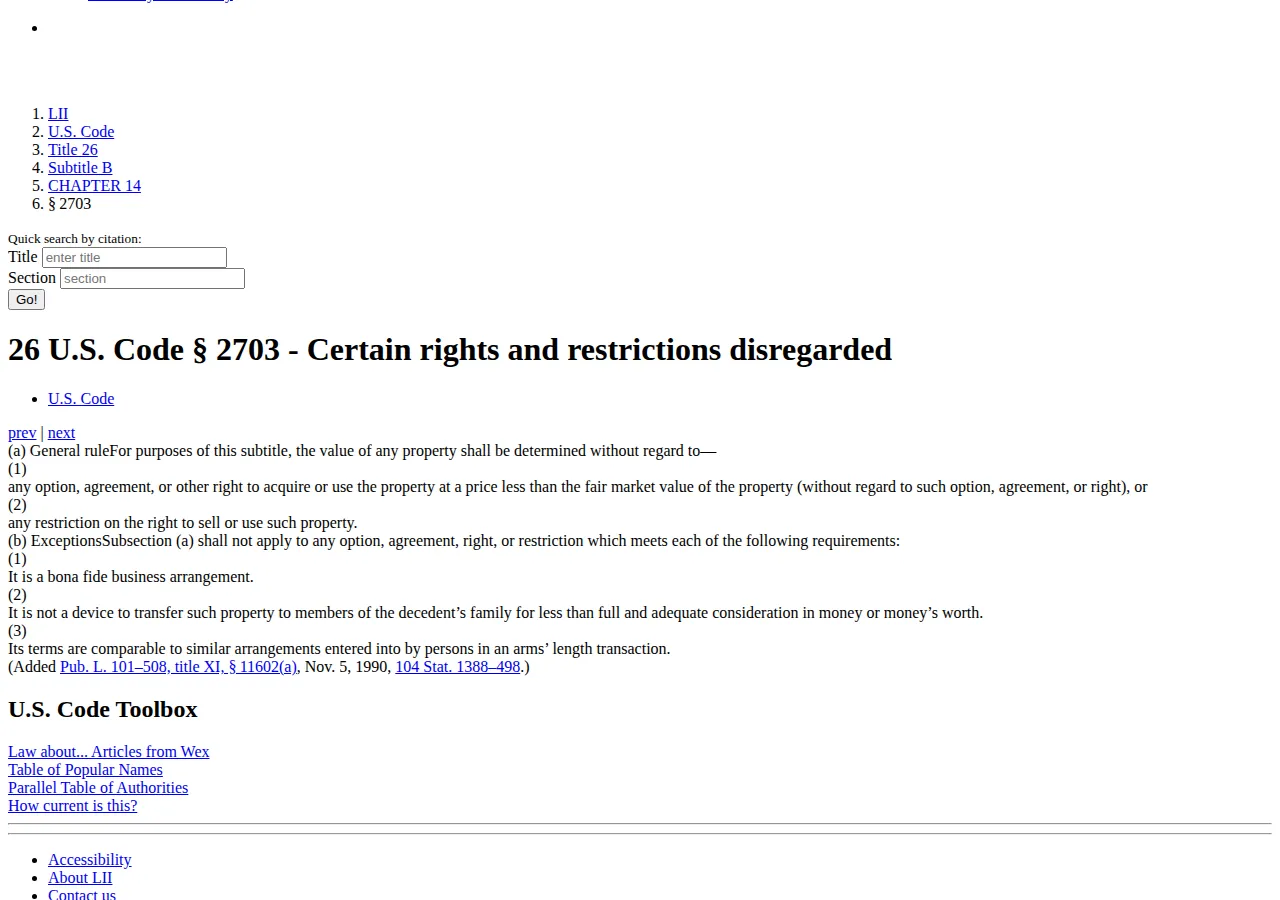
Whether the IRS respects that $4.8 million is governed by § 2703: "the value of any property shall be determined without regard to any option, agreement, or other right to acquire or use the property at a price less than the fair market value of the property." The price is ignored unless it passes § 2703(b)'s three tests: a bona fide business arrangement; not a device to transfer property to the decedent's family for less than full and adequate consideration; and terms comparable to an arm's-length transaction.
A price one owner can change alone fails — the Tax Court disregarded an agreement's price in Estate of Blount partly for that reason, affirmed on appeal — as does a restriction binding during life but not at death, or a first-offer agreement with no enforceable right to buy. Fail § 2703 and the IRS values the interest at fair market value; the difference is a phantom asset.
The key-person policy — $2 million on the person the floor runs through
Dev's key-person policy is $2 million of 20-year level term, owned by the company — 1.67 years of EBITDA, 41.7 percent of revenue, enough for a 12-to-18-month search.
Five independent 2026 agency reads put a healthy 45-year-old male non-smoker at $85–$155 a month per $1 million of 20-year term. This playbook's planning rate is $120 a month per $1 million, the midpoint, and every premium figure below is built on it as a model rate.
Over twenty years the company pays $57,600 for $2 million of coverage — 2.88 percent of the face. Our business interruption insurance comparison covers the sibling risk: the building burns down. The premiums are not deductible — § 264(a)(1) denies any deduction for premiums on a policy "if the taxpayer is directly or indirectly a beneficiary under the policy or contract."
Section 101(j) — the consent form that decides whether $2 million is tax-free
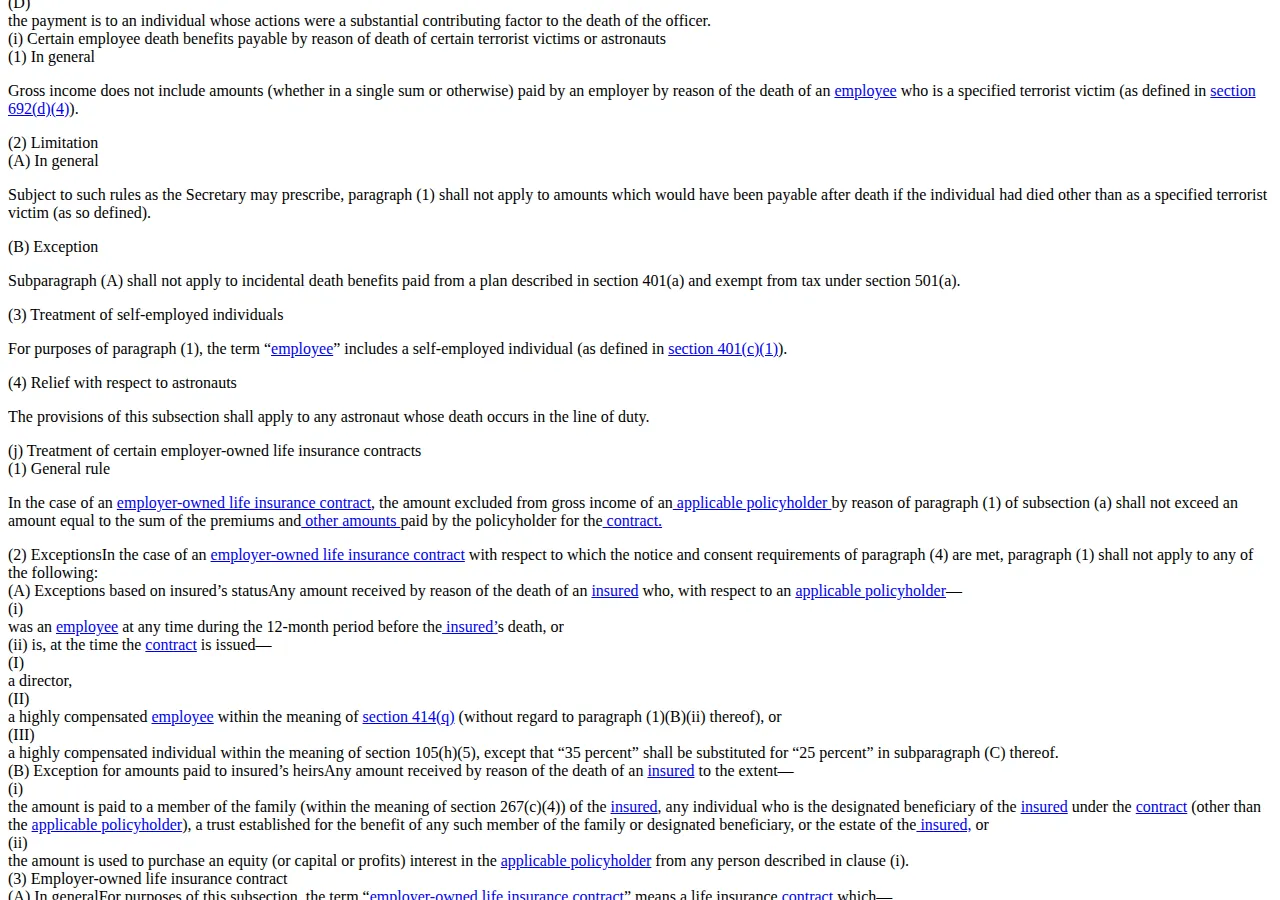
Section 101(a)(1) excludes amounts received "under a life insurance contract, if such amounts are paid by reason of the death of the insured." But § 101(j) (Pension Protection Act of 2006; contracts issued after August 17, 2006) takes most of it back: the exclusion "shall not exceed an amount equal to the sum of the premiums and other amounts paid by the policyholder for the contract."
If Dev dies in year six, 6 × $2,880 = $17,280 in premiums paid — and without notice, consent, and an exception, that is all the company excludes.
The corporate rate is 21 percent under § 11(b). A skipped form costs $416,371.20 — 20.8 percent of the proceeds. Done right, the tax is zero.
Three elements, all required before issuance under § 101(j)(4): written notice of intent to insure and the maximum face amount; written consent to being insured and to coverage continuing after employment; and written notice the employer will be a beneficiary. Under § 101(j)(2) the full benefit is then excluded for an insured who was an employee in the 12 months before death, or a director, highly compensated employee, or highly compensated individual at issuance; and for amounts paid to the insured's family, beneficiary, their trust, or the estate — or used to buy an equity interest from them.
Notice 2009-48 fills in the traps. Q-7: consent is required even for an owner-employee of a wholly-owned company. Q-9: a consent expires — the contract must issue within one year of the consent date or before employment ends. Q-14: a material increase in the death benefit is a new contract, needing consent again. The tax estimator runs the § 101(j) failure math on your own numbers.
The annual filing — Form 8925, every year the policies are in force
Section 6039I requires the policyholder to report employer-owned contracts yearly on Form 8925: line 1, employees at year-end; line 2, the number insured under contracts issued after August 17, 2006; line 3, total insurance in force; line 4a, whether a valid consent exists for each.

Harbor & Vale's filing reads: 15 employees, 3 insured, $4,800,000 in force, line 4a Yes. A "No" on line 4a confesses the exclusion is capped at premiums.
Cross-purchase vs entity redemption — the same $4.8 million, two different tax results
In a redemption the company owns one policy on each owner and buys the dead owner's interest itself; in a cross-purchase each owner owns a policy on every other owner. Coverage is identical; everything else differs.
| Attribute | Entity redemption | Cross-purchase | Authority |
|---|---|---|---|
| Who owns the policies | The company | Each owner, on the others | ACTEC buy-sell guidance |
| Survivors' basis | Unchanged | Stepped up to price paid | § 1012 |
| Estate-tax value (Connelly, 2024) | Proceeds inflate company value | Proceeds are not a company asset | 602 U.S. 257 |
A cross-purchase needs n(n−1) policies — 3 owners need 6, 10 need 90 — while a redemption always needs n.
Under the redemption the company pays $230.40 a month on Mara, $201.60 on Dev, and $144.00 on Priya: $576 a month, $6,912 a year, $138,240 over twenty years, all nondeductible. The cross-purchase splits the same $576 across six policies — Dev $1,120,000 on Mara, $560,000 on Priya; Mara $1,033,846.15 on Dev, $640,000 on Priya; Priya $646,153.85 on Dev, $800,000 on Mara — pro rata to ownership.
The difference that moves money is basis. In a cross-purchase the survivor's basis is what they paid: Dev contributed $140,000; if Mara dies he pays $1,120,000 for part of her interest, and his basis becomes $1,260,000. If the company later sells and Dev's share is $2,500,000, his gain is $1,240,000 — against $2,360,000 under a redemption, where his basis stays at $140,000.
Then there is Connelly. In Connelly v. United States, 602 U.S. 257 (2024), a company held $3.5 million of insurance on each of two brothers to fund a redemption; when Michael died it used $3 million of proceeds to redeem his shares. The estate valued the company at $3.86 million, excluding the proceeds; the IRS at $6.86 million, and assessed $889,914 more tax. Unanimous: a redemption obligation at fair market value is not a liability that reduces the corporation's value.
Apply it to Harbor & Vale: Mara dies, the company receives $1,920,000, equity value becomes $6,720,000, and Mara's 40 percent is valued at $2,688,000 against a $1,920,000 redemption price. The $768,000 gap is a phantom asset: value the estate is taxed on but does not keep.
The 40 percent rate is the top estate-tax rate under § 2001(c). Two honest limits: the $15,000,000 basic exclusion under § 2010(c)(3)(A) shelters most estates outright — see our estate-tax exemption and portability playbook — so the gap is a reporting problem today, a tax problem only past the exemption. Under a cross-purchase the policies are owned by the survivors, the proceeds are never a company asset, and Connelly has nothing to attach to.
Section 264 — what the premiums cost after tax, and the exception that survives
Section 264(a)(1) is short and absolute: no deduction for premiums on a life insurance policy "if the taxpayer is directly or indirectly a beneficiary under the policy or contract." The company pays $2,880 a year on Dev's key-person policy and $6,912 a year on the buy-sell policies from after-tax dollars.
The key-person loan exception in § 264(e)(1): interest on policy loans for a key person is deductible "to the extent that the aggregate amount of such indebtedness with respect to policies and contracts covering such individual does not exceed $50,000." A key person is an officer or 20-percent owner under § 264(e)(3). At a stated 6 percent model loan rate, interest on a $50,000 loan is $3,000 a year and deductible; on a $200,000 loan it is $12,000, of which $9,000 is disallowed.
The disability trigger — the event life insurance does not cover
Disability arrives first — and with no insurance money attached. Harbor & Vale's agreement names disability as a trigger on the same terms as death, funded by a separate buy-out policy on each owner. The elimination period is typically 12 to 24 months — Tokio Marine HCC offers 12- or 24-month periods, two other independent reads agree — and the buyout clock must not mature before the money arrives. If the agreement obliges the company to buy Priya's interest at month six and the policy pays at month twelve, the survivors owe $1,200,000 they do not have.
Priya's interest is $1,200,000. At month twelve the policy pays $1,200,000 as a lump sum or 24 monthly installments of $50,000. Installments are easier on cash flow but have two costs: simple interest at 6 percent on $1,200,000 is $72,000 a year, and Priya's life insurance must stay in force during the payout, because the installments stop if she dies mid-buyout. Our business credit comparison prices the bridge if the clocks ever misalign.
Who this is for — and who should not build it
This playbook is for a closely held company with two to four owners, one person whose absence would cut revenue, and owners who can agree on a valuation formula while everyone is alive and friendly — and that can carry $6,912 a year of premiums and file Form 8925 every year. It is not for a sole owner, whose plan is a key-person policy plus a sale or wind-down — our LLC dissolution playbook covers the wind-down half. It is not for owners who will not sign a valuation formula: an unfunded agreement with no price is worse than no agreement.
Founder & CEO Insight — Enow A. Jovial
Execution checklist
- [x] Fix the price — 4.5× trailing EBITDA less debt, binding on life and at death.
- [x] Choose the structure — cross-purchase for two to four owners; redemption for larger groups, phantom gap calculated.
- [x] Do the consent first — notice of intent and face amount, consent to coverage continuing after employment, notice the company will be a beneficiary — before issuance.
- [x] Buy the policies — $2 million key-person term on Dev at $240 a month; $4.8 million of buy-sell face at $576 a month.
- [x] Fund the disability trigger — buy-out policies on each owner, elimination period set so the money arrives before the buyout clock matures, definition verbatim.
- [x] File Form 8925 every year the contracts are in force; answer line 4a honestly.
- [x] Re-price annually — re-run the valuation, raise face amounts when interests move more than 10 percent, renew consents nearing expiry.
- [x] On a trigger event, run the sequence — file the claim, confirm the § 101(j) exception, receive the proceeds, pay the estate or the disabled owner by the return due date, record the ownership.