A single founder dies in 2026 leaving a $20,000,000 estate: an LLC interest, a house, and an investment account. Under the exclusion in force for 2025, $6,010,000 of that estate would be taxable and the federal bill would be $2,349,800. Under the exclusion in force for 2026, $5,000,000 is taxable and the bill is $1,945,800. One statutory number changed by $1,010,000, and the family's tax fell by $404,000. That number is the basic exclusion amount in section 2010(c)(3) of the Internal Revenue Code, and the One Big Beautiful Bill Act, Public Law 119-21, raised it to $15,000,000 for decedents dying in 2026. This guide runs the statute, the portability election that doubles the number for married couples, the gift-tax side of the same credit, and the filing deadlines that decide whether any of it survives.
What the $15,000,000 exclusion is, in one paragraph
Section 2010 gives every United States citizen or resident a unified credit against the estate tax, and the credit shelters an applicable exclusion amount: the basic exclusion amount plus any deceased spousal unused exclusion amount transferred from a predeceased spouse. Section 2010(c)(3) now states the basic exclusion amount plainly: $15,000,000. The Internal Revenue Service confirmed the figure in Revenue Procedure 2025-32: estates of decedents who die during 2026 have a basic exclusion amount of $15,000,000, up from $13,990,000 for estates of decedents who died in 2025. The increase is permanent. The Tax Cuts and Jobs Act doubling that produced the $13,990,000 figure was scheduled to expire at the end of 2025, cutting the exclusion roughly in half; the One Big Beautiful Bill Act replaced the expiring doubling with a $15,000,000 base that is indexed for inflation in calendar years after 2026, rounded to the nearest $10,000, with 2025 as the base year. There is no reversion date in the statute. The exclusion is unified: lifetime taxable gifts draw down the same $15,000,000, so every dollar of taxable gift made during life is a dollar less of exclusion left at death.
> [!KEY TAKEAWAY]
> The 2026 federal estate-tax exclusion is $15,000,000 per person, $30,000,000 for a married couple that elects portability, and it is permanent and indexed after 2026. The number that matters is not the size of the estate but the taxable estate: gross estate minus the exclusion, taxed at up to 40 percent.
Why it matters
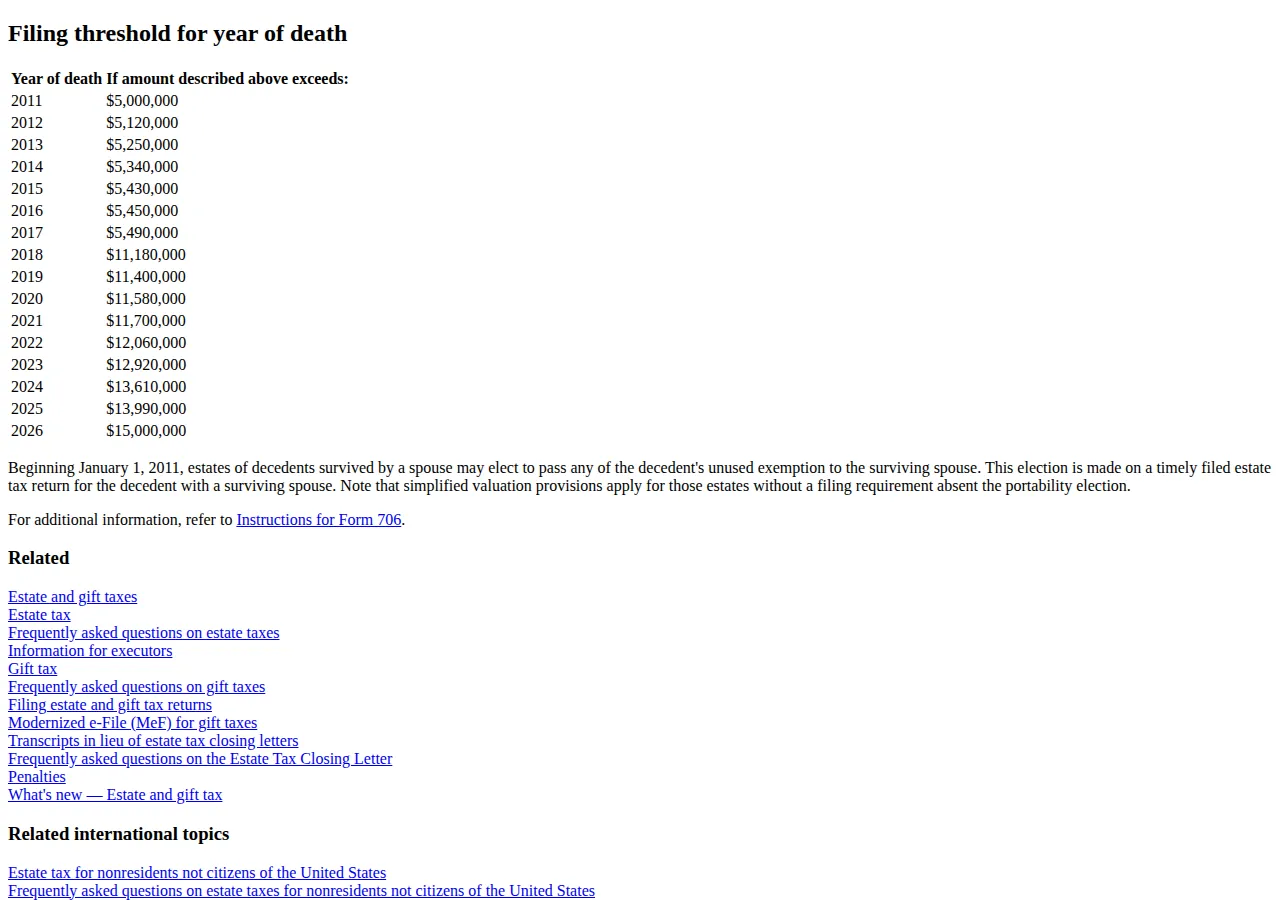
The exclusion decides who files at all. An estate tax return, Form 706, is required only when the gross estate plus adjusted taxable gifts exceeds the filing threshold for the year of death. For a 2026 death that threshold is $15,000,000. A $14,000,000 estate owes no federal estate tax and, in the ordinary case, files no return — but the executor who skips the return also skips the portability election, and the surviving spouse loses the unused half of the couple's exclusion. The exclusion also decides the price of doing nothing: at the 40 percent top rate, every $1,000,000 of estate above the exclusion costs $400,000 in tax. For a founder whose business is the estate, the exclusion is the difference between the heirs keeping the company and selling it to pay the tax. And because the exclusion is unified with the gift tax, the same $15,000,000 governs lifetime transfers: a founder who gifts $5,000,000 of business interests during life has $10,000,000 of exclusion left at death, not $15,000,000.
> [!FOUNDER]
> "A $15,000,000 exclusion is not a reason to skip the planning. It is the reason to do it now, while the number is permanent and the portability election costs one return. The families that lose money under this law are not the ones over the line — they are the ones under it who never filed." — Enow A. Jovial, Founder & Chief Executive Officer
The exclusion, year by year
| Tax year | Basic exclusion amount | Filing threshold | Authority |
| :--- | :--- | :--- | :--- |
| 2025 | $13,990,000 | $13,990,000 | Rev. Proc. 2025-32 |
| 2026 | $15,000,000 | $15,000,000 | 26 U.S.C. section 2010(c)(3); Rev. Proc. 2025-32 |
| After 2026 | $15,000,000, indexed to inflation | Indexed amount | 26 U.S.C. section 2010(c)(3)(B) |
| Authority | 26 U.S.C. section 2010(c)(3)(A) | IRS estate-tax filing table | 26 U.S.C. section 2010 |
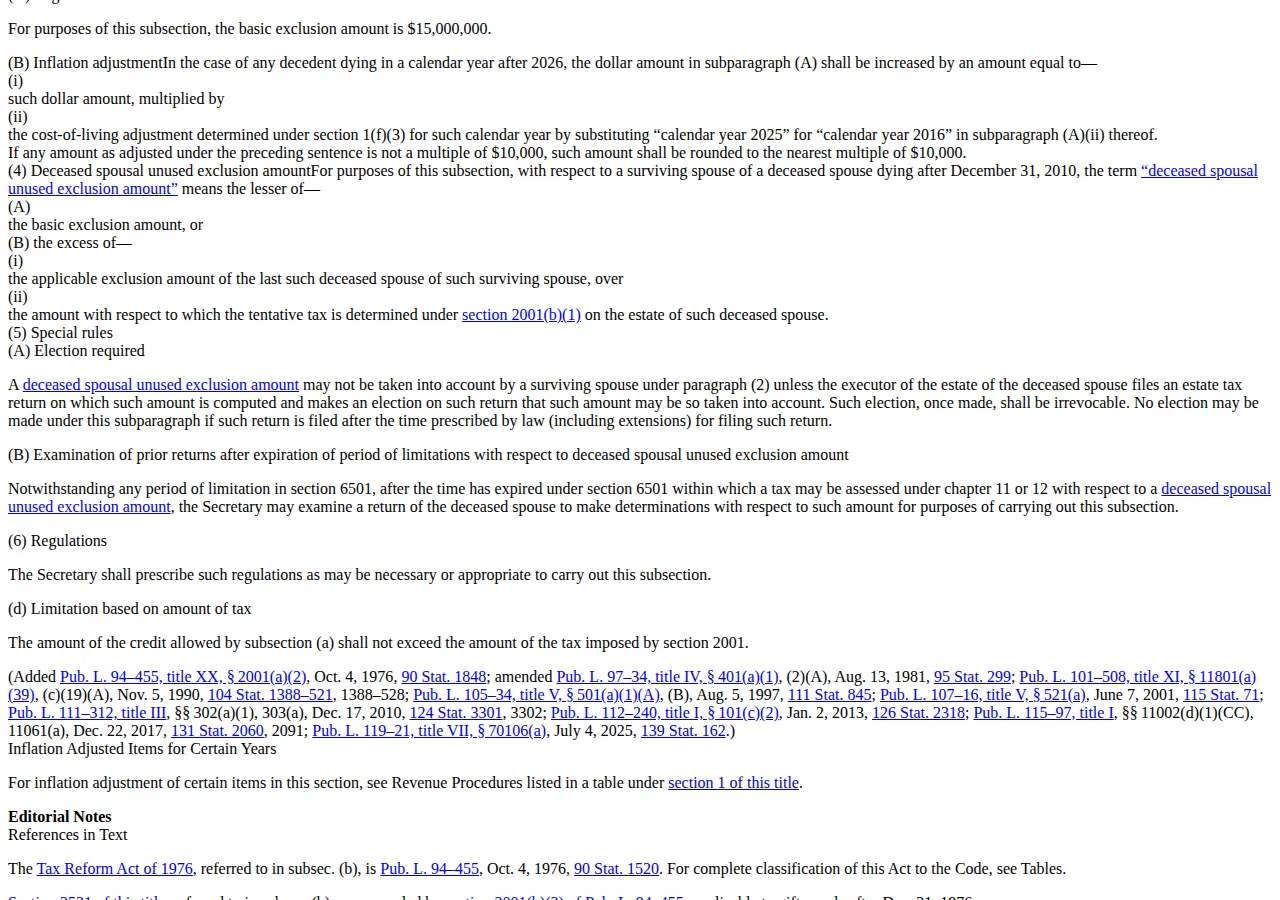
The 2025-to-2026 increase is $1,010,000. At the 40 percent top rate, that increase alone is worth $404,000 of tax on an estate above the line. The inflation adjustment after 2026 uses the cost-of-living adjustment under section 1(f)(3) with 2025 as the base year, and the adjusted amount is rounded to the nearest $10,000 — so the exclusion will creep upward in $10,000 steps rather than jumping.
The worked estate: $20,000,000, single, 2026
The estate tax is computed on the taxable estate: gross estate, minus deductions, minus the applicable exclusion amount. The rate schedule in section 2001(c) reaches 40 percent above $1,000,000 of taxable estate, and the tax on the first $1,000,000 is $345,800:
$
\text{Tax} = \$345,800 + 0.40 \times (\text{Taxable estate} - \$1,000,000)
$
For the $20,000,000 estate of a single decedent in 2026:
| Step | 2025 exclusion | 2026 exclusion |
| :--- | :--- | :--- |
| Gross estate | $20,000,000 | $20,000,000 |
| Less basic exclusion | $13,990,000 | $15,000,000 |
| Taxable estate | $6,010,000 | $5,000,000 |
| Tax: $345,800 + 40% of excess over $1,000,000 | $345,800 + $2,004,000 = $2,349,800 | $345,800 + $1,600,000 = $1,945,800 |
| Authority | 26 U.S.C. sections 2001(c), 2010(c) | 26 U.S.C. sections 2001(c), 2010(c) |
The $404,000 saving is exactly 40 percent of the $1,010,000 exclusion increase — the internal check that the table and the statute agree. The same arithmetic cuts the other way: a $20,000,000 estate with no planning and a 2025 death paid $2,349,800. Deductions sit on top of the exclusion: debts, administration expenses, and charitable bequests reduce the gross estate before the exclusion applies, and the unlimited marital deduction under section 2056 shelters everything passing to a citizen spouse outright. The estate assumes no marital deduction and no charitable bequests, so the exclusion does all the work.
Portability: the $30,000,000 couple
Portability is the second half of the exclusion, and it is an election, not an automatic right. Section 2010(c)(2) defines the applicable exclusion amount as the basic exclusion amount plus the deceased spousal unused exclusion amount, the DSUE. Section 2010(c)(4) defines the DSUE as the lesser of the basic exclusion amount or the deceased spouse's unused exclusion: the spouse's applicable exclusion minus the amount on which tentative tax was determined for that spouse's estate. The formula:
$
\text{DSUE} = \min(\text{Basic exclusion}, \text{Deceased spouse's exclusion} - \text{Deceased spouse's taxable estate})
$
$
\text{Survivor's exclusion} = \$15,000,000 + \text{DSUE}
$
Case study: the first spouse dies in 2026 with a $9,000,000 estate and no lifetime taxable gifts. The DSUE is $15,000,000 minus $9,000,000, which is $6,000,000. The surviving spouse's applicable exclusion becomes $15,000,000 plus $6,000,000, or $21,000,000. The couple shelters $30,000,000 between the two deaths — $9,000,000 at the first death and $21,000,000 at the second — against $15,000,000 for a single person with no portability. The DSUE is capped at the basic exclusion amount, so a first spouse who uses none of the exclusion transfers the full $15,000,000, and a first spouse who uses all of it transfers nothing.
> [!WARNING]
> Portability is lost if the executor does not elect it. Section 2010(c)(5)(A) requires the executor to file an estate tax return on which the DSUE amount is computed and to make the election on that return, and the election is irrevocable once made. No election may be made on a return filed after the time prescribed by law, including extensions. An estate below the filing threshold must still file Form 706 to elect portability — the return that is not otherwise required is the one that saves the surviving spouse up to $6,000,000 of tax.
The return is due nine months after the date of death, and the estate may request an automatic six-month extension by filing Form 4768 on or before the due date. For estates with no filing requirement that missed the deadline, Revenue Procedure 2022-32 provides a simplified method to obtain an extension: file a complete and properly prepared Form 706 on or before the fifth anniversary of the decedent's date of death, with the notation "FILED PURSUANT TO REV. PROC. 2022-32 TO ELECT PORTABILITY UNDER SECTION 2010(c)(5)(A)", and no user fee is required. The relief is available only when the estate had no filing requirement independent of the portability election; an estate above the threshold that files late has no simplified relief and must request a letter ruling.
The gift side of the same $15,000,000
The exclusion is unified across the gift tax and the estate tax under sections 2505 and 2010. A taxable gift during life consumes exclusion that would otherwise shelter the estate, and the gift tax is computed on cumulative lifetime taxable gifts. The annual exclusion is separate and does not consume the lifetime exclusion: for 2026, the annual exclusion for gifts is $19,000 per donee, and the annual exclusion for gifts to a spouse who is not a United States citizen is $194,000, both confirmed in Revenue Procedure 2025-32. A founder who gives $19,000 a year to each of three children moves $57,000 a year out of the estate without touching the $15,000,000. A $5,000,000 taxable gift of business interests, by contrast, leaves $10,000,000 of exclusion for the estate. The generation-skipping transfer tax shares the same number: section 2631 sets the GST exemption amount equal to the basic exclusion amount under section 2010(c), so the 2026 GST exemption is also $15,000,000. The filing mechanics differ — gifts go on Form 709, estates on Form 706 — but the credit is one pool.
!The IRS estate-tax filing threshold table, showing $13,990,000 for 2025 and $15,000,000 for 2026
Who should NOT plan on the exclusion alone
The exclusion is generous, but it does not cover everyone, and the gaps are where the tax falls. A nonresident alien decedent gets a unified credit of $13,000 under section 2102(b)(1), which shelters $60,000 of United States-situated estate — not $15,000,000 — unless a treaty provides otherwise. A surviving spouse who is not a United States citizen gets no unlimited marital deduction; the $194,000 annual exclusion for gifts to a noncitizen spouse is the substitute, and a qualified domestic trust is the usual vehicle for the balance. An estate that holds a closely held business at a valuation the IRS disputes can find the exclusion consumed by an appraisal the family never budgeted for, which is why the valuation date and the appraisal record matter. And an estate that owns foreign-situated assets or a foreign entity faces the section 2101 situs rules on top of the domestic exclusion. The exclusion also does nothing for state estate tax: a dozen states impose their own estate or inheritance tax with exclusions far below $15,000,000, and the federal return does not pay them.
Decision table
| Situation | Applicable exclusion | The move that matters | Authority |
| :--- | :--- | :--- | :--- |
| Single, $20,000,000 estate, 2026 death | $15,000,000; tax $1,945,800 | Use the full exclusion; lifetime gifts reduce it dollar for dollar | 26 U.S.C. sections 2001(c), 2010(c)(3) |
| Married, first spouse $9,000,000 estate | Survivor $21,000,000 after DSUE | File Form 706 and elect portability even though no tax is due | 26 U.S.C. section 2010(c)(2), (4), (5) |
| Married, first spouse used the full exclusion | Survivor $15,000,000; DSUE $0 | Portability transfers nothing; plan with lifetime gifts and trusts instead | 26 U.S.C. section 2010(c)(4) |
| Noncitizen surviving spouse | No unlimited marital deduction | Use the $194,000 annual exclusion and a qualified domestic trust | 26 U.S.C. sections 2056(d), 2523(i) |
| Nonresident alien decedent | $13,000 credit, sheltering $60,000 | Treaty relief is the only route to a larger credit | 26 U.S.C. section 2102(b)(1) |
| Grandchildren as beneficiaries | $15,000,000 GST exemption | Allocate the GST exemption on Form 706; it equals the basic exclusion | 26 U.S.C. section 2631 |
The filing checklist
> [!TIP]
> File Form 706 for the first spouse even when the estate is far below $15,000,000. The return costs an appraisal, a CPA review, and a filing; the portability election it carries is worth up to $6,000,000 of exclusion to the survivor, and Revenue Procedure 2022-32 gives five years to fix a missed election only when the estate had no filing requirement. The cheapest estate-tax return a family ever files is the one that owes no tax.
What this guide does not do
This guide states the federal statute and the IRS figures as published for 2026. It does not value a business, choose a trust, or decide whether a lifetime gift beats a testamentary transfer — those turns on the appraisal, the basis step-up under section 1014, and the family's state tax. The SALT cap $40,000 playbook runs the other side of the same household return: how the $40,000 state-and-local-tax cap and its $500,000 phase-down change the itemized total. The section 199A QBI deduction playbook prices the 20 percent deduction that decides how much of a pass-through business's income is taxed at all. And the Schedule C playbook runs the self-employed return that feeds the estate's income in the years before death. For the numbers behind the exclusion, run the tax estimator and confirm the filing threshold for the year of death against the IRS estate-tax table before the executor signs the return.