Business Interruption Insurance: What It Pays, the Coinsurance Trap, and the Claim File
A fire closes a bakery for 90 days. Property insurance rebuilds the ovens and repairs the roof. Nothing in the property policy pays the rent while the doors are closed, the loan, the taxes, or the payroll for the bakers you want to keep. That gap is what business interruption insurance closes — business income coverage. It pays the income the business would have earned, plus the expenses that keep running, until the business is restored.
What it pays — net income plus continuing expenses
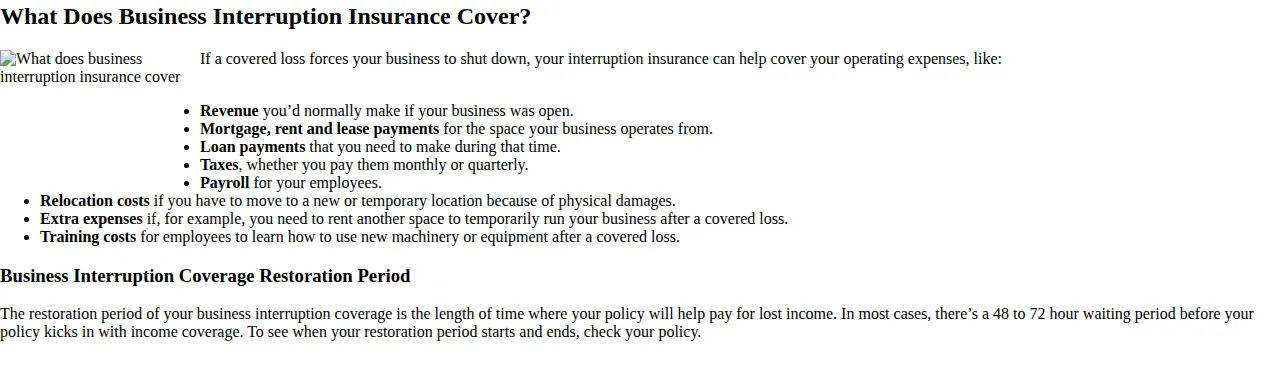
The Insurance Information Institute defines it plainly: business income coverage helps with operating expenses during the period of restoration, and it includes lost net income based on financial records, mortgage, rent and lease payments, loan payments, taxes, and employee payroll. The Hartford adds relocation costs and extra expenses such as renting temporary space.
The trigger matters as much as the list: a claim needs direct physical damage to the property from a covered peril. The coverage pays the income the operation would have produced if the loss had not happened:
Continuing expenses are the costs that do not stop when the doors close: rent, loan payments, taxes, premiums, and payroll for the people you keep. Expenses that stop — ingredients, hourly wages, shipping — are saved expenses the insurer subtracts.
Worked example — the 12-month worksheet
The limit is set from a business income worksheet, the CP 15 15 Business Income Report/Worksheet in ISO form language. It projects the next 12 months of net income and continuing operating expenses. Take Riverside Bakery:
| Worksheet line | 12-month projection |
|---|---|
| Net income (before income taxes) | $96,000 |
| Payroll for retained staff | $180,000 |
| Rent | $48,000 |
| Loan payments | $24,000 |
| Taxes | $12,000 |
| Continuing operating expenses | $264,000 |
| Business income value | $360,000 |
A 12-month indemnity needs a $360,000 limit. The insurer measures the claim against the same two numbers, so a worksheet built from last year's tax return and this year's budget later proves the loss. Update it every year.
The indemnity period — how long the money runs
The period of restoration is the time the policy pays lost income and extra expenses while the business is restored. The Insurance Information Institute states the standard property policy limits it to 30 days, extendable to 360 days by endorsement. Thirty days covers a burst pipe; a fire that guts a kitchen takes months — permits, bids, lead times, inspection. Pick the period from the rebuild, not from the premium.
Two clocks run inside the period. The waiting period — typically 48 to 72 hours — pays nothing; business income coverage usually has no dollar deductible, so the waiting period is the deductible, measured in time. The period ends when the property should be repaired, rebuilt, or replaced with reasonable speed and similar quality; it does not end when the policy expires.
Worked example — the same bakery, closed 90 days by fire. Monthly business income is $30,000 ($8,000 net income plus $22,000 continuing expenses), or $1,000 a day; extra expense is $4,500 a month for a temporary stall.
The three waiting-period days cost $3,000 — the policy never pays them. The $100,500 total sits well inside the $360,000 limit. Stretch the closure to 12 months and the same daily rate needs the full $360,000, plus extra expense.
The coinsurance trap — the penalty for a low limit
The ISO forms CP 00 30 and CP 00 32 carry a coinsurance condition: the policy states a coinsurance percentage — 50 percent is the minimum — and the required amount is that percentage times the business income value. Carry less and the insurer pays only the ratio of what you carried to what was required, applied to the loss:
Rough Notes works the textbook case, Poppy's Pop Sticks: projected annual income and expenses of $200,000, a 50 percent requirement, an $80,000 limit carried, and a $50,000 loss when a tornado closes the plant for three months:
Poppy absorbs a $10,000 shortfall — 20 percent of the claim gone because the limit was 20 percent light.
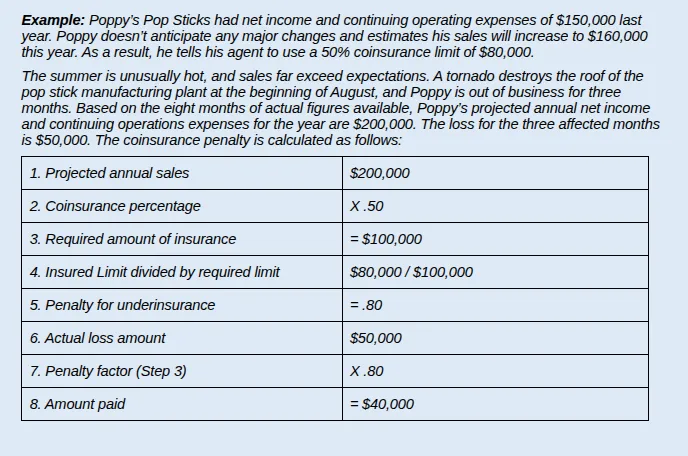 The penalty applies even when the loss is far below the limit: the ratio, not the size of the loss, decides the payment. Growth is the usual cause: the projected value rose over the summer and the January limit no longer met the requirement by August.
Three options remove the coinsurance condition — all chosen at purchase, not at claim time:
| Option | How it works | Coinsurance? | Authority |
|---|---|---|---|
| Coinsurance | Carry the stated percentage of the 12-month value | Yes, 50% minimum | ISO CP 00 30 |
| Agreed value | Agree the value in advance; no penalty at the agreed amount | Suspended 12 months | ISO CP 00 30 |
| Maximum period of indemnity | Choose a limit for a stated number of months | Removed | ISO CP 00 30 |
| Monthly limit of indemnity | A fraction of the total — 1/3, 1/4, or 1/6 — paid monthly | Removed | ISO CP 00 30 |
Agreed value carries a 10 percent surcharge and needs the worksheet every year. Any of the three beats discovering the penalty in the adjuster's letter.
Extra expense — the money that shortens the closure
Extra expense coverage pays the costs beyond normal operating expenses that are necessary to keep the business running or to reopen sooner: renting a temporary location, leasing replacement equipment, paying overtime, hiring extra staff, expediting shipping. The test is necessity: the expense must avoid or minimize the suspension. A standalone extra expense form uses a cumulative percentage schedule — 40 percent of the limit within 30 days, 80 percent within 60 days, 100 percent beyond 60 days. Inside the CP 00 30 form, extra expense is bundled with business income and begins immediately. Keep every receipt: extra expense is paid from invoices, not from estimates.
Civil authority and ingress/egress — when the damage is next door
Sometimes the building is fine and the street is closed. Civil authority coverage, inside the ISO CP 00 30 form, pays business income and extra expense when a government order prohibits access because of physical damage to other property from a covered peril. Three conditions must all hold: the damage is to property other than the insured's, the damaged property is within one mile, and a civil authority order prohibits access. Business income begins 72 hours after the order, extra expense immediately, and the benefit runs at most four consecutive weeks under the standard form. Some carriers write it shorter — typically two weeks — so the declarations page states the number that applies.
Ingress and egress coverage is the related provision for blocked access without a formal order — a washed-out road, a collapsed bridge. It is not standard on every form, so check the endorsements. A curfew imposed for reasons unrelated to the nearby property loss does not trigger civil authority coverage.
Contingent business interruption — when the supplier burns
Contingent business interruption, also called dependent properties coverage, pays when damage to property the business does not own reduces or ends its earnings. The Insurance Information Institute lists four kinds: suppliers of the parts, materials, or services needed to operate; buyers, including a sole buyer; providers, a manufacturing location that makes products for the insured's customers; and drivers, or leader locations — anchor stores and venues that draw customers to the area. A bakery whose only flour mill burns down loses income with no damage to its own building; contingent coverage is the only provision that responds. It is an endorsement, priced on the dependency.
BOP vs standalone vs endorsement — three ways to buy it
Most small businesses buy business income coverage inside a business owner's policy. A BOP bundles commercial property, general liability, and business income in one package, and the Insurance Information Institute states it is generally less expensive than buying the coverages separately. Candidates are normally companies with 100 employees or fewer and revenues of up to about $5 million; some, such as restaurants, may be ineligible and must buy coverages separately. The liability leg is general liability — see our liability comparison for how it differs from professional liability and cyber.
The second route is a standalone commercial property policy with a business income endorsement — for businesses too large or too risky for a BOP, or that need a longer indemnity period. The third is an endorsement added to an existing property policy. All three buy the same coverage; they differ in limits, indemnity period, and whether coinsurance applies. The form number — CP 00 30 with extra expense, CP 00 32 without — tells you which one you hold.
What it does not cover
Business interruption insurance does not cover flood or earthquake damage, which need separate policies — and if the property policy excludes flood, the business income coverage does not pay for a flood displacement either. It does not cover pandemics, viruses, or communicable diseases such as COVID-19; the standard exclusions also list bacteria and nuclear accidents. It does not cover undocumented income: cash sales never recorded are income the insurer cannot see and will not pay. It does not cover utilities as a rule — an offsite power outage is a standard exclusion — though a utility services endorsement extends coverage to a suspension from disrupted electric, gas, or water service. It does not cover broken items from a covered event, such as glass: the property policy handles the glass.
The boundary — property pays to rebuild, income pays the lost months
Property insurance pays to repair or replace the building and equipment. Business interruption insurance pays the income the business would have earned while the building could not be used, plus the expenses that continued. One rebuilds the asset; the other carries the business through the rebuild. Neither replaces the other.
The claim — proved from the books
A business interruption claim is an accounting exercise with an insurance wrapper, won or lost on documentation. Notify the carrier promptly — filing deadlines run from the loss, and the proof of loss is a signed, sworn statement due within a stated time. The calculation forensic accountants use:
Worked example — the bakery again, over the same 90 days: revenue would have been $150,000 without the fire, actual revenue was $30,000, and saved variable expenses were $30,000:
The $90,000 is the lost business income for the period — the same gross loss the earlier example computed — before the waiting period and the limit are applied. The documents that support it are: tax returns for two to three years; monthly profit-and-loss statements for the 12 to 24 months before the loss and for the loss period; bank statements; sales records; payroll records; receipts for every extra expense; and a dated log of the repair timeline — permits, bids, equipment lead times — which proves the length of the restoration period. Name the entity on the claim: an S-Corp files Form 1120-S, a C-Corp files Form 1120, an LLC files with its owner's return or on its own form, by election, each under the business EIN. Saved expenses are mostly COGS — the ingredients and materials not bought while closed — split on the P&L from continuing payroll and FICA taxes, and a CPA should assemble the file. Run the closure math on your own figures first with the break-even calculator.
Founder & CEO Insight — Enow A. Jovial
Execution checklist
- Complete the worksheet: 12 months of net income plus continuing expenses — that sum is the 12-month limit.
- Choose the indemnity period from the rebuild time: 30 days standard, extendable to 360 days.
- Confirm the coinsurance percentage and recheck the limit every year after growth.
- Consider agreed value, maximum period, or monthly limit to remove the coinsurance penalty.
- Note the 48 to 72 hour waiting period; budget for the unpaid days.
- Add civil authority and ingress/egress coverage; check the window.
- List the top three dependent properties; price contingent coverage on them.
- Add a utility services endorsement if an offsite outage would close you.
- Keep 12 to 24 months of profit-and-loss statements, tax returns, and bank statements ready.
- Name the claim filer in the operating agreement — see our operating agreement breakdown — and notify the carrier the day of the loss.