The invoice that pays payroll, six weeks late
A B2B founder finishes a 25,000 dollar job on net 60 terms and payroll lands on Friday. The work is done, the customer is good for it, and the cash is still 45 days away. Three instruments buy the time between the invoice and the money: a revolving line of credit, a term loan, and invoice factoring. They are not interchangeable: one charges interest only on what you draw, one amortises a lump sum, and one sells the invoice at a discount.
> [!KEY TAKEAWAY]
> A line of credit is the cheapest way to bridge a known, short gap. A term loan is the cheapest way to fund a known, one-time purchase. Factoring is the most expensive way to get cash fast, and it earns that price only when the receivable is large, the customer is slow, and no cheaper instrument will underwrite the business.
Who this guide is for, and who should stop here
This guide is for a founder, CFO, or finance lead of a United States B2B business with receivables on net 30 to net 90 terms, annual revenue between roughly 250,000 and 10,000,000 dollars, and a specific cash need with a known date. It assumes an EIN, a business bank account, and books that can produce an AR aging report on demand. The worked examples use a 25,000 dollar invoice, a 60,000 dollar draw, and a 120,000 dollar loan.
It is not for a pre-revenue startup with no receivables and no operating history: no lender here underwrites a business with nothing to collect against. It is also not for a business that needs more than 5,000,000 dollars, the statutory ceiling of the SBA 7(a) program.
> [!FOUNDER]
> "Every founder learns the same lesson once: revenue is not cash, and the gap between the two is where businesses die. The financing decision is never about the rate on the landing page. It is about how many days you need the money for, and what you pledge to get it."
> — Enow A. Jovial, Founder & Chief Executive Officer
The three instruments, defined
| Instrument | What you get | What you pledge | How you repay |
| :--- | :--- | :--- | :--- | :--- |
| Business line of credit | A revolving limit, drawn as needed | Usually unsecured at small sizes; a general lien at larger ones | Interest only on the drawn balance, monthly |
| Term loan | A lump sum up front | A general lien on business assets; often a personal guarantee | Fixed monthly payments of principal and interest |
| Invoice factoring | An advance on a specific invoice, usually 80 to 90 percent of face value | The invoice itself, assigned to the factor | The customer pays the factor; the reserve releases minus the fee |
A line replenishes as you repay it; a term loan does not. Factoring creates no debt: it converts the receivable into cash at a discount, which is why it is available to businesses that cannot borrow. That distinction is the whole guide.
The cash conversion cycle is the frame that decides whether you need financing at all: cutting DSO from 48 days to 32 days frees 16 days of receivables, and the cash conversion cycle and DSO reduction playbook runs that math for your own revenue. Financing is what you buy when the cycle will not move fast enough. If you take card payments too, the Stripe versus Square versus PayPal processing-fee playbook prices the rails the money arrives on: a 2.9 percent processing fee on a factored invoice is a second discount stacked on the first.
The line of credit: interest on what you draw, nothing on what you do not
A line of credit charges interest only on the drawn balance, for the days it is drawn. Bluevine offers lines up to 250,000 dollars with rates from 7.8 percent for top qualifying customers and no maintenance fees, issued by Celtic Bank. The rate is an APR on the drawn amount; the undrawn portion costs nothing.
Interest on the average daily balance is:
$
\text{Interest} = \text{Average drawn balance} \times \frac{\text{APR}}{365} \times \text{Days drawn}
$
Draw 60,000 dollars for 45 days at 12 percent APR and the interest is 887.67 dollars. Draw the same 60,000 dollars for 90 days and it is 1,775.34 dollars. The cost scales with days: a line suits a payroll gap measured in weeks, not a two-year purchase, where 60,000 dollars drawn for 730 days at 12 percent costs 14,400 dollars in interest with no principal repaid.
Run your own draw through the business loan calculator before you sign, and model the draw you actually need, not the limit you were offered.
The term loan: a fixed schedule for a fixed need
A term loan gives you a lump sum and a fixed repayment schedule. OnDeck offers term loans from 5,000 to 400,000 dollars, repaid daily or weekly over 6 to 24 months, secured with a general lien on the business. Its lines of credit run 6,000 to 200,000 dollars, repaid weekly or monthly over 12, 18, or 24 month terms, and are unsecured. The monthly payment on a fully amortising loan is:
$
M = P \times \frac{r(1+r)^n}{(1+r)^n - 1}
$
with P the principal, r the monthly rate, and n the months. Borrow 120,000 dollars at 10 percent APR over 24 months and the payment is 5,537.39 dollars a month. The total paid is 132,897.39 dollars, so the interest is 12,897.39 dollars: the honest number to compare against 887.67 dollars for 45 days of a line and a 500 dollar fee for 30 days of factoring on a 25,000 dollar invoice.
A term loan suits a one-time need whose asset outlives the loan. It does not suit a recurring gap: borrowing for a quarterly payroll shortfall means the second shortfall arrives while the first loan still has 18 payments left.
Invoice factoring: selling the receivable at a discount
Factoring is not a loan. A factor buys your invoice, advances roughly 80 to 90 percent of its face value within 24 to 48 hours, and releases the reserve, minus its fee, when your customer pays. The fee is typically 1 to 5 percent of invoice face value per 30 days, with most B2B businesses paying 1 to 4 percent. Those are 2026 market ranges across seven independent factoring guides, not quotes: your rate depends on volume, customer credit, payment speed, and industry. AltLINE, a bank-owned factor, publishes roughly 0.5 to 3 percent with an 80 to 90 percent advance, the low end of the range and the right anchor for a strong-credit customer base.
The worked example, on a 25,000 dollar invoice at an 85 percent advance and a 2 percent fee per 30 days:
$
\text{Advance} = 25,000 \times 0.85 = 21,250
$
$
\text{Fee} = 25,000 \times 0.02 = 500
$
$
\text{Reserve release} = 25,000 - 21,250 - 500 = 3,250
$
You receive 21,250 dollars on day one and 3,250 dollars when the customer pays. But the fee is charged on the full invoice value, not on the cash you received, so the effective cost is 500 divided by 21,250, which is 2.35 percent per 30 days, or 28.2 percent simple annualised. At a 3 percent fee on an 85 percent advance, the same arithmetic gives 3.53 percent per 30 days, or 42.4 percent simple annualised. That is why factoring feels cheap and is expensive: the quoted percentage is small, the base it applies to is large, and the advance you receive is smaller than both.
Recourse versus non-recourse is the second price. In recourse factoring, the common and cheaper structure, you repurchase or replace the invoice if your customer does not pay within roughly 90 to 120 days. Non-recourse, where the factor absorbs the credit risk, usually costs roughly 0.5 to 1.5 points more per month. A factor that verifies invoices with your customers also tells them you sold the receivable, and some procurement departments treat that as a signal. Weigh it before you sign.
The SBA 7(a) backstop, and the lien behind every loan
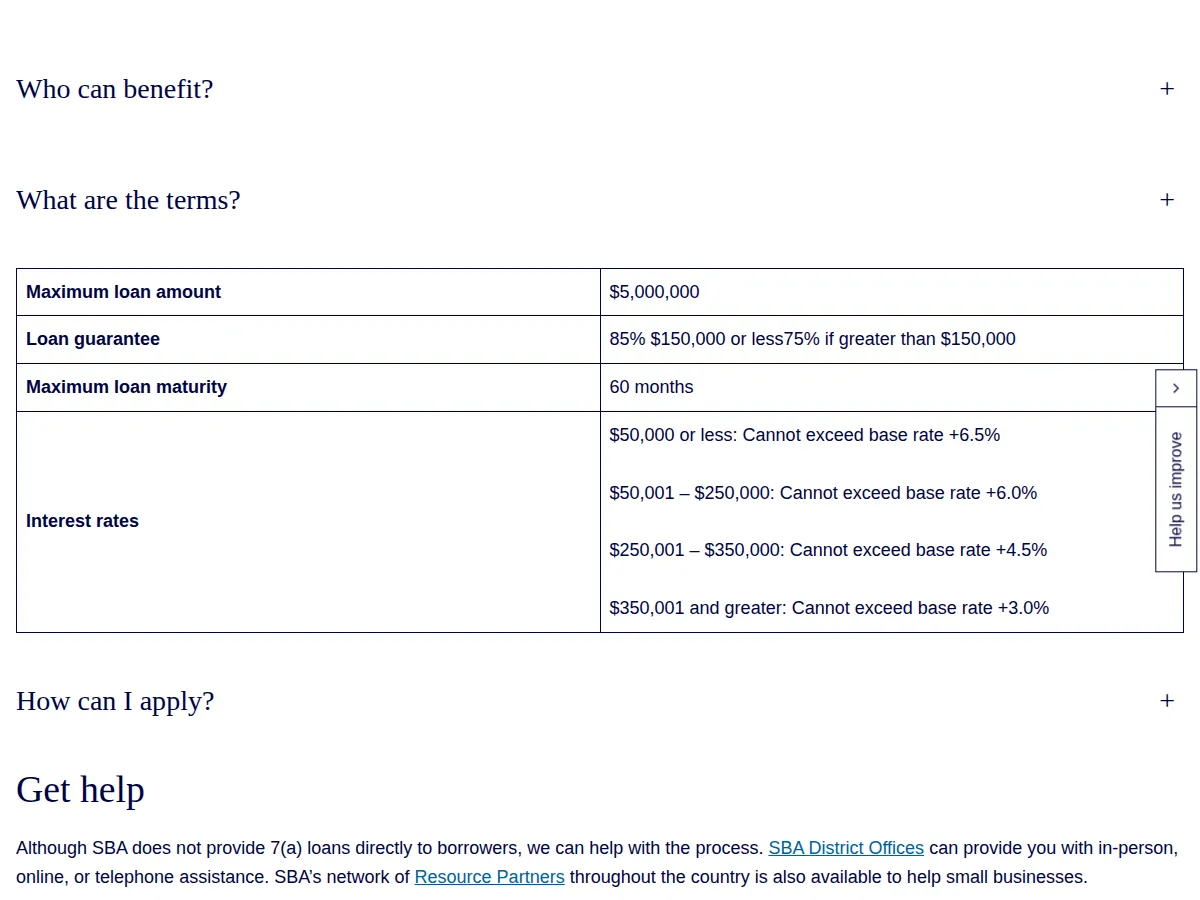
The SBA does not lend directly. Under 15 U.S.C. section 636, the SBA guarantees loans made by participating lenders, and the 7(a) program is its primary vehicle: a maximum loan of 5,000,000 dollars, a guarantee of 85 percent on loans of 150,000 dollars or less and 75 percent above that, repaid from business cash flow in monthly payments. The 7(a) Working Capital Pilot adds monitored lines of credit inside the same program, up to 5,000,000 dollars, with a maximum maturity of 60 months and rate caps tied to size: base rate plus 6.5 percent at 50,000 dollars or less, plus 6.0 percent to 250,000 dollars, plus 4.5 percent to 350,000 dollars, and plus 3.0 percent above that. Eligibility requires an operating, for-profit United States business that is small under SBA size standards and unable to obtain the credit on reasonable terms from non-government sources.
| 7(a) WCP term | Figure | Authority |
| :--- | :--- | :--- |
| Maximum loan amount | 5,000,000 dollars | SBA 7(a) program page |
| Guarantee | 85 percent at 150,000 dollars or less; 75 percent above | SBA 7(a) program page |
| Maximum maturity | 60 months | SBA 7(a) program page |
The guarantee is why a 7(a) loan is cheaper than an online term loan for the same borrower: the lender's loss is capped, so the rate is capped. The price is time: a 7(a) application takes weeks, sometimes months.
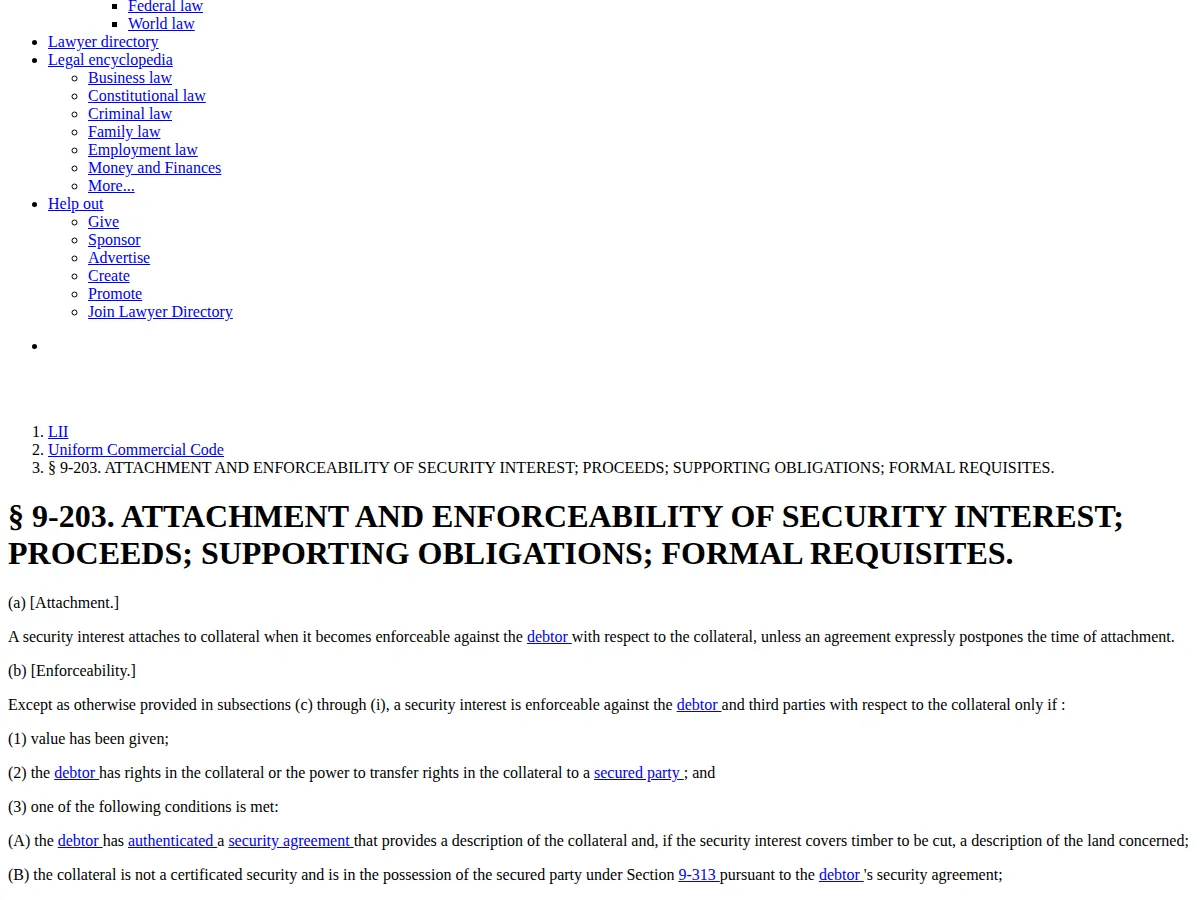
Behind every term loan and most large lines sits the security interest, governed by Article 9 of the Uniform Commercial Code. Under UCC section 9-203, a security interest attaches only when value has been given, the debtor has rights in the collateral, and the debtor has authenticated a security agreement describing it. Under section 9-310, perfection against third parties generally requires filing a financing statement. A general lien on "all business assets" reaches equipment, inventory, receivables, and deposit accounts, so a borrower who signs one for a 120,000 dollar term loan and later factors receivables has already pledged those receivables.
> [!WARNING]
> A general lien and a factoring agreement can collide in the same receivables. If your term loan carries a UCC-1 filing on all assets, a factor will either refuse the invoice or demand a subordination or intercreditor agreement. Do not sign a factoring agreement while a general lien is on file without written consent from the lien holder: the factor's due diligence will surface the filing, and a surprise at funding is the best-case outcome.
The decision table: which instrument for which need
| Need | Best instrument | Cost on the worked example | Why | Authority |
| :--- | :--- | :--- | :--- | :--- |
| Payroll in 45 days, invoice pays in 60 | Line of credit | 887.67 dollars on a 60,000 dollar draw | Interest only on days drawn | Bluevine line terms |
| One-time 120,000 dollar purchase, 2-year life | Term loan | 12,897.39 dollars interest over 24 months | Fixed schedule matches a fixed need | OnDeck term loan terms |
| 25,000 dollar invoice, net 60, no borrowing capacity | Factoring | 500 dollars per 30 days; 28.2 percent simple annualised on cash received | No debt created | 2026 market ranges, 1 to 5 percent per 30 days |
| Planned expansion, weeks to close | SBA 7(a) | Rate capped at base plus 3.0 to 6.5 percent by size | Guarantee lowers the rate | 15 U.S.C. section 636; SBA 7(a) page |
| Recurring quarterly shortfall | None: fix the cycle | The DSO math, not a loan | Borrowing compounds the debt | Cash conversion cycle playbook |
The break-even between factoring and a line is a function of days. At a 2 percent fee per 30 days on a 25,000 dollar invoice, the fee is 500 dollars. A line at 12 percent APR costs 500 dollars after roughly 25 days on a 60,000 dollar draw and roughly 61 days on a 25,000 dollar draw. If the customer pays inside 30 days and you can draw a line, the line wins. If the customer pays in 90 days, factoring costs 1,500 dollars on the same invoice while the line on 25,000 dollars costs 739.73 dollars. The arithmetic is not close once the term stretches past one period.
Operator boundaries: who should not use each instrument
A line should not fund a loss: if the business loses money every month, the balance never revolves down, and the lender will reduce the limit at the moment it is needed most. A term loan should not fund working capital that turns over in weeks: paying 24 months of interest for 45 days of cash is a category error. Factoring should not be used on your largest customer without telling them, or on invoices under dispute.
> [!TIP]
> Ask every lender for the same three numbers in writing: the APR or the per-30-day fee, the total dollars paid over the exact term you need, and every fee that is not interest, including draw, origination, and minimum monthly charges. The term sheet is the price. The landing page is advertising.