What an IRS audit is — and what it is not
An IRS audit is a review and examination of an organization's or individual's books, accounts, and financial records to ensure the information reported on the tax return is reported correctly and the amount of tax is correct. That is the Internal Revenue Service's own definition, and it sets the boundary of the whole exercise: the examiner is testing the return against the records, not conducting a general investigation of your business.
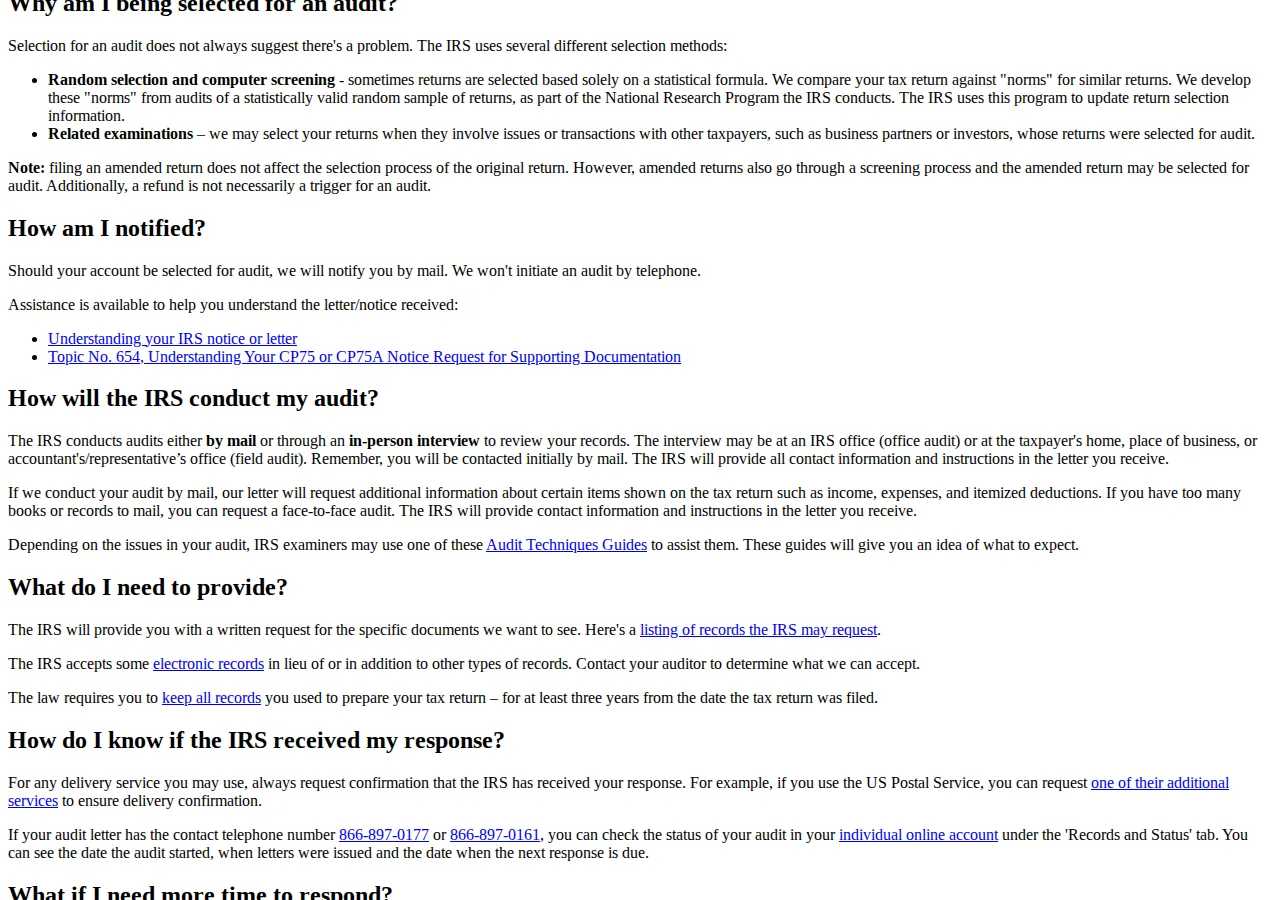
Returns are selected by random selection and computer screening — the IRS compares a return against "norms" for similar returns and flags the outliers — or by a related examination, where your return touches a return already under audit. Neither path means the IRS believes you cheated. A computer score is not an accusation, and treating it like one is the first mistake operators make.
The first contact is always by mail. The IRS states this plainly: you will be contacted initially by mail, and the letter provides all contact information and instructions. If someone calls or emails claiming to be the IRS and demanding immediate payment, that is not an audit — it is a scam. The letter names the tax year, the items, and the examiner, and sets the first deadline. Miss it and the examiner proceeds on the file as it stands.
This playbook is for founders, S corporation and C corporation owners, and Schedule C filers — the people whose returns carry the deductions and entity elections that attract computer screening. It is not a criminal defense manual: if a special agent is involved, retain a tax attorney before you write to the examiner.
The three audit types
The IRS conducts three kinds of examination.
| Audit type | Where it happens | What the examiner sees | Authority |
|---|---|---|---|
| Correspondence audit | By mail | The items named in the letter, and the documents you send back | IRS audits page; Publication 556 |
| Office audit | At an IRS office | The items under examination, plus what you bring to the interview | IRS audits page |
| Field audit | At your home, place of business, or accountant's office | Your books and records in place | IRS audits page |
The correspondence audit is the most common and the most winnable: narrow scope and a written exchange you control. The office audit adds an interview — prepare like a deposition, documents indexed. The field audit is the broadest: the examiner is inside your operation and can observe how it runs. A field audit of a business with sloppy books is where a single-year adjustment becomes a three-year one. The scope discipline applies in every type: the examiner's authority is the items and years named in the letter. Answer those, and do not volunteer adjacent years, entities, or deductions unless the examiner asks.
The examiner's document requests name the records by their tax forms: payroll registers showing FICA withholding, the EIN letter for the entity, the LLC operating agreement or the S-Corp election on Form 2553, the C-Corp board minutes authorizing the deduction, bank statements tracing each ACH and Wire transfer, and the CPA workpapers behind the filed return. A return whose books are kept on a GAAP basis with a CPA-reviewed trial balance answers an IDR in hours; a return built from a shoebox of receipts answers it in weeks, and every week of delay is a week the examiner spends looking for the next item.
The assessment clock: 26 U.S.C. § 6501
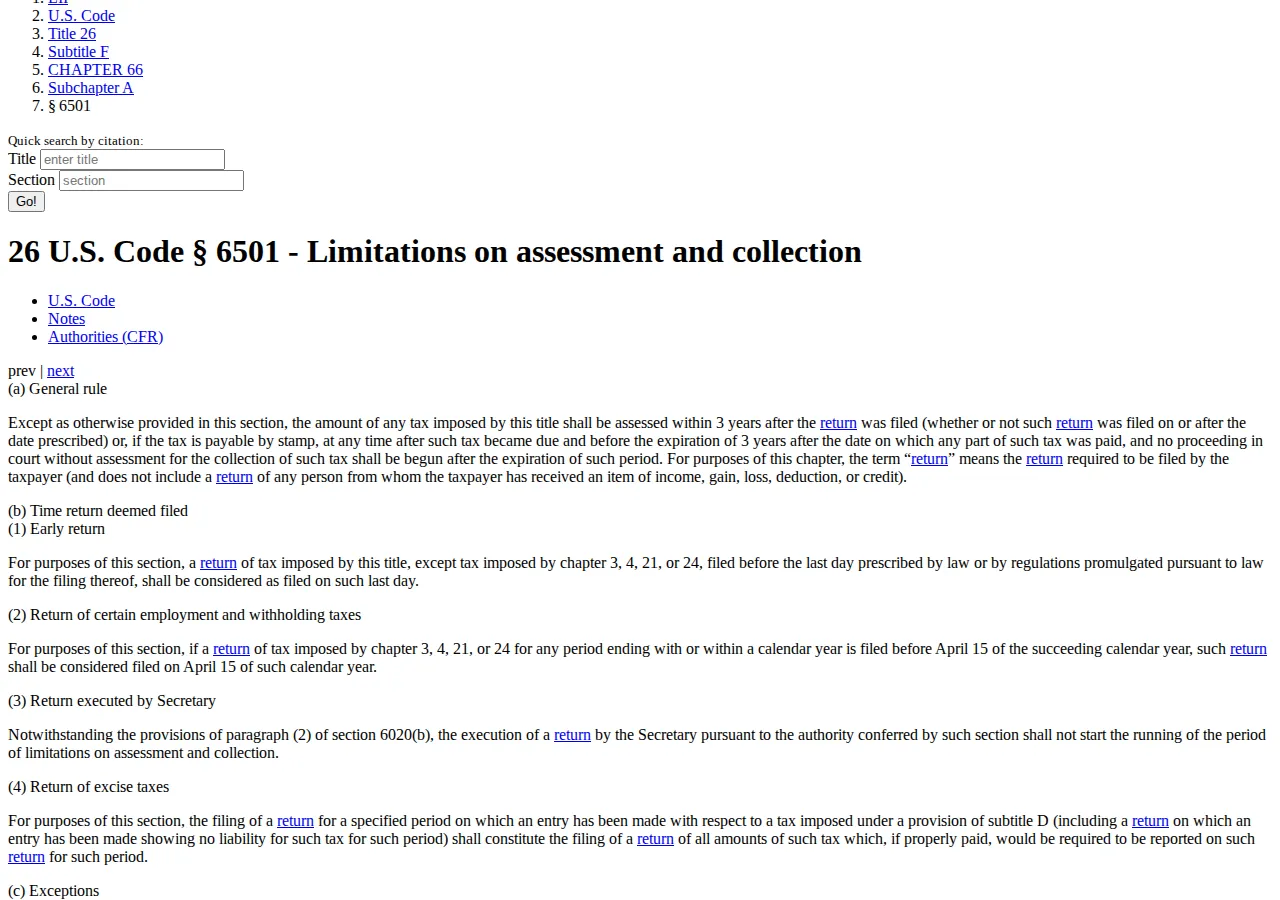
The single most valuable fact in audit defense is the date the IRS loses the power to assess. Section 6501(a) provides that the amount of any tax imposed shall be assessed within three years after the return was filed. The clock starts on the filing date, or the due date if you filed early, and runs out on the third anniversary.
| Situation | Assessment window | Authority |
|---|---|---|
| Ordinary return | 3 years after filing | 26 U.S.C. § 6501(a) |
| Omission of more than 25% of gross income | 6 years after filing | 26 U.S.C. § 6501(e)(1)(A) |
| False or fraudulent return | No limit | 26 U.S.C. § 6501(c)(1) |
| Failure to file a return | No limit | 26 U.S.C. § 6501(c)(3) |
Run the dates on your own return first. A return filed April 15, 2026 closes to assessment on April 15, 2029 — and on April 15, 2032 if the omitted income exceeds 25% of the gross income stated on the return. State $400,000 of gross income and omit $120,000, and you have crossed the line — $120,000 exceeds $100,000.
The clock also governs refunds: Publication 556 gives the example of a taxpayer recovering a $700 refund on an amended return filed within three years after filing the return. The same window that limits the IRS limits you.
The penalty math: 26 U.S.C. § 6662
An audit that finds an underpayment does not end with the tax. Section 6662(a) adds 20 percent of the portion of the underpayment attributable to negligence, to any substantial understatement of income tax, or to substantial valuation misstatements. The examiner does not need to prove intent: negligence — a failure to make a reasonable attempt to comply — is enough. Whether an understatement is "substantial" is a formula, and the formula differs by taxpayer:
An individual filer whose return should have shown $80,000 of tax reported $60,000 — a $20,000 understatement against a threshold of the greater of 10% of $80,000 ($8,000) or $5,000. The understatement is substantial, the penalty is $4,000, and the total exposure on that item is $20,000 of tax plus $4,000 of penalty, plus interest.
For a corporation other than an S corporation or a personal holding company, the threshold is the lesser of 10% of the tax required — or $10,000 if greater — and $10,000,000. A corporation that should have shown $500,000 and reported $440,000 faces a $60,000 understatement against a $50,000 threshold, so the penalty is $12,000. A § 199A claimant faces a tighter test: under § 6662(d)(1)(C), the 10% figure becomes 5%. The QBI planning in the § 199A QBI deduction playbook carries this consequence, and the audit is where it lands.
Interest sits on top of both. Under § 6601(a), interest at the underpayment rate runs from the last date prescribed for payment to the date paid; the rate under § 6621(a)(2) is the federal short-term rate plus three percentage points. Interest runs from the original due date, not from the audit — which is why paying the asserted tax while you contest the penalty stops the interest clock on the tax. If the balance cannot be paid in full, see the offer in compromise playbook. Before the audit, estimate the tax at stake with the tax estimator so the exposure math starts from a number you computed, not one the examiner hands you.
The reasonable-cause exception in § 6664(c) is the off-ramp: a taxpayer who shows reasonable cause and good faith is not liable for the penalty on that portion. The facts that win it are reliance on a qualified advisor after full disclosure and contemporaneous records. "My accountant did it" fails when the accountant was given incomplete numbers.
The burden shift: 26 U.S.C. § 7491
In a court proceeding, the burden of proof ordinarily sits with the taxpayer. Section 7491(a) shifts it — but only to a taxpayer who earns the shift: introduce credible evidence, comply with substantiation, maintain the records, and cooperate with reasonable requests. Meet all four and the burden on that factual issue moves to the IRS. Under § 7491(c), the IRS bears the burden of proof on any penalty.
That is the operating logic of this playbook: § 7491 makes the record the leverage — a bank statement, a contract, a log, an invoice, a board minute; records kept contemporaneously in the ordinary course.
Founder & CEO Insight — Enow A. Jovial
The response sequence: 30-day letter to Tax Court
Publication 556 lays out the sequence: a set of gates, each with a deadline and a different forum. Missing a gate moves you to a worse forum.
- The 30-day letter. The examination report arrives with the proposed changes, an agreement or waiver form, and notice of the right to appeal within 30 days. Do not sign the agreement form — signing waives the appeal right on those items.
- The protest. File a written protest with the facts, the law, and the documents. A protest that attaches the contract, the log, and the statute section is the document the Appeals officer reads first.
- Appeals. The Independent Office of Appeals reviews the case fresh. Publication 556 lists fast-track mediation alongside the regular appeal — a mediated settlement is faster and cheaper than a litigated one.
- The 90-day letter. If Appeals does not resolve it, the IRS issues the statutory notice of deficiency. You have 90 days to petition the Tax Court; miss it and the assessment becomes final.
- Tax Court. The petition must be filed within the 90 days. Small tax cases — generally disputes of $50,000 or less per year — can proceed under simplified procedures, but that route waives the right to appeal.
There is no step where ignoring the letter helps: an unanswered 30-day letter becomes a 90-day letter, and an unanswered 90-day letter becomes an assessment.
If the examination touches employment taxes, the trust fund recovery penalty and the deposit rules in the Form 941 payroll filing playbook apply, and the personal liability question is separate from the business adjustment.
Penalty relief: first-time abatement and what replaces it
Not every penalty survives the audit, even when the tax does. The IRS grants relief for reasonable cause and for first-time abatement — FTA — which applies to taxpayers with three years of timely compliance. Three clean years buys the first penalty off.
Read the current IRS penalty-relief page before relying on FTA: the IRS states FTA is transitioning to Automatic Exemption from Penalty, or AEP, starting in Summer 2026. The three-year compliance history remains the qualifying fact, but the form of the relief and how it is claimed are changing.
Who should not use this playbook as written
This playbook assumes a civil examination of a filed return. It does not cover a criminal investigation, a return prepared with knowledge of a false item, or an offshore disclosure problem. If the examiner asks about a return you know contains a false statement, or a special agent has contacted you, retain a tax attorney and say nothing until counsel directs it — the civil audit record is admissible. It also does not cover the notice that is not an audit: the CP2000 underreporter response playbook covers the computer-generated notice that proposes a tax change from third-party information matching. Treating a CP2000 like an audit wastes the response window; treating an audit like a CP2000 wastes the appeal rights.
The operator sequence
- Read the letter twice. Note the years, items, examiner, and deadline; calendar it.
- Run the § 6501 clock. If the three-year date has passed and no 25% omission exists, tell the examiner in writing — the assessment is time-barred.
- Pull the record for the named items only. Statements, invoices, contracts, logs, minutes, indexed to the IDR.
- Compute the § 6662 exposure first, on the worst plausible adjustment.
- Respond in writing, on time. Answer the IDR with an index; keep a copy of everything sent.
- Protest inside 30 days if you disagree. Attach the documents and statute sections; do not sign the agreement form.
- Use Appeals. Fast-track mediation where the facts are strong; regular Appeals where the law is disputed.
- Petition Tax Court inside 90 days if the 90-day letter issues. Missing it converts a dispute into an assessment.
- Claim penalty relief in the protest. Attach the three-year compliance history and the current FTA or AEP procedure.
Operator checklist
- [x] Audit letter read twice: years, items, examiner, deadline calendared.
- [x] § 6501 clock computed: three-year and six-year dates for every year named, in writing.
- [x] Record indexed to the IDR: every requested item matched to a document, copies retained.
- [x] § 6662 exposure computed: substantial-understatement test run on the worst plausible adjustment.
- [x] Response in writing, on time, with proof of sending retained.
- [x] Protest filed inside 30 days where disputed, with documents and statute sections attached; agreement form unsigned.
- [x] Appeals used and 90-day letter calendared: mediation or Appeals requested; Tax Court petition deadline tracked.
- [x] Penalty relief claimed in the protest: three-year compliance history attached; current FTA or AEP procedure confirmed.
- [x] Criminal-exposure screen passed: no false return, no special agent, no offshore issue — or a tax attorney retained.