A proposal, not a bill
A CP2000 arrives when the income or payment information the IRS received from third parties — employers, banks, payment apps, marketplaces — does not match what you reported on your return. The series covers CP2000 and variants CP2000A through CP2000E, all from the same Automated Underreporter process.
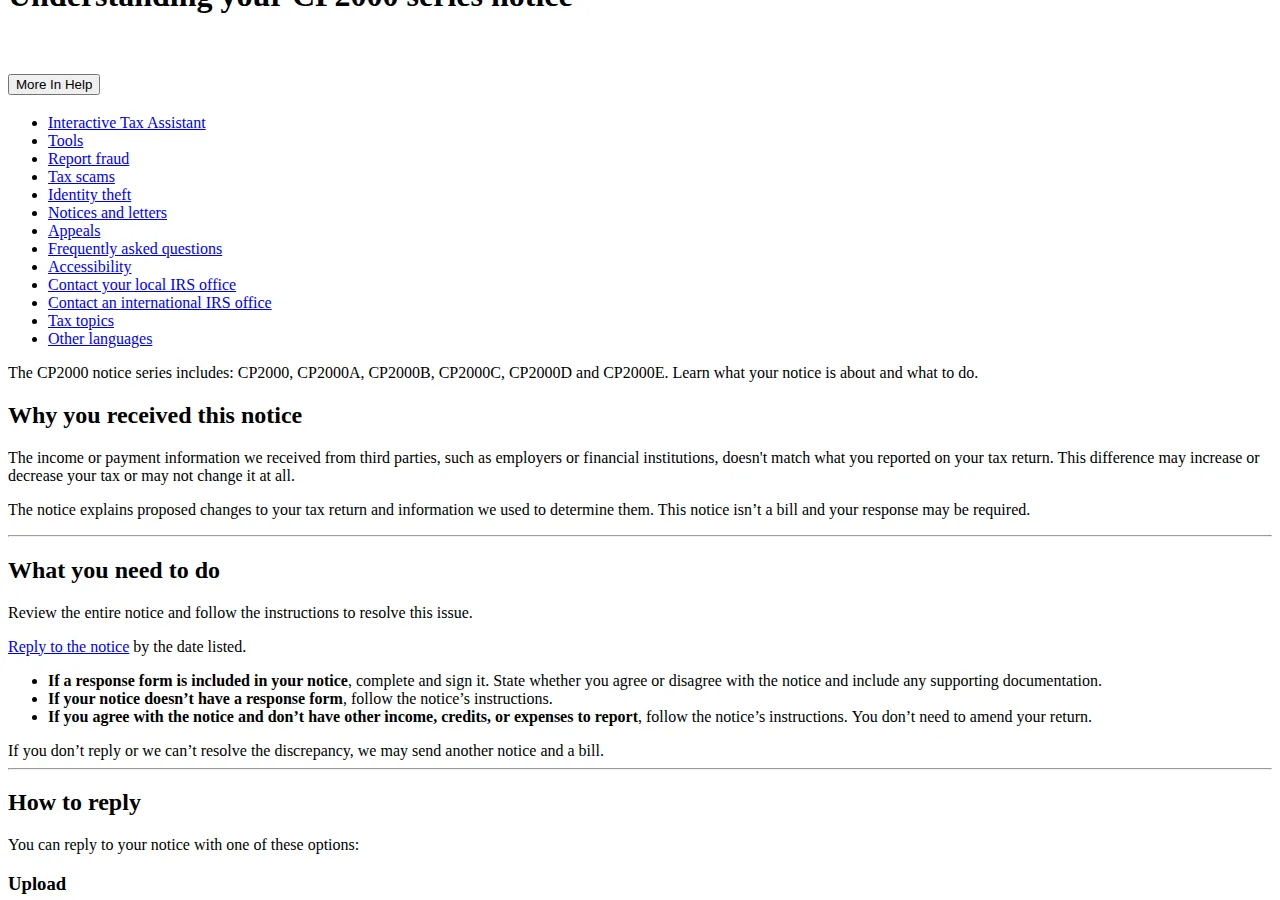
First: this notice is not a bill. The IRS says so in plain words on its CP2000 page. It is a proposal, and your response may be required. A bill demands payment; a proposal invites a reply — agree, disagree, or partially agree — and the reply decides what you owe and whether you keep your Tax Court rights.
> [!KEY TAKEAWAY]
> A CP2000 proposes a change; it does not assess one. The 30-day response window is where the outcome is decided. Silence does not freeze the case — it hands the decision to the IRS.
The 30-day clock
The response due date is 30 days from the notice issuance date, printed on page 1. Publication 5181, the IRS guide to this process, repeats the instruction throughout: reply by the deadline given in the notice, and if you cannot meet it, call the number on the notice to request more time.
The Internal Revenue Manual, IRM 4.19.3, states the extension mechanics. Call before day 30 and the assistor gives you an additional 30 days. Call on or after day 30 and the new due date is 30 days from the call. Do not ask for a second extension unless extenuating circumstances apply; the manual tells assistors not to grant multiples.
Timeline built on a notice dated September 1, 2026.
| Day | Event | Authority |
| :--- | :--- | :--- |
| Day 0 — Sep 1, 2026 | CP2000 issued | IRM 4.19.3 |
| Day 30 — Oct 1, 2026 | Response due date, page 1 | IRM 4.19.3; IRS CP2000 page |
| No response | CP3219A Statutory Notice of Deficiency, certified mail | IRS CP2000 page; Pub 5181 |
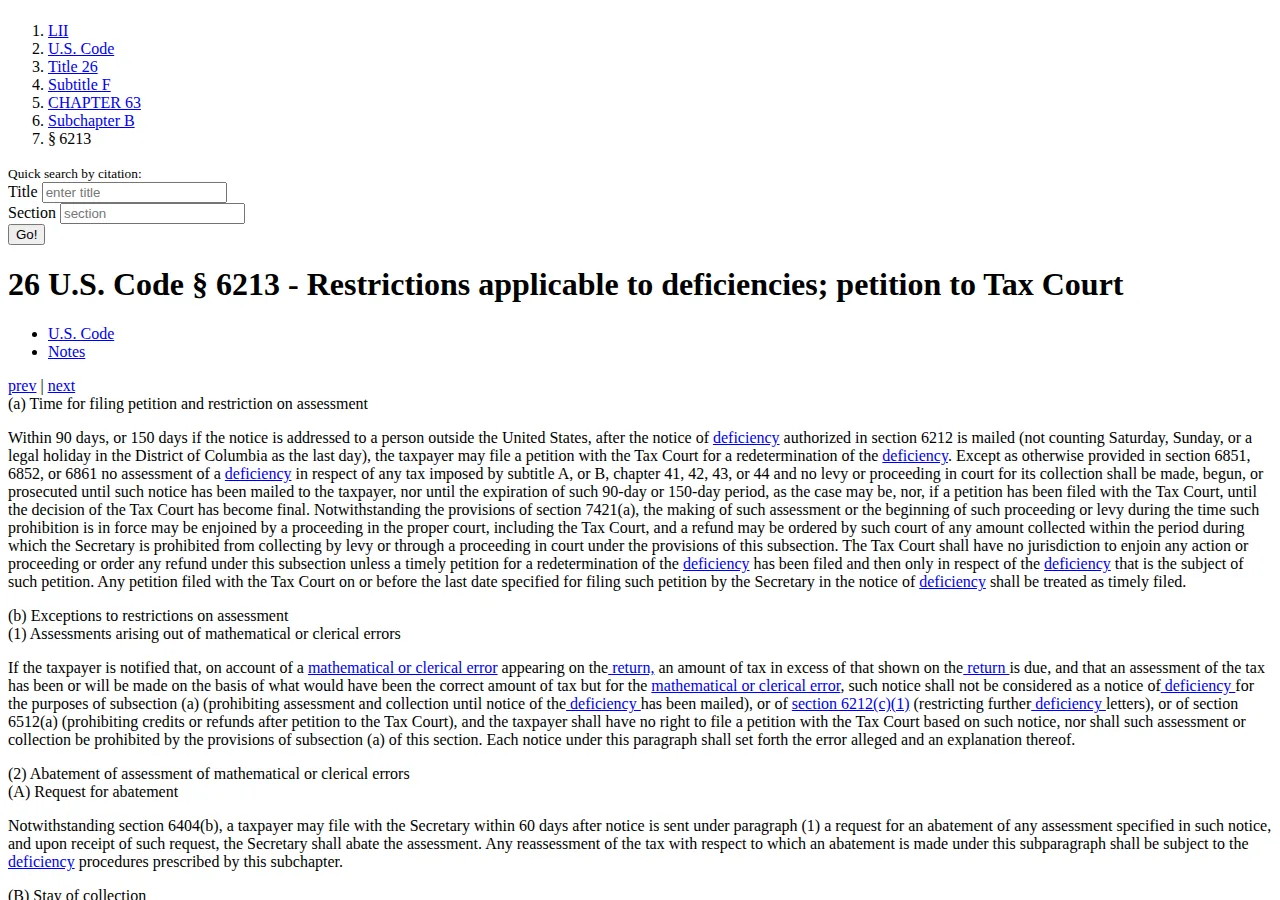
| CP3219A + 90 days | Deadline to petition the U.S. Tax Court (150 days if addressed to a person outside the United States) | IRC § 6213(a); IRM 4.19.3 |
> [!WARNING]
> The 90-day Tax Court window is statutory. IRC § 6213(a) gives 90 days from mailing of the notice of deficiency, or 150 days if the notice is addressed to a person outside the United States, and the IRM states flatly that IRS employees cannot extend it. You can keep working with the IRS to settle during those 90 days, but the petition deadline does not move.
!IRC § 6213(a): the 90-day petition window, 150 days outside the US
Read the notice before you touch the response form
A CP2000 has three parts that matter. First, the proposed changes page: each item the IRS says was underreported or misreported, the amount, and the tax effect. Compare every line against your return and your own records — W-2s, 1099s, 1098s, brokerage statements. Each 1099 carries the payer's EIN, the notice is keyed to your SSN, and income from an LLC or S-Corp needs the entity's return and a CPA's eye before you answer. The usual causes are payer errors, timing errors, and double-counting. Second, the explanation page, which shows how the IRS computed the proposed tax. Check the arithmetic.
Third, the response form — the only part the IRS needs back. It asks one question with three answers: agree, disagree, or partially agree. Sign it (joint filers need both spouses to sign) and send it by the channel the notice gives you: the IRS Document Upload Tool, fax, or mail to the address in the top-left corner of page 1. Send photocopies, never originals.
Agree, disagree, or partially agree
The three paths are not equal in effort or risk. Pick the one that matches the facts, not the one that feels fastest.
| Path | When it fits | What you send | What happens next | Authority |
| :--- | :--- | :--- | :--- | :--- |
| Agree | Every line checks out | Signed form; payment or Form 9465 if you cannot pay in full | IRS assesses the agreed amount | IRS CP2000 page; Pub 5181 |
| Disagree | Lines are wrong and you can prove it | Form marked disagree, explanation per item, supporting documents | IRS reviews; accepts the return, or sends a revised notice on the rest | IRS CP2000 page; Pub 5181 |
| Partially agree | Some lines right, some wrong | Form marked partially agree, agreeing to the correct items and disputing the rest | IRS assesses the agreed portion, re-works the rest | IRM 4.19.3; Pub 5181 |
The disagree path has one rule that decides most cases: address every issue. Publication 5181 is explicit — name the line number or schedule where you included the amount, and if the amount sits inside a larger total, break the total down. A letter that says "this is wrong" without a document loses to a notice that says "here is the 1099." A letter that attaches the corrected 1099, the pay stub, or the brokerage statement wins. If the IRS rejects your explanation, it tells you why, and you can send more; if it accepts only part, it sends a revised notice on the rest, and the clock restarts on those items.
Worked example: the cost of waiting
Mara Ellison, a freelance designer, left $20,000 of 1099-NEC income off her 2025 return — the payer sent the form to an old address and she never saw it. The CP2000 proposes $4,800 of additional tax at her 24 percent marginal rate, against a total tax required of $32,000. The CP2000 is dated September 1, 2026; the original return was due April 15, 2026.
$
\text{Additional Tax} = \$20{,}000 \times 24\% = \$4{,}800
$
Interest runs from the original due date, not from the notice date — a point most taxpayers miss. For the quarter beginning October 1, 2026, the IRS individual underpayment rate is 7 percent per year, compounded daily, announced in news release IR-2026-98. The rate resets quarterly as the federal short-term rate plus 3 percentage points, so a payoff figure computed today is stale next quarter. The failure-to-pay penalty is 0.5 percent of the unpaid tax for each month or part of a month, capped at 25 percent.
Scenario A: Mara agrees and pays on October 16, 2026 — 45 days after the notice, 184 days after the due date. Scenario B: she waits and pays on March 30, 2027 — 210 days after the notice, 349 days after the due date.
$
\text{Total} = \text{Tax} + \text{Tax} \times \left( \left(1 + \frac{0.07}{365} \right)^{\text{days}} - 1 \right) + \text{Tax} \times 0.5\% \times \text{months}
$
| Scenario | Days from Apr 15, 2026 | Interest at 7% daily | Penalty months | Penalty | Total due |
| :--- | :--- | :--- | :--- | :--- | :--- |
| A — pay Oct 16, 2026 | 184 | $172.39 | 7 | $168.00 | $5,140.39 |
| B — pay Mar 30, 2027 | 349 | $332.23 | 12 | $288.00 | $5,420.23 |
In Scenario A, interest is $4,800 × ((1 + 0.07/365)^184 − 1) = $172.39, and the penalty covers 7 months — October 16 falls in the seventh part-month after April 15. In Scenario B, interest is $4,800 × ((1 + 0.07/365)^349 − 1) = $332.23, with 12 penalty months. Waiting 165 extra days costs $279.84 for the same $4,800 of tax.
Scope note: interest here is computed on the tax balance only; the IRS also charges interest on unpaid penalties.
The penalty stack
The CP2000 itself carries no penalty. The penalties attach to the underlying failure and stack on top of the tax and the interest.
| Penalty | Rate | Cap / note | Authority |
| :--- | :--- | :--- | :--- |
| Failure to pay | 0.5% of unpaid tax per month or part of a month | 25% of unpaid taxes | IRS failure-to-pay penalty page |
| Failure to pay, approved plan | 0.25% per month | During the approved plan | IRS failure-to-pay penalty page |
| Failure to pay after intent to levy | 1% per month | After 10 days past a levy notice | IRS failure-to-pay penalty page |
| Accuracy-related | 20% of the underpayment portion | Substantial understatement, individual: greater of 10% of tax required or $5,000 | IRS accuracy-related penalty page |
Mara escapes the accuracy-related penalty. Her understatement is $4,800; the threshold is the greater of 10 percent of $32,000 ($3,200) and $5,000 — so $5,000. Because $4,800 is below $5,000, there is no substantial understatement. The same facts with a $6,200 understatement would cross the line, and the penalty would be 20 percent × $6,200 = $1,240.
Reasonable cause can remove or reduce a penalty. Interest is different — by law the IRS cannot remove or reduce interest unless the penalty is removed or reduced. Pay what you can now; every dollar paid stops its own interest and penalty clock.
Response or amended return: which one wins
If you agree with the notice and have no other income, credits, or expenses to report, you do not need to amend your return. The signed response form closes the case. Filing a 1040-X on top of an agreed CP2000 adds a second process that can delay assessment and create a duplicate-adjustment tangle.
If you agree but do have other items to report — income you also left off, a credit you missed, an expense you can now document — file Form 1040-X, write "CP2000" on top, and send it with your response form. The IRS folds the new items into a revised notice.
If you disagree, do not file an amended return for the disputed items. An amended return concedes the income; a disagree response contests it, and the IRS will process the amendment as an admission. The 1099-NEC contractor reporting playbook covers the form that generates most CP2000s, and the quarterly estimated tax guide covers the payment habit that keeps the next CP2000 from arriving with a failure-to-pay penalty attached.
> [!TIP]
> Pay the agreed amount with the response, even while disputing part of the notice. It stops interest and the penalty on that portion; a partial payment is not an admission on the disputed items.
The response checklist
1. Read page 1 and circle the due date. 30 days from issuance; set a reminder 7 days before it.
2. Pull every information return for the year. W-2s, 1099s, 1098s — compare each to the notice.
3. Match each notice item to a line on your return. Reported, in a larger total, in the wrong year, or never reported.
4. Gather the document for every disagreement. Corrected 1099, pay stub, brokerage statement, proof of a deduction.
5. Decide the path per item, not per notice. Agree to the correct items, dispute the wrong ones.
6. Complete and sign the response form. Joint filers: both spouses sign. Mark your path and explain each disputed item.
7. Send it by the channel on the notice. Document Upload Tool is fastest. Keep the confirmation or receipt.
8. Pay what you agree you owe, now. If you cannot pay in full, include Form 9465 — the penalty drops to 0.25 percent a month during an approved plan.
9. Check prior years for the same issue. If the same income is missing there, file amended returns before the IRS finds them.
10. Keep the notice, the response, and every document for at least three years, with the IRS acceptance letter.
If you do nothing
The IRS continues to process the proposed changes, and interest keeps accruing. Then the CP3219A arrives by certified mail — the Statutory Notice of Deficiency, also called the 90-Day Letter — the last administrative step before assessment.
From the mailing of the CP3219A you have 90 days to petition the U.S. Tax Court, or 150 days if the notice is addressed to a person outside the United States. The period is statutory; IRS employees cannot extend it. If you do not petition and no agreement is reached, the tax is assessed, and collection follows under Publication 594, The IRS Collection Process. The quarterly payroll tax filing playbook shows how the same sequence works on the business side, where the stakes compound faster.
One more door exists after assessment: audit reconsideration, permitted in some situations. But the IRM warns that letting the 90 days lapse loses significant administrative and judicial avenues. Reconsideration is a request, not a right.
> [!FOUNDER]
> "A CP2000 is the cheapest tax fight you will ever get. The IRS shows you its evidence before it assesses anything, and gives you 30 days to answer with documents. The taxpayers who lose CP2000 cases are not the ones with weak facts — they are the ones who never answered. By the time the 90-Day Letter arrives, the cheapest fight in the system has become the most expensive one."
> — Enow A. Jovial, Founder & Chief Executive Officer
Edge cases worth knowing
Identity theft changes the response entirely. If someone used your name and Social Security number, reply with a completed Form 14039, Identity Theft Affidavit, attached to your response. Never sign an agreement form for income you did not receive.
A proposed refund is still a CP2000: review it the same way — the matching program can overstate income just as easily as it understates it.
A CP2000 for a closed year proposes changes only to the items listed. But if the same issue appears in a prior year, the IRS expects you to amend that year yourself, and the failure-to-pay clock on that year has been running since its own due date. Run the payoff math before you pay: use the worked formula above and confirm the current quarterly rate on irs.gov. The pricing calculator shows the same discipline: state the inputs, show the formula, let the reader re-run it.
Closing checklist
1. Due date circled from page 1; reminder set 7 days before.
2. Every notice item matched to a return line or a missing document.
3. Path chosen per item: agree, disagree, or partially agree.
4. Response form signed by both spouses for a joint return.
5. Explanation and documents attached for every disputed item.
6. Agreed amount paid, or Form 9465 included for a payment plan.
7. Confirmation, fax receipt, or certified-mail receipt kept.
8. Prior years checked for the same issue, amendments filed where needed.
9. Acceptance letter or revised notice filed with the tax records.