IRS Payroll Tax Deposit Schedule: Semiweekly vs Monthly Playbook — the $50,000 Lookback, the $100,000 Next-Day Rule, and the Penalty Ladder
A company runs payroll on Friday, January 30, 2026, creating $12,000 of employment tax liability: withheld income tax plus both shares of FICA. As a monthly schedule depositor it is due the 15th of the following month — but February 15, 2026 is a Sunday, and the Monday after it is Presidents' Day, so the legal due date is Tuesday, February 17 — eighteen days later. As a semiweekly schedule depositor, Wednesday, February 4 — five days later. Get the schedule wrong and the deposit lands late, on a penalty ladder of 2 to 15 percent under 26 U.S.C. § 6656.
The lookback period decides your schedule
Each year, every employer must determine its deposit schedule from the total tax liability reported on Form 941, line 12, during a four-quarter lookback period. For a 2026 Form 941 filer the lookback runs July 1, 2024 through June 30, 2025. Add the four quarters' line-12 totals: $50,000 or less is monthly for 2026; more than $50,000 is semiweekly. Exactly $50,000 is monthly; $50,001 is semiweekly — the boundary is a cliff, not a range.
Two details change the arithmetic. A new business starts at zero: for Form 941 filers, tax liability for any quarter in the lookback period before the business started or was acquired is considered to be zero, so a new employer is a monthly depositor for its first calendar year. And corrections do not rewrite history: adjustments on Form 941-X, 943-X, 944-X, or 945-X do not affect the lookback amounts.
Monthly schedule: one deposit a month, due the 15th
A monthly schedule depositor deposits the employment taxes on payments made during a month by the 15th day of the following month. The deposit period is the calendar month, so every payday inside the month accumulates into a single deposit. Deposits are due on business days only: if the 15th falls on a Saturday, Sunday, or District of Columbia legal holiday, the deposit is timely if made by the close of the next business day. The filing mechanics are covered in the companion quarterly Form 941 filing guide.
There is one exit from the deposit routine. If the total tax liability on Form 941, line 12, is less than $2,500 for either the current quarter or the prior quarter, and the employer did not incur a $100,000 next-day deposit obligation during the current quarter, the employer may pay the tax with a timely filed return instead of depositing.
Semiweekly schedule: two deposit windows a week
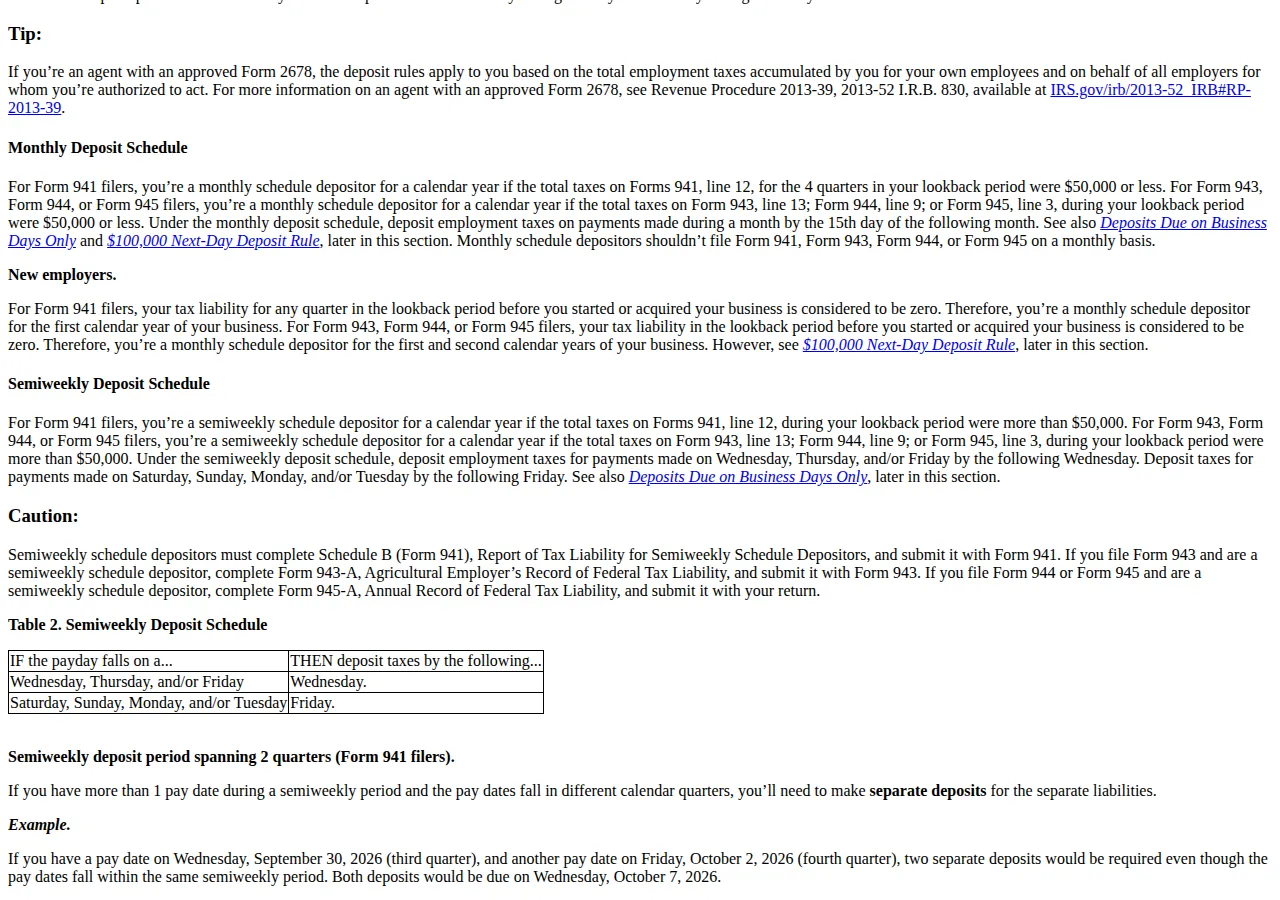
A semiweekly schedule depositor works in two deposit periods each week: Wednesday through Friday, and Saturday through Tuesday. Taxes for payments made on Wednesday, Thursday, or Friday are deposited by the following Wednesday; taxes for payments made on Saturday, Sunday, Monday, or Tuesday are deposited by the following Friday.
Green, Inc. is the worked example: a semiweekly depositor that pays wages once a month, on the last Friday. It still deposits just once a month — but under the semiweekly schedule, so its liability for the May 29, 2026 (Friday) payday must be deposited by June 3, 2026 (Wednesday).
A semiweekly depositor must also complete Schedule B (Form 941), Report of Tax Liability for Semiweekly Schedule Depositors, and submit it with Form 941, listing liabilities by the date wages were paid.
At the quarter boundary, a pay date on Wednesday, September 30, 2026 (third quarter) and another on Friday, October 2, 2026 (fourth quarter) need two separate deposits, both due Wednesday, October 7, 2026.
The decision table
| Route | Who it covers | Deposit due | Reporting | Authority |
|---|---|---|---|---|
| Monthly schedule | Lookback $50,000 or less | 15th of the following month | Form 941, line 16, by month | Pub. 15 § 11 |
| Semiweekly schedule | Lookback over $50,000 | Wed–Fri pay → following Wednesday; Sat–Tue pay → following Friday | Schedule B, by pay date | Pub. 15 § 11 |
| Pay with the return | Line-12 liability under $2,500, no $100,000 day | With the timely filed return | Form 941, line 14 | Pub. 15 § 11 |
| Next-day deposit | $100,000+ in one deposit period | Next business day | Same reporting, plus the flip | Pub. 15 § 11 |
The $100,000 next-day rule
The $100,000 next-day deposit rule overrides both schedules. If an employer accumulates $100,000 or more in taxes on any day during a monthly or semiweekly deposit period — measured before any reduction for nonrefundable credits — it must deposit the tax by the next business day, monthly or semiweekly alike.
Accumulation stops at the period boundary, and the boundary is what saves or catches an employer. A semiweekly depositor that accumulates $95,000 on a Tuesday (in the Saturday-through-Tuesday period) and $10,000 on Wednesday does not trigger the rule: $95,000 is deposited by Friday and $10,000 by the following Wednesday. Fir Co. accumulates $110,000 on a Monday and must deposit it on Tuesday, the next business day.
A monthly depositor that accumulates a $100,000 liability on any day during the deposit period becomes a semiweekly depositor on the next day and remains so for at least the rest of the calendar year and for the following calendar year. Elm, Inc. started May 4, 2026, accumulated $40,000 on Wednesday, May 6, and $60,000 on Friday, May 8 — $100,000 in total — became a semiweekly depositor on May 9 for the remainder of 2026 and for 2027, and had to deposit the $100,000 by Monday, May 11.
Worked example: the penalty ladder on a $12,000 deposit
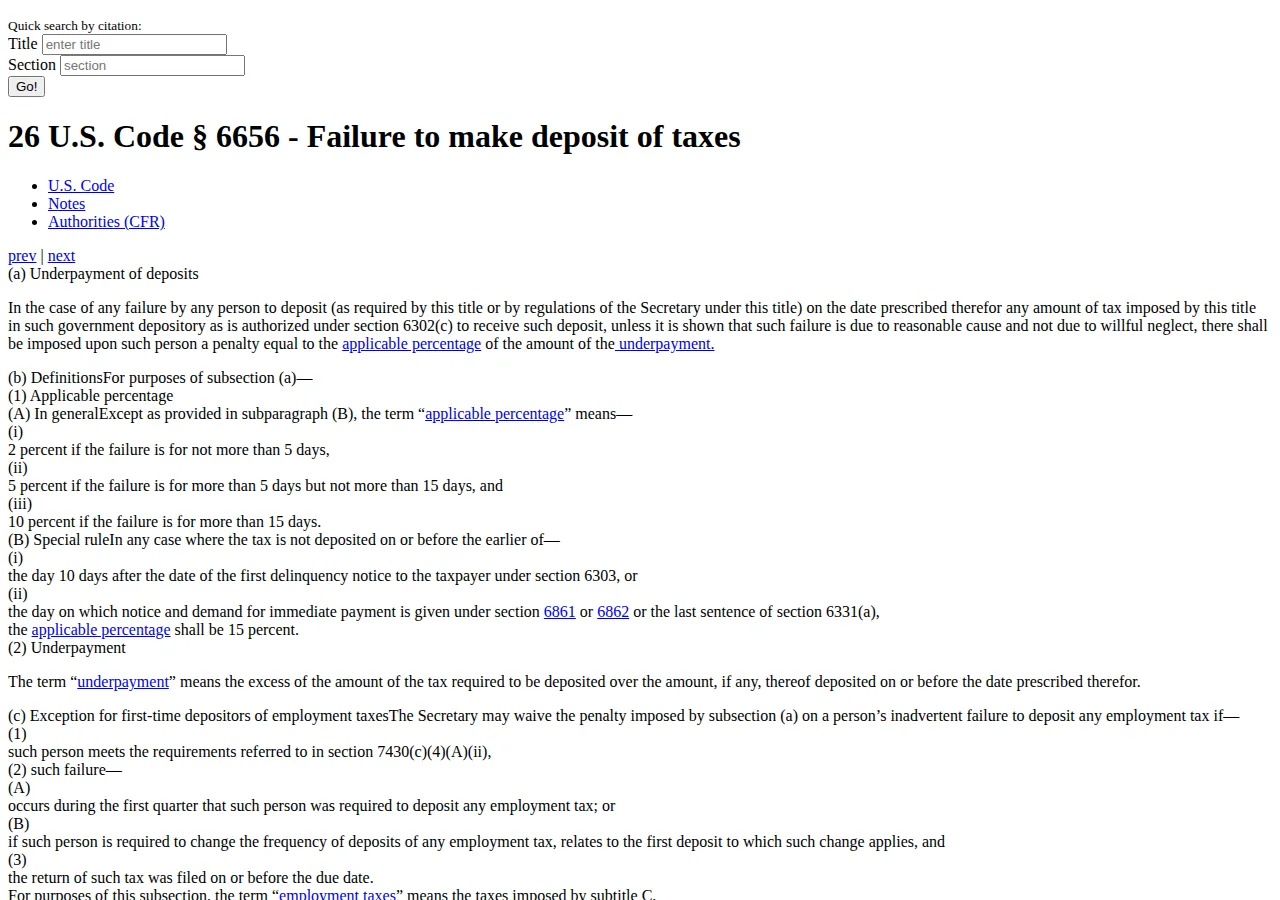
The penalty for a late deposit is set by 26 U.S.C. § 6656, and it is a ladder, not a flat rate: 2 percent if the failure is for not more than 5 days, 5 percent if it is for more than 5 days but not more than 15 days, and 10 percent if it is for more than 15 days. The 15 percent rate applies where the tax is not deposited by the earlier of the day 10 days after the first delinquency notice under section 6303, or the day notice and demand for immediate payment is given under section 6861, 6862, or the last sentence of section 6331(a). On the opening $12,000 deposit:
Late deposit penalty amounts are determined using calendar days, starting from the due date of the liability — weekends count. A deposit due Wednesday and made the following Monday is five days late, at 2 percent; made the Tuesday after that, six days late, at 5 percent. Publication 15 adds a 10 percent rate for amounts that should have been deposited but were instead paid directly to the IRS or paid with the return.
Under the accuracy of deposits rule, no penalty applies for depositing less than 100 percent if the shortfall does not exceed the greater of $100 or 2 percent of the amount of taxes otherwise required to be deposited, and the shortfall is paid by the shortfall makeup date. On a $12,000 required deposit, 2 percent is $240, so a $200 shortfall is inside the tolerance:
The makeup date is the return due date for a monthly depositor, and for a semiweekly depositor the earlier of the first Wednesday or Friday on or after the 15th day of the following month, or the return due date — for example, May 15, 2026 (Friday) for an April 2026 shortfall.
How the money actually moves: EFTPS and the cutoffs
All federal tax deposits must be made by electronic funds transfer, through the Electronic Federal Tax Payment System (EFTPS), IRS Direct Pay, or the IRS business tax account. EFTPS is a free service of the Department of the Treasury. A new employer that indicated a federal tax obligation when requesting its EIN is pre-enrolled in EFTPS; the PIN arrives by mail.
The EFTPS cutoffs decide whether a deposit is on time. EFTPS accepts same-day payments of $1 million or less if the payment is submitted before 3:00 p.m. Eastern time on a business day. If the payment is more than $1 million, it must be submitted by 8:00 p.m. Eastern time the day before the date the deposit is due. If a cutoff is missed, the fallback is a same-day wire through the Federal Tax Collection Service, arranged with the bank in advance. Payroll software that files the return does not necessarily make the deposit — compare providers in the payroll software cost guide before assuming the deposit is covered.
The filing side: Schedule B, the averaged penalty, and the first-time waiver
The return is where deposit mistakes surface. A monthly depositor reports liabilities, not deposits, by month on Form 941, line 16; a semiweekly depositor reports liabilities by pay date on Schedule B. Getting the two mixed up is its own penalty: the IRS may assess an averaged failure-to-deposit penalty of 2 percent to 10 percent when a monthly depositor does not properly complete line 16, or a semiweekly depositor completes line 16 instead of Schedule B, fails to attach Schedule B, or enters deposits instead of liabilities on it — provided the line-12 liability is $2,500 or more.
Deposits are also applied in an order the employer may not expect: generally to the most recent tax liability within the quarter, not the oldest. Cedar, Inc. owed $1,000 on April 15 and $1,500 on May 15, missed April 15, and deposited $2,000 on May 15 — $1,500 went to May and $500 to April, so $500 of the April liability stayed undeposited.
Two statutory safety valves exist for a first mistake. Section 6656(c) lets the Secretary waive the penalty on an inadvertent failure to deposit employment tax if the employer meets the requirements referred to in section 7430(c)(4)(A)(ii), the failure occurred during the first quarter the employer was required to deposit employment tax — or relates to the first deposit after a required change in deposit frequency — and the return was filed on or before its due date. Topic 758 adds the filing side: the return is generally due April 30 for the first quarter, with ten additional days if all taxes were deposited on time.
Who this schedule does not fit
The deposit schedule is the wrong tool for three kinds of employer. First, the very small employer whose quarterly liability stays under $2,500 should pay with the return and skip deposits entirely — but only while the quarter stays under $2,500 and no $100,000 day occurs. Second, the employer that confuses pay frequency with deposit frequency: paying monthly does not make you a monthly depositor, and Green, Inc. proves it. Third, the employer with liabilities these rules do not cover: the rules do not apply to FUTA tax, which has its own deposit rules and its own return, Form 940, covered in the Form 940 FUTA guide.
Execution checklist: run the schedule in one pass
- Step 1 — Add the lookback. Sum Form 941, line 12, for July 1, 2024 through June 30, 2025 (for 2026). $50,000 or less is monthly; more is semiweekly.
- Step 2 — Write the schedule down. Record monthly or semiweekly, the deposit periods, and the due-date rule, and give it to whoever runs payroll and whoever moves the money.
- Step 3 — Activate EFTPS. Confirm the PIN is active before the first payday, and note the 3:00 p.m. Eastern same-day cutoff for payments of $1 million or less.
- Step 4 — Diary every due date. Monthly: the 15th of the following month. Semiweekly: the Wednesday after a Wednesday–Friday payday, the Friday after a Saturday–Tuesday payday.
- Step 5 — Watch the $100,000 line. Check the accumulated liability in each deposit period before a bonus or commission run.
- Step 6 — Reconcile Schedule B or line 16. Before filing Form 941, verify the total liabilities reported equal the line-12 total.
- Step 7 — Keep the deposit record. Dates, amounts, and EFTPS acknowledgment numbers go in the payroll file, because the 90-day designation window under section 6656(e) runs from the penalty notice.
Founder & CEO Insight — Enow A. Jovial
The deposit schedule is a calendar, not a judgment call. Add four quarters, compare the sum to $50,000, and the schedule is decided. Then the only decisions left are operational: schedule the EFTPS payment the morning after payday, watch the $100,000 line before any large pay run, and reconcile Schedule B or line 16 to line 12. Run the penalty on your own numbers through the profit calculator — a $12,000 deposit at 15 percent is $1,800, the cost of one missed Wednesday.