A filed Form 941 is not a finished Form 941
Form 941 is the employer's quarterly federal tax return; Form 941-X is the instrument that fixes it. The IRS states the purpose in one sentence: "Use Form 941-X to correct errors on a Form 941 that you previously filed." One form per quarter, on the April 2026 revision.
An overreported quarter is cash the business paid and does not owe. An underreported quarter gathers interest at 7 percent a year, compounded daily, plus a failure-to-pay penalty. Find the error and you control the outcome; wait, and the calendar decides it.
> [!KEY TAKEAWAY]
> Form 941-X is a deadline instrument first and a form second. The 3-year / 2-year claim window of 26 U.S.C. § 6511 decides whether the money can still move at all. Check the window before touching a single line.
What Form 941-X corrects — and what it cannot touch
Form 941-X corrects the tax figures on a filed Form 941 or Form 941-SS: wages, tips, and other compensation; federal income tax withheld; taxable social security wages and tips; taxable Medicare wages and tips; wages and tips subject to Additional Medicare Tax withholding; tax adjustments; and the nonrefundable and refundable portions of the credits the form carries. Each correction goes in Part 3 in three columns: corrected amount, originally reported amount, difference. Column 3 nets increases and decreases on the same line.
Three boundaries decide whether 941-X is the right paper. First, if the only errors relate to the number of employees who received wages (Form 941, line 1) or to federal tax liabilities on Form 941, Part 2, or Schedule B (Form 941), do not file Form 941-X — correct those through the Instructions for Schedule B (Form 941). Second, federal income tax withholding errors can be corrected only if discovered in the same calendar year the wages were paid, and an overcollection only if the employees were also repaid or reimbursed in that same year. A prior-year nonadministrative withholding error cannot be corrected on Form 941-X. Third, no refund claim may be filed to correct federal income tax or Additional Medicare Tax actually withheld. See the irs-form-941-quarterly-payroll-tax-filing-playbook for the original filing.
The claim window: section 6511 runs the clock
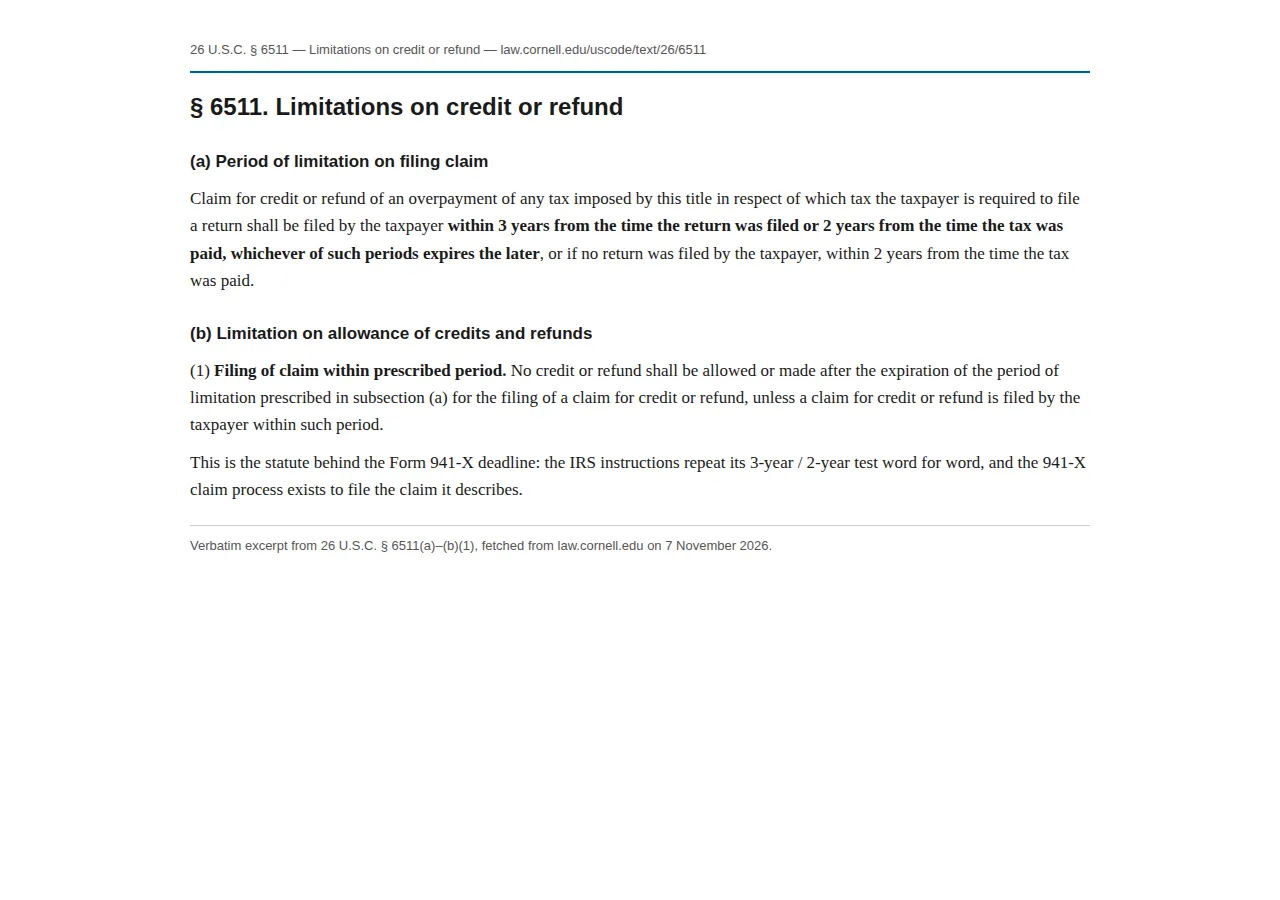
Every 941-X correction runs against a limitations period set by 26 U.S.C. § 6511. Subsection (a) states the rule in one sentence: a claim for credit or refund of an overpayment must be filed "within 3 years from the time the return was filed or 2 years from the time the tax was paid, whichever of such periods expires the later," or, if no return was filed, within 2 years from payment. The IRS instructions repeat the test: overreported taxes within 3 years of filing or 2 years from payment, whichever is later; underreported taxes within 3 years of filing.
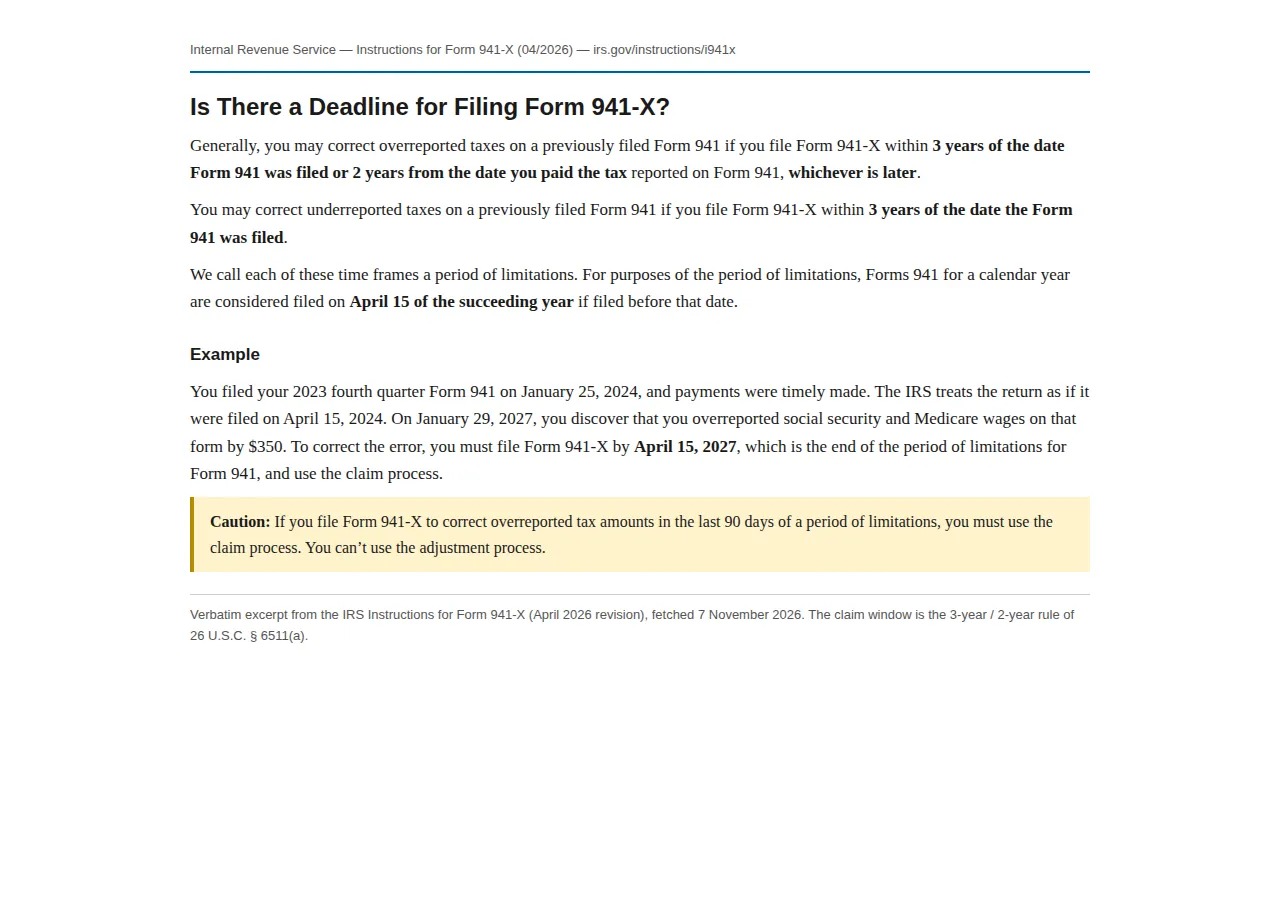
For limitations purposes, Forms 941 for a calendar year are considered filed on April 15 of the succeeding year if filed before that date. A first-quarter return filed on April 30, 2026 is treated as filed on April 15, 2027, and the 3-year clock runs to April 15, 2030. The IRS example: a 2023 fourth-quarter Form 941 filed January 25, 2024 is treated as filed April 15, 2024; a $350 overreport discovered January 29, 2027 must be corrected by April 15, 2027, using the claim process.
Apply the same test to a current quarter. Harborline Logistics LLC filed its first-quarter 2026 Form 941 on April 30, 2026 and paid the tax the same day. The return is deemed filed April 15, 2027. The 3-year rule gives until April 15, 2030; the 2-year-from-payment rule gives until April 30, 2028. The later date governs: the window closes April 15, 2030, and the adjustment process ends 90 days earlier, January 15, 2030.
> [!WARNING]
> The 3-year / 2-year test is a hard stop. Section 6511(b)(1) bars any credit or refund after the period expires unless a claim was filed inside it. A $50,000 overpayment found one day late is a $50,000 loss.
Adjustment or claim: the Part 1 choice
Part 1 forces one choice: only one box may be checked. Line 1 is the Adjusted Employment Tax Return; line 2 is the Claim. A line 1 credit is applied to the Form 941 or Form 944 for the period in which the 941-X is filed. A line 2 claim asks the IRS for a refund or abatement of the amount on line 27. Under § 6402(a), the IRS may first apply an overpayment against other tax debts the employer owes.
| Situation | Part 1 box | What happens | Authority |
| :--- | :--- | :--- | :--- |
| Underreported tax only, on time | Line 1 — Adjusted return | Pay line 27 by filing; generally interest-free | Instructions for Form 941-X, Part 1 line 1 |
| Overreported tax, credit wanted | Line 1 — Adjusted return | Negative line 27 credited to current Form 941/944 | Instructions for Form 941-X, Part 1 line 1 |
| Overreported tax, refund wanted | Line 2 — Claim | IRS refunds line 27 plus interest, less § 6402 offsets | Instructions for Form 941-X, Part 1 line 2; 26 U.S.C. § 6402(a) |
| Filed in the last 90 days of the window | Line 2 — Claim (mandatory) | Adjustment barred; separate 941-X for underreported tax | Instructions for Form 941-X; § 6511(a) |
| Both under- and overreported on one form | Line 1 — Adjusted return (mandatory) | Net line 27; pay if positive, credit if negative | Instructions for Form 941-X, Part 1 line 1 |
The exact sequence, from discovery to signature
Discovery sets the clock. The due date for correcting underreported tax is the due date of the return for the quarter in which the error was discovered. Discover an error in January–March and the 941-X is due April 30; April–June, due July 31; July–September, due October 31; October–December, due January 31. Pay line 27 by the time of filing.
Example: an employer who discovers on May 15, 2026 that $10,000 of social security and Medicare wages was underreported on the 2026 first-quarter Form 941 must file and pay by July 31, 2026. At the combined 15.3 percent FICA rate, that $10,000 carries $1,530 of additional tax.
Part 2 is the certification layer, where most 941-X filings fail on review. Line 3 certifies that Forms W-2 or Forms W-2c were filed or will be filed with the Social Security Administration showing the correct wage and tax amounts — check it even when no W-2 amount changes. If all corrections are underreported, line 3 is the only certification needed. Overreported amounts trigger lines 4 and 5: the employer must have repaid or reimbursed the employee share of overcollected social security and Medicare tax, or obtained written employee consents to claim on their behalf under Rev. Proc. 2017-28.
Part 3 is the arithmetic: lines 6 through 40 — corrected amount, originally reported amount, difference. Part 4, line 43, is the explanation — detailed grounds and facts for every correction, both halves of any netted line, and the reason for any worker reclassification, with the § 3509 rates used if any apply. Part 5 is the signature under penalties of perjury. A late underreported correction must also attach an amended Schedule B (Form 941), or the IRS may assess an "averaged" failure-to-deposit penalty.
Worked example: a $3,060 credit with two errors in one quarter
Worked example: Harborline Logistics LLC, a fictional 14-employee freight broker in Columbus, Ohio, files its first-quarter 2026 Form 941 and finds two errors on September 14, 2026. Error A: a $24,000 bonus batch was posted twice, overstating both social security wages and Medicare wages by $24,000. Error B: $4,000 of taxable fringe benefits — personal use of a company vehicle — was never reported, understating both wage bases by $4,000. Withholding is unchanged; the errors touch FICA wages only. FICA rates per IRS Topic No. 751: 6.2 percent Social Security and 1.45 percent Medicare per side, 15.3 percent combined.
$
\text{Overreported FICA} = \$24{,}000 \times 15.3\% = \$3{,}672
$
$
\text{Underreported FICA} = \$4{,}000 \times 15.3\% = \$612
$
$
\text{Net Correction (Line 27)} = -\$3{,}672 + \$612 = -\$3{,}060
$
The negative line 27 is a $3,060 credit. Check: net wages fall $20,000; $20,000 × 12.4% = $2,480 for Social Security and $20,000 × 2.9% = $580 for Medicare, and $2,480 + $580 = $3,060.
For Part 2, the employee share is $1,530 and the employer share is $1,530. Before Harborline can use the adjustment process, it must repay or reimburse the $1,530 employee share — or hold written consents — and check the matching box on line 4. The credit applies to the third-quarter 2026 Form 941: the error was discovered in the third quarter, more than 90 days before the April 15, 2030 deadline. Run your own wage error through the tax estimator. The wage-reporting side is covered in the irs-form-w-2-employee-wage-reporting-playbook — if W-2 amounts change, a Form W-2c goes to the SSA beside the 941-X.
What a late correction costs
An on-time underreported correction is interest-free. It escapes the failure-to-pay penalty, the failure-to-deposit penalty, and interest when four conditions all hold: the 941-X is filed on time, line 27 is paid by the time of filing, the discovery date is entered on the form, and line 43 explains the grounds and facts in detail. The protection fails if the issue was raised in a prior-period examination, the employer knowingly underreported, or a notice and demand or § 7436 determination was received.
Miss the deadline and the meter starts. Interest on underpayments runs at 7 percent a year, compounded daily, for the fourth quarter of 2026 under IR-2026-98 and Rev. Rul. 2026-15 — the same 7 percent applies to non-corporate overpayments; corporate overpayments earn 6 percent. The failure-to-pay penalty is 0.5 percent of the unpaid tax for each month or part of a month, capped at 25 percent. On Harborline's $612 slice, three months late costs $612 × 0.5% × 3 = $9.18, plus interest.
$
\text{Interest}_{92 \text{ days}} = \$3{,}060 \times \left(\left(1 + \frac{0.07}{365}\right)^{92} - 1\right) = \$54.46
$
$
\text{Interest}_{365 \text{ days}} = \$3{,}060 \times \left(\left(1 + \frac{0.07}{365}\right)^{365} - 1\right) = \$221.85
$
Under § 6501(a), the IRS must assess tax within 3 years after the return was filed. Exceptions: 6 years where omitted gross income exceeds 25 percent of the gross income stated, and no limit for a false or fraudulent return filed with intent to evade tax.
Two more traps. First, the employee retention credit: P.L. 119-21 bars any ERC or refund for the third and fourth quarters of 2021 unless the claim was filed on or before January 31, 2024, and extends assessment for those quarters to 6 years after the credit was claimed or the original return was filed, whichever is later. ERC wage records must be kept at least 7 years. Second, keep employment tax records at least 4 years.
> [!TIP]
> File in the discovery quarter: the due date, the interest-free treatment, and the 90-day cutoff each follow a different clock. Diary all three the day the error is found.
941-X vs 941 vs W-2c: the boundary map
The three forms answer three different questions, and using the wrong one is the most common 941-X mistake after a missed deadline. Form 941 reports the quarter's tax. Form 941-X corrects a filed 941. Form W-2c corrects the wage and tax amounts shown to an employee and to the SSA. A wage error usually needs both: the 941-X fixes the employer's tax account, and the W-2c fixes the employee's wage record.
Line 42 is checked when workers were reclassified in either direction. An employer who never filed Form 941 because every worker was treated as a contractor files a Form 941 for each delinquent quarter instead, using § 3509 rates where entitled. The irs-form-1099-nec-contractor-reporting-playbook covers when a worker is a contractor at all. Form 941-X also corrects Form 941-SS for quarters beginning before January 1, 2024, under the same rules.
The 12-step execution checklist
1. Freeze the discovery date. It sets the due date and the interest-free test.
2. Run the § 6511 test. 3 years from filing or 2 years from payment, whichever is later; 3 years from filing for underreported tax.
3. Classify the error. Underreported, overreported, or both; withholding or FICA.
4. Check the walls. Schedule B-only error, prior-year withholding error, or refund claim for tax actually withheld — stop and use the right instrument.
5. Choose Part 1. Line 1 for adjustment or mixed corrections; line 2 for a refund claim; line 2 mandatory inside the last 90 days.
6. Repay or get consents. Repay the employee share, or hold written consents under Rev. Proc. 2017-28.
7. File or confirm the W-2c. File Form W-2c if wage amounts change; check line 3 either way.
8. Complete Part 3. Corrected, originally reported, difference.
9. Write line 43. Grounds and facts for every correction, both halves of any netted line, § 3509 rates if workers were reclassified.
10. Attach an amended Schedule B if late. Required for underreported corrections filed after the discovery-quarter due date.
11. Pay line 27 with the filing. A late-paid balance loses interest-free treatment.
12. Keep the file. Consents, discovery memo, corrected registers, filed 941-X — 4 years; 7 for ERC wage records.
> [!FOUNDER]
> "A payroll error is not a scandal — it is a test of whether the business has a system or only a habit. The system finds the error, dates the discovery, runs the statute, and files the correction in the same quarter. The habit finds the error at year-end, shrugs, and pays interest on it for a year. Form 941-X rewards the first business and taxes the second."
> — Enow A. Jovial, Founder & Chief Executive Officer
Who this is not for
Form 941-X is the wrong tool for three employers: a Schedule B-only error, which follows the Schedule B instructions instead; prior-year federal income tax withholding that was actually withheld, which the instructions flatly forbid correcting; and an ERC claim for the third or fourth quarter of 2021 never filed by January 31, 2024, because P.L. 119-21 closed that door. For everyone else, it is a dated, documented, quarter-bound job.