IRS Form 940: The Annual FUTA Tax Playbook for Employers
Form 940 settles a business's federal unemployment tax for the year: filed once a year, covering only the Federal Unemployment Tax Act (FUTA) tax, paid entirely from the employer's own funds — never from an employee's pay.
What FUTA pays for, and who pays it
FUTA is a federal excise tax: 26 U.S.C. § 3301 levies "6 percent of the total wages" paid during the calendar year, funding unemployment compensation through the Federal Unemployment Trust Fund.
Only employers pay it — the IRS states on its Form 940 page: "Only employers pay FUTA tax. Do not collect or deduct FUTA tax from your employees' wages." It applies only to the first $7,000 of wages paid to each employee during the calendar year, the FUTA wage base set by 26 U.S.C. § 3306(b)(1). Form 941 reports wages, withheld income tax, and both halves of FICA quarterly, while Form 940 reconciles FUTA alone — see the IRS Form 941 quarterly payroll tax filing playbook.
> [!KEY TAKEAWAY]
> FUTA costs $42 per employee per year at the full credit. The return is cheap; losing the credit is not.
Do you have to file? The three tests
Answer yes to either question and you must file; the tests in 26 U.S.C. § 3306(a) apply to the current and preceding year.
| Employer type | Filing test (current or preceding year) | Authority |
| --- | --- | --- |
| General employer | Wages of $1,500+ in any quarter, OR 1+ employee for part of a day in 20+ different weeks | 26 U.S.C. § 3306(a)(1); Instructions for Form 940 |
| Household employer | Cash wages of $1,000+ in any quarter for domestic service | 26 U.S.C. § 3306(a)(3) |
| Agricultural employer | Cash wages of $20,000+ for agricultural labor in any quarter, OR 10+ farmworkers on each of some 20 days in different weeks | 26 U.S.C. § 3306(a)(2) |
Count every employee for the 20-week test; a partnership does not count its partners. If the business was sold during the year, each employer who answered yes files its own Form 940; the successor-employer rule in § 3306(b)(1) lets the successor count the predecessor's wages toward the $7,000 base. No wages in the year: check box c; closed business: box d, final return.
Household employers usually report FUTA on Schedule H (Form 1040). Agricultural employers file Form 943; non-cash farm payments and H-2A payments are excluded from FUTA wages.
The math: 6.0 percent, a 5.4 percent credit, 0.6 percent net
The gross rate is 6.0 percent; the maximum credit for state unemployment taxes paid is 5.4 percent; the net rate is therefore 0.6 percent. The Instructions for Form 940 state the 2025 gross rate as 6.0 percent (0.060) and the maximum credit as 5.4 percent (0.054).
Gross tax:
$
\text{Gross FUTA} = \text{FUTA taxable wages} \times 0.060
$
Net tax:
$
\text{Net FUTA} = \text{FUTA taxable wages} \times (0.060 - 0.054) = \text{FUTA taxable wages} \times 0.006
$
FUTA taxable wages are the first $7,000 paid to each employee during the year, after subtracting exempt payments (ceilings: $42.00 net, $420.00 gross per employee).
The credit is not automatic: it is earned by paying all state unemployment tax by the due date of Form 940, and a late payment earns a reduced credit under the line 10 worksheet. State-excluded wages — corporate officers' wages in some states are the instructions' example — pay FUTA at the full 6.0 percent rate.
> [!WARNING]
> The 5.4 percent credit is earned by paying state unemployment tax on time; a late payment earns a reduced credit.
Credit-reduction states and Schedule A
A state that borrows from the federal government to pay unemployment benefits and does not repay in time becomes a credit-reduction state, losing part of the 5.4 percent credit. The U.S. Department of Labor sets the states each year; the reduction is 0.3 percent for the first year, plus 0.3 percent for each additional year unpaid. The added liability is incurred in the fourth quarter, due by January 31 of the following year.
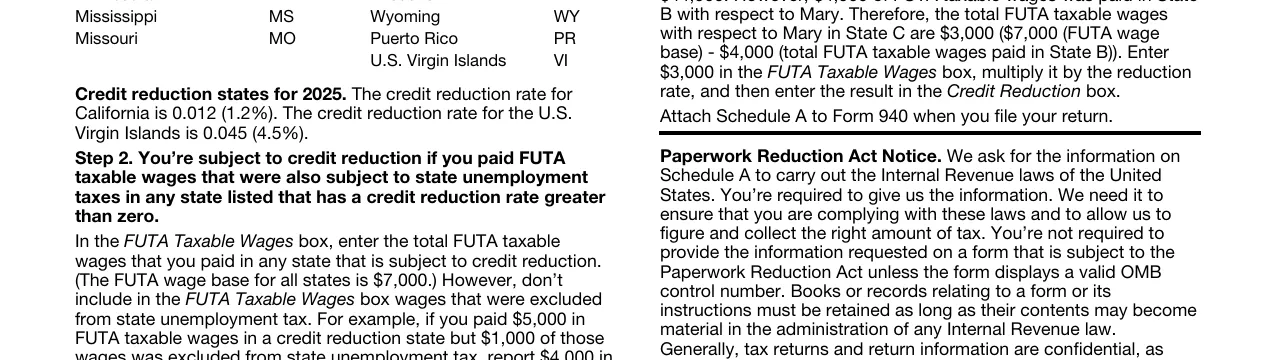
For 2025: California at 1.2 percent and the U.S. Virgin Islands at 4.5 percent. At a 0.3 percent reduction the credit is 5.1 percent, for an effective rate of 0.9 percent; a California employer faces 1.8 percent, or $126 per employee. Schedule A gives a worked case: $21,000 times 1.2 percent is a $252.00 credit reduction. For 2026, check the DOL page after November 10.
Schedule A (Form 940) is required for employers that paid FUTA wages and state tax in more than one state, and for any employer that paid FUTA wages in a credit-reduction state. Check every state where the employer paid state unemployment tax; for credit-reduction states, enter the FUTA taxable wages paid there, multiply by the reduction rate, and carry the total to Form 940, line 11.
!Schedule A credit reduction states
Deadlines: January 31, the weekend shift, and February 10
The filing due date is January 31 of the year after the tax year. The weekend rule moves a due date on a Saturday, Sunday, or legal holiday to the next business day, and employers that deposited all FUTA tax when due may file by February 10.
The 2025 return was due February 2, 2026 (January 31, 2026 was a Saturday), extended to February 10, 2026. The 2026 return is due February 1, 2027 (January 31, 2027 is a Sunday), extended to February 10, 2027.
State unemployment taxes must be paid by the Form 940 due date to earn the full credit; a state law deferring payment does not preserve it.
> [!TIP]
> January needs two dates: the state payment date and the filing date. Pay the state first, then file.
The deposit rule: $500 is the trigger
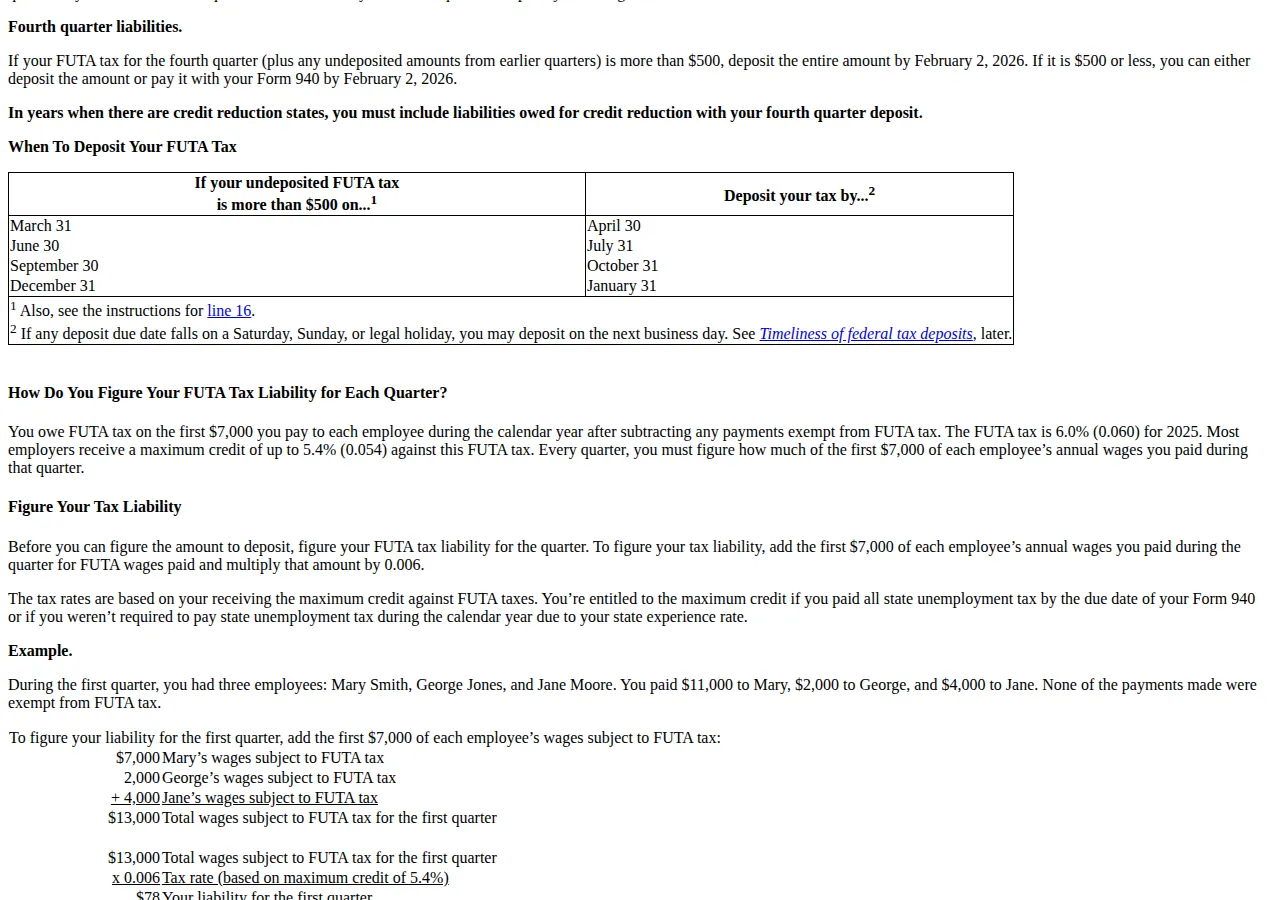
Form 940 covers a calendar year, but the tax often must be deposited first: the trigger is $500 of cumulative FUTA tax liability. Carry a quarterly liability of $500 or less forward until the cumulative total exceeds $500, then deposit by the last day of the month after the quarter ends:
| Quarter ends | Deposit by |
| --- | --- |
| March 31 | April 30 |
| June 30 | July 31 |
| September 30 | October 31 |
| December 31 | January 31 |
For the fourth quarter: liability over $500 (with undeposited earlier amounts) is deposited in full by January 31; $500 or less may be paid with the return.
Deposits must be made by electronic funds transfer — EFTPS, IRS Direct Pay, or the IRS business tax account, or through a tax professional, financial institution, or payroll service. A card may pay a balance due, with a fee, but never a tax that must be deposited. The employer stays responsible when a third party deposits.
A small employer will often never deposit: twelve employees at the full credit produce $504 of annual FUTA tax, which — with wages spread evenly through the year — crosses $500 only in the fourth quarter, so the whole year's tax can be paid with the return. A payroll weighted toward the first quarter crosses $500 in Q1 instead.
FUTA versus SUTA versus FICA
FUTA is employer-only, annual, and capped at $7,000 per employee — 6.0 percent gross, 0.6 percent net. SUTA is set state by state and usually reported quarterly. FICA splits between employer and employee: Social Security 6.2 percent each up to the $184,500 wage base for 2026, Medicare 1.45 percent each, Additional Medicare 0.9 percent over $200,000 (Topic No. 751). For the W-2 close, see the IRS Form W-2 employee wage reporting playbook.
Filing Form 940, step by step
1. Confirm the filing requirement: apply the three tests to the current and preceding year; note successor, final-return, or no-liability (box c or d) status.
2. Gather payroll registers and state payment records: line 3 total payments, line 5 exempt payments.
3. Line 7: total payments minus exempt payments minus wages above the $7,000 base.
4. Line 8 gross tax (line 7 times 0.060), then the credits on lines 9 and 10, including late state payments at their reduced credit.
5. Complete Schedule A if multi-state or in a credit-reduction state, carry the reduction to line 11, and subtract credits from line 8 for line 12.
6. Enter total FUTA tax deposited on line 13; line 12 minus line 13 is the balance due (line 14) or an overpayment (line 15a), refundable by direct deposit or applied forward.
7. Complete Part 5 (line 16) only if line 12 exceeds $500; confirm line 17 equals line 12.
8. Sign in Part 7, name a designee in Part 6 if desired, and file electronically or by mail; keep the return, deposit records, and payroll registers.
The identifiers: EIN, SSN, ITIN, and entity type
The employer's EIN, issued on Form SS-4, goes in the header and on every deposit; a business awaiting its EIN writes "Applied For" and the application date. Employees are identified by SSN on Forms W-2 and in the payroll register behind the line 3 total. An individual ineligible for an SSN who must file a U.S. tax return uses an ITIN, issued on Form W-7. Entity type shapes the filing, not the tax: an LLC, a partnership, an S-Corp, or a C-Corp all file the same lines, but the Part 7 signer differs — a member for an LLC, an officer for a corporation — and an S-Corp owner-employee's wages count toward FUTA while distributions do not. FICA and SECA mark the boundary: wages on Form 940 are subject to FICA, while a sole proprietor's own earnings are subject to SECA and never appear on the proprietor's own return. A CPA will tie the line 3 total to the payroll register and wage expense under GAAP, and check the state payments claimed as a credit.
> [!FOUNDER]
> "The cheapest tax on the books is the one employers ignore. Forty-two dollars per employee is not a burden; it is a rounding error with a filing deadline. The employers who get hurt are not the ones who cannot pay — they are the ones who never put January 31 on the calendar and discover the credit is gone."
> — Enow A. Jovial, Founder & Chief Executive Officer
Mistakes that cost the credit
Four errors account for most of the avoidable cost: paying the state late, counting wages above the $7,000 base (it resets every January 1), forgetting Schedule A (a California or U.S. Virgin Islands employer that skips it underpays by 1.2 percent or 4.5 percent for 2025), and depositing late (the $500 threshold is cumulative).
Contractors do not enter this return: payments to independent contractors are reported on Form 1099-NEC, and no FUTA tax applies — but a worker later reclassified as an employee creates FUTA liability retroactively. For the contractor side — the $2,000 threshold for 2026 payments, the January 31 furnishing deadline, and backup withholding — see the IRS Form 1099-NEC contractor reporting playbook.
Before filing, check the total employment-tax picture with the tax estimator. Then file and keep the records.