Three vendors, three theories of payroll
Gusto, Rippling, and QuickBooks Payroll all run payroll, file taxes, and pay people by direct deposit, and that shared sentence hides three different bills. Gusto sells payroll with HR attached: one subscription, a base fee plus a per-person fee, and benefits and compliance as tier steps. QuickBooks Payroll sells payroll inside the accounting system: the same base-plus-per-person shape, priced to keep the books and the pay run in one ledger. Rippling sells payroll as one module in a workforce platform spanning HR, IT, and finance, and prices the bundle by quote, publishing only a per-employee floor. A buyer who compares only the per-person fee will misprice all three, because the base fee, the tier step, and the quote are where the money actually moves.
This playbook prices all three on the same headcounts, from the vendors' own pricing pages read in November 2026, and then sets the software bill against the employer tax bill it exists to get right. Prices are a snapshot with a date, not a quote: vendors reprice without notice, and QuickBooks now sells payroll both standalone and bundled with an accounting plan, so a bundled quote and a standalone quote for the same tier will differ. Re-check the live page before signing.
> [!KEY TAKEAWAY]
> At 10 employees, Gusto Simple and QuickBooks Core land within $6 a month of each other, and Rippling cannot be totalled at all without a quote. The software decision is therefore not a price decision at small scale. It is a scope decision: which tier's inclusions — multi-state payroll, same-day deposit, contractor payments, workers' comp administration — match the workforce you actually run.
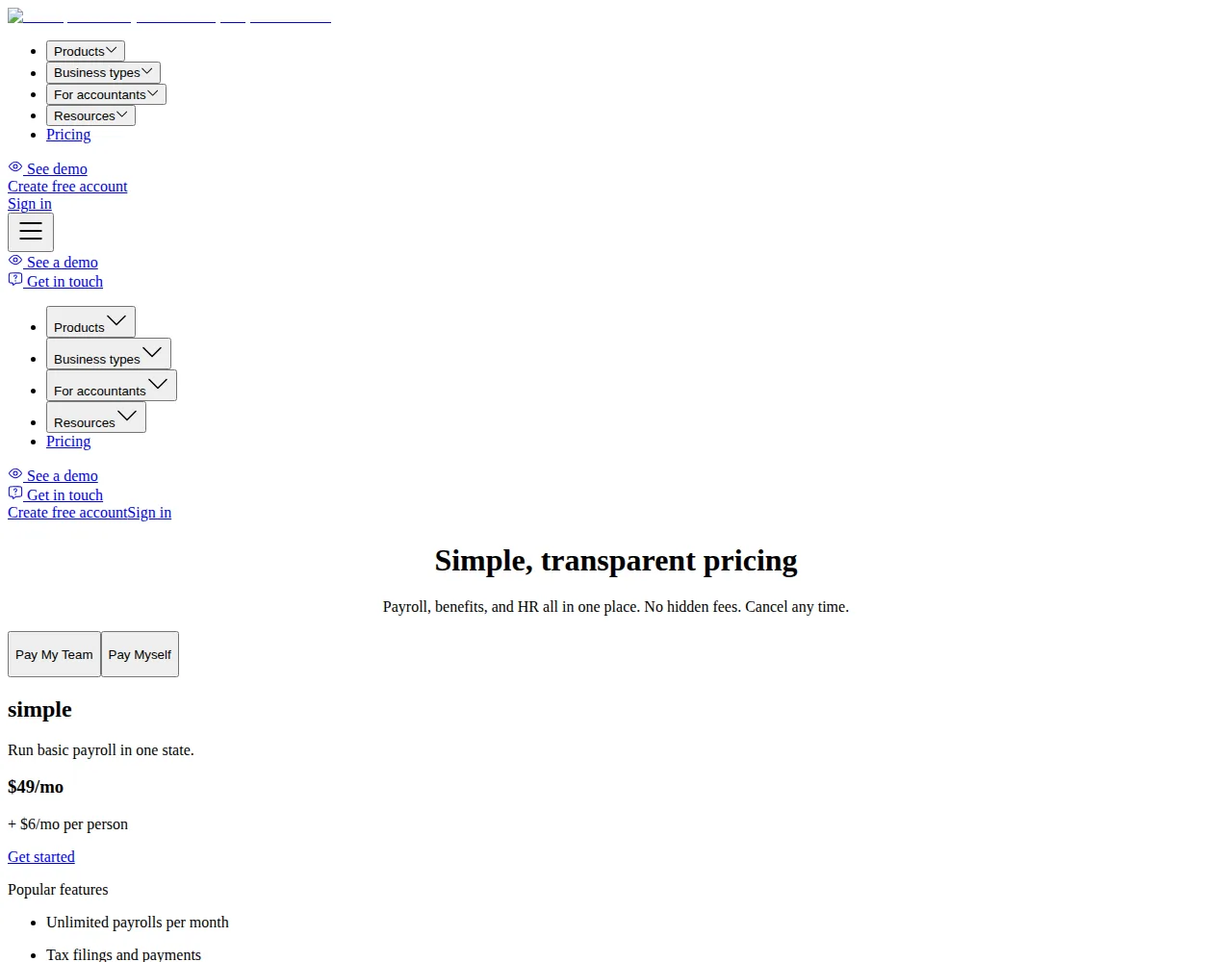
The pricing table, from the vendors' own pages
| Vendor | Entry tier | Middle tier | Top tier | Billing note from the page |
| :--- | :--- | :--- | :--- | :--- |
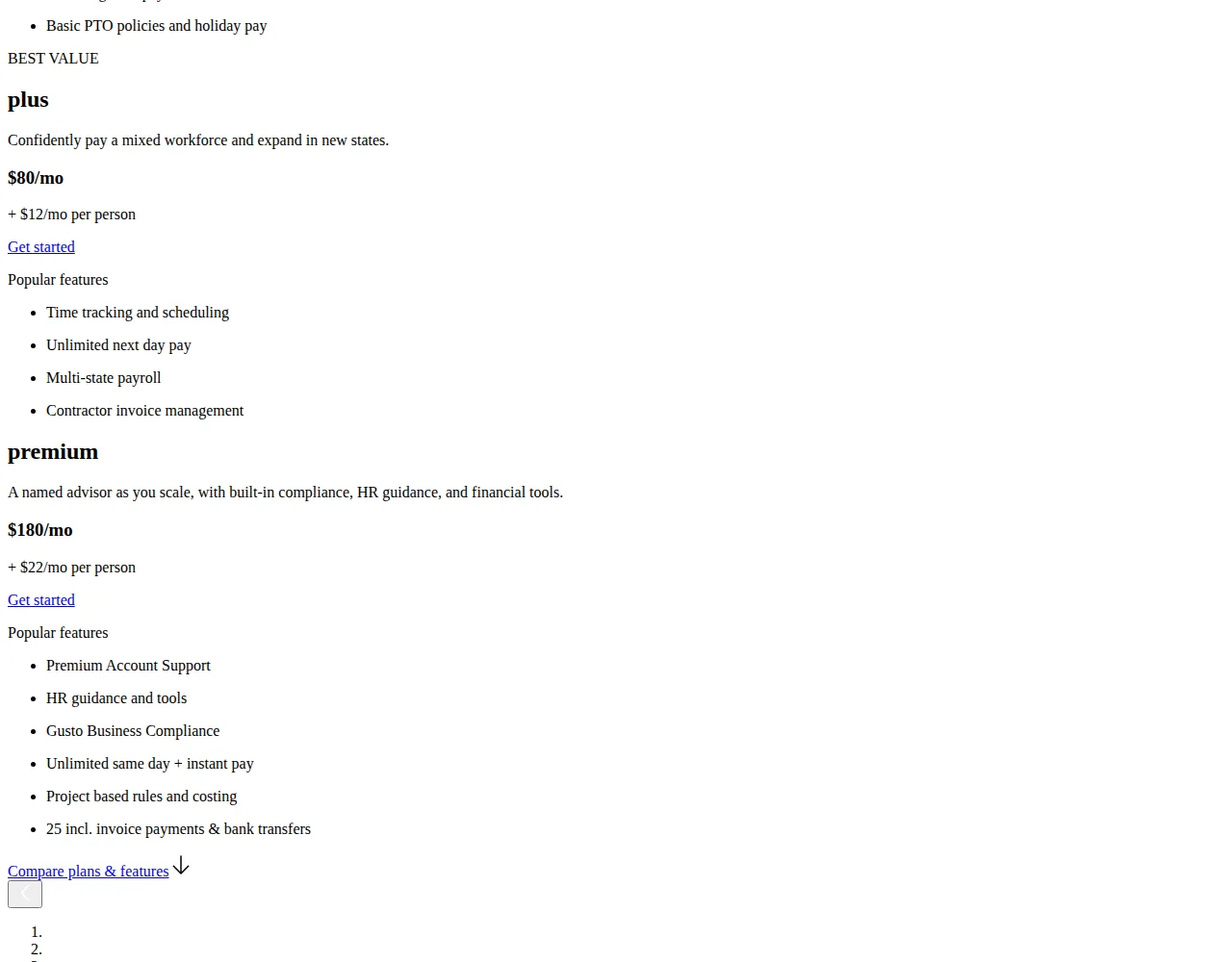
| Gusto | Simple, $49 per month plus $6 per person | Plus, $80 per month plus $12 per person | Premium, $180 per month plus $22 per person | Cancel any time; contractor payments from $5 per payment to US bank accounts |
| QuickBooks Payroll | Core, $50 per month plus $6.50 per person | Premium, $88 per month plus $10 per person | Elite, $134 per month plus $12 per person | Standalone structure published on Intuit's own community, effective July 1, 2025 |
| Rippling | From $8 per employee per month, plus a monthly base fee | Modules priced per product | Custom quote | Total cost depends on the products selected; no published bundle total |
How those figures were verified matters, because one of them resisted verification. Gusto's tiers and Rippling's $8 floor with quote-based structure were read directly from those vendors' pricing pages. QuickBooks' pricing page itself did not load from this author's network, so its figures rest on Intuit's own community post stating the July 2025 structure, corroborated by multiple independent reads of the same page. Because Intuit now also bundles payroll with accounting plans, a bundled quote will show different totals from the standalone figures below.
The employer-cost math at 10 and 25 employees
$
\text{Monthly software cost} = \text{Base fee} + (\text{Per-person fee} \times \text{Headcount})
$
At 10 employees on monthly billing:
$
\text{Gusto Simple} = \$49 + (\$6 \times 10) = \$109 \text{ per month, } \$1{,}308 \text{ per year}
$
$
\text{Gusto Plus} = \$80 + (\$12 \times 10) = \$200 \text{ per month, } \$2{,}400 \text{ per year}
$
$
\text{Gusto Premium} = \$180 + (\$22 \times 10) = \$400 \text{ per month, } \$4{,}800 \text{ per year}
$
$
\text{QuickBooks Core} = \$50 + (\$6.50 \times 10) = \$115 \text{ per month, } \$1{,}380 \text{ per year}
$
$
\text{QuickBooks Premium} = \$88 + (\$10 \times 10) = \$188 \text{ per month, } \$2{,}256 \text{ per year}
$
$
\text{QuickBooks Elite} = \$134 + (\$12 \times 10) = \$254 \text{ per month, } \$3{,}048 \text{ per year}
$
$
\text{Rippling floor} = \$8 \times 10 = \$80 \text{ per month before the undisclosed base fee, } \$960 \text{ per year minimum}
$
At 25 employees the same formula gives Gusto $199, $380, and $730 a month, against QuickBooks $212.50, $338, and $434. Two patterns emerge. First, Gusto's Premium tier is the outlier at scale: $296 a month dearer than QuickBooks Elite at 25 headcount, buying a named advisor and compliance tooling only a company with real HR complexity should pay for. Second, Rippling's floor is the cheapest line and the least informative: without the base fee and module prices, no honest total exists.
Worked example: the software bill against the tax bill
Payroll software exists to compute, deposit, and report the employer tax bill correctly, so set the two side by side. For 2026, IRS Publication 15-A puts Social Security at 6.2 percent each up to the $184,500 wage base, and Medicare at 1.45 percent each with no cap. The employer share is therefore 7.65 percent of wages below the wage base. Federal unemployment tax adds 6.0 percent on the first $7,000 of each employee's wages, reduced to 0.6 percent — $42 per employee per year — by the full 5.4 percent credit for timely state payments.
Worked example: 10 employees earning $5,000 a month each, all below the wage base:
$
\text{Monthly wages} = 10 \times \$5{,}000 = \$50{,}000
$
$
\text{Employer FICA} = \$50{,}000 \times 7.65\% = \$3{,}825 \text{ per month}
$
$
\text{Employer FUTA} = \frac{10 \times \$42}{12} = \$35 \text{ per month}
$
$
\text{Gusto Simple share of FICA} = \frac{\$109}{\$3{,}825} = 2.8\%
$
$
\text{Gusto Premium share of FICA} = \frac{\$400}{\$3{,}825} = 10.5\%
$
The software bill runs from 2.8 percent to 10.5 percent of one month's employer FICA at this headcount. That ratio frames the tier decision: the step from Simple to Plus costs $91 a month, or 2.4 percent of the FICA line, and buys multi-state payroll, time tracking, next-day pay, and contractor invoice management. For a single-state salaried team that step is shelfware; for a four-state hourly team it is cheaper than one state-registration mistake. To test the tier step against your own headcount and wage bill, run the figures through the break-even calculator.
What each tier actually buys
Gusto Simple runs basic payroll in one state: unlimited payroll runs per month, tax filings and payments, and employee self-service. Gusto Plus, marked best value, adds time tracking and scheduling, unlimited next-day pay, multi-state payroll, and contractor invoice management. Gusto Premium adds a named advisor, HR guidance and tools, business compliance support, unlimited same-day and instant pay, and project-based rules and costing. The Plus step is where Gusto stops being a payroll tool and becomes an HR platform; the Premium step is where it becomes an advised service.
QuickBooks Core covers full-service payroll with federal and state tax filing, next-day direct deposit, and an employee portal. Premium adds local tax filing, automatic state new-hire reporting, same-day direct deposit, time tracking, workers' comp administration, and HR support. Elite adds expert setup, tax penalty protection, and a personal HR advisor.
Rippling's structure resists this kind of tier table, and that is itself information. Payroll, benefits, time and attendance, and device management are separate modules, each with its own per-employee price, under one platform fee. A company that wants payroll plus IT device management genuinely gets one system; a company that wants payroll alone pays for modules it will not open. Get the written quote with every module itemized before comparing Rippling against any total in this guide, and treat any Rippling total built from the $8 floor as a floor, not a price.
Contractors, states, and the calendar that punishes lateness
Employees are only half the workforce question. Gusto's pricing page states contractor payments from $5 per payment to US bank accounts, in more than 120 countries, with no monthly per-contractor fee stated. QuickBooks reports contractor pay on Form 1099-NEC, and the classification question — employee or independent contractor — is the first section of the employer's tax guide for a reason: misclassification converts a contractor's invoice into back wages, back taxes, and penalties across every quarter of the relationship. No vendor makes that determination for you; their questionnaires collect facts, and the determination remains the employer's.
Multi-state payroll is the second half. Gusto's Plus tier includes multi-state payroll, while Simple is single-state; state tax registration help is a paid add-on at $85 per month per state on an annual contract. The rule is simple: register in a state before the first pay date there, not after the first payroll runs. A hire starting in a new state on Monday creates a registration, withholding, and unemployment-insurance obligation that same week.
The federal calendar runs on four rails. Form 941, the quarterly employment tax return, reports wages, withheld income tax, and both halves of FICA. Form 940, the annual return, reconciles FUTA. Forms W-2 and W-3 close the year for employees, and Form 1099-NEC closes it for contractors. For the full W-2 playbook — deadlines, boxes, the penalty ladder, and the March 3 check — see the IRS Form W-2 employee wage reporting playbook. Federal deposits must move electronically, through EFTPS or an equivalent channel. Miss a deposit and the exposure is not a software fee: late-deposit penalties scale with lateness, and the trust fund recovery penalty can reach 100 percent of the withheld taxes against responsible persons personally. That asymmetry is why payroll software is bought for accuracy first and price second.
> [!WARNING]
> Never run payroll in a state where the company is not registered for withholding and unemployment insurance, and never pay a worker as a contractor because the contractor plan is cheaper. The first mistake creates a retroactive filing obligation in every affected quarter; the second converts the entire relationship into back pay, back taxes, and penalties. Both mistakes cost multiples of any tier saving in this guide, and neither is cured by switching vendors after the fact.
Decision table
| Decision factor | Gusto | QuickBooks Payroll | Rippling | Authority |
| :--- | :--- | :--- | :--- | :--- |
| Best for | Small teams that want payroll plus HR in one subscription | Companies already running QuickBooks for accounting | Companies that want HR, IT, and finance on one platform | Vendor pages, Nov 2026 |
| Entry total at 10 employees | Simple $109 per month | Core $115 per month | $80 per month floor before base fee | Vendor pages; Intuit community |
| Middle total at 10 employees | Plus $200 per month | Premium $188 per month | Quote only | Vendor pages |
| Top total at 10 employees | Premium $400 per month | Elite $254 per month | Quote only | Vendor pages |
| Multi-state payroll | Plus tier and above | Premium tier and above | Module-based | Vendor pages |
| Quotable total without a sales call | Yes, all three tiers | Yes, standalone tiers | No, base fee undisclosed | Editorial verification, November 2026 |
| Switch signal | Outgrowing single-state Simple, or needing an advisor | Outgrowing Core's deposit speed, or leaving QuickBooks accounting | Paying platform fees for modules nobody opens | Editorial analysis of vendor terms |
The migration math nobody budgets
Switching payroll providers is priced in the planning spreadsheet as a subscription delta and experienced as a migration project with a hard deadline: the next pay date. The following model is illustrative, using the team's own rates, and exists so the subscription comparison is never read in isolation:
$
\text{Migration cost} = (\text{Employees} \times \text{Hours per employee} \times \text{Loaded rate}) + \text{Parallel-run cost}
$
$
\text{Illustrative migration} = (10 \times 1 \times \$75) + \$500 = \$1{,}250
$
Ten employees at one hour each of verification, enrollment, and reconciliation at a $75 loaded rate, plus a $500 parallel-run allowance, costs $1,250 — more than a full year of the $6 monthly gap between Gusto Simple and QuickBooks Core at this headcount, and roughly six months of the Plus-to-Premium step. At small scale, switching to save $6 a month costs more than staying. Switch for scope — multi-state coverage, deposit speed, contractor volume — or for accuracy failures, never for the subscription delta. For the state-nexus side, see the remote employee state income tax nexus payroll guide, and for the accounting half, see the QuickBooks Online vs Xero comparison.
Execution checklist
> [!FOUNDER]
> "Payroll software is the cheapest insurance in the company, and the most expensive place to economize. The subscription is a rounding error next to the tax flow it moves; buy the tier that files correctly in every state you operate in, and treat any saving smaller than one parallel pay run as noise."
> — Enow A. Jovial, Founder & Chief Executive Officer
Operator boundaries: who should not pick each tool
Do not pick Gusto Simple if the team works in more than one state, because the tier is single-state by design and the upgrade to Plus is the real price. Do not pick QuickBooks Payroll if the company is leaving QuickBooks accounting, because the integration that justifies its price leaves with the ledger. Do not pick Rippling for payroll alone, because the platform fee buys modules the team will not open. Do not pick any vendor on the entry tier if contractor volume is high, because contractor payments and 1099 reporting sit outside the entry price on every platform here.
> [!TIP]
> Schedule the switch for the first pay period of a quarter, never mid-quarter. A quarter-boundary switch gives the new provider a clean 941 and a single system of record for the whole quarter; a mid-quarter switch splits one quarter's filings across two systems and doubles reconciliation work. For the deposit schedules, penalty ladder, and correction route behind that clean quarter, see the IRS Form 941 quarterly filing playbook. For the contractor side of the same workforce — the $2,000 threshold, the January 31 deadline, and the penalty ladder — see the IRS Form 1099-NEC contractor reporting playbook.